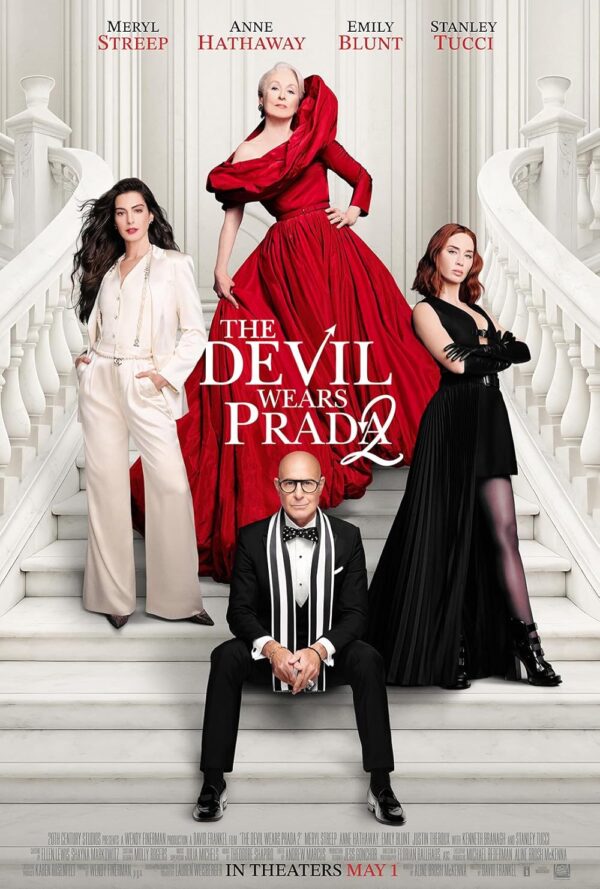
The Devil Wears Prada 2
by Aline Brosh McKenna
I went to The Devil Wears Prada 2 hoping to get some feel-good nostalgia, but found the movie to be so disconnected from the present moment that I had a hard time investing in the conflict or characters. The acting is great, but the plot doesn’t stand the test of time.
Set 20 years after the original, the movie addresses the death of print journalism when award winning journalist Andy (Anne Hathaway) loses her job when the newspaper she works for folds. She’s hired to be the features editor of Runway to help give them credibility after they publish an inaccurate piece about a fast fashion brand.
Miranda Priestly (Meryl Streep) is still the editor-in-chief, although she’s been somewhat defanged due to HR complaints. She has to hang up her own coat–the indignity! Nigel (Stanley Tucci) is still in his role as Miranda’s second in command, which (given the two decade time jump) is depressing in itself. You deserve more, Nigel.
Runway gets new ownership and is looking to be gutted and Miranda removed from her role. Andy has to help save the magazine to save her job and, problematically, Miranda’s position as an icon and industry leader.
A huge problem with the movie is that Miranda is still terrible and I do not care even remotely if she remains the boss of pretend Vogue. She’s out of touch and mean-spirited, and we know from the last movie (and this one) that she’s only Andy’s ally as long as it benefits her. Even if she loses her job she’s still super rich and can presumably still influence the world of fashion from wherever she winds up. Or, you know, retire. It doesn’t matter to me.
The other problem is that we’re living in a world that is so remarkably different from 2006 (when the first movie is set) that the stakes mean nothing to me. There’s a scene where the characters are at a dinner at Italian fashion week, seated under Davinci’s Last Supper, dressed in couture, and I almost said out loud “I do not care about any of these people.”
When the original movie premiered, chick-lit like Confessions of a Shopaholic and TV shows like Sex in the City were incredibly popular. Being a young woman in The Big City and scoring high fashion at a sample sale was very much in the zeitgeist. The idea of blowing an entire paycheck on a pair of luxury shoes was a funny quirk. This was before people had Go Fund Mes set up to pay for healthcare crises.
Since the movie’s release we’ve had The Great Recession, Brexit, the #MeToo movement, multiple mass shootings, Black Lives Matter, a pandemic, and an insurrection (and I bet I’m forgetting things). It cost me $86 to put gas in my car today, and the thought of spending a ton of money on a handbag feels like conspicuous consumption, not aspiration. I do not have time to worry about Miranda Priestly when healthcare and basic essentials are on the verge of being unobtainable by the middle class (if not already there). At one point Nigel jokes that he once styled Ruth Bader Ginsberg and I thought “Oh yeah, she died and so did our right to abortion.”
In the first movie we were told that if you were plucky and resilient and survived that first terrible boss, you could make it anywhere, girl! You were on your way up! Th sequel is a reminder that no matter how hard you work and what you overcome, things may not get better. There’s a reason that we’re getting new installments of The Hunger Games and Veronica Roth is releasing a new Divergent book.
Basically, this movie did not read the room at all.
I still like the original Devil Wears Prada and I still watch it as a comfort movie. I do this because it reminds me of when I was just starting out and the world felt full of promise. The second movie falls flat because it’s a reminder of all the times that promise didn’t materialize. The rich are richer (there’s a Jeff Bezos-esque character in the movie and the fact that he can buy literally anything is treated as a funny joke that comes across totally tone deaf) and the idea of drooling over luxury couture feels too far fetched in our current economy for the movie to be escapist.

I don’t want to be a dick about it, but I kinda have to point out that #MeToo and Black Lives Matter are really good things we could have used desperately in 2006 (and any time earlier). Like I think the point of the review is that what is happening in the US is bleak and increasingly desperate and so this movie feels tone deaf. And sure! I hated the first one as oblivious conspicuous consumption propaganda so I am not surprised that is also true of the second. But it’s just… It’s not new that cops are killing Black people and getting away with it, it’s news that some people are willing to take their head out of the (aspirational capitalist) sand and begin to admit that maybe that should change. I just think it’s really important to remember that these movements – even though they have yet to result in the changes we need – are revealing horrors that have been there all along, and are a sign of hope and changing consciousness.
I hope this doesn’t come across as nitpicky or ungenerous, I believe I understand what Elyse is saying and I agree. I just feel like using movements as shorthand for what they are fighting against is kind of dangerously Orwellian. (Like how Orwellian has come to mean… ok I will shut up now.)
KKW, I don’t disagree with you. What I was trying to say was that in 2006 chick lit and SATC were all part of a cultural zeitgeist that the movie fit into contextually and without that context today it feels really out of place and didn’t age well
I was wondering how this movie was going to land, and I’m not surprised it was like this. Your assessment makes absolute sense to me, Elyse. Maybe it’s because, back in the day of the first movie, I was in my early 20s and the world also felt full of possibilities to me – now, in my jaded 40s, it just makes me tired and more outraged at the increased inequity in society, and stories like this don’t feel like escapism.
thank you for articulating why I wasn’t joining the hype in the leadup to this movie coming out. I’m in the target age group (old enough when the first came out to have seen and loved it; young enough now to be nostalgia bait for the endless glut of sequels and reboots) and yet I just did not feel the need to reopen the Devil Wears Prada well. It’s so firmly set in the time period it came out in, and that time is not now.
Oops, I’m the odd person out here. I saw it and enjoyed the movie very much, perhaps because I had such a different starting point. I never saw the first film, as I think high fashion is boring, stupid and wasteful. And Emily Blunt’s character explaining the inflation of luxury goods prices reinforced that- seriously, paying thousands for a purse is insane, and a business catering to a shrinking class of increasingly rich customers is awful.
What I saw when I watched the movie was various hard-working people trying to do work that they love and pay their bills while at the mercy of increasingly unstable, ignorant and capricious oligarchs who hold all the cards (sound familiar?). Andy and all her reporter colleagues get fired en masse while winning prizes for excellence. The Bezos figure is a disloyal barbarian, as is Sports Wear Boy (though I don’t consider sportswear a sign of depravity.) Kenneth Branagh’s character remarks that the parties he’s required to attend were more fun when he was drinking. Andy goes to a lunch with scads of celebrities (I’ve never heard of) and has to worry about staining the clothes she doesn’t own. Miranda acts Miranda while worrying about losing her livelihood and her passion, and Andy walks red carpets in more borrowed clothes in between scrambling like a lunatic to get a job and keep herself and her friends employed. Emily Blunt’s character is selfish and weird, and still gets dumped by her lousy boyfriend and her employer. If this is glamor, you can have it! Salvation (at least for now) comes from a good-person female oligarch and one wonders how long that will last. And the cherry on the cake is that solidarity from an underappreciated colleague (Nigel) is what gave Andy her second chance in the first place.
Again, I’m not the target for this subject. I thought most of the clothes were ugly or boring – my favorite outfit on Andy was her famous blue sweater and jeans. The cast was excellent; in addition to all the leads on the poster, who were good individually and together, it was great to see Branagh, see more of “Kate Sharma” and meet the lovely girl who played Andy’s assistant – more people in a chancy business that caters to fickle tastes.
I spend hours every day staying informed about what’s going on and trying to do what I can about it. A single visit to a world so foreign to me both reminded me why I feel high fashion is weird and boring and served as a very enjoyable break from every day. (And Gaga was terrific.) Not the best, most important or most meaningful movie I’ve seen, but well done and enjoyable. I’d give it a B.
Wow, haven’t seen the sequel but this review really aligns with my worldview. I enjoyed the original but unlike a lot of people I just enjoyed it as a romcom, I didn’t (and don’t) care deeply about couture and no, Miranda’s famous speech about cerulean blue did not change my mind. Just because someone had some great zippy (and mean) lines does not mean those are words to live by!!!
Maybe SBTB could review The Sheep Detectives? (I have a strong feeling it would appeal to a lot of folks around here.) Do y’all take requests?
For me the highlight of Devil Wears Prada 2 was when Miranda goes home and her husband (Kenneth Branagh) comes to talk to her while holding a book. The book was THIS IS HAPPINESS by Niall Williams. I couldn’t help leaning over to my sister and saying “I loved that book” – which even though I meant to whisper was probably heard by half the theater.
<boring-old-poop mode>
Are film studios now afraid that if they give a sequel its own name, people won’t know it’s a sequel, will judge it on its own merits and will therefore not go see it? Heck, “The Devil Still Wears Prada” was right there.
</bopm>
Echoing the request for a review of The Sheep Detectives!