
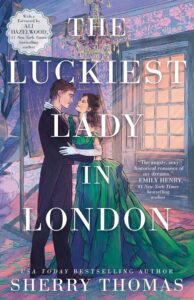
 The re-release of The Luckiest Lady in London has arrived, and Sherry Thomas joins me to talk about the writing of that book more than 13 years ago, how romance and historicals have changed, and how this book is a reflection and subversion of another very, very famous historical romance.
Plus, she gives us recommendations of her favorite historical romance authors and some of their books.
Note: we had some connectivity issues, so sometimes the edit sounds a little abrupt. If you’re watching the video, the video does freeze while the audio continues. My apologies.
Music: purple-planet.com
Update, 9:33amET: The transcript is here, too!
❤ Read the transcript ❤
↓ Press Play
This podcast player may not work on Chrome and a different browser is suggested. More ways to listen →
Here are the books we discuss in this podcast:


Make sure to disable your ad blocker to see all the books.
You can find Sherry Thomas at her website, SherryThomas.com. She’s on Bluesky, on Instagram @writersherrythomas, and on Facebook as AuthorSherryThomas.
If you like the podcast, you can subscribe to our feed, or find us at Apple Podcasts, Spotify, or wherever you listen to your favorite shows!
❤ More ways to sponsor:
Sponsor us through Patreon! (What is Patreon?)

What did you think of today's episode? Got ideas? Suggestions? You can talk to us on the blog entries for the podcast or talk to us on Facebook if that's where you hang out online. You can email us at sbjpodcast@gmail.com or you can call and leave us a message at our Google voice number: 201-371-3272. Please don't forget to give us a name and where you're calling from so we can work your message into an upcoming podcast.
Thanks for listening!
Transcript
❤ Click to view the transcript ❤
[intro]
Sarah Wendell: Hello and welcome to episode number 730 of Smart Podcast, Trashy Books. I’m Sarah Wendell, and my guest today is Sherry Thomas! The re-release of The Luckiest Lady in London has arrived, and Sherry joins me to talk about the writing of that book more than thirteen years ago, how romance and historicals have changed, and how this book is a reflection and subversion of another very, very famous historical romance. Plus, she gives us recommendations of her favorite historical romance authors and some of their books.
I do want to note we had some connectivity issues. There were periods of time when the audio would delay and the video would delay, so sometimes the edit sounds a little abrupt, and I apologize. If you’re watching the video and you notice the video freezes, same thing. My apologies; I did everything I could to make it functional for y’all. I hope it worked.
I have a compliment, and I love when I have a compliment. This is for Leslie R.
Leslie: a new wool is being spun right now that’s being named after you, because the world is a little warmer, kinder, and softer with you in it.
If you would like a compliment of your very own, have a look at patreon.com/SmartBitches. Your support ensures an artisan transcript from garlicknitter – hey, garlicknitter! [Hey, Sarah! – gk] It keeps the show going week after week, and if you join, you get to be part of one of the most wonderful communities on the internet. Have a look at patreon.com/SmartBitches if you are interested in learning more. And if Patreon support is not in the cards, please may I humbly ask that you review the show wherever you listen.
I will have links to all of the books that we talk about – there are many – in the show notes at smartbitchestrashybooks.com/podcast under episode 730.
So, shall we get started? On with the podcast with Sherry Thomas to discuss The Luckiest Lady in London.
[music]
Sarah: Hello, Sherry Thomas. Thank you so much for doing this interview! I am so excited to talk to you again. I think we just figured out that it’s been seven years since we’ve talked?
Sherry: It has been! At the Loyalty Bookshop in DC, right?
Sarah: Yeah, I’m pretty sure that was it, ‘cause we did that super cool event for the Lady Sherlock series. And then there’s a, there’s a speakeasy bar in the back, and they had custom cocktails.
Sherry: It was. And, and they, they custom made a drink menu, which I still have on my wall in the room where we have a TV.
Sarah: I’ve been talking a lot about the RT convention because we recap old issues of RT magazine on the podcast. And so I think –
Sherry: Which is such a cute idea!
Sarah: Thank you. It’s so fun. Oh my gosh. But I look at, like, the RT convention and the RWA convention and I think, oh my gosh, there are people I saw at least two to three times a year that I haven’t seen in like seven or eight years now, and I just, I took it for granted! I really did.
Sherry: I know, I know, right? That is, that is don’t know what you got till it’s gone! Yeah. This is, I recently, last year I restarted our local romance group as a non-affiliated group, just because I was like, you know, We do need this. The, the, the old – I mean we want new people to come too, but at, at first it was just for the old-timers to have, like, a, a, a way to meet, structure, with a structure. You know, like, it’s, it’s already there; the monthly meeting’s there. You can just show up.
Sarah: Mm-hmm.
Sherry: You don’t have to specifically make appointments to see each other in person, otherwise. I mean, it is in person, but you don’t have to, like, you know, make one-on-one appointments. We can see each other as a group and go back to talking about books, writing, craft, and all those good things that made you want to be a writer in the first place.
Sarah: So cool! And it’s wild that it’s sort of like us who are, who are like, I guess, I guess we’ve got to start something if we want to see people again.
Sherry: Yeah! Yeah, yeah. And, and, and I always say, like, I am not an organizer? And I am, like, one of the person happiest to be sitting at home, so if I am organizing something like this, like – [laughs] – you know things are bad.
Sarah: I have taken on the job of herding cats; you know that the situation is dire. Yes –
Sherry: Yeah.
Sarah: – I totally agree.
Sherry: Yeah.
Sarah: So we are here to talk about a re-release of The Luckiest Lady in London. First of all, when I got an announcement about this I thought, That’s so cool! That’s so nifty! Like, that’s so – were you really excited when this idea came along?
Sherry: I was just told, you know, like people in most traditional publishing were just told like last summer? Yeah, I think this was last summer – my agent said, Call me on the phone. Like, I hardly ever speak to her on the phone. I mean, I hardly ever email her, either, ‘cause normally if you’re a writer who produces one book a year, you have no reason to, like, contact either your agent or editor most of the time. So she, she actually said Call me, so I was like, Okay, I’ll call you. So she had various news for me, you know, like blah-blah, they want two Lady Sherlock books, and also, by the way, they would like, they’re going to re-re-, re-release Luckiest Lady in London! And I was like, really? I, I was, I was, like, astonished, because, you know, I just learned about the, the winter of historical romance not long before that.
Sarah: [Laughs]
Sherry: But, but apparently this is, this is not a unique phenomenon, because I spoke to another local friend, and she’s also like, Yeah, she cannot get a front-list historical romance contract. She cannot get a contract to write more historical romance – so this is somebody who’s been writing historical romance for longer than I have – but her publisher is also reissuing her backlist. So –
Sarah: That’s so interesting!
Sherry: Yes, yes, and apparently the backlist are doing okay. So I, apparently, I think there’s just more expenses involved in editing, producing, publicizing a new book versus an old book, especially one like Luckiest Lady in London that’s already earned out like, I don’t know, ten, twelve years ago. So –
Sarah: [Laughs]
Sherry: – it’s financing its own release! Own re-release.
Sarah: That’s fascinating. So they were just like, Hey, we’re re-releasing it. Did they give you –
Sherry: Yeah!
Sarah: – any reasons why they made that decision? I’m, I’m, I’m, I mean –
Sherry: No, no!
Sarah: – I’m totally aware that – I’ve said that historical romance is in a coma. I love the way you describe it as the winter of historical romance. I, I also believe that genres don’t die. They will always come back, and historical will come back?
Sherry: Somehow, yes.
Sarah: Yes, they never die. And I thought, Okay, well, if you’re going to re-release a title as great as this one – like, The Luckiest Lady in London is one of, one of the top, like, top romances in historical romances. People –
Sherry: Oh, thank you!
Sarah: – constantly recommend it to each other. It’s –
Sherry: Gosh, thank you!
Sarah: No, seriously, it’s so good! It’s so very good. And it makes sense to say, Oh hey, remember these incredible titles. Let’s bring them into this newer format, not mass market. We’re putting it in trade; we’ll give it a different cover. It’s like reintroducing some of the great titles from, what is that? Has it been thirteen years since this book came out?
Sherry: I think it came out 2013…
Sarah: So let’s re-in-, let’s just reintroduce this, this, this romance to readers who are now gravitating towards trade. I mean, it makes, I, it makes sense. Like, I can imagine the minutes from the meeting where they made this happen. Like, I understand it totally? I just, it never occurred to me, of course they wouldn’t tell you until it was done. My gosh! [Laughs]
Sherry: Yeah, yeah! I, I was never told anything, like, except, you know, by the time I was told, I was told, like, they will do a new cover in the illustrated style, and it will be trade paperback, and that was the only thing I was told. And I wasn’t even required to say Yes, I agree, or No, I don’t agree, because the book is still under contract! They have the – [laughs] –
Sarah: Right?
Sherry: – they have the rights! My publisher has the rights. So.
Sarah: So what are your feelings –
Sherry: I mean, it, it never, it never reverts…
Sarah: – about the re-release?
Sherry: – just, but it hasn’t happened yet, so I am just, you know, like, hey, look at that! You know? It’s like, it’s like you have a new shirt in your closet, closet you haven’t worn yet. It’s just sitting there, it’s looking nice, but nobody else has seen it yet, so, like, you know, it’s just there. You’re happy it exists, but you don’t really think about it one way or the other. Yeah.
Sarah: Right. I mean, you do have to get involved, I guess, with, you know, doing things like talking to me to talk about the book.
Sherry: [Laughs] Yeah, which is a little bit bizarre, because the book is so old, yeah.
Sarah: Well, my theory has always been if a reader hasn’t read it, it’s a new book?
Sherry: It’s a new book. And, and also let me just say, actually, this is not the first time my books have been re-released with a new cover, but this is a much happier occasion, because shortly after my first two books came out, my first two historical romance books came out, and, like, the first one came out with lots of fanfare. It was, like, had a, back then was considered a, a huge print run for a debut book, but it didn’t do as well as the publisher had hoped. So, like, the next year, basically, they came, my first book came out in 2008, so basically in 2009, they were like, We’re, like, putting new covers on these. So, you know, in the hope to, to, like, maybe the first two covers were not sexy enough, they were not reaching the people they were hoping to reach, they, so they put new cover. So that was not like re-releasing under the best of circumstances.
So this one is like a much happier occasion. Yeah. So let’s put it that way. This is, so – yes, I am happy about it. I am thrilled about it – [laughs] – if I think about it that way!
Sarah: I mean, let us all make money seems like a really good plan. I, I support any –
Sherry: It is, it is –
Sarah: – incarnation of that plan.
Sherry: It is the only plan, ‘cause, like, nothing is possible until you have a few bucks in your pocket. [Laughs]
Sarah: That’s right. What do you remember about writing this book? Do you remember the creation of this book at all?
Sherry: I actually remember the creation of this book fairly clearly. It was created in two stages? So this was the second manuscript I’d ever written. The first manuscript I’d ever written turned, was what later got completely rewritten as Private Arrangements, my first book. But there was like a five-, eight-year gap between when it was first written and was published, rewritten and published.
So this one I remember so clearly. Like, I was lying in bed one night, 2001, and just had this idea that was this, like, basically huge sexual power imbalance. And I am of the generation who get kind of like turned on by such ideas, you know. I think all my books have, like, it started with some sort of power imbalance, and they try to go toward the power parity, right? So, so this is, I was like, oh, what if this girl has to marry this guy, and she really didn’t want to marry him? But, you know, she’s married him, so now they’ve got to consummate the marriage. And I was like, Ooh! And I wrote that in three months, which is to this date still the fastest I’ve ever written a book. And those happen to be the mid-, middle trimester of my second pregnancy, so that’s why I remember the timing. Otherwise I don’t remember what time. Yeah –
Sarah: Hmm.
Sherry: – and, and I was like, wow! So that means, like, in my third trimester I could write another book! But instead what happened in my third trimester, I just slept all the time.
Sarah: You did just write a book while growing a person?
Sherry: Yes, yes.
Sarah: So I can understand you needed a nap, but wow!
Sherry: Right, so – so, and, and this book, like, I queried with it, and within a week after the second baby was born, I had myself an agent! So everything just seemed like, you know, done! I had, my family’s finished, and I’m about to have a career! But no, it did not sell, and it did not sell, and I still liked this book a lot. So I would go back and periodically reread it, and I would go, I like it! Why didn’t it ever sell? And then fast forward to – gosh, was this 2012? Maybe 2012, and my publisher wants two more historical romance from me, and I was like, I have no more new ideas! But my agent didn’t want me to walk away from historical romance yet, so I was like, Okay, I have this book under the bed. So if you guys will take it more or less as is, then I’m willing to sign a two-book contract. And they’re like, We’ll take a look at it. And my then-editor read it and said, I like this a lot! You know, so I was like, Okay, in that case I’ll just do some minor revisions and I’ll turn it in. But then three months before the book was due, I sat down and I read it and I was like, All these years I thought it was great! And I can still see why at that time I might, and I felt, I’m like, No, this is so stupid; this doesn’t work; that doesn’t work. I can see, like, whole new ways of how to do this! And, and so then I revised it. The whole first half, maybe first sixty percent of the book, was redone.
Sarah: Oh gosh!
Sherry: And – yes! – and I loved it! And the thing was, it was some conference I went to, or book signing or something. I, I was in New York and I had to meet with my agent and my editor, and they met at the same time. I did not know it! But when I sat down, they both told me how much they hated the new manuscript, and I was, like, shocked! Like, I don’t think I ever had such a, like, sit-down meeting where they told me everything that was wrong with a book. I’ve, I’ve had, like, plenty of emails to that effect, but never a face-to-face meeting.
But I liked the book so much! So then I went home and I called in some favors. I sent this book out to four friends and said, I want you to read them, like, as fast as you can and get you back your gut feeling. And they all said, It worked great for us! So now I was like, Okay then, four to two. And I am obviously weighed in favor of the four people, so I just went back to my editor and said, You know what? I will revise it more, but I really like it as it, and I’m going to make it even more what it is. And thank goodness she didn’t say, you know, Change it the way I want or I’m pulling your advance. No, she just said, All right.
So then this book was my vision came to life, and I’m just super glad that readers responded to – but, I mean, I think my agent and my editor were, like, shocked and confused because it was nothing like the one they already read and liked. They just, like, didn’t have time to wrap their heads around it.
So these days mostly what I remember about writing this story was the revision. I was just cackling because, you know, it was such a gleeful process of revising it. There was, like, just some fun things were said on the page and, like, naughty things, you know, intended, threatened and all that. It was just like, I was having a good time. I was having a good time revising this book. Cannot say that for all my books, but I had a good time revising this one.
Sarah: That’s amazing! Like, they were both like, No, we hate it, and you said, Too bad.
Sherry: Only, only, like, later. I said too bad after a week.
Sarah: Yeah.
Sherry: I gave myself…
Sarah: Some time passed, and then I said, Too bad. I’m going anyway.
Sherry: Yeah.
Sarah: That’s – wow.
Sherry: Yeah.
Sarah: So can you talk about how this book has a power imbalance at the beginning?
Sherry: This book has a power imbalance in the beginning because our, our heroine – I mean the, what, they’re called female main character nowadays, right? The FMC in the beginning has no money, has a family who need support, so she’s in London to try to net a rich man because in a world where women didn’t work or at least weren’t paid anything worthwhile when they’re working, so to support, you know, she has four other sisters that she needs to support, especially one who is epileptic and cannot support herself. So she needs to net a rich man, and all she has is reasonable looks and, like, you know, this guile and this understanding of human nature. She’s, like, totally there to be this, like, very pleasant, very marriage-ful – you know, she does appear the kind of a woman, like, any man would be, you know, lucky to have as a wife. But the thing is she’s deliberately made herself appear that way.
And our hero is the man with everything, except, you know, completely damaged inside, but that is not obvious on the surface. And so he has money, he has position, he has everything she could possibly want, except he doesn’t want to marry her. He, he just wants to play games with her, basically, because they recognize each other as what they actually are from the moment they – like, the moment they met, they recognized that they’re not who they seem. But she’s not in a position to do anything about him, whereas he is in plenty of position to, like, lure her to the dark side with his good looks, his, you know, charming manners, his money and his darkness. Yeah, she really kinda likes the darkness in him.
Sarah: Wow. And, and because I know how fluent you are in romance, one of my favorite things about your writing is that, because you are so deeply fluent in all of the mechanics and the tropes and archetypes and the –
Sherry: [Laughs]
Sarah: – and the commonalities of romance, you love to subvert them or really interrogate them. And one thing that this book does is it really interrogates the, the power imbalance of people who can act without any consequence, like with the male main character –
Sherry: Mm-hmm.
Sarah: – and then people for whom every action carries enormous consequences that are easily negative.
Sherry: Yeah! They’re walking on life’s edge. They’re walking – like, Louisa is walking on life’s edge. Yeah.
Sarah: So you’re just, you’re playing with that and looking at, okay, well, what is the morality of two people who are saying, Well, I’m only here to marry for money and stability? And a, a hero who’s like, Well, I’m really just here to fuck around, to –
Sherry: Fuck things up? [Laughs]
Sarah: Yeah, fuck things up, and it, and I, and I’m not going to ever see any consequences, and none of this really matters to me. And, and neither of them really see the other as a person. ‘Cause they’re not supposed to. That world is not set up for them to recognize each other’s humanities; they’re, they’re set up as, as foes in just about – it’s such a, the, the whole market of historical romance, the marriage market, is setting people up as potential allies, but they start from a position of, of opposition.
Sherry: I mean, the thing is, you have to recognize marriage is an economic institution, right?
Sarah: Yes!
Sherry: It had always been an economic institution.
Sarah: Yes.
Sherry: Even today it is; just people are less willing to, to face that fact.
Sarah: Oh no! Very true!
Sherry: So, so, so if, if you, if you see that, then you can understand. So Louisa, Louisa understands that completely! And Felix also understands that completely. So this is why they, you know, from the beginning, they can, like, like, she, she knows what she’s doing, and he also knows what she’s doing, but he does not despise her for it, because he understands why she has to do it. He just finds it fun to mess with her plans. [Laughs] That’s what it is. Again, because, because he, he does not need to face any consequences of her plans going wrong.
Sarah: No, and one thing I’ve learned very recently watching all of the, you know, billionaire tech bros destroy our society is that when you have that much resources and you get bored, it’s dangerous.
Sherry: It is very, very dangerous. Yes, yes.
Sarah: Right, like –
Sherry: And we, we’re, we are interrogating this just because, like, Felix still has some sort of conscience left, which is, otherwise he wouldn’t be a romance hero. [Laughs]
Sarah: Yes.
Sherry: I mean, although these days, these days, I don’t know what passes for a romance hero anymore. [Laughs]
Sarah: It’s a very different animal, and sometimes I’m like, Wow, I hate everything about you, and I don’t care if you’re happy. You’re terrible! Moving on.
Sherry: [Laughs]
Sarah: So Felix is, he’s socially confident, he has interpersonal skills, and he’s pleasant to be around. And at the time, if I’m remembering correctly, in historical romance, there were a lot of stompy, grumpy, terrifying –
Sherry: [Laughs]
Sarah: – like, frowny, grump-ass heroes. And this guy is, like, smooooth. He’s very charming. Was this your attempt to challenge the archetype of the sullen, stompy, grumpy hero who is titled and wealthy and, again, faces no consequences for having zero interpersonal skills at all? It’s all fine that they have no interpersonal skills. Meanwhile, Felix is like, I’m the king of interpersonal skills. I can charm anyone. Was this you interrogating that archetype a little bit?
Sherry: I tend to like just to reverse things to see how things work out. So this book, I don’t think this book was necessarily inspired by Lord of Scoundrels, but it’s, it is, very much stands in, like, it’s a reflection of Lord of Scoundrels. So Lord of Scoundrels, which, at the time I was coming up as like a still unpublished writer, was, like, three times in a row, it was voted as the greatest, you know, romance ever written by All About Romance. So that book probably, you know, every, every, every writer coming up, historical, has read that book and been influenced by that book in some way. So Luckiest Lady in London, I always say it’s kind of like, What if, you know, Lord Dain grew up – and he’s had a terrible childhood, and he grew up, but instead of turning into Lord Dain, who’s, like, the worst scoundrel, you turn into the perfect gentleman. So instead of, like, hanging out all your faults out there for everybody to see, you, like, instead of, package it perfectly that nobody can see.
So it’s the same thing, and I think very much the, the way Luckiest Lady is structured is exactly like how Lord of Scoundrel is structured. You have that first chapter to explain kind of like, Yes, like, we know he’s terrible, but this is why he’s terrible. You know, so that readers will have a little patience. Otherwise you go, like, What’s wrong with this person, you know?
Sarah: Screw this guy. This fucking guy, I don’t want to read about him. Yeah, totally.
Sherry: [Laughs] Yeah, but also I’m not saying I find socializing difficult, but I find socializing in the context one is more likely to see in the, let’s say in the publishing industry difficult. Like, like, when I was, when I was young and knew nothing, I wanted to work in an embassy. Not because I knew what works, working in embassy entailed; because I like hors d’oeuvres, and I like cocktail dresses. And I thought, you know, working in an embassy is just nothing but, like, cocktail parties every day, and I was like, How wonderful!
Now, to this day I still love a cocktail dress, and I still love hors d’oeuvres, but cocktail parties are like my worst nightmare, just because I don’t know how to circulate. Like, this, this idea of moving from one person to the next; like, you only talk this much and then you move on; that is still like a nightmare to me. I have no problem sitting down at dinner. Like, give me the boring-est person at dinner and I’m sure we’ll be okay. But just this, this circulating, this kind of looks like a party where you just go and you expect to go around talking to people, that is still, like, terrifying to me.
So for me, like, a person who knows how to talk to other people, who can come just up to me, like somebody who just standing there, like, you know, like a deer in headlights, and just say, Hey, what are you doing here? Like, I am so grateful for that. I’m so grateful for the social mavens. Like, you know, I don’t necessarily need them in daily life, but I’m so grateful when I come across one in a social situation who’s just like, Yeah, hi, how are you? Like, come and meet this and that person; you know, just put you at ease. I am so grateful for this kind of person, and I just think, like, they don’t get acknowledged enough for, like, how much they contribute to the fabric of society. And I think there actually are plenty of men who are good at this.
And I was like, why do we celebrate only one kind of man, the kind of man that you just can’t take anywhere? Like, no, I’m not like that. I want a man that I can take everywhere and never have to apologize for. You know, it’s like, I would like George Clooney. That’s, that’s what I want. If I want to take someone out anywhere, please let me have George Clooney.
Sarah: [Laughs]
Sherry: Like, he can talk to and charm everybody. That’s the sort of person you want to meet your friends or to come to your house and, you know, like, these romance heroes are just like, you know, I’ve had kids who throw tantrums. Like, I don’t need to be raising a husband. [Laughs]
Sarah: Okay, that is so funny. So – [laughs] – I want a man that I don’t have to be embarrassed to take everywhere!
Sherry: I, I aspire, I aspire to be that kind of woman, and so I would like that sort of man.
Sarah: Obviously, yes, absolutely. And, and Felix – I, I agree with you. You start with the, okay, this is why this character is such a bastard and why you’re, you, you’re going to have some empathy and some understanding, even though – and like you said, you need some patience, because this person is truly, like, there is damage. But Felix internalized that damage as, I can’t let anyone see it; I can’t let it touch anyone; I must be the most perfect, the smoothest, the most – what’s the word I’m looking for? Debonair? Is that the word I’m looking for? Yeah.
Sherry: Not sure he’s exactly debonair, but he’s definitely like Prince Charming. He’s definitely your prototypical Prince Charming. And, and the thing, the thing about, you know, I like, I am grateful for the, the social mavens, but Felix is not a, like, completely connected; completely, like, popular – his popularity is a further part of his armor. That’s all –
Sarah: Yeah.
Sherry: – part of who he is, that’s all what he built up around him, because he grew up quite lonely, like, on an estate with no other children, no one to play with, no one – so this is, this is also part of – because, because he understands being liked, being loved, being adored, being trusted, being admired is power.
Sarah: Yes.
Sherry: So, so this is very much all part of power. This is, you know, he’s leveraging social power.
Sarah: So Felix is an inversion of, of Dain from Lord of Scoundrels. How is Louisa an inversion of Jessica?
Sherry: I think Jessica would never, like, lower herself to be, like, pleasant to people she doesn’t want to be pleasant to –
Sarah: [Laughs]
Sherry: – because I don’t think, I don’t – I mean, Louisa is not like that either, because Louisa very carefully picks, has, you know, she has targets who she believes will be extremely good husband to her, in the sense that she believes she can persuade them, that she can exert her own feminine influence. Basically, she’s power from the shadows. Louisa is meant to be, like, sees herself as, you know, in a marriage, she’ll be, like, perfect on the outside, but she will, you know, try to leverage as much of this guy’s resources for her own end as possible. So I think Jessica probably would not stoop to the kind of, to that kind of scheming because Jessica is not in the same economic need. She is not in financial straits the way Louisa’s family is. Our –
Sarah: Yes.
Sherry: – our, our, you know, our economics kind of determine our path in life in many ways, so – or at least determine what kind of starting path we have to go on.
Sarah: Yes, that’s very true. Now, I love the contrast in a lot of especially historicals where, for a lot of character arcs and story arcs, marriage is the end point. Like, we’re going towards the HEA where we’re going to get married and live happily ever after. You sort of imagine the, the back of the carriage in Cinderella in the animated Disney where –
Sherry: Yes, yes, yes.
Sarah: – you know, Just Married is The End. It’s the same,
Sherry: Yeah.
Sarah: Yeah. I love when marriage is a point in the timeline of the story, but it’s not the end. It’s not the last one; it’s actually middle or earlier because you have to learn how to be married and how to – it’s a very big adjustment, and this is, this, this whole book is one of my favorite pieces of romance catnip, which is the, the distance and difference between your public self and your private self, what motivations and costumes they wear in society versus when they are alone or with one other person. Your publicist, Kaila Mundell-Hill, mentioned that this book is your exploration of the limits of that Cinderella story. Can you talk more about that?
Sherry: Yeah! I don’t know if there’s a girl who’s, like, from the get-go said the Cinderella story is fraud. I don’t think there’s a single girl, or at least there’s not a single girl I know. All I know is romance readers and writers, so obviously I don’t know any single woman – [laughs] – who’s ever said, like, Yeah, Cinderella? You know, that, that’s a, that story is a fraud from the very beginning. No, we don’t think that! We love it! Like, I think to this day, if you dangle something that’s Cinderella-themed in front of me, I will at least take a look at it, if only to see the dress, if nothing else, you know. It’s such a charming fairytale.
From the evolutionary point of view, it has got such a powerful allure, because when I think of romance I always think from the evolutionary point. [Laughs] I don’t know if everybody else does, but I do. Because the whole of evolution is how to gather enough resources to guarantee your own and your offspring’s survival, right? This is, this is just the deepest human drive. And women, by the disadvantages biology and society have placed on them, have much more difficulty gathering these resources. And also because they have to gather not only for themselves, but for their offspring.
So for the longest time, one of the best ways to have enough resources is to have a romantic/marital partner who has these romances and to share them with you because, one, that’s what the law demands; two, he would do it exactly the same, even if the law didn’t demand it; but the double protection, both love and the protection of the law.
So Cinderella, the Cinderella dream is like, for the long-time history, kind of like at the top, what an ordinary girl could dream about, that you would have, you will have access to all these resources, all this protection; that you will live free of, you know, want, and that your children will also live free of want. So it is a powerful allure.
But we all know, you know, after the carriage rolls out of frame is when the trouble really starts. I think you’ve been married a long time also, right?
Sarah: Twenty-six years.
Sherry: Yeah! I, my thirtieth anniversary was this year. So –
Sarah: Yay! Congratulations!
Sherry: Oh, thank you, thank you! So I’ve been married since I was, the day I was old enough to legally drink, I got married. So, so we old married women know that the hard part starts after the I do. And –
Sarah: Oh yes.
Sherry: – the hard part will keep coming and keep coming and keep coming.
Sarah: Right, because you grow and you change and you become different people as you age. Yeah!
Sherry: You change, and circumstances arise, and if you are like me, like, as soon as you’re married, you’re like, you know, childbirth is thrust up on you. Then that’s like whole new – you don’t even have, you didn’t even have time to get to know each other –
Sarah: Mm-hmm!
Sherry: – as marital partners before you are just, like, co-parents for many years.
So, so, so yeah! So I do love the Cinderella, but I’m, like, too, way too past it to be convinced. Like, I need to see how these people behave with each other when they are actually, like, you know, isolated in this institution that kind of locks people together for the rest of their life. I need to see that they can handle it; they can, they can handle this kind of closeness; and they can handle what they will learn about each other after marriage; that they can handle new circumstances coming in that explode their preconception of what, you know – or even about themselves that make them realize, I am not who I thought I was. I don’t feel about you the same way I thought it was. I need to see people handle that, in a way.
I still think I write fairytales, and not everybody might agree, would agree, but I still think I read write, write fairytales. These are just fairytales with a few more, you know, figurative dragons thrown in. It does not end with waking the princess up with a kiss or when the castle door closes. We see, like, a bit of the dragon battle behind the castle door. So yeah, that is, that is what I like to do. And I, I love marriage-in-trouble stories, maybe because I’ve been married so long. [Laughs]
Sarah: And it’s, it’s interesting that your, your thoughts on marriage reflect the major conflicts of this book. The marriage, for them, is the public performance. Like, that’s where –
Sherry: Mm-hmm!
Sarah: – the public performance of Yes, we are a married couple; we are off the Marriage Mart now. We’re done; we’re gone; you’re not going to see us every week. We have publicly married, and everyone’s like, Okay, check! Bye! For them, their marriage begins when they are, as you said, in private trying to figure out how to get along. And so they have to figure out the reality of their marriage in privacy when it’s not in public. It’s probably much easier –
Sherry: Mm-hmm.
Sarah: – for them both to be in public, but now they have to, like –
Sherry: Yeah, yeah, yeah!
Sarah: – get along together and, like, you know, deal with problems and figure out a way –
Sherry: ‘Cause these, these are –
Sarah: – to get along in the same space.
Sherry: These are both public performers, so it’s much easier –
Sarah: Yes!
Sherry: – for them to perform marriage when there’s an audience than have to, like, actually live it in private.
Sarah: Right, and if they’re, and if they’re in private, well, private is where you don’t need your armor. And so for Felix, that’s, that’s very threatening to not need his armor or to want, or, or to start wearing it in private when he’s not used to, because there’s this other person there.
Sherry: Right. So basically they both had a moment of armor down, because these are two people very much in lust. They may not necessarily think they are in love yet, but they’re very much in lust, and, you know, in a euphoria of, you know, like, the sexual rapture, you know, you do let your guard down, and, and then they quickly find out, ooh, you know, this, this is not going to work, and so, like, they have to, like, rebuild things up. Yeah, there’s like a mini-burn, like, like a mini rebuild from the ashes right after their wedding night. And then there’s, like, a bigger rebuild from the ashes later on in the book.
So this, this whole, this whole thing is about how relationship kind of fall apart, and you have to, like, work at it. Not necessarily work at it, but you just have to kind of like live through it, I guess. Live through it and then change and grow with it. Yeah.
Sarah: And you have to choose, when it falls apart, do you want to let it stay broken, or do you want to do the work of building something else? This choice is their, the start of their private marriage.
Sherry: Yeah. I think this choice is, everybody has very different circumstances, but I think this choice basically underlies every marriage that’s still ongoing, right? Every, every marriage that’s not broken up is one in which both partners, like, at various points in this marriage, have decided, Yes, we would rather stay together, or I would rather stay and work, than said, Fuck it, I’m gone. Yeah.
Sarah: Yeah, I choose us over me is why it works in the long term.
Sherry: Right, right. Obviously they don’t have that choice of ending the marriage, but they could have –
Sarah: No.
Sherry: – lived separate lives inside the marriage –
Sarah: Oh yeah!
Sherry: – which was a very common thing. But, you know, they did not do that either. These people –
Sarah: No.
Sherry: – were like, like, did some hard shoveling.
Sarah: I am told by Kaila that this is your TED Talk about how flawed characters should redeem their own damn selves and each other –
Sherry: [Laughs]
Sarah: – and leave the innocent people alone. Which, yes, I support this so much, because so often it’s, the, the heroine must imbue the, the hero with, you know, patience and love, and her love changes him, and she does a lot of restoration work on his character. Don’t you make somebody who doesn’t have these problems deal with you. You need to deal with yourselves and each other privately. What inspired this perspective? I completely, I completely agree!
Sherry: See, Cinderella, we, we just talked about the Cinderella fable, and I said, you know, I am not immune to its charm. However, I have always been completely immune to the charm of the story of a woman transforming a man with her innocence and her, her virtue and, and just her brightness and sunshine and all that. I think partly because if Louisa is, Louisa is the imp to Felix’s devil, then I myself have always been some sort of an imp. I don’t have that, I never had that, I don’t think even as a very young girl I had that maternal thing that I want to hold something, you know, a wounded creature into my arms and take care of it and – just never had it! So I absolutely could not understand, you know, why you would look at this man with all his problems and go, Come here, you know, I will fix you. I’m like, No! Have him find a professional! You know, you don’t do that! And I think real life largely bears out my wariness of this. Because in real life, all you hear is women who have somehow broken themselves in the process of trying to fix someone else. Like, you very rarely hear, like, this actual story of I fixed him or whatever. You know, people either have to change themselves, or they don’t change at all.
So, so, so Felix very much had to fix himself. He very much had to recognize his own problem and, like, go on basically this journey of, you know, trition? What’s the word I’m looking for? Con-, contrition. Yeah, he makes it up to Louisa for what he tried to take away from her in the very beginning, and also just to, step by step, watch him become somebody who only takes, who only have the upper hand, to somebody who will tolerate a moment when he does not, is not in control of everything and to just give. So he’s, like, truly in uncharted territory. He can only give. He cannot demand anything in return.
So for that, I’m very satisfied with his journey. And as for the part about You should not bother the true innocents? It’s not that you should not bother true innocents. It’s that I have actually seen true innocents in my life, and they freaking do not understand what your problem is!
Sarah: [Laughs]
Sherry: True innocents are, like, kind of like horrified by, you know, what actual people do. Like – and, and I think we are all in a way, you know, true innocents at our particular level. We can only understand this much and no further. We may, we might be able to empathize it, but that doesn’t mean we’re not still like, like, You, you did what? But, but why?
Sarah: Mm-hmm.
Sherry: Why would you make this choice? Why would you – so only people who have, like, at least, like, have a similar kind of thinking process, like, people who are, like, fundamentally different from you are not going to understand you! They’re just going to be like, What the hell? you know. So true innocence is not going to redeem anybody. They will just sit, be sitting there going like, I don’t understand!
Sarah: And they’re not equipped, like, they don’t have the equipment to –
Sherry: They, they are not! They really, they really are a different kind of creature from the, from the rest of us. Yeah.
Sarah: Yeah! It just, it doesn’t occur to them that this is, this is possible, so they have no equipment with which to deal with it!
Sherry: Yeah! They, they, they, they are not. They are, to, to deal with it, they have to become at least a little bit like you, and then they’re not true innocents anymore.
Sarah: No, that’s not what you want for them.
So speaking what, much largely about historical romance, especially from, you know, ten to fifteen years ago, which is where this book falls, which, which do you most recommend? Which are some of your favorites of –
Sherry: I, I –
Sarah: – the contemporaries, the contemporary to your books?
Sherry: Right, right, right! I think I pretty much would recommend – I feel like this is what everyone would recommend, but then again, you know, we can only see our point of view – so Meredith Duran, for sure!
Sarah: Oh, Meredith Duran.
Sherry: She deals with similar complexity of characterization, this, you know, same inner human darkness and, and just fabulous writing. There’s Joanna Bourne; there’s Courtney Milan; Jeannie Lin; let’s see, Cecilia Grant. So yeah, I, I, I feel like it was a good time to be reading historical romance ten, fifteen years ago, because there were, there were a lot of interesting concepts, and there were lots of writers who were not afraid of, you know, a little flaw, a little messiness, but they are still, in the end, writing fairytales that, you know, love con-, love does conquer all, good sense does conquer all, and there is –
Sarah: Yes.
Sherry: – like, justice, there’s fairness and justice at the end of a story. Yeah.
Sarah: And speaking specifically of Meredith, her first book begins with, is it the Sepoy Rebellion? I think that’s it?
Sherry: Oh, the Great Indian Mutiny of 19-, 1857, yeah. The Mut- –
Sarah: Yes, thank you!
Sherry: – the Great Mutiny of 1857, yeah.
Sarah: Yeah, and it starts out with a period of history that a lot of historical romance readers knew absolutely nothing about and really interrogated the concept of colonialism at a time when historical romance really hadn’t done a lot of that. If anything, it was reinforcing colonialism in every direction, whether you’re talking, going to the American West –
Sherry: [Laughs]
Sarah: – or you’re going, you’re going east from the UK. Like, you just, colonialism all the way down. And one of the things that Meredith’s books did was really interrogate that whole system. I also just want to tell you I, I know you, you, you used to be critique partners. I don’t know if you still are.
Sherry: No, no.
Sarah: Of all of the people –
Sherry: I have never been critique partners with Meredith Duran.
Sarah: Oh!
Sherry: Meredith Duran and I and our critique partner were a ménage! [Laughs]
Sarah: Oh!
Sherry: We have the same critique partner, but we’ve never been each other’s critique partners. Yes. Although –
Sarah: I did not know that!
Sherry: Yes! Although, although I have asked her to read a manuscript of mine that I was convinced was misjudged by my agent, and she came back and said, Sorry, no, your agent was right. And so –
[Laughter]
Sherry: So yes. Thank you, Meredith, for that. You were both right. Yeah.
Sarah: All of the people from that time period, Meredith Duran is the one that I get the most email about asking what happened? Is she, is she ever going to write again? Of all of the people, if you are still in touch with Meredith, please, please let her know –
Sherry: Uh-huh.
Sarah: – of all of the people, I get email about, Hey, do you know anything about this author? It is, Meredith is number one every time. I miss her, I love her books –
Sherry: I think, I think Meredith does know that? I am still in contact with her, so I will pass that on.
Sarah: I hope she does know that.
Sherry: Yes, yes. And I very much, for my own sake, also hope she returns to – I’m not one hundred percent sure she’ll return to historical romance, but –
Sarah: Mm-hmm.
Sherry: – I, I at least want her to be writing something, right?
Sarah: Yes.
Sherry: Yeah. Yeah, Meredith is alive and well, I can tell people this much.
Sarah: Oh, I never doubted it, but wow, do readers just love her books –
Sherry: Yes.
Sarah: – and wish there were more.
Sherry: Yes, as – and well they should!
Sarah: Which I think is just –
Sherry: Well they should, yeah.
Sarah: I think that’s just the nicest compliment to someone’s writing? Like, I miss you. I miss your writing.
Sherry: Yeah!
Sarah: Like, it’s –
Sherry: Yeah!
Sarah: – that’s such a gift.
Sherry: Yeah.
Sarah: There are a number of romance –
Sherry: Absolutely, she had that in spades, yeah.
Sarah: Yes.
Sherry: She had that gift in spades, yeah.
Sarah: Gosh, yes. Now, there are a number of, of historical, of romance readers who are now just discovering the genre, who are looking at historical romances from ten to fifteen years ago. And I see them, they’re, they’re, they’re, you know, they’re much – like, a lot of people are much younger than me at this point, but they’re much younger than me –
Sherry: [Laughs]
Sarah: – they’re just starting out. Their, their understanding and experience with romance is so different from mine. And they’re like, Hey, I’m going to read this Judith McNaught book, or I’m going to read Jude Deveraux from 1989, and I’m just –
Sherry: [Laughs]
Sarah: – I, I just want to grab them and be like –
Sherry: Good luck!
Sarah: – Okay. Okay. Okay, so –
Sherry: Why, why not go back to Rosemary Rogers from 1974, you know?
Sarah: Just, just rip your bodice yourself, it’s fine. And so if someone picks up Jude Deveraux, I always just want to be like, Okay, I need you to understand how much fatphobia you are about to encounter, because it was just, it was just baked in. We couldn’t do anything about it at that time, and we didn’t even notice it half the time because it was just everywhere. So I just need you to understand –
Sherry: Yeah.
Sarah: – what you’re about to run into.
And I look at romance readers from, the, you know, the, the newest readers who are now going, Oh, historicals! I want to try some. And the most recommended ones, you, as you mentioned, even in polls today, even in polls right now, Lord of Scoundrels and books from ten to fifteen, up to like twenty years ago. So if there are readers who are listening, who’s like, Oh, I’ve never read a historical from that period, what advice would you give them? What direction would you steer them in?
Sherry: The imp in me will steer them directly toward The Sheik and say, you know, Get, get, get it all out. Get the rape and adverbs part of our historical romance –
Sarah: Rape and adverbs!
Sherry: – out of your system. Actually –
Sarah: Oh my God…
Sherry: – actually, actually, actually, it is, it is not so bad. What I mean, the adverbs part is not so bad in, in The Sheik.
Sarah: The rape is.
Sherry: Rosemary, Rosemary Rogers has, has passed on, so I can say this in public. I loved her stuff when I was like in my teenage years. I was, like, absolutely swept away. And I used to know where all the good stuff was in, in – I, I still think I, I think – on page 144 or 146 is like when the first love scene gets going in Sweet Savage Love. I can still tell you that from the top of my head. And, but the thing was, right before my own first book came out, I went back and took a look at that, and I was like, Oh my God! This is really, there really is an adverb in every sentence! And somebody’s eyes did something flashingly! You know, flashingly! And, and I was like, I, I did not know that was a word! So I kind of had to set the book down.
So, you know, it, it’s like if you want to, if you want to actually make an academic study, you have to start with The Sheik, but beware.
Sarah: You’ve got to go way back.
Sherry: And then if you, if you want to see, like, the heir apparent to The Sheik, you can start with Rosemary Rogers and see where I got started.
Like, but, but I think for sure I would recommend Lord of Scoundrels. For sure I would recommend Laura Kinsale and Judith Ivory, and if you want to see the evolution of, like, how powerless people, heroines, really could be, you, you can have a crack at To Have and to Hold. Patricia Gaffney’s To Have and to Hold, to this day, still one of the most controversial books in, in, in romance for a good reason. Like, that’s only if you want to, if you want to, like, make an academic study. If you, if you are just like a regular person, who’s sort of like more into consent, then, then maybe don’t start that far.
But I still like my old favorite. I still like Laura Kinsale, I still like Judith Ivory, and I still think, I think Lisa Kleypas has re-, rewritten some of her stuff?
Sarah: Yes, that’s my understanding: a couple of them have been rewritten.
Sherry: Yeah. So, so if folks are completely new and are not, like, didn’t grow up in a time when I think the goal was – there was a time, there was a time – I think Lisa Kleypas put it very beautifully, very succinctly – when people did not want women in historical romance to be responsible for their own orgasms.
Sarah: Yes! She said that to me. Yes, that the idea –
Sherry: Yeah, yeah. I think, I think, I think the idea was for, you want your orgasm to be kind of crammed down your throat. [Laughs]
Sarah: Yeah.
Sherry: Like, just thrust upon you with no warning whatsoever, and you’re just, like, What?! You know, like, Wow! You know, That exists, and I like it! You know, but I don’t want to say I like it, so please, you know, somehow, like, shove it sideways on me again. So if you don’t mind that – I think people who are reading dark romance?
Sarah: They’re fine.
Sherry: And don’t mind it? Yeah. Go ahead. Go ahead.
Sarah: They’re fine. You understand –
Sherry: Yeah.
Sarah: – the dynamics here. Yeah.
Sherry: Yeah, yeah. But if you, if you want, like, or if you, if you’re willing to look at it, but at least you want it to be self-aware, then the works from ten to fifteen years ago are okay.
Sarah: For sure.
Sherry: Yeah.
Sarah: Do you have a favorite Kinsale or a favorite Judith Ivory?
Sherry: My favorite Judith Ivory is probably The Beast, which is my first Judith Ivory, because I’d never seen prose like that –
Sarah: Yep.
Sherry: – in historical – I mean in romance, period – and I’d never seen characterization like that. I was like, Oh my God, can, can characters be that self-aware? I had absolutely no idea!
And, and my favorite Kinsale are three. The Shadow and the Star, which the great Lisa Kleypas herself wrote a Desert Isle Keeper review for on All About Romance; that’s how I found, found that book. And her medieval duology, For My Lady’s Heart and Shadowheart, and I think Shadowheart to this day is like, has anybody ever done it like this? Like, you know, taken an assassin hero who’s also a – he’s a sub! He’s a sub!
Sarah: Yeah.
Sherry: He’s a sub in a, in a Domme-sub relationship. Yeah. And yet that book is the closest thing to a – what’s a category of romance? – to an inspirational! Like a true inspirational, because it’s got, it’s got religion and salvation as its backbone. That’s what its, its, its power, its power to move comes from in that book.
Sarah: Yes.
Sherry: Because it’s all about salvation, about being able to, like, save your soul, and because the, the hero believes so deeply that if, you know, he might go to hell. Like, he, like, this is, this was back when people actually believed absolutely in heaven and hell.
And so, so yeah, I think for the, for the emotive power of, like emotional intensity, like, I think you still cannot beat Laura Kinsale. Like, so –
Sarah: Yeah.
Sherry: – when I write as a historical romance, that was what I wanted. I wanted to combine Laura Kinsale’s intensity with Judith Ivory’s characterization – not to say that Laura Kinsale is not excellent at characterization.
Sarah: I, I think you’re right, especially Laura Kinsale. No one has done it like that before. Her books still have this uniqueness to them.
Sherry: Yeah, yeah, absolutely!
Sarah: Because if you describe them to somebody right now with, like, absolutely no context, they, like, the whole, just the characters and the plot, people would think you were out of your gourd.
Sherry: I feel that this is why I like it. I think in some ways my work has that – like, I don’t see it, because they are like what I like to read, but I have seen my books described as bonkers – [laughs] – at various places by various readers. And then, like, come to think of it, it is kind of bonkers in a sense that it’s basically like you set lab conditions, and you dial it to maximum.
Sarah: Yes.
Sherry: So that’s what makes it bonkers, because –
Sarah: Yes!
Sherry: – whatever it is, whatever it is, it is dialed to the maximum. There’s, like, no half-assed, you know – that’s what Laura Kinsale is. She does not half-ass her characterization; she does not half-ass her situation. Like, a hero in an insane asylum. Have you ever seen one? You’re about to meet one now!
Sarah: How about a really powerful lord who has a stroke and aphasia and gets –
Sherry: But that’s what I mean! Like, he’s, yeah.
Sarah: Yeah, and gets sent to an asylum, and the heroine is a Quaker mathematician. Like, sure, absolutely!
Sherry: Right, like –
Sarah: Dial it all the way up!
Sherry: Like, can, can, can you, like, imagine this, this matchup? Like, yes, she could! Yeah.
Sarah: Yes, and she did, and it is –
Sherry: And, and, and I think her bonkers-ness, like, inspired and gave permission to a whole generation of us, you know.
Sarah: Yes, it really did. And the thing that I have so much respect for, for her and for all of you and the authors that have come later is that you can’t really dial it all the way up to the maximum if you don’t understand the established lab conditions first. If you don’t understand the basic fundamentals of historical romance, you can’t exaggerate and make them extreme, because you don’t have the, like, the core of them. And so what you and what Kinsale and, and Meredith all do is take some very familiar concepts and just blow them into XXXL size. You know, it’s like the difference between seeing a, a small image of a book cover and then seeing like the 3000 by 4000 pixel image.
Sherry: [Laughs]
Sarah: You’re like, Oh, I can see all the details now! That’s kind of what y’all do, and you need to, you need to be able to understand the core before you blow it all the way up, which is, like, my favorite thing about historical romance at this time. And I said, I say a lot, you know, that genres don’t die and they come back, and I think more than other subgenres, I think that historical romance in particular is very much in conversation with prior generations of historical romance. They are so closely connected –
Sherry: I think so.
Sarah: – and informing each other. And this isn’t to say that contemporary now doesn’t have any relation to contemporary fifteen years ago, it absolutely does, but historical romance is so unique in the genre itself that every, every romance is influenced by or a reaction to or is in conversation with the historical romances –
Sherry: Absolutely.
Sarah: – that have come before.
Sherry: Absolutely. Yes. Because, because some of the older books were just so influential. Like –
Sarah: Yes!
Sherry: Because, because when romance I think as a genre totally blew up, it was historical romance. So it’s like –
Sarah: It was historicals.
Sherry: – I cannot name, like, contemporary romances from the ‘70s or ‘80s. Maybe there are some Diana Palmer books. The ‘70s ones were like – so, for example, when I bought my copy of Sweet Savage Love from a Walmart in either ‘89 or ‘90, it was – I, I didn’t know how to read it back then, but later I flipped it to the, you know, opening the inside page, and it was, like, on its fifty-seventh printing. So, you know, that kind of tells you, and, and, like, un-, unless you, you, unless a book is selling in tremendous quantities, a book that old doesn’t get into Walmart to start with, you know.
Sarah: Yeah.
Sherry: So, so yeah, their influence was, like, unparalleled. Yeah.
Sarah: Yes. What books are you reading right now that you might want to tell people about?
Sherry: Okay, I am – speaking of historical romance, I am very excited. I think it’s come out already. Felicity Niven has a new book called Earl on Fire, and I read it, and I loved it! And the thing is, ever since 2017, I think I’ve been mostly reading, like, Chinese web novels?
Sarah: Mm-hmm.
Sherry: So, ’cause that’s just, like, further away, like, my internal editor completely, like, when it first came across Chinese web novel, it just kind of, like, died! Because, you know, my Chinese was so bad, I couldn’t even tell whether it’s well written or not. And it’s like I’ve never seen, you know, storytelling like this. So, so for, like, the past eight, nine years I’ve been mostly reading Chinese web novel, so I’m just, like, only now trying to get back into reading English.
And Felicity’s was a very welcome reintroduction to historical romance, partly because I just realized that her, her characters are like my and my husband’s age. Which is, like, I mean, we don’t think ourselves as terribly old, but you do write our age on paper, it’s like, ooh, that’s kind of old for his, like, they’re like fifty and fifty-five?
Sarah: Yep.
Sherry: And, and so that’s one thing. And two, it’s just like a beautifully written fairytale! I just – because I still love fairytales, and I love broken characters come together and mending each other and just, like, you know, them being able to face the world again together. And I just love that book! So people please check it out.
And at the moment I am listening to, I participated in the Kickstarter last year called After the End. It was organized –
Sarah: After the End.
Sherry: – by Ali Hazelwood and Adriana Herrera. It’s eight, eight dystopian romance novellas. And at the time it, you know, I finished it and I had to, like, get on deadline for other things. But now we’re about to go on tour. I’m like, Oh, let me, you know, just,
now the audiobook is available, so – at least for us. I think the actual audiobook will be available for the wider population very soon, also. So I’ve been listening to a couple of the audios, and I’m like, I am enjoying this! I am, like, delighted to be in a collection with these people.
And the next thing I’m reading is my friend Julia London’s book called Rules for Aging and Larceny, which is basically Ocean’s Eleven Meets Golden Girls. And I’m like, how cool is that concept? So it comes out end of, end of June. So those are books that I’ve been reading on the, you know, romance/women’s fiction side.
Sarah: That’s awesome! Where can people find you if you wish to be found?
Sherry: People can find me at sherrythomas.com. I’m also on Bluesky as @sherrythomas.com. Instagram is @writersherrythomas, and Facebook as @AuthorSherryThomas. But I – just be forewarned – I use social media as just like email. Like, it’s in case people want to contact me, I don’t post much; I have nothing much to say to the general public. [Laughs]
Sarah: I’m not, wait, I’m not, I’m not sure that’s allowed. Like, I think that everyone has to have lots and lots to say to the general public on the internet right now. Like –
Sherry: Oh my God, really?
Sarah: – the, the, the default is just, I’m telling you every thought in my head. Yeah. [Laughs]
Sherry: Yeah, no. It’s just, you know, the, the first, first thing to go out of my head when I have anything to do with social media. Like, yeah, the, don’t, don’t remember that for months and months on end when I’m busy. But I do check it once in a while just in case anybody has contacted me on that. So it’s, it’s okay if readers want to contact me. Just, you, you will not find much thoughts. I’m, like, too lazy to put thought into words since that’s, like, my –
Sarah: [Laughs]
Sherry: – already my whole job.
[outro]
Sarah: And that brings us to the end of this week’s episode. Thank you tremendously to Sherry for hanging out with me. I really enjoyed this conversation, and I’m really looking forward to hearing what you have to say about it. You can find me on social media @SmartBitches. You can make a comment on Smart Bitches; every podcast has a post on the site, so you can comment there. Or you can email me at Sarah@smartbitchestrashybooks.com. But I would love to hear what you thought of this episode.
I end with a terrible joke each week because I love them and I love sharing them with you and then having you get upset at me. It’s really probably something I should think about more, but I’m not going to! This week’s joke comes from 11b-33t. No idea what that means; it probably means something that I don’t recognize. But this is a good joke
What vegetable do you eat when your tire is flat?
Give up? What vegetable do you eat when your tire is flat?
Asparagus.
Get it? A-spare-I-guess? Asparagus? [Laughs] It’s so bad! Oh, that was delightful.
On behalf of everyone here, we wish you the very best of reading. Have a wonderful weekend, we will see you back here next week, and in the words of my favorite retired podcast Friendshipping, thank you for listening. You’re welcome for talking!
[end of music]
This podcast transcript was handcrafted with meticulous skill by Garlic Knitter. Many thanks.
Remember to subscribe to our podcast feed, find us on Apple Podcasts or wherever you listen to your favorite shows.


Thank you, Sarah! What a fabulous conversation with one of my all time most favorite writers. I loved Luckiest Lady in London when I read it years ago, so I’ll happily give it a reread now that it’s back in the news, and I’ve taken Sherry’s recommendations and begun checking my shelves to see what treasures (do I have “The Beast”??) are still missing.
Thank you, Sarah and Sherry, for sharing this fun conversation. It was a blast from the past to realize how many of the books being discussed I read back in the day.
As regards contemporary romances from the eighties, I was reading Elizabeth Lowell, Jayne Ann Krentz, Nora Roberts, and LaVyrle Spencer.
“How about a really powerful lord who has a stroke and aphasia and gets –” so, what is the title to this book? I remember a similar story where the FMC has some bully boys to help her retrieve the MMC from something similar. And one where the FMC breaks into his castle and saves him, but cannot remember the title of either of these and you don’t name the book in your podcast — just allude to it. Help me, please!
Aryn, I’m so sorry – my bad! The powerful lord who had a stroke is from Flowers from the Storm by Laura Kinsale.