
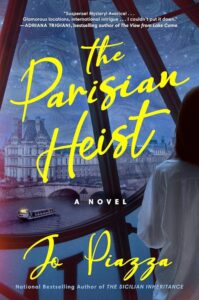
 Jo Piazza is my guest this week to discuss her new book, The Parisian Heist. This book is a dual timeline story weaving together a 1990s heist at the Orsay museum with the story of Jo van Gogh, Vincent van Gogh’s sister in law, who is the reason we know who Vincent is today.
Along the way we talk about
- DNFing books
- Stealing art
- Mythologizing artists usually men
- And how many women do nearly everything half scared.
And if you’d like to watch this episode, you can find us on YouTube @SmartPodcastTrashyBooks!
The transcript is already here, too, so enjoy!
❤ Read the transcript ❤
↓ Press Play
This podcast player may not work on Chrome and a different browser is suggested. More ways to listen →
Here are the books we discuss in this podcast:


Make sure to disable your ad blocker to see all the books.
You can find Jo Piazza – and her book tour! – at her website JoPiazza.com. Her podcast is Under the Influence.
And you can hear her discussing her book Everyone is Lying to You in Episode 677. Everyone is Lying to You with Jo Piazza.
We also mentioned:
- Anthony Amore, Director of Security and Chief Investigator at the Isabella Stewart Gardner Museum
- The Gardner Museum Theft
- The Red Wheelbarrow Bookshop, Paris
- In the Café: Agostina Segatori in Le Tambourin, Van Gogh Museum
- A Crab on its Back, Van Gogh Museum
- Bookcase Books, Jo Piazza’s pop up bookstore, on Bookshop.org
Music: purple-planet.com
If you like the podcast, you can subscribe to our feed, or find us at Apple Podcasts, Spotify, or wherever you listen to your favorite shows!
❤ More ways to sponsor:
Sponsor us through Patreon! (What is Patreon?)

What did you think of today's episode? Got ideas? Suggestions? You can talk to us on the blog entries for the podcast or talk to us on Facebook if that's where you hang out online. You can email us at sbjpodcast@gmail.com or you can call and leave us a message at our Google voice number: 201-371-3272. Please don't forget to give us a name and where you're calling from so we can work your message into an upcoming podcast.
Thanks for listening!
Transcript
❤ Click to view the transcript ❤
[intro]
Sarah Wendell: Hello! And welcome to episode number 728 of Smart Podcast, Trashy Books. I’m Sarah Wendell, and my guest this week is Jo Piazza. Jo is here to discuss her new book The Parisian Heist. This book is a dual-timeline story weaving together a 1990s heist at the Orsay Museum with the story of Jo van Gogh, who is Vincent van Gogh’s sister-in-law, and who’s also the reason we know who Vincent is today. Along the way, we’re going to talk about DNFing books, stealing art, mythologizing artists – usually men – and how many women do nearly everything half scared.
I will have links to all of the books and the places on the internet that we discuss, including pictures of the art that we’re discussing and some information about famous heists!
I have a compliment this week!
To Caitlin J.: You are the human version of a perfectly broken-in, marvelously supportive couch. It is extremely easy to be comfortable and feel held and loved around you. And also, you’re really hard to find, because finding the perfect couch is impossible.
If you would like a compliment of your very own or you’d like to support this show: patreon.com/SmartBitches. The single best reason to join the Patreon is the people in the Patreon community. Honestly. When you join, you help support me, make sure the show keeps going, you help support handcrafted transcripts from garlicknitter – hi, garlicknitter! – [Hi, Sarah and all my transcript readers! – gk] – but you also get a wonderful, wonderful community of supportive, lovely people around the world! Have a look: patreon.com/SmartBitches. And if Patreon support is not in the cards, may I please humbly ask that you leave a review wherever you listen, because it really, truly, absolutely, no one is lying about this, makes an enormous difference.
All right, are you ready to talk about art and heist and how to heist your art? Let’s do this! On with the podcast.
[music]
Sarah: Welcome back, Jo Piazza.
Jo Piazza: Hi! Thank you so much for having me!
Sarah: Oh, believe me, it, it is my pleasure, because, wow, did I have a good time reading The Parisian Heist.
Jo: Oh! That makes me so happy. You are one of the smartest readers I know, so hearing that from you –
Sarah: Oh, thank you!
Jo: – obviously means so much.
Sarah: Oh, that’s such, that’s a really lovely thing to say. Thank you! Would you please introduce yourself and tell the people who will be listening who you are and what you do?
Jo: Yeah! I am Jo Piazza. I am the author of fourteen books, most recently The Parisian Heist. I write books about women. Honestly. I mean, if we could have, like, a section in the bookstore that’s like badass women trying to kick the patriarchy down the road? That’s what I do. I’m also a mom of three feral kids who might pop in here at any time. And I live in Philadelphia!
Sarah: We’ve talked about this when you’ve been on a pod-, on the podcast before. I remember meeting you for lunch back when you were the editor of, was it In Touch and Life & Style?
Jo: In Touch and Life & Style. Yes, two magazines you will prominently see displayed at grocery store checkouts.
Sarah: Do they even still exist?
Jo: I doubt it. I actually, I have no idea. I don’t, I don’t think they do.
Sarah: You, you mentioned that you write books about women. I still think about your book Celebrity, Inc.?
Jo: Oh yes! I still think about my book Celebrity, Inc.! I thought about it the other day, because when Spencer Pratt was running for, for the mayor of Los Angeles, I had a whole chapter on Spencer! Like, I interviewed him for, essentially to dissect the business of reality TV. And I was like, He was an evil genius, is still an evil genius, and I’m actually kind of shocked he didn’t win.
Sarah: I think if the election, the, the run-up to the election had gone on for maybe another month or two, he actually would have, because people were like, Oh, it’s cool and popular to back Spencer Pratt. Let me just go ahead and do that so I get my name associated with all these other names –
Jo: Yeah.
Sarah: – and not really – we don’t need to actually think about whether or not this is a good idea. We don’t, we don’t –
Jo: Well, exactly, exactly. And I mean –
Sarah: – we don’t need to think about that!
Jo: But that’s the way it is with everything these days, right? It’s like, what is cool and popular? What is going to, like – I, like, I feel like we are – and with books, too! I’m curious –
Sarah: Yes!
Jo: – what you think about this. You know, it’s such a herd mentality. It’s like, everyone else is reading Yesteryear. I have to read Yesteryear even if I pick up Yesteryear and I hate it. So it’s like –
Sarah: Yes!
Jo: – yeah, it’s crazy.
Sarah: It’s very weird to me also that – and I do want to ask you about Yesteryear because you were so brilliant about it – I, I constantly tell people who I know in my real life, ‘cause when they find out I’m a book blogger, like, Oh, I have to finish this book. And I’m like, You don’t have to do anything. There’s no unfinished book – Oh no, I just, I have to. Did you ever ask yourself why you’re making yourself do something that you’re not enjoying?
Jo: Mm-hmm!
Sarah: Who, who, who is going to come and, like – there’s, there’s no unfinished book police. If so, I’m way higher on the list of people they’re going to pick up. You’re that, you’re not even in the top twenty.
Jo: You’re not even in the top ten. No. I –
Sarah: [Laughs]
Jo: Well, you know, and I’ve been writing about this a lot. I DNF all the time.
Sarah: Oh, hell yeah!
Jo: I don’t have time, I don’t have time for a bad book. I give a book fifty pages. I also don’t feel guilty about skipping ahead to the end to find out what happened. I’m like –
Sarah: Oh yeah!
Jo: – okay, cool. Or I google it. Or I ask someone. I’m like, I just want to know the twist. Because I don’t want to spend time with a book that I’m not enjoying!
Sarah: And I think that there are a lot of books – we’ve, I’ve talked about this on the show considerably – I think that books are being developed from the marketing angle, not from an –
Jo: Yes!
Sarah: – a development or craft angle? It’s like, what are the –
Jo: Yeah.
Sarah: – hooks and tropes that I need to put in? It’s almost like they make a graphic and then reverse engineer the book to fit all the hot tropes? It’s –
Jo: Hundred percent.
Sarah: – like writing books as fast as possible –
Jo: Yeah.
Sarah: – possibly with AI, to capture trending topics.
Jo: Yeah! Yeah! A hundred, I mean it, it’s a hundred percent. But then also, you know, a lot of books I don’t think are being edited that well lately.
Sarah: No.
Jo: Yeah.
Sarah: Well, I think it’s because all the editors got laid off, or people don’t want to pay for editing; they want to pay for marketing. All of the –
Jo: Oh, I wish they were paying for marketing. [Laughs]
Sarah: Are, are, really? Shocking.
Jo: Wish they were paying more for marketing, but –
Sarah: I, I have to tell you this as an aside: one of the things we do on the podcast is we recap old issues of Romantic Times magazine, which was a –
Jo: Uh-huh!
Sarah: – massive magazine – I don’t know if you were familiar with it – that would review every romance that came out in a month from like 1981 to I think 2018.
Jo: God, stop it! Can we bring it back?
Sarah: I would love to, except that we wouldn’t, we, how much paper we would use to try to pub-, to, to review every romance that was just published. Like, we’d run out of paper. I would cause, like, a global problem?
But at one point in 1997 I saw a little, there’s a little gossip column in the magazine. And an agent had negotiated a new contract for a writer that included television promotion for all of the hardcover releases, and that the publisher was now booking ads for this person on Oprah, on CNN, on all of the – I don’t even know if it was CNN. CNN might not have existed yet, but it was definitely Oprah.
Jo: Mm-hmm.
Sarah: It was definitely, like, local stations and national broadcasts, and they were responsible for booking TV as part of the contract. Can –
Jo: I –
Sarah: – you imagine?
Jo: No, but also I would love, love-love-love to see book ads on TV. I would love to see books –
Sarah: Oh my God.
Jo: – in more places!
Sarah: I would love to see book ads in, in the little ads that are currently just pharmaceutical ads on streamers?
Jo: Oh my God. Oh my God.
Sarah: I don’t need to know about Cymbalta. I don’t need to know about –
Jo: I know so much about Cymbalta. My, my husband and my nine-year-old son make fun of those ads so much because of all of the, like, caveats, and they’re like –
Sarah: Yes.
Jo: – If you take this, you will die!
Sarah: Yes! You’ll have explosive diarrhea! No, that’s just food safety.
Jo: That’s just food safety. Yeah, exactly.
Sarah: So, thank you, by the way, for this book, for a very entertaining, entertaining few days. This book, The Parisian Heist, had the most perfect unexpected marketing moment in the world.
Jo: We really did. We really did.
Sarah: Can you please tell me about this incredible moment and also about the book?
Jo: Yeah! So I, I’ve been writing this book for about three years now.
Sarah: Mm-hmm.
Jo: And you know, it was inspired, one of my friends is a really great artist and children’s book author, Steven Weinberg, and he wrote a book called What is Color?, and he discovered the story of Jo van Gogh. He didn’t discover – I mean he learned it. And so he’s like, You know, this is just ripe for a feminist novel! But I, Steven Weinberg, can’t write it.
Sarah: [Laughs]
Jo: I feel like you can. And then I had, then we had a couple glasses of wine and I started writing the book. And so I knew –
Sarah: Sometimes it happens that way.
Jo: Sometimes it happens that way. And so I knew I wanted to tell the untold story of Jo van Gogh. Jo inherited hundreds of Vincent van Gogh’s mostly worthless paintings. He sold one in his lifetime. Art critics did not like him. They thought he was sloppy and messy. And Jo was his brother’s wife. His brother passed away shortly after Vincent did. And she was in her twenties with a sick one-year-old baby, no money, and just hundreds of worthless paintings that no one wanted. And, you know, she made it her life’s mission to create his brand, to build this massive story and narrative around Vincent. She became an art dealer when women were not art dealers. And she’s the reason we know Vincent van Gogh’s name today. She’s the reason that so many college students have lost their virginity underneath a poster of Starry Night. Like –
Sarah: That line made me snort so hard.
Jo: I mean, I love, I, I love that line.
Sarah: It’s so true.
Jo: Yeah, it’s so true! It’s so true. And she was just, she was a badass who never expected to have to be a badass, right? But, like, it’s, I think it’s such a beautiful example of how women pivot? And I love her story.
But then I also knew, I’m like, if I’m diving into the art world, I want to do a modern timeline too, to talk about, you know, what makes art famous? Who gets to be an artist? Especially today, and especially when it comes to women. So –
Sarah: Yeah.
Jo: – in the modern timeline – which is actually not modern; it’s 1996, and I’ll explain that in a minute – we have three young struggling artists in Paris who end up working with the widow of the largest art-dealing family in the world to bring them down by pulling off a heist in the Musée d’Orsay. And –
Sarah: As you do.
Jo: As you do, as you do. But I also, I love heists, right? Like, I love a good heist, so I was just so psyched to write a heist book? And so the book is finished, it’s done, locked, I can’t do anything with it. Cover was about to come out, come out, and then those dudes robbed the Louvre.
Sarah: [Laughs]
Jo: And we were, so we’re about to release the cover like a week later, but I’m like, Release it now! Release the cover now! And we did. We did. We released it. And yeah, so people are like, Oh, did you, are you the one who robbed the Louvre? And I’m like, If I thought it would sell more books, I’d go rob the Louvre again, okay? Like, are you kidding?
Sarah: I’m not busy; we can do it today.
Jo: Let’s do it to-, let’s just go to Paris and rob the freaking Louvre. Like –
Sarah: I mean, why not?
Jo: Yeah, why not? I love a pub-, a publicity stunt.
Sarah: [Laughs] Now you mentioned that Jo, or is, Jo van Gogh [Yo van Goch] in, in –
Jo: Yo van Goch!
Sarah: Yo van Goch.
Jo: I know. I just call, I just call her Jo in the interviews because it just gets confusing for –
Sarah: Of course.
Jo: – for the American readers. But yeah, it’s Yoch van Goch.
Sarah: So you mentioned she created an entire market for Van Gogh’s work based on scarcity, mythology, and some most excellent manipulation.
Jo: So much good manipulation. Yeah. I mean, she, she was really good at doing what hadn’t been done that much yet back – ‘cause, you know, this is late 1800s, early 1900s – at stoking demand by pulling things from the market or acting like they’d already been taken and pitting different buyers against each other. And then the biggest thing she did, honestly, is that she published Vincent and Theo’s letters, but very, very meticulously, like deciding how to craft this narrative of him as, like, kind of this madman genius and, like –
Sarah: Yes.
Jo: – martyr to his art, right?
Sarah: It’s our favorite kind of white guy artist, let’s be real.
Jo: Favorite! What, no, that is, that is the world’s favorite kind of white guy artist, honestly.
Sarah: Hundred percent.
Jo: Right? And so –
Sarah: Tortured, alone –
Jo: Tortured!
Sarah: – genius.
Jo: Yeah. And it’s like, why was he alone? Because he was probably a dick! And yeah! So, I mean, she was doing all these things, but there was no playbook for her, right? Like, she just taught herself how to do this. She’d watched Theo as an art dealer, and he was a successful art dealer. You know, he worked with so many of the impressionists, the post impressionists. He still, he still hadn’t sold his brother’s stuff, and she did!
Sarah: Yep. And made a story about them, and made a story of them –
Jo: Of them.
Sarah: – to make them and, and entice them. And all of the other people that she was enticing were mostly men –
Jo: All men! All, all men.
Sarah: – because of course there were.
Jo: Of course there were.
Sarah: Yeah.
Jo: You know, there were, I mean, there were some women, obviously, wives mostly, who were collecting art for their rich husbands –
Sarah: Mm-hmm.
Jo: – you know. And there were some amazing women collectors – Isabella Stewart Gardner, who, I mean, I love her story, I love her museum.
And I have a heist expert now, by the way, who I can text and ask about heist-y things?
Sarah: Oh my God!
Jo: Yeah.
Sarah: I would never leave them alone.
Jo: I don’t!
Sarah: I would be, I have, I have so many questions.
Jo: I don’t. I text –
Sarah: Oh my God.
Jo: – I text Anthony all the time. So it’s Anthony Amore, and he is the head of security at the Gardner Museum. And so he’s the one who is still trying to track down these lo-, stolen Vermeers that got stolen in the ‘90s. And yeah, he was, he was my, he was my heist expert.
Sarah: Can I ask what your theory is on the Gardner Museum heist? I, I’ve seen theories that it was the Irish mafia? I’ve seen –
Jo: Yeah.
Sarah: – I’ve seen theories that it was the New York mafia fucking with the Boston mafia.
Jo: Right. Right, right, right.
Sarah: It was, it’s all mafia, like the, a bunch of guys are involved in this.
Jo: Yes, exactly. I think, I actually don’t think the mafia was involved at all. And I do think that it was somewhat of an inside job? The Gardner heist really informed my heist in this one.
Sarah: I was going to say, there’s a lot –
Jo: Yeah, there’s a lot of similarities –
Sarah: – of similarities.
Jo: – there’s a lot of similarities, yeah. Well, because what, we have to, and you know, Anthony said, he’s like, I think you crafted one of the most realistic heists because they’re amazingly simple? They require some insider knowledge; they require –
Sarah: Mm-hmm.
Jo: – patience and honestly a lot of luck!
Sarah: Oh!
Jo: And, you know, most heistver, heisters are not expert criminal masterminds, which is why I actually don’t think it is the mafia?
Sarah: That’s a very good point.
Jo: I think it’s probably someone who thought they could get away with it and then realized they couldn’t do anything with the art!
Sarah: Yep.
Jo: Yep.
Together: Yep.
Sarah: I think you’re right.
Jo: But Anthony, Anthony thinks he’s going to find them. He thinks he’ll find the paintings. Like I said, it’s his life’s work now. And I told him when he does, then I’ll write the screenplay…
Sarah: Hell yeah!
Jo: Yeah, yeah, ’cause, I mean, he’s a, he’s a very dashing gentleman.
Sarah: I, I sort of just, I love a heist because in most cases no one’s getting hurt.
Jo: Well, that’s why –
Sarah: You’re stealing some stuff.
Jo: – it often seems like a victimless crime –
Sarah: Yeah.
Jo: – right? Like – and also I think a lot of people kind of view it as kind of like Robin Hood stealing from the rich and –
Sarah: Mm-hmm!
Jo: – giving to the poor. But that, that’s not the, the best way to view it, and Anthony and I talk about this a lot, because museums are there so you get to see this art. If museums –
Sarah: That’s true.
Jo: If museums didn’t exist, they would be, like, locked in some rich dude’s bathroom, or a climate-controlled chamber.
Sarah: Yep. Yep. Like a lot of the Works Progress art is hidden in private collections because technically it cannot be bought and sold; it belongs to the government. That is my –
Jo: Exactly.
Sarah: – that is my favorite thing to think about, like in the middle of the night when I can’t sleep. The fact that the Secret Service has to monitor eBay and other secondhand sites –
Jo: Uh-huh.
Sarah: – to watch for Works Progress works, and then they, they go and they get them. Like, they’re like, No, you may not have this. I don’t care how much you paid for it; I don’t care how much you invest in it.
Jo: I love this. I love this.
Sarah: This doesn’t belong to you. You have to give it back.
Jo: Yeah, I love that job for them. I really do.
Sarah: Right?
Jo: Yeah. Yeah.
Sarah: I also, I remember very recently I was in New York and I went to the Met, and I went to the Costume Institute exhibit about bodies.
Jo: Mm!
Sarah: Have you seen it?
Jo: No, I haven’t seen it yet! I’m dying to go. One of the producers on the Mary Calvi show is a docent there, and I told her that she needs to take me on a private tour.
Sarah: Oh my gosh.
Jo: Yeah.
Sarah: I was there at the end of – I was, I was there in the middle of June, so New York City schools were not out yet, and there were so many school trips. And I was just sort of low-key hanging out behind the students ‘cause they got the really cool trip guides and docents.
But inside the Costume Institute, it’s a, it’s a very cool exhibit because it’s all about the body, and the way that the exhibit is structured is, there’s all of these gowns, fabric art, costumes – it’s, you know, garments.
Jo: Right.
Sarah: But each one is paired with a piece of the collection that matches it in terms of theme, inspiration, time, or some other connection. So, like, one dress with loops and loops of fake hair and real hair is paired with –
Jo: Oh!
Sarah: – hair memorial jewelry from the Victorian era and explaining how hair as a memorial device and as a meaningful device of a, of a piece of a person to put on your person is related to this, like, gown. Like, blew my mind. I was in there for hours, but I noticed that if you got too close, a voice would say, You are too close to the exhibit. Please step back.
Jo: Oh!
Sarah: You are too close. And there were, like, security people running around. I’ll be honest, the big problem was that I had to dodge a lot of influencers who were sort of going through the exhibit, taking selfies of themselves at the exhibit. I, I, I ducked around a lot of outstretched camera arms?
Jo: I’ll bet you did. Well, you know, it’s, it’s interesting you brought that up because I didn’t start the book in, let’s start writing and have the modern timeline in ‘96. And so originally, you know, one, one of my, my main characters was constantly dodging influencers…
Sarah: Yes!
Jo: Because I’ve never, I think it’s worse than ever ‘cause I was in –
Sarah: Yes.
Jo: – I went to the Orsay, I went to the Louvre a bunch of times, and I’ve just never seen so many people only looking at the art through their screens!
Sarah: Yes! And –
Jo: Yeah!
Sarah: – and documenting that they are with the art, not, not looking at the art.
Jo: Exactly.
Sarah: It’s a weird…
Jo: It’s a weird, it’s a weird thing. Well, setting it in ‘96 was so beautiful and freeing? Because –
Sarah: Yes! I was going to say!
Jo: I mean, not only ‘cause it should be like the, they’re in, like, smoky Paris-, smoky Parisian nightclubs with, like, you know, Liam Gallagher and, you know, but also, there’s no, it’s so much more fun to get, to discover information or to have to find things, to not have –
Sarah: Mm-hmm!
Jo: – everyone and everything available to you –
Sarah: Yes.
Jo: – in the palm of your hand. And so yeah, I mean, I just loved living in that timeline, frankly.
Sarah: Ah!
Jo: I’d like to live in that timeline now!
Sarah: And also you’re, not only are they living in a time where they can’t just easily find the information, but they are not being constantly surveilled either. You can get away with a lot more because there’s not a million cameras on people’s phones and glasses now – ugh! –
Jo: Well, that’s the thing, that’s the thing!
Sarah: – looking at you.
Jo: Yeah, yeah, yeah, yeah. I mean, the technology, the technology for security still isn’t the best as we have learned!
Sarah: Oh, I was just, I just wrote a note: museum security is really lax!
Jo: Yep!
Sarah: In other parts of the Met – you know, the, the costume exhibit is telling me to step back – in other parts of the Met –
Jo: Yep.
Sarah: – I didn’t see a dude from the Met for like five or six minutes. And I’m like, can I just, like, like, rub my face on a painting? Is anyone here? Like –
Jo: Yes.
Sarah: – nothing. Very little in the way of active security that I could see.
Jo: Yeah, yeah. And it was the same with the Gardner heist. I mean, at that point they were using dot matrix printers and, like –
Sarah: [Laughs]
Jo: – motion sensors to, like –
Sarah: Yep.
Jo: – map out what galleries someone may have been in? It’s so – yeah. Yeah.
Sarah: It’s very old.
Jo: I mean, honestly, I think I could pull off a heist now.
Sarah: Oh, I, I have no doubt that you could.
Jo: Yeah, yeah.
Sarah: I mean –
Jo: Hundred percent. Hundred percent.
Sarah: So what did you learn about art and collectors and the value of art while you were writing this? Was there any research that blew, like, blew your mind?
Jo: Well, you know, just how big the dark market for art is, like the shadow market.
Sarah: Yes, I have so many questions about that.
Jo: This, like, you know, I mean like multi-billion dollar shadow market of art being traded back and forth between criminals and heads of state, and just very rich people who are managing to profit off of it. And then also the manipulations of the market, which I knew –
Sarah: Mm-hmm.
Jo: – but also I didn’t know-know of how, you know – what makes art famous? Why is art famous? You can go to the Paris Flea Market – which is one of my favorite places in the world, and it features prominently in the book – and find a dozen masterpieces that are gorgeous from a hundred years ago that maybe only three people have ever seen!
Sarah: Mm-hmm.
Jo: But, you know, they’re –
Sarah: Framed and everything!
Jo: Framed and everything, but they’re not hanging in a museum because they didn’t have a powerful or persuasive patron or a lot of money to get themselves there.
Sarah: Mm-hmm.
Jo: And so I just think, I think so much about who gets that privilege of deciding This is great art, this is a great artist, and who has that ability. And, you know, that was also why I wanted to have this modern timeline of women to show, you know, it’s a real struggle to get there if you don’t have these kinds of connections.
Sarah: And when art existed, you know, hundreds of years ago, there was a patron model, and that’s still largely true!
Jo: It’s still largely true! You know, it’s a little bit more corporatized now? But it is, I mean, it’s who is allowed to have access?
Sarah: Right.
Jo: Yes. Yes.
Sarah: And –
Jo: And frankly, for a very long time it was not women!
Sarah: No, absolutely not! Makes me think of the interview I did with Fortesa Latifi about Like, Follow, Subscribe –
Jo: Ah!
Sarah: – and we were, I was very excited to see you in that book. ‘Cause I’d, like, Hey, did you know about this book? And then I read it, I’m like, Of course she knew about it! She’s in it. She’s in it!
Jo: You’re like, She’s an expert in here.
Sarah: Yeah, she’s quoted in here!
Jo: Yeah, yeah.
Sarah: Duh, I should have realized. But one of the questions we were discussing was, you know, the legislation to try to protect child influencers –
Jo: Mm-hmm.
Sarah: – and how it’s all inadequate and confusing and difficult. And I said, Actually, what really needs to happen, the legislation that needs to happen is universal basic income. And the same thing –
Jo: Hundred percent.
Sarah: – applies here. If we had universal –
Jo: Yes.
Sarah: – basic income, we’d have a lot more people who are able to make art that might be incredible.
Jo: I know! I mean –
Sarah: Yeah.
Jo: – and I think about universal basic income all the time.
Sarah: Me too!
Jo: Right?
Sarah: All the time!
Jo: Literally all the time! How much lovelier would it be if we didn’t have to, you know, hustle so hard to do the sales and marketing in the first week that will keep the book alive –
Sarah: Mm-hmm!
Jo: And we can just focus on making the art! Right? Like, I want the book to reach readers, and I love making money, but, like, so much of the marketing and sales falls on me that I’m exhausted by it!
Sarah: I remember your book tour for Everyone Is Lying to You! You did events all over the country; you had pie-baking contests –
Jo: Doing twenty-three on this one! Yeah!
Sarah: That’s a lot!
Jo: Yeah! I know! I know! Absolutely! It’s, I mean, yeah, it’s bananas, it’s bananas, but you know what? We do it. And so many of the themes in the book, in Parisian Heist, are about women hustling.
Sarah: Yep!
Jo: We hustle, we pivot, we do the things, you know –
Sarah: Yes.
Jo: – we’re constantly adapting to new mediums. And I love that this is also kind of an intergenerational story? So we…
Sarah: Yes, very much.
Jo: – young women in their twenties, then we have Stella, the widow of the largest art dealing billionaire in the world, and she’s in her seventies, seventies or eighties. And she pivots, and she completely reinvents herself, and I love that story too. I just think it’s gorgeous. And it’s also women helping other women and supporting other women. Like, we have unlikable characters who do some bad things, but, like, you would still, I think you still like them? You like being on the page with them. That’s my quibble with Yesteryear: I’m like, I don’t like anyone in this book. I’m like –
Sarah: Mm-hmm.
Jo: – I can’t root for anyone in this book. And that was one of the reasons I’m like, I’m not enjoying reading this. I do like, I, I, I write unlikable women all the time, but I need to understand them? I need to know the motivations, and I want them to be enjoyable to be with.
Sarah: Yeah, absolutely. And you, you don’t want to be in the head of a person who is so unpleasant that you feel unpleasant. I have plenty of things in my life that make me feel unpleasant. I don’t need more!
Jo: No, I don’t, I don’t need more.
Sarah: Not in my leisure time.
Jo: No! Not in my leisure time, no! No! I want to – it’s funny, I was, I was at a dude ranch last week, working on my new book that’s coming out next summer. It’s a dude ranch murder for hire thriller?
Sarah: Nice!
Jo: Yeah, it’s a little White Lotus, a little Yellowstone, a little Dirty Dancing? I was doing some research, and I tried to read Los, Lonesome Dove. It’s a beautiful book. Beautiful book. Not for me.
Sarah: No.
Jo: Not for me.
Sarah: [Laughs]
Jo: So I put it down after about fifty pages, didn’t feel guilt or shame about it, and then picked up Lost and Lassoed, which is a delight.
Sarah: Oh yes! Would you like another recommendation?
Jo: Yes, I would.
Sarah: They, these are erotic contemporary, but the –
Jo: Uh-huh?
Sarah: – Rough Riders series by Lorelei James.
Jo: Oh! Okay!
Sarah: They are older, and they are – I believe Lorelei James is from, I want to say South Dakota. And not only does she incorporate the, the racism and the poverty and the difficulties of small, small rural ranching areas, but everybody is fucking everybody else, and it is –
Jo: Everybody, everybody.
Sarah: – so hot. And it’s –
Jo: It’s so hot.
Sarah: – it is not, it –
Jo: It’s so hot, yeah.
Sarah: – and it’s a very good portrayal of a particular period of time and a space in the United States that not a lot of people see, plus a lot of fucking. Like, so much –
Jo: I know, right?
Sarah: – so much boning. You would love those –
Jo: Yeah.
Sarah: – as research, and also just because they’re really good.
Jo: And because there’s a lot of bone.
Sarah: Now, I want to ask you a personal favor.
Jo: Yeah.
Sarah: I think I understood it from the book, but I wondered if you would explain to me art as a money laundering operation.
Jo: Yeah! Yeah. So, I mean, there’s a lot of different ways that art can be a money laundering operation, and mostly because they can be cash exchanges. And so, you know, when you’re buying and selling something in cash, and this is part of the shadow market, you’re not paying taxes on it; there’s no records of it. And, you know, that’s also why art is often used as collateral in large drug deals and in large arms deals, things like that. And, you know, it’s an entire business! It’s an entire business of, you know, people manipulating this underground market, and it’s fairly well known, too.
Sarah: Mm-hmm.
Jo: Art crime, I think last, it was like a sixteen-billion dollar industry. I also worked with an FBI expert who’s, you know, works on art crime. And so, yeah! It’s, it’s incredible! There’s, there’s a lot – well, and because art has gotten, become such a commodity? So when we’re in Jo van Gogh’s day, you know, the paintings are selling, but not for millions of dollars, right?
Sarah: No.
Jo: And so, like, that’s a relatively modern phenomenon that you have something that’s worth thirteen million dollars, right? And, like, very few objects that can be carried in a suitcase are worth that much money, right?
Sarah: Absolutely.
Jo: And so, like, that’s why it does become kind of the perfect vehicle for laundering and illicit trades.
Sarah: And – okay, thank you for explaining, because that makes a lot more sense that it is like a stand-in for cash and it’s used as collateral because you, how, how are you going to, how are you going to trace it? You, there’s no receipt; no one’s –
Jo: There’s no receipt!
Sarah: – no one’s recording this.
Jo: Yep.
Sarah: No one’s recording this!
Jo: Yeah.
Sarah: But everyone agrees, much like baseball cards, this is worth X million; you know, this is the equivalent of ten million dollars. So here you go; it’s a thing.
Jo: ‘Cause every agrees. And it’s like –
Sarah: Right. It’s by this weird male fiat.
Jo: This w-, exactly, exactly. And again, so much of it is male –
Sarah: Mm-hmm.
Jo: – this decision.
Sarah: Oh yes.
Jo: You know, I, when I was in Paris I went to an auction at Sotheby’s, which is so lovely. They have a wonderful restaurant at the Parisian Sotheby’s that had a truffled croque monsieur –
Sarah: Ohhh!
Jo: – I’m still thinking about! I’m still thinking about it, ’cause it was –
Sarah: I’m thinking about it right now. Whoo!
Jo: – it was incredible. I’m going to, I’m going back to Paris in September, and I’m going to, going to need one.
And the room was mostly male. Which was, which was interesting because it was like a, you know, Greek antiquities, and yeah! Just, it was really, really fueled by testosterone, which, you know –
Sarah: Mm-hmm.
Jo: – I don’t love that.
Sarah: And I, and I also don’t like being in rooms like that, because I know –
Jo: I don’t like being in rooms like that either. No.
Sarah: I just know that there’s a very large percentage of that room that isn’t going to take me seriously no matter what reason I’m there.
Jo: No matter what I do.
Sarah: Yeah.
Jo: No matter what I do. Right?
Sarah: Absolutely.
Jo: Yeah.
Sarah: Now, I do want to ask you about one of the more interesting moments, which we’ve already touched on, when Anna, who is the character that you invented –
Jo: Mm-hmm, mm-hmm.
Sarah: – is the sidekick? Copilot to, to, to –
Jo: Pilot. Copilot.
Sarah: – to Jo van Gogh?
Jo: Copilot to Jo Van Gogh. Yeah. Well, this, that was interesting, right? Because this was the first time that I was writing a real person? And, you know, the journalist in me just couldn’t inhabit her head. I didn’t feel comfortable doing it. Even though I spent so much –
Sarah: Completely understand that!
Jo: – so much time researching her diaries and all of this, I wanted to have someone observing her –
Sarah: Yeah.
Jo: – the way that the reader would be observing her.
Sarah: Otherwise it gets a little close to Real People Fiction.
Jo: Exactly, exactly. And you just, it just –
Sarah: Yeah, which, which makes me uncomfortable.
Jo: Which makes me uncomfortable!
Sarah: So one of the things that Anna says is that people don’t want art; they want mythology, they want gossip, they want a scandal.
Jo: Yes!
Sarah: Which, I mean, absolutely true.
Jo: Hundred percent.
Sarah: It, it, it’s not, it’s not so much the thing itself as the story about the thing that makes it so valuable and also this fiat of men?
Jo: Mm-hmm.
Sarah: What are some examples of that phenomenon that you’ve discovered in your research? I mean, obviously the Van Gogh story is a primary one because it was very, very lyrically set up for him to be this tortured, deep –
Jo: Mm-hmm.
Sarah: – artist who had all of these ideas and who was basically in a body and a mind that was not healthy enough to meet what –
Jo: Yeah.
Sarah: – what the, what the creative urges were?
Jo: Yeah. Yeah. I mean, Van Gogh is such a good example, but there’s so many more, right? You know, like all of the stories that were being told about Lautrec at the time, about, you know, all of his bad behavior. And I would also venture to say Hemingway. Hemingway’s myth- – I don’t like Hemingway, and I think that his mythology is what has made him more of a, a Man of Genius –
Sarah: Mm-hmm!
Jo: – than anything else? Also, Gauguin. I read, you know, because Gauguin spent so much time with Vincent, often under duress because he was also a client of Theo’s, and Theo was essentially paying him to hang out with Vincent because Vincent –
Sarah: Oof!
Jo: – didn’t have friends. And so, and he, you know, Gauguin was there when Vincent famously cut off his ear. You know, but his legend was made a lot larger than him as well, right? You know, just like, again, like this outsized figure. And yeah, and there’s just, there’s so many stories about that that I think, where the mythology is so much bigger than the actual person itself.
And we love scandal, right? Like, I mean what, look what does well on social media!
Sarah: Mm-hmm! You know, and was I wrong? Am I overreacting? Was I the asshole?
Jo: Yeah.
Sarah: What’s, what’s going wrong here? Yeah. Those are the most popular –
Jo: Yeah.
Sarah: – subreddits, and then people tell stories on Reddit, and then other people make them into TikTok and YouTube videos, so they, you know, source this content. And so there’s some real creative writers in there writing up fake scandals, because –
Jo: Right? I know! It’s bananas.
Sarah: – you know, and it’s so juicy, and it’s a short form little story, and –
Jo: And it’s fun! And it’s fun.
Sarah: – you know, it’s other people’s –
Jo: So, like, other people’s drama, but I mean that’s also why we read books!
Sarah: Yes. I think it’s the quote from Pride and Prejudice:
>> What are we but to make sport for our neighbors and laugh at them in our turn?
Jo: Yes!
Sarah: Like –
Jo: Yes.
Sarah: – we’re literally here to do that and also fart around.
Jo: That’s what we’re here to do. Yeah, exactly.
Sarah: That’s what we’re here to do.
Jo: Yeah.
Sarah: I also noticed that in this book, fear is a major driving motivation for a lot of the characters. Fear of poverty, fear of not being able to eat, fear of having to go back to untenable situations, or fear of having nowhere to go and nowhere to –
Jo: Yes.
Sarah: – grow to and just being stuck, and that, you know, like many, many women before them, the value of an object becomes what they need to survive, whether it’s jewelry or in the current era, you know, really expensive handbags. That’s –
Jo: Yes! Yes!
Sarah: – that’s cash money very quickly. If you, if you need ready cash, you just sell a couple of Birkins and move on with your life.
Jo: Yes, you do! Yes, you do!
Sarah: And so fear is this driving motivation for so many of the characters. And it’s also a book about – I’m trying, I’m not, I don’t think I’m, it’s spoilery to say the absolute uselessness of some powerful men.
Jo: Yeah! Yeahyeahyeahyeahyeah!
Sarah: Super useless. And at one point –
Jo: Suuuper useless! Yeah.
Sarah: Yes. And there’s, at one point there’s a character who is terrified of his family, and he’s not going to stand up to them, not for anyone, not even for himself, and I wrote in my notes, Meanwhile, every woman in this book is doing everything half scared.
Jo: Half scared! Half scared of the insecurity, of the instability of the world and the insecurity and instability of being a woman.
Sarah: And knowing that there aren’t men who are going to look out of, look, look out for them unless it’s, there’s something in it for them.
Jo: Unless there’s something in it for them. And, you know, and that’s one of the themes in my book, right? It’s always women helping other women –
Sarah: [Laughs]
Jo: – women hel-, women saving themselves? And, you know, we have, we have men in the books. There’s men, there’s good ones and there’s dead ones, and you know, you, it’s, you’re one or the other most of the time. And also some hot sex. I mean, I’ve got, I’ve got some good boning and near-boning in the Louvre, so.
Sarah: I did, I did notice the near-boning in the Louvre and I’m, like, saying, Oof!
Jo: Near-boning in the Louvre, yeah. I thought –
Sarah: Security cameras, girl!
Jo: There’s places where there’s not security cameras, and he would know because, you know, he’s a, you know, kind of useless rich man. And, but I did research for that. I was in the Louvre, and I walked, I, like, traced their steps to make sure they were in front of the right piece of art. So that was kind of fun, ‘cause it’s like no one, like, there’s all these school groups around me and I’m like, you don’t want to know what’s in my head.
Sarah: Yeah, no. I, I’m, excuse me, I’m trying to find a place for my characters to bone. Could you –
Jo: Yeah!
Sarah: – move out of the way, please?
Jo: Move out of the way. I need to get in front of the statue so they can bone here. Yeah.
Sarah: Not to give you more work because that’s terrible, but have you thought about doing a little Parisian Heist walking tour, like, gui-, like a little graphic of the, of the Louvre?
Jo: Yeah, we’re do-, we’re doing one! We’re going to do one. We’re going to do one. So we’re having an event in Paris –
Sarah: Mmm, marvelous!
Jo: – on September 16th – I know, I know – in collaboration with Red Wheelbarrow, which is an, is an English-language bookstore there that is wonderful. And yeah, we’re going to do some Parisian Heist tours in both the Orsay and the Louvre.
Sarah: Oh, I love that.
Jo: Yeah.
Sarah: That is so excellent.
Jo: Yeah, it’s going to be great. It’s going to be great. And yeah, we have a lot, I mean, I’m, I have like a twenty-three-stop tour that I’m leaving for tomorrow morning.
Sarah: Ohhh.
Jo: I know, but, and, but here’s the thing: I, I hate the marketing and publicity? I love the tours. Like, I love spending time with readers.
Sarah: Mm-hmm!
Jo: But I just, it’s really the social media sales part of it that I’m like, Ohhh!
Sarah: Yes. Oh, oh, oh yes, believe me –
Jo: All of that! All of that.
Sarah: – I understand.
Jo: Yes!
Sarah: Every time, every time I turn around, you’ve got to pick up a new platform because that’s where everyone is. And I’m like, I don’t –
Jo: That’s where everyone is!
Sarah: – I don’t want to talk to camera! Sorry!
Jo: I don’t want to talk to camera! I know!
Sarah: Yeah. Yep.
Jo: I know! I know.
Sarah: I talk about this a lot: I really think that there’s a divide between those of us who had text-based social media first and those of us who had visual-based social media first, and I am a text-based social media person all the way.
Jo: Well, and I’m also an audio person who doesn’t really like to be on video. So, yeah!
Sarah: Yes! Audio, yes; video, not so much. I understand completely.
Jo: Not so much. Mm-mm, mm-mm.
Sarah: Now, there are a number of quotes from Van Gogh in this book –
Jo: Yeah.
Sarah: – and some that I actually, like, copied and pasted ‘cause I loved them, like the idea of just, We who are alive should live more.
Jo: Yes! Yeah.
Sarah: What were some of the quotes that really stuck with you? Or were, did you know some of them and feel like you had to include them in the book?
Jo: Yeah, no, I didn’t know a lot of them. I’d read all of his letters between him and Theo, and then also letters that he wrote to other members of the family. And, you know, really, I’ve got like three different books, and they’re all dog-eared and highlighted, and, you know, I think he was tortured! You know, Jo wasn’t making that up.
Sarah: No.
Jo: He was tortured, and I do think he was a beautiful artist, a very different kind of artist than, you know, a lot of people then. And he did have some incredible insights into what it means to be a human being, to create art, and to just be a person in the world.
One of the things that I think is very interesting, I mean, ‘cause we’re talking about, like, the insecurity of just being an artist and life, is he was terrified that his brother would no longer be able to support him, because he wasn’t making any money. Theo was paying for Vincent’s entire life!
Sarah: Yeah.
Jo: And when he found out that he was marry, getting married and settling down, he was very worried that that safety net was going to go away, and he, it’s one of the reasons that kept contributing to his terrible depression and anxiety, because he had nothing else!
Sarah: Nope!
Jo: He had nothing to fall back on, right? And had Jo not inherited those paintings, we would never, we would not see them. They would be gone.
Sarah: No.
Jo: They ve-, they very, like, they were, you know, he would trade them to people for, like, food and services and for sex.
Sarah: Yeah.
Jo: But, you know, and Dr. Gachet, who was his doctor in Auvers, was very, like, very into collecting. He was treating all of these male artists for their insecurity issues?
Sarah: [Laughs]
Jo: And they would trade, like, their paintings and stuff? But I don’t think he could have pulled off what Jo did. He had a lot of Vincent’s paintings.
So that insecurity is real. And so I do think that that, like, he had a lot of wisdom? But again, we know his quotes because someone decided to share them with the world, right?
Sarah: Mm-hmm.
Jo: We do not have, like, so many records of letters and diaries from a lot of women.
Sarah: No.
Jo: Also, because not just that women weren’t writing, always writing them, but women aren’t, weren’t the gatekeepers –
Sarah: No.
Jo: – of, of who, who got to know these things. That’s why Jo is so remarkable, because, you know, she did manage to get this done.
Sarah: Yeah. And all too often a woman’s narrative of things is not used to increase anything’s value.
Jo: Well, and I say this in the book, right? Like –
Sarah: Yeah.
Jo: – Vincent could get away with being a tortured madman genius, and it’s not a good look on a girl.
Sarah: Nope, can’t do that!
Jo: Nope. Nope.
Sarah: Nope.
Now, this is a dual timeline, and I’m always fascinated by, by dual timeline books. And I always wonder when I’m, when I’m reading one, did you write both time-, timelines concurrently and paste them together, or did you write one and then the other and weave them in? What was this process like for you as a writer?
Jo: I always write straight through. And so, like, for this and Sicilian, I write straight through. I just, I sit down and get my butt in a seat. I don’t outline; I just fly by the seat of my pants, fifteen hundred words every day.
Sarah: Mm-hmm.
Jo: But then afterwards, I take them apart and read them on their own as if they were their own novels and make sure they could hold up on their own? And they can’t, usually, and so then I have to go back and, you know, rejigger some things. And then I read them together for the first time to make sure that all of the reveals and Easter eggs all line up. And then I read the entire book out loud to myself.
Sarah: What are the challenging parts of writing for you? Dialogue, exposition, backstory? What, what are the parts where you’re like, Okay, this, this needs more polishing?
Jo: Yeah, yeah, yeah. I am such a plot girl, right? So, like, I mean, I can, like, do plot all day long. I’m not as good with interiority, but then I also don’t really like novels with a lot of interiority. But you know, you do have to, have to have a lot more, so that’s probably the hardest part for me.
Sarah: Oh, that’s interesting.
Jo: Yeah.
Sarah: Because you, you’re going to tell a yarn.
Jo: I, yes! I mean…
Sarah: You’re a yarn writer.
Jo: I’m a yarn writer! I’m a page-turner writer, right?
Sarah: Yeah.
Jo: Like, so, like, yeah, but then, like, you know, getting inside someone’s head, I get kind of bored.
Sarah: [Laughs]
Jo: That’s – yeah. Yeah.
Sarah: I’m sorry, that’s really funny! [Laughs] Even a character you created: Yeah, okay, girl, just keep – move on. Let’s go!
Jo: Even a character I created.
Sarah: Get over it. Go do the next thing. That’s so funny.
Jo: Yep.
Sarah: And interiority is tricky because, like you said, you need a reason to care about these people, and the motivation sometimes comes from the interiority.
Jo: Yes.
Sarah: So you understand the reason why people are doing the things that they’re doing and what their, what their Why is; that’s all interiority.
Jo: It’s all interiority! Exactly, exactly. But that is definitely the hardest part for me.
Sarah: That’s so interesting.
Jo: Yeah!
Sarah: So what are some of your favorite pieces of art?
Jo: Oh, you know, I actually really became a Van Gogh fan. I’m going to grab one.
Sarah: Ooh! Just one of the Van Goghs that you, you got in trade?
Jo: That I, that I stole?
Sarah: Yeah, sure.
Jo: Yeah, so Augustina, who, you know, is the owner of the restaurant and, like, another badass woman who was running her own business, was one of Van Gogh’s girlfriends for a little bit, but then she was just like, Oh, you’re so much.
Sarah: [Laughs]
Jo: And she, but she, she modeled for a lot of, a lot of the famous artists, and I, I love this painting that he did of her. And she’s just, she’s sitting in her own cafe. She’s like, she looks like a badass bee. And drinking a beer, and just –
Sarah: Mm-hmm.
Jo: – like, she’s got this judgy look on her face.
Sarah: I was going to say, she is done with his shit.
Jo: She is done, she’s done with everyone’s shit. She’s done with everyone’s shit, okay? And so I love, I love that one. There’s also a really beautiful – oh! I, I got very into the more obscure Van Goghs? I love – so the lilacs are not one of the obscure ones –
Sarah: Mm-hmm.
Jo: – or the irises; I love the irises. But then, you know, this weird crab. Like, he painted this we-, so much weird stuff? And so I got very, very into those.
Sarah: I think you could – is that crab upside down?
Jo: Yeah!
Sarah: I think that crab is a male. You can tell the sex from their bellies.
Jo: I, yeah, yeah! I think it’s a…
Sarah: I think that’s a boy crab. Of course he point –
Jo: Boy crab.
Sarah: – of course he painted a boy.
Jo: Of course he did.
Sarah: The, the, the irises are in the costume exhibit with –
Jo: Are they?!
Sarah: – with some art that is inspired by those motifs and how different artists – I think one of them might be an Alexander McQueen?
Jo: Ohhh!
Sarah: Gorgeous. You, seriously, you will really love this exhibit. I hope you get – I mean, it’s on till January. You’ve got time, but it’s, it was truly incredible. Like, I just, when I wasn’t dodging influencers, I was, like, my eyes were falling out of my head.
Jo: Oh! All right, well, I’ll, I’ll go in September.
Sarah: I hope so!
Jo: Yeah, I’m on it.
Sarah: So you did a lot of travel –
Jo: So much.
Sarah: – for this book. You, I, I – one thing I do when I’m developing questions is I look at your other interviews, ‘cause I don’t want to repeat too many questions that you’ve had, but it also, you know, helps me familiarize myself –
Jo: Totally, yeah!
Sarah: – with, with what other people are asking you. And I, I noticed that you said you, you started this book in Paris, and then you finished this book in Paris.
Jo: Yes, I did. And –
Sarah: And took a little side trip to, it was Amsterdam, right?
Jo: Yeah, yeah.
Sarah: Yeah.
Jo: So I, I went to Paris. It was my, my best friend Glynnis MacNicol’s fiftieth birthday. And yeah, started writing. I forgot my computer, and I was like, that will not deter me. That will not, I will not let that deter me. And so I just wrote fifteen hundred words a day on my phone. Mostly sitting in the galleries at the, at the Orsay. And then went to Amsterdam, you know, to the Van Gogh Museum, and a lot of the book does take place in Amsterdam, and so, you know, got a lot of color there. Spent a lot of time in the library of the Van Gogh Museum, going through Jo’s diaries and, you know, different books that only they had access to. And then, but also, and also in all of these museums, there’s just not enough mentions of Jo? Like, there’s a big picture of her and her story, but there should be a lot more in the Van Gogh Museum.
Sarah: Mm-hmm.
Jo: And then not, pretty much nothing in the Orsay or the Louvre. So, the Van Gogh Museum is doing a big exhibit on the entire family this summer, which I think will correct some of that? But I, I just, I really want, like, everyone looking at a Van Gogh to be like, I would not know this, I would not see this here if it were not for this woman.
Sarah: Yes. But she’s not going to get credit.
Jo: No, well, she is now!
Sarah: Yeah, she is now.
Jo: She is now.
Sarah: I, I, I also love how you just seem to manifest amazing marketing opportunities like, okay, this museum is going to do an exhibit on the family, and here you are –
Jo: I know!
Sarah: – written a book about the family!
Jo: I know, I know. I’m trying to get them to sell it in the museum gift shop.
Sarah: Oh, fingers crossed; that would be brilliant.
Jo: I know! The Philly art museum is a little squeamish because it has Heists in the title, and I’m like, but it’s a good heist! [Laughs]
Sarah: Do they really think that the word heist is going to inspire other people?
Jo: I don’t know. We’ll see, we’ll see.
Sarah: Like –
Jo: Like –
Sarah: – listen –
Jo: – cross your fingers. Yeah.
Sarah: – I am familiar with Philadelphia and its people? My dad lives there, and I’m from Pittsburgh.
Jo: Yeah.
Sarah: The Philly museum, if it wanted to have been heisted, it would have been already, because I know Philly fans, and they would have heisted many times over. I think they need to chill!
Jo: They would have taken the Rocky statue! They would have taken –
Sarah: Yeah!
Jo: – the Rocky statue, okay? Like –
Sarah: Yeah, they wouldn’t have even gone inside! They would have been like –
Jo: They wouldn’t have to.
Sarah: – this is what we need. Thanks very much.
Jo: This is what we want. Thank you.
Sarah: Yeah. [Laughs]
Jo: Thank you. Yep. No one likes us; we don’t care. Yep.
Sarah: So what are some of your recommended favorite places in Paris and Amsterdam?
Jo: Oh my gosh! I mean, we went to the coolest restaurant in Amsterdam. I have a shirt from them that says “Shrimply the best.” It’s like a, it’s a fish market? You walk in and there’s a fish market, and you, you’re just, like, looking at your fish and you’re like, All right, I want that. And they’re like, Okay, we know how we’re going to prepare that. And then you go into the restaurant and they prepare this, like, beautiful fish dish for you. It’s –
Sarah: Ohhh.
Jo: – absolutely ridiculous. You can also stay in Amsterdam in the old bridge houses? They’re available to rent out, kind of like Airbnbs, and they are, like, overlooking the river and the canals, and they’re all, like, different shapes and, like, from different eras, and they’re just in-, incredibly cool, incredibly cool. And then, you know, I mean the Van Gogh Museum is incredible; the Rijksmuseum is incredible. Jo spent a lot of time in the Rijksmuseum, obviously. We rented a boat? So you can rent your own boat and navigate through the canals, which is just an absolute delight – through the canals and through the Amstel River.
I love Amsterdam. I’ve been a few times now, and I just, like, I remember when I first went, I was like, Is it just going to be a bunch of people, like, smoking pot and prostitutes? And I was like, No! It’s, like, so, it’s so much more. It’s so, so wonderful.
And Paris, I usually stay in the Marais, and I have, like, all of my favorite things there. I stay in a hotel that’s called, in English, the Little Windmill. I love Red Wheelbarrow books. I like Red Wheelbarrow books a lot more than Shakespeare and Company, the very famous bookstore there now, because that one always has an influencer line! It didn’t two years ago, and now, like, there is a line of influencers out the door, and it’s no longer an enjoyable experience.
Sarah: Yeah, it – [sighs] – I don’t want to just blanket condemn influencers –
Jo: No!
Sarah: – because it’s like I’m, I’m Gen X, and it annoys me when people who are my age start to shit on millennials, and it’s like no –
Jo: Yes.
Sarah: – nonononono –
Jo: Yes.
Sarah: – nonononono. First of all, we were subjected to that treatment and we’re still subjected to that treatment, so we have –
Jo: Totally!
Sarah: – no business passing it on. Like –
Jo: Yeah, exactly.
Sarah: – knock it off. But the way in which people have – you know what it’s like? They’re, so you’re at an airport gate, and the, you know, it’s probably about ten minutes. Some people are going to just stay in their seats and stay out of the way, and some people are going to become gate lice, and they’re just going to stand there in the way, staring at the gate agent –
Jo: Yeah.
Sarah: – as if that’s going to make things move faster. And that’s what re-, influencers remind me of. They are in the way.
Jo: They’re in the way.
Sarah: They’re ostensibly doing the same thing as you, but there are some people who, when they are influencing in a space, think that they’re the only person in the space, or act as if they are the only person there.
Jo: Well, and it’s everywhere. I mean, it’s constantly, you know, the, the line of influencers at, like, surrounding, the scrum of them surrounding the Trevi Fountain in Rome was insane –
Sarah: Oh!
Jo: – the last time I was there?
Sarah: Yep, I saw that!
Jo: And then, oh! In the Mona Lisa room, ‘cause the Mona Lisa is so tiny! So you can’t see her past all of the influencers, and they’re all taking selfies with her!
Sarah: I think about this all the time, because I spend a lot of time thinking about how we have sort of bifurcated every hobby? Like –
Jo: Yes.
Sarah: – there’s reading as a hobby, which is when you buy books and read them through whatever means you want.
Jo: Mm-hmm.
Sarah: You know, audiobooks are reading. Don’t let anyone tell you different!
Jo: No!
Sarah: But then you also have the aesthetics of being a reader, which is co-opting and using external things to decorate yourself to convey the ethics –
Jo: Mm-hmm.
Sarah: – and ethos of I am a Reader, and how you –
Jo: I am a Reader, yes.
Sarah: – perform that with, with accessories. It’s not actually about reading the book; it’s about the aesthetics of being perceived as someone who reads books.
Jo: Yes, yes. Reading as performance!
Sarah: Yes, and I think there’s so much performance. I don’t just go to a museum; I perform going to a museum.
Jo: Exactly. Exactly, yep.
Sarah: Right? I don’t, I don’t perform going to a, a tourist spot.
Jo: The world we live in is bananas.
Sarah: It’s weird!
Jo: It’s so weird.
Sarah: So weird! And on the other hand, like, yes, absolutely document yourself. Like, I think all the time about how we have so many images of young women right now who are making sure they document their lives, and how many families have no pictures of mom because she was the one taking the pictures and –
Jo: …all the photos.
Sarah: – wasn’t in them. Yeah!
Jo: I know. I know. Yeah.
Sarah: It’s a weird transition, and it’s not all good or bad. It’s just, when you’re in the way and you’re making things hard for everybody, that sucks.
Jo: It sucks! It sucks. I know.
Sarah: Do not love it.
Jo: Do not love. Do not love. Do not subscribe.
Sarah: [Laughs]
Jo: Do not love that. Mm-mm. Mm-mm.
Sarah: So, speaking of influencers, what is next with your podcast Under the Influence? Which is –
Jo: You know –
Sarah: – so good, by the way.
Jo: Thank you!
Sarah: I love to bring you with me on Amtrak. I –
Jo: I like, oh, I like being with you on Amtrak. I – yeah, we’re, you know, we’re still, we’re still chugging along. I, one of the things I want to do a big deep dive in going forward, once I get through this book tour, is the rise of AI in influencing and –
Sarah: Oh God, yes.
Jo: – AI influencers and how that’s going to impact pretty much everything, honestly.
Sarah: Yes.
Jo: Particularly in the realm of children and deep fakes and all of that. So that’s where we’re going in the fall.
Sarah: Wow. I was laughing because the minute you said artificial, AI, I was like, yeah, artificial intelligence, and it made me think of how in Everyone Is Lying to You, one of the things you expose is how artificial the sets are and the books or –
Jo: Yeah!
Sarah:- the, the, the –
Jo: Yeah.
Sarah: – houses there. This is a –
Jo: Yeah.
Sarah: – rented kitchen. This is, this is a set. This isn’t where they live. You know, there’s, the house where they live has evidence that humans live there.
Jo: Yeah!
Sarah: Whereas right now, so – even in like the interior decorating subreddit, people are posting pictures where it’s like, there’s no sign that a human lives there? Like, why –
Jo: No!
Sarah: – do you need your home to look like an IKEA catalog? And IKEA catalogs actually have, like, a rumpled hoodie on the couch sometimes! This is –
Jo: Yeah, yeah, of course, of course! Yeah! Well, and –
Sarah: – so – what’s the word I’m looking for? Austere!
Jo: Exact- – well, also, the amount of enhancements you can do now on your –
Sarah: Mm-hmm!
Jo: Like, I mean, you can look like a whole different person; you can have whole different background. Like, it, it is all – it’s, and it’s all going to get more and more out of control. So that’s, that’s where we’re going. We’re going to have a little fun with it.
Sarah: [Laughs]
Jo: We’re also going to do a big thing on Disney influencers, which I’ve always found fascinating. And yeah, it’s going to be, it’s going to be a wild ride after I, after I get through this book launch.
Sarah: Oof! Now also, I know you also bought a book trailer!
Jo: I did! I have a bookstore now! You need to curate all of my, my romance, because –
Sarah: I would be delighted to help you stock, especially some of –
Jo: Yeah.
Sarah: – like, the older titles that are just so good that should be discovered in any era.
Jo: Right? Exact- – well, I mean, and that’s one of the goals, right? Because I want people to be able to find books?
Sarah: Yes.
Jo: Thou-, you know, thousands and thousands of books are released every Tuesday. Like, even, my books sell really well, and even keeping them in stock in bookstores is hard. Peo-, it’s hard for people to discover backlist titles! And so –
Sarah: Very hard.
Jo: – you know, most of our books are backlist, honestly, and they’re curated by me of books that I like and books my friends like and also mostly female authors and also authors that aren’t assholes? And so, yeah, we, like, travel around the Catskills, we pop up all over the place. We’re trying to pop up on Bastille Day here in Philly. I won’t be here, but I think Nick’s going to do it. And yeah! It’s been great, because we also, like, we’re taking the books to the readers? So we go to –
Sarah: Yes.
Jo: – breweries and wineries. So people get to see books out in the wild, and they get really excited.
Sarah: There was a, a library on a school bus that used to visit my kids’ elementary school, and the novelty –
Jo: Ah!
Sarah: – of a library on wheels, no matter what wheels they are, is so delightful.
Jo: I, I know! I know! Exactly, exactly. And, you know, I’m going, going to a lot of beachy bookstores in the next couple of weeks –
Sarah: Yes.
Jo: – and I think we’re just going to go out on the beach and be like, Can we sell you a beach read here on the beach?
Sarah: That’s brilliant.
Jo: I know, I know!
Sarah: How excited were you when you found the perfect trailer?
Jo: So it’s that my friend Rose, it was actually hers, and she was doing a mobile florist out of it.
Sarah: Ah!
Jo: I know, I know, and then now she’s doing a brick-and-mortar florist, and she’s like, I think this is the perfect trailer for you, and I’m like, It is the perfect trailer for me; I love it.
Sarah: That’s amazing. See, yet again, like, the power of female connection.
Jo: The power of female connection. Exactly –
Sarah: I love it.
Jo: – exactly. Yeah, no. Being, and being a bookstore seller is really fun, because I get to connect with readers and find out what they like and what they don’t like. And, you know, it’s just, I think so – look, ninety percent of my readers are buying on Amazon, and so, like, I don’t shit on Amazon, right? I’m like –
Sarah: Nope.
Jo: – you want, you, like, you want – it’s annoying, for sure? Like, I’m, I, the fact that Amazon exists is annoying.
Sarah: That’s not our fault. That’s the fart of –
Jo: But it’s not our fault, right?
Sarah: That’s the, that’s the fault of poor regulation and oversight.
Jo: Exactly, exactly! And, like, I get it! Life is hard; you want things to be easy. And –
Sarah: And some people don’t have any other options, ‘cause Amazon ate them, so yeah.
Jo: …Amazon ate them, right? But, like, there is something wondrous about being in person and talking about books together.
Sarah: Oh, it, it is my favorite thing to do.
Jo: I know.
Sarah: Especially when someone is going to be honest with you about what they like or they don’t like?
Jo: Totally!
Sarah: Because, listen, I learned, you learn so much more from what someone doesn’t like. I have maintained that theory for ages.
Jo: Absolutely! Absolutely. And you know, I never publicly shit on books, because I also know how hard it is to write a book?
Sarah: Mm-hmm.
Jo: And I also think book, books are so subjective. Like, what you love –
Sarah: Oh –
Jo: I mean, I think Yesteryear has shown us that.
Sarah: Oh, absolutely.
Jo: Right? Like, I’ve never seen a book so polarizing. It’s either like you love it or you hate-hate it. And I think that’s really interesting.
Sarah: So you have a bookstore; you have a big old book tour –
Jo: Yeah.
Sarah: – you’re working on another book.
Jo: Yeah.
Sarah: I feel like such an asshole asking So what’s, what’s next for you? What are the, what, what does the rest of this year bring, in addition – starting with some big old travel?
Jo: Big old travel. You know, finishing up the edits on The Last Ride, which is, you know, my dude ranch thriller. And then I just closed a new deal for a middle-grade series.
Sarah: Oh, congratulations!
Jo: Yeah, yeah!
Sarah: Can you talk about it at all yet?
Jo: I can! I can, I can. So it is about the, it’s a dinosaur adventure middle-grade series. It’s called The Bone Crew…
Sarah: Love it!
Jo: I know. it was actually originally called Dig Kids, but it sounds too much like Dick Kids, and so, when you say it fast, so changed that. But now it’s The Bone Crew, and I’m like, why do I have such a filthy mind? And so it’s the kids of paleontologists who travel around the world with their parents, you know, solving dinosaur mysteries. A lot of science in it, ‘cause I have a science-minded kid who, like, does not like a lot of the middle-grade options out there for him? And one of the, on one of the digs they find a kind of, like, break in the geological continuum, and they end up in a multiverse where the asteroid never hit and dinosaurs never died, and they have to find their way back.
Sarah: Oh dang!
Jo: Yeah. Yeah…
Sarah: So it’s a little bit like, it’s almost like a little Jumanji.
Jo: It’s a little it’s a little Jumanji, which is my – [laughs] – which is what my, my son said. He’s like, That’s a little too Jumanji, Mom. And I’m like –
Sarah: [Laughs]
Jo: – There can, there’s room for more than one Jumanji. But we –
Sarah: Yes.
Jo: – actually, when we were out west, we went on a fossil hunt, and we found some Allosaurus bones, which is super cool –
Sarah: That’s so cool!
Jo: – and now, I mean, I’m essentially a paleontologist. There, you know, there’s a, there’s a romance paleontology…
Sarah: Yes, yes! Fossil Feud.
Jo: Fossil Feud. I, I’m going to, I’m going to try to get that on my NetGalley, right now, actually.
Sarah: So I always ask this question: what books are you reading that you might want to tell people about?
Jo: So I just finished Under Story by Chloe Benjamin, which isn’t out until September? And it’s just one of the best books I ever read. I love it so, so much; I’m obsessed with it. I’m also obsessed with The Fountain by Casey Scieszka. I’m biased ‘cause she’s one of my good friends and it’s set in the valley that we live in in the Catskills. But yeah, those are my two top picks for right now.
Sarah: That’s fantastic, thank you! Where can people find you if you wish to be found?
Jo: If I wish to be found – I mean, I always want to be found. I want everyone ordering The Parisian Heist like right now. I’m on the Instagram @jopiazzaauthor.
Sarah: Thank you so much for doing this interview?
Jo: Thank you so much…
Sarah: I really appreciate it –
Jo: I love it!
Sarah: – especially knowing how busy you are?
Jo: I mean, this was the highlight of my day!
[outro]
Sarah: And that brings us to the end of this week’s podcast. I will have links to where you can find Jo Piazza, including on her book tour, and I will have links to the art we discussed, bookstores around the world, and some heists. I do like a heist.
As always, I end with a terrible joke. Actually, I have two, and I can’t choose between them, so you’re going to get both. They’re both really bad.
Joke the first: What is a seal’s favorite subject in school?
Give up? What is a seal’s favorite subject in school?
Art, art, art!
[Laughs] Art, art, art!
Okay, so that was bad, right? But maybe you saw that one coming. So here’s, here’s another one, just like a bonus:
What kind of shoe do artists wear?
Give up? What kind of shoe do artists wear? What’s their favorite?
Skechers.
[Laughs] I just, I just, I just love the groan. It’s like, Ohhh, Sarah.
On behalf of everyone here, I wish you the very best of reading. Have a wonderful weekend, and we will see you back here next week. And in the words of my favorite retired podcast Friendshipping, thank you for listening. You’re welcome for talking!
[end of music]
This podcast transcript was handcrafted with meticulous skill by Garlic Knitter. Many thanks.
Remember to subscribe to our podcast feed, find us on Apple Podcasts or wherever you listen to your favorite shows.


Thank you, Sarah and Jo, for sharing your fascinating conversation. And now I want a truffled croque monsieur!