
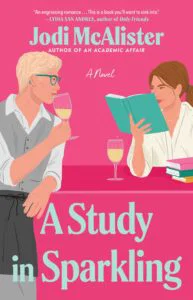
 By listener request! My guest today is author and professor Jodi McAlister. You might remember Jodi from her appearance in episode 626 when we talked about her Marry Me Juliet trilogy, set within a fictional version of The Bachelor.
Now she’s in the middle of a new trilogy she’s calling Love Notes, and we’re going to discuss the latest book, A Study in Sparkling. We’re going to discuss learning a TON about wine, and about writing romance set within the terrifying world of academia. Then I come to find out she’s done recent published research on erotic audio dramas, and about the bonkbusters of the 80s.
Special thanks to Josephine for requesting this interview and asking such thoughtful questions!
ETA: The transcript is here!
❤ Read the transcript ❤
↓ Press Play
This podcast player may not work on Chrome and a different browser is suggested. More ways to listen →
Here are the books we discuss in this podcast:




Make sure to disable your ad blocker to see all the books.
You can find Jodi McAlister at her website, jodimcalister.com.au.
We also mentioned:
- IASPR: the International Association for the Study of Popular Romance
- The IASPR call for papers for the 2027 conference
- The Bonkbuster: Women’s Popular Reading in the 1980s.
- Audioerotica
- Somm (documentary)
If you like the podcast, you can subscribe to our feed, or find us at Apple Podcasts, Spotify, or wherever you listen to your favorite shows!
❤ More ways to sponsor:
Sponsor us through Patreon! (What is Patreon?)

What did you think of today's episode? Got ideas? Suggestions? You can talk to us on the blog entries for the podcast or talk to us on Facebook if that's where you hang out online. You can email us at sbjpodcast@gmail.com or you can call and leave us a message at our Google voice number: 201-371-3272. Please don't forget to give us a name and where you're calling from so we can work your message into an upcoming podcast.
Thanks for listening!
Transcript
❤ Click to view the transcript ❤
[intro]
Sarah Wendell: Hello and welcome to episode number 740 of Smart Podcast, Trashy Books. I’m Sarah Wendell, and by listener request, my guest today is author and professor Jodi McAlister. You might remember Jodi from her appearance in episode 626, when we talked about her Marry Me, Juliet trilogy, which is set within a fictional world of The Bachelor. Now she’s in the middle of a new trilogy she is calling Love Notes, and we are going to discuss the latest book, A Study in Sparkling. We talk about learning an absolute ton about wine, and about writing romance set within the terrifying world of academia – ah, ah, ah! And then I come to find out that she’s just done recent published research on audio erotic dramas and the bonkbusters of the ‘80s, so we’re going to learn a ton.
Special thanks to Josephine for requesting this interview and for asking such thoughtful questions.
As always, there will be links to the books that we discuss, and to some of Jodi’s academic work in the show notes.
A big hello and thank-you to the Patreon community. If you are not a member of the Patreon, we would love to have you. It is truly one of the loveliest groups of humans, and Patreon support means that we have handcrafted transcripts from garlicknitter – howdy, garlicknitter – [Howdy! – gk] – and it also means that the show keeps going week after week, and we get to keep doing Romantic Times Rewind. There are lovely benefits for Patreon members, and we would love to have you join us: patreon.com/SmartBitches.
Before we get started, I just want to mention that Jodi is in Australia, and I’m on the other side of the planet, so sometimes the sound might get a little muddy, and it may sound as if there’s a bit of a delay? We’ve done everything we can to mitigate that, but just please be aware, if you notice any oddities in the audio, it is likely because we were on opposite sides of the planet. Isn’t technology amazing? It’s so cool. [Laughs] Anyway, on with the podcast!
[music]
Jodi McAlister: Hello! I am Jodi McAlister! And I live a double life, and both of these lives have to do with romance. So during some parts of the day, usually the very early mornings, I am a romance author! And my latest book, A Study in Sparkling, has just come out! In the other part of my day, I am an academic. So I study romance, and I’m the current president of the International Association for the Study of Popular Romance, which is pretty exciting. I was honored to sort of ascend to that position. So yeah! Two careers, they twine around each other like a DNA double helix, and they are both romance. [Laughs]
Sarah: I did not know that you were the president of IASPR! Congratulations! That’s so cool!
Jodi: Thank you! Yes, I took over at the beginning of the year for the wonderful Jayashree Kamblé, who was a –
Sarah: Ohhh!
Jodi: – wonderful president before me!
Sarah: There are so many people – I talk about this all the time on the show – there are so many people who I would see like once a year at romance conferences, either at RT or maybe RWA, and I would see Jayashree and I would see Eric Selinger, and maybe I would see, like, some – it’s like, there were readers from Australia that would come to RT every now and again –
Jodi: Mm.
Sarah: – when it was on the West Coast. And when I, when RT closed, and then when I resigned from RWA, I was like, I am, there are people I’m never going to see them again. There’s no reason that I will be in the same space with them, and it makes me so sad? But I’m so excited that you guys are, like, IASPR is kicking ass and taking names. Congratulations, Madam President!
Jodi: Thank you! And the call for papers for our next conference is currently open. If there are any baby scholars out there or less baby scholars, adult scholars who would like to submit proposals, so you can find it on the IASPR website, which is iaspr.org. And it will be in Spain in June next year.
Sarah: Oh, shut up, really?
Jodi: Yeah, it’s going to be awesome.
Sarah: Where in Spain is it going to be?
Jodi: In Oviedo, which is in the sort of northwest.
Sarah: Oh –
Jodi: Not too far from places like Bilbao and San Sebastian.
Sarah: Yep. Oh – am I going to have to come up with a proposal?
Jodi: Yes, do it! Do it!
Sarah: [Laughs] Do I have anything to say other than what the fuck is wrong with people?
Jodi: Well, the theme is Choosing Love. I’m sure you could have –
Sarah: Oh!
Jodi: – some things to say about the theme Choosing Love?
Sarah: Is, is Chuck Tingle going to be your featured speaker?
Jodi: Oh my God, can you imagine? That would be incredible.
Sarah: ‘Cause isn’t that one of his phrases? Like choose love or no, show love. Everyone should, all the buckaroos should show love. I, I don’t know, I think Mister, Doctor – Dr. Tingle, excuse me – Dr. Tingle would be an excellent speaker for IASPR. You should totally just bring him over to Spain.
Jodi: [Laughs] I will take that to the next IASPR Board meeting.
Sarah: Yeah, tell them I said so. They’ll be like, Oh God.
[Laughter]
Sarah: So let’s start with your book. Congratulations on A Study in Sparkling. What is your –
Jodi: Thank you!
Sarah: – elevator pitch for this book?
Jodi: Okay! So noting that this is a rather long elevator, like maybe we’re going to the top of a skyscraper or something like that.
Sarah: Totally fine! Let’s do it.
Jodi: But yeah, this is the follow-up to my book An Academic Affair, which came out last year, and it follows Fiona, who is the sister of the hero from that book, and she has just gone through some pretty major drama in her life. Her husband, after thirteen years of marriage, was like, Hey, guess what? I’ve got a secret second family, and not only that, I am leaving you and our kids for them. So she has had…
Sarah: Fuck off!
Jodi: He’s, he’s garbage. One of the biggest challenges I had in writing this book was trying to make him slightly more than one-dimensional.
Sarah: I was really thinking, like, I’ve got to ask about how you wrote a total piece of shit. [Laughs]
Jodi: Like, seriously, it was the hardest thing. ‘Cause he could have been – I mean he still is a little bit cartoonish at times, if I’m being real, but trying to give him, like, the slightest bit of dimensionality was truly the hardest thing I’ve ever done.
Sarah: Oh man.
Jodi: Yeah. Anyway, so she has been dumped by this terrible, terrible man. And even though he is garbage and she is like, Wow, he’s a piece of shit; I can see that he is a piece of shit; I don’t want him back; obviously this has up-ended her life in really, really profound ways.
Sarah: Mm-hmm.
Jodi: And he was the breadwinner, while she, like, she worked, but she did, like, he, he was the breadwinner, while she kind of did a lot of the childcare. So now she’s relying on her parents for money. She’s relying on her brothers, with whom she’s never been that close, for support. So she feels pretty profoundly embarrassed and humiliated. That is her number one emotion. She is hurt, but also, more than anything, her pride is just in tatters.
Sarah: Yeah.
Jodi: Enter Satoshi, who is the owner and proprietor of the local wine bar, which Fiona has been a patron of for some time. Is probably going to a bit less now that she is a single mother with three kids to look after, but those people who have read An Academic Affair will know that Fiona and Satoshi have got this kind of easy friendship.
Sarah: Yeah.
Jodi: He is a bit younger than her, so in this book, she’s thirty-six, he’s twenty-eight? And he has kind of accidentally become one of her best friends. And when she tells him one night about how difficult it has been to kind of put herself back together and also that, you know, she doesn’t think she’s ever going to have sex again, he offers to help her in that way, in quite a specific way, even though for a long time he has been desperately in love with her and thought that this was hopeless. So –
Sarah: …pining. I just, I just have to tell you thank you for the pining. I love pining.
Jodi: Oh.
Sarah: So –
Jodi: He, he has a Bachelor of Yearn-alism. He’s a, he’s an…!
Sarah: Bachelor of Yearn-alism! [Laughs] Oh my God! Thank you for that.
Jodi: No worries. I cannot claim credit; I stole that from someone. But yeah, that –
Sarah: [Laughs more]
Jodi: Satoshi is a, like, a major yearner. The very first line of this book is:
>> I fell in love with Fiona Fisher-Sinclair at about 7 p.m. on a Tuesday. It was inconvenient for several reasons, like it happening during a busy service in my wine bar, and her being married with three children.
That’s the prologue, which takes place the night that Fiona’s terrible husband dumps her. So they start this kind of friends-with-benefits arrangement where he knows she is not ready for anything, like, serious, ‘cause she just got out of this terrible marriage, and is desperately trying to keep it casual, even though he is head over heels in love with her, while she is kind of like a newborn baby deer trying to get back to her feet. And even though they are both these incredibly kind, well-meaning people who only want to do right by each other, they’re so nice that they do end up hurting each other a little bit along the way before they finally figure it out in the end. It’s a romance novel: of course they figure it out at the end.
Sarah: I mean, that’s where we’re going, of course.
Jodi: Yeah. So yeah, this is my book about embarrassment and how you –
Sarah: Ah!
Jodi: – kind of put yourself back together.
Sarah: And it’s, it’s really hard sometimes, I think, to write, and I know it’s hard for me to read sometimes, embarrassment, because, I mean, I feel secondhand embarrassment, like, almost physically.
Jodi: Mm!
Sarah: Like, I –
Jodi: Yeah.
Sarah: – I know you and I have talked at length about reality TV because your previous trilogy was all about the, The Bachelor. It was Marry Me, Juliet, but it was The Bachelor.
Jodi: Mm.
Sarah: And I, I cannot watch The Bachelor, The Real Housewives, or anything because the secondhand embarrassment, like, gives me physical pain – [laughs] – which makes me sound like such a delicate flower, but it’s true? Embarrassment is a real challenge to tackle in writing ‘cause that’s a really intimate emotion. Would you be willing –
Jodi: Yeah!
Sarah: – to talk a little bit about how you explored embarrassment and also how you wrote a piece of shit?
Jodi: Yeah, absolutely! So –
Sarah: Tell me about your villain. [Laughs]
Jodi: Yeah, let me tell you about Matt Sinclair, piece of shit.
[Laugher]
Jodi: Like, I decided I wanted to write a book about embarrassment for exactly this reason. Like, sometimes I think embarrassment, and especially secondhand embarrassment, is the emotion I feel most intensely?
Sarah: God!
Jodi: I don’t know if that is a healthy or good thing about myself, but it is certainly a true thing. And so, because romance is a place where you get to explore big feelings, I was like, Okay – [laughs] – let’s do this one!
Sarah: Let’s do it!
Jodi: If we can solve embarrassment, how much harder will the happy ending hit, you know? And whether or not we solve embarrassment is, is one thing, but this is – like, I thought a lot about how Fiona would be feeling, ‘cause I set up this big soap-operatic thing that happened to her in the first book, where she was a secondary character. So when it came to write about her, I was like, okay, let’s – I, I personally have never been left by a piece of shit abandoning me with our three children, so I had to, you know, really go inside myself and think about how I would feel in that situation. And of course you would feel hurt, and of course you would feel betrayed, but I came to the conclusion that humiliation would be, like, this huge ingredient in the cocktail –
Sarah: Yeah.
Jodi: – because she had no idea. She was married to this man for thirteen years, and she had no fucking clue at all. And this is combined with a host of issues she has, which we also kind of explored a little bit in the first book, where –
Sarah: Mm-hmm.
Jodi: – she comes from this family of academics! Like, both her brothers have PhDs and are working scholars. Her dad is this big-time professor – also a bit of a piece of shit, though not quite as much of a piece of shit.
Sarah: Mm-hmm.
Jodi: Her mum was a PhD student who dropped out to marry her dad. And she dropped out of undergrad so she could marry this man, and all her family was saying, No, don’t do it; it’s a terrible idea. And she was like, Well, fuck you all; it’s a great idea. And it turns out they were right.
Sarah: Which is the worst. [Sputters]
Jodi: Yeah!
Sarah: Just the worst, ‘cause the people that you want to turn to for support have a really high likelihood of being like, And did we tell you not to do this? Hm, hm?
Jodi: Mm! And so even though particularly her brothers are really, like, showing up for her in this way that she didn’t expect they would, every time she talks to them, she still feels stupid. Like, she, she feels stupid and betrayed and humiliated. And there’s this other mum at school who’s always like, Oh my God, Fiona! How are you, you poor thing? Like, is just really making a production over what a, like, pathetic fool Fiona is, and she hates it so much?
Sarah: Is there a word for that, when people do that to you? When they just want to sort of, like, extract a little bit of your embarrassment through false sympathy? I feel like there should be, like, a name for that behavior. You know what I mean?
Jodi: Probably in German.
Sarah: Yes! Absolutely, a hundred percent in German.
Jodi: Yeah. Like, it’s next door to passive-aggression, but it’s not quite passive-aggression, you know? It’s, it’s siblings or cousins or something.
Sarah: Yes.
Jodi: And so what I sort of landed on for the romance is that Satoshi is the one person who does not make Fiona feel embarrassed. And early on in their relationship, that, that is kind of seeping through? Like, when he’s like, Hey, how about, you know, oh, you don’t think you’ll ever have sex again? How about I help you out with that? She’s like, she thinks he’s doing it out of pity, you know? Like –
Sarah: Yeah.
Jodi: – that she’s this object of charity, and it makes her feel so sick. But when he can finally prove to her that no, he, he likes her for her! He thinks she’s great, not just this woman that was fooled. She is, she gets to be Fiona, not just wife that was left –
Sarah: Mm-hmm.
Jodi: – single mother, idiot who didn’t realize her husband was cheating on her for more than a decade.
Sarah: Yeah.
Jodi: And that is really, really powerful and really, really palpable. And this isn’t to say that he magically cures all her embarrassment issues with his penis? It takes a little bit more than that. But –
Sarah: [Laughs]
Jodi: – I think they –
Sarah: More than just your penis.
Jodi: Yeah. [Laughs] But I think by the end they both leave each other ultimately better than they found each other.
Sarah: That’s fabulous, because that’s all, that’s only what you want.
So, age difference! Was that something you wanted to explore in this book deliberately? Like, is that a tension that you wanted to incorporate, or is that just where the characters ended up in their lives when they, when they intersected in your story?
Jodi: I mean, it’s a little bit of both. Like, I create – like, ‘cause this is the second book in a series, I created Fiona first, and so she –
Sarah: Mm-hmm.
Jodi: – was fairly fully formed until Satoshi walked onto the page, and I was like, Oh, okay. Okay, I see what’s happening here. Like, I am not one of those writers that is like, Oh, my characters tell me what to do! I don’t subscribe to that kind of muse-based school of thought? But it’s like he popped up on the page, and I was like, Okay, I need a nice wine man here. And then they spoke two lines to each other, and I was like, Ohhh! This could work! This –
Sarah: Yep!
Jodi: – is good! And so I thought about them as, like, I was very clear that I wanted them both to be adults.
Sarah: Mm-hmm.
Jodi: So, where, when, like, she’s thirty-six, he’s twenty-eight? So where, it’s not an age gap in a sort of maturity sense, even though they are at quite different stages of their lives, which is a tension. So she’s got three kids, and he has huge, huge career aspirations. So it’s not just that he, that he runs this wine bar; he is also studying for the Master Sommelier exam, which is the hardest exam in the world. Like, not just the hardest wine exam, it is the hardest exam. It’s got a pass rate of something like five percent. There is an entire cuvée of champagne that is said to taste like failure, because they serve it at the ceremony where they announce new master sommeliers, and nearly everyone in the room has just failed their exam. So –
Sarah: Yikes! That was actually my next question: how much did you learn about wine while writing this book –
Jodi: Oh –
Sarah: – and about the somm test? Because I watched the documentary Somm, which I’m assuming was part of your curriculum –
Jodi: Mm.
Sarah: – and how intense that exam is, and how people take it year after year and study all year. And, and this is the exam where you have to, like, taste a wine and not only just identify the wine, but the year, where it came from, what the notes are. You have to be able to taste something and, like, fill out an entire character profile about this wine. Is that what this is?
Jodi: Oh yeah, absolutely! And I, like, so I went to school. I went to wine school. I learned how to do that!
Sarah: No way! Oh my God, tell me everything; that’s so cool!
Jodi: [Laughs] I mean, I went through kind of a – there’s sort of two pathways for wine school. There is the Court of Master Sommeliers, which is what Satoshi is part of, which has a lot more kind of hospitality service elements. I went through the Wine and Spirits Education Trust, which is a little bit more winemaking grounded, which has turned out to be useful for me because it’s – spoilers: the next book in the series is about Satoshi’s brother, who is a winemaker. So –
Sarah: Perfect!
Jodi: – I was kind of two birds with one stone. But both of them, you have to learn not just kind of the fundamentals of kind of wine theory, or in Satoshi’s case a lot more than the fundamentals. He did the hardest one you could do, and I did moderately normal one. Like –
Sarah: [Laughs]
Jodi: – he essentially did a PhD, and I did, like, what you might call in the US an AP course. Like –
Sarah: Right.
Jodi: – big, big difference.
Sarah: Yeah…certificate. Yeah.
Jodi: Yeah.
Sarah: Ooh!
Jodi: Like, in Australia I would say I, like, went to TAFE, you know?
Sarah: [Laughs]
Jodi: Like, it’s like a Cert IV. So, but you not only have to learn all this theory, but there is a tasting component, so I had to sit a tasting exam –
Sarah: Oh damn!
Jodi: – where you were – yeah. So Satoshi would have to do six wines in twenty-five minutes, and he would have to identify a lot more than I had to. I just, I didn’t even have to identify the grape. I just had to correctly describe the characteristics, kind of like maths where you show your working.
Sarah: Yeah.
Jodi: And we, I only had to do two. He had to do six in twenty-five minutes; I got two in half an hour. [Laughs] And one was white, and one was red, and – ’cause it’s the, the baby tasting exam. They just –
Sarah: Right.
Jodi: – give you, like – they’re not going to give you hard ones. They give you very classic ones, but I –
Sarah: Did they give you Australian wines?
Jodi: One of – I found out what our wines were afterwards. One of them was Australian, and one was from Italy, I think.
Sarah: Oh, that’s really cool!
Jodi: Yeah! And I did pass with distinction. I was very proud of myself.
Sarah: Hell, yes, you did! That’s awesome! Congratulations!
Jodi: I’ve got, I’ve got a little pin and everything, which is like, look, here’s a person that knows a lot about wine.
But it turned out to be, like, obviously very, very, very useful for writing this book. But also, like, I work a lot between my two jobs. It was kind of this weird respite in a way, even though I was doing all this study on the side, because you have to use a whole different part of your brain.
Sarah: Mm-hmm.
Jodi: You have to, like, look and smell and taste, and if I am sitting here at a keyboard, those are not senses that I use very much, you know?
Sarah: Mm-hmm.
Jodi: And so it was, it was like learning a whole new language. It was really exciting.
Sarah: Did this deepen your appreciation for wine, or did you always just love wine and now you, like, like, have more words for it?
Jodi: I mean, I’ve always loved wine, but now I am –
Sarah: Me too.
Jodi: – absolutely insufferable.
[Laughter]
Jodi: A couple of years ago, there’s a, the Romance Writers of Australia is still kind of alive and kicking, and there is a group of authors that go the Wednesday before every conference. We go on a, like, little, like, we go around to a nearby, like, wine region usually. And when the conference was in Adelaide a few years ago, it was the first year I was invited along, which I was very excited about. And my friend Kate was going with me, Kate Cuthbert, and I made her promise –
Sarah: Hi, Kate!
Jodi: [Laughs] I said, Kate, you cannot let me be too strange about wine. And we came up with a safe word, and everything that she could say when I got too intense?
Sarah: [Laughs]
Jodi: It was mimosa? But thankfully, one of the first questions someone asked was like, Who knows about wine? And I was like, Oh, I know about wine. And they didn’t mind that I get very, very intense…
Sarah: Oh, so mimosa, mimosa was not invoked in this outing. Excellent!
Jodi: No.
Sarah: Oh, that’s fabulous. That’s so cool.
So in this book, you’ve got a second-chance love story. You have someone who’s rebuilding their life, so it’s like their second chance, which they actually did not plan for, but it’s their second life as an adult. A second chance love story, an age gap, and also, like, a no-strings-attached kind of arrangement. Where did you start when you were writing? Did you have all of those tropes in mind? Did you kind of see this figured out, or did these develop as you were writing?
Jodi: They definitely developed as I went along. So I never start from the place of trope. I think that is the way to write a bingo card instead of a book.
Sarah: Thank you! That is the perfect way to say that. I think we have a real problem in romance with people starting their books with the marketing and working backward.
Jodi: Yeah. I mean, I started with embarrassment, honestly. Like, I started –
Sarah: Yep.
Jodi: – that theme. Like, I knew what I wanted to write my book about.
Sarah: Mm-hmm.
Jodi: And so with Fiona, I thought really carefully about, like, what kind of person I needed to pair her with and what kind of relationship would work for her. Like, I could not put someone like her who has just been so brutally hurt in something like an enemies-to-lovers dynamic. She does not need someone to be mean to her right now? In fact, that might make her shatter into a thousand pieces, and not in a, like, fun orgasm way; in a, like, deeply psychologically damaging way.
Sarah: Yeah.
Jodi: And she also needs, there can’t be any question that her, that her partner would have a problem with her kids, either. Like, her kids have to come first. They’re extremely important to her, and I almost thought about the relationship between Satoshi and Fiona’s kids, particularly Fiona’s eldest child, Lex, who is nonbinary, as a kind of reverse Parent Trap situation? Where instead of Lex wanting to get their parents back together, they really idolise Satoshi. Satoshi is a pansexual, and he’s Lex’s queer icon, so to speak. So Lex was kind of delighted at the idea of – [laughs] – Fiona and Satoshi being together. And so sort of the inverse of that trope of the, the kid who’s like, No, get back together with my real dad! Lex is very, very mad at their real dad.
So I needed someone for Fiona who was going to be kind and gentle and patient. And so Satoshi is a man who has all those qualities. But I also needed the narrative to have some conflict, because here is a sad woman, and here is someone who is very nice to her. Sounds lovely in theory, but I think that would be a wonderful paragraph – [laughs] – in a romance novel, maybe a chapter. I don’t think you could stretch that to ninety-five thousand words.
Sarah: Mm-mm.
Jodi: And so rather than making Satoshi a manic pixie wine boy, which he could kind of potentially become –
Sarah: [Laughs]
Jodi: – I really, I started to dig deep into where all that kind of kindness comes from? And Satoshi is both a chronic people-pleaser, which kind of comes from working in hospitality his whole life – like, this is his whole job; he is a consummate hospitality professional – but he’s also a perfectionist. And because he is so used to kind of plastering his hospo smile on the whole time – you know, he adores Fiona. He loves her so much, but he’s so committed to doing things on her timeline and being exactly what she needs, being just as patient as she needs, that he pushes his own needs down and down and down and down and down, and is like, No, what, what I need isn’t important. So important, I don’t want to even, even want to burden you with it, Fiona; you’ve got enough going on already.
And so thinking about how I could write a friends-with-benefits relationship where they’re both kind of having a nice time, but also there are some problems, and the way that they could grow and develop and slowly open up to each other, these two people who are on some levels quite good communicators and on other levels have all these things that they’re like, No, I, I cannot possibly burden the other person with this, for reasons that I hope feel real and not like, you know, how miscommunication can feel deeply unearned sometimes. I wanted to make sure where they talk past each other it felt earned in this book.
Sarah: Yes.
Jodi: But the, kind of the crisis in this book is that they are both too kind – [laughs] – for their own good, ultimately.
Sarah: Yep. And, and there’s a, there’s a long history of I’m going to suppress my needs for my, you know, my romantic interest.
Jodi: Yes.
Sarah: Like, that has, that’s a very common gesture, both in humans and in romance novels where the humans are fictional. And it’s especially, I think, taught to women and femme-presenting people as the correct way to run your life: that your needs should come last after all of these other things. And so it’s both heady, almost just, like, dizzying to have someone after, after her husband completely humiliated her and lied to her and deceived her and then completely publicly just destroyed her life, to have someone be like, No, I want, I want to provide you with, with kindness and good sex. I want to be kind to you, but as a result of that, I’m not going to give you any of the burden of my emotions or any of the burden of my needs.
Jodi: Yeah.
Sarah: And it’s like, that sounds really generous? But that is not sustainable!
Jodi: No, and as –
Sarah: [Laughs]
Jodi: – as they find out.
Sarah: Surprise! Yeah, you can’t, you can’t live an imbalanced, suppressed life if you’re not giving as much as you receive. So –
Jodi: Like, I have some pretty big beef with the notion of love languages? Mostly –
Sarah: Really!
Jodi: – ‘cause it does not come out – well, ’cause it doesn’t come out of anything scientific at all. Some guy –
Sarah: No.
Jodi: – just made it up. [Laughs]
Sarah: Some guy just made it up who had a lot of sexist beliefs.
Jodi: Yeah. But if, if we, you know, just kind of set that aside, Fiona and Satoshi both have acts of service as a love language? They are both people that desperately like to do things for the other person to show their love. Satoshi does it to the, to an extreme with Fiona. And Fiona, in her kind of position of humiliation, is having so many other people do things for her that it is kind of making her feel worse and worse and worse, because she wants to be the giver; she doesn’t know how to be the receiver. And yeah, some, some crises occur as a result.
Sarah: And that’s a really tough internal conflict to write, too. That I am used to being the one who gives and depletes, and I am not, I’m not comfortable and I’m not familiar with receiving care and receiving, like, just gentility and –
Jodi: Yeah.
Sarah: – compassion, especially if she’s been dealing with people like, Oh honey, I’m so sorry for you! Are you okay? Like, that person is actually not talking to you in, in your best interest.
Jodi: No.
Sarah: That person is all about themselves.
And it’s very hard, that’s a very hard internal conflict to write because it’s so common, but it is a challenge to write that because you don’t want to tip too far into, like, self-abnegation and martyrdom, even though that is what they’re doing. It’s a real balance. And –
Jodi: Yeah.
Sarah: – as an internal conflict, that’s, that is very meaty. It has a lot to do.
Jodi: Yeah, well, I didn’t want to make the only conflict in this narrative external.
Sarah: No, no!
Jodi: I mean, this is, this isn’t to say there isn’t any external conflict. Like, a lot of Fiona’s worry, because she’s got this whole kind of crisis over embarrassment and she’s got her pride, is that she thinks about what their relationship will look like. Like, they, people will see this woman who has been, you know, humiliated and dumped by her husband, had no idea that he was cheating on her for their entire marriage. They see her rebound into a relationship with this, like, hot younger man, and they go, Oh, look, there goes Fiona! She’s having a midlife crisis!
Sarah: Yep.
Jodi: She’s really conscious of what it will look like?
Sarah: Yeah.
Jodi: Even though, you know, Satoshi, they are more to each other than just, like, you know, older woman, younger man.
Sarah: Yeah.
Jodi: She’s so conscious about the appearances, and he, that kind of tip, tips off his insecurities. He is very much a –
Sarah: Of course!
Jodi: – a younger brother, and he has another kind of crisis of his own is that, in that his, his older brother Isamu is twelve years older than him, and Satoshi always feels like his brother is treating him like a child. And so even though he initially kind of doesn’t care about his age difference with Fiona – he’s like, No, she’s just Fiona; it’s cool; I literally do not think about the fact that she is eight years older than me – when she thinks about it, it makes him think about it, and he gets all in his own head about that, and doesn’t tell her, obviously, because he can’t give her that burden to carry, and poor boy twists himself up in so many knots.
Sarah: Yeah. And I get it, you know, because if everyone’s talking about you, the last thing you want is to give people more to talk about you with. If you don’t want to have that notoriety, it, it feels very like you, almost like you’re naked all the time, because people are going to be watching and talking about everything you do.
Jodi: Fiona just doesn’t want to be the news…
Sarah: Yeah! I, I don’t want to be the main character of everyone else’s gossip. I would really like to move on. Can someone please do something dramatic?
Jodi: Yeah. Like, she is desperately struggling with being the main character of the, like, school WhatsApp chats? Like –
Sarah: Ohhh, yeah.
Jodi: And, like, every time she opens one it feels like a new humiliation, and she knows that they will have so many things to say about her and Satoshi, even though he’s the best boy in the world.
Sarah: Yeah. And it’s, it is a big step at any age, I think, to be like, All right, fuck it. I don’t care. I’m going to do myself. And that’s my favorite part of, like, a, a character journey in a romance is when they reach the point of, You know what, I’m done caring. I’m done giving a shit. This is not as important. I am the most important. And for two people who are constantly acting, acting in service and acting in expression of love, to put themselves first is a very tricky and, and very complicated prospect, because that feels like you’re doing something wrong!
Jodi: Yeah! Yeah, absolutely. Neither of these people know how to be selfish.
Sarah: No, and sometimes you need to be selfish!
Jodi: Yeah! I mean, even in places where it looks like Fiona is putting herself first, sometimes it’s, it’s her kids! She’s putting her kids first, you know? She is, she really doesn’t know how to be selfish at all.
Sarah: And then you just sort of watch them learn to be selfish and it’s delightful.
Jodi: Yeah, it’s a good time.
Sarah: Now, in…
Jodi: …happen in bed sometimes…
Sarah: Well, I mean, who knows? It could, it could, maybe.
Now, in An Academic Affair, which is the first book in this series, you have a whopping rivals-to-lovers story and a marriage of convenience plot, first of all. Nice job. Excellent setup.
Jodi: Thank you.
Sarah: Would you like to talk a little bit about that book and, and tell me how long you’ve been thinking about this series? How long has this series been sort of percolating?
Jodi: The answer to that is, perhaps ironically given what we’ve just been talking about, extremely embarrassing. So –
[Laughter]
Jodi: – the last time, the last time I was on this podcast, we were talking about my book Not Here to Make Friends.
Sarah: Yeah!
Jodi: And so that book, as I’m sure I talked about, was extraordinarily difficult, not so much to write, but to edit.
Sarah: Mm-hmm.
Jodi: So I, the first manuscript I turned in was in single point of view, and my editor was like, Great! What if it was dual point of view, though? And I said, That would be an un-, like a hellish amount of work! And she was like, I know. Nevertheless! And so it went through like four rounds of structural edits because there were, like, changing it into dual POV was not just as easy as flipping the perspective of some of the chapters. Like –
Sarah: Yeah.
Jodi: – if we knew what Lily was thinking that whole time, the whole narrative would fall apart, so I had to come up with this, like, whole other timeline. It was, it was a lot, a lot, a lot of work.
And deep in the weeds of editing that book, my publisher came to me and were like, Hey, so you’ve got another book on your contract. Do you have any ideas? And I was like, Yeah, yeah, okay, I’ve got some ideas. Here’s four. Two of these I’m really excited about. Two I am not quite so excited about at the moment, but I’ve been thinking about them for a while, so I could write them. Let me know what you think. And she got back to me a few days later and was like, None of these. What else do you –
Sarah: Oh God! Yikes!
Jodi: And ordinarily I would be like, Okay, cool, good feedback. Give me a minute and I will go away and think. But not only was I, like, deep in the weeds of structural editing this book, I was also, like, really in a, like, work bottleneck in my academic job. I was working crazy amounts at this point and not sleeping. And so I panicked! I was like, Okay, if I don’t have an idea right now, they’re going to cancel the rest of my contract, and I will never write again. Extremely good, normal, healthy reaction? And so I made up a book in ten seconds. I said, I will write about academics and rivals. And she said, Good, do that. And so –
Sarah: That was actually my next question: what led you to set a book in the truly traumatic and impenetrable world of academia? Well, that’s a good answer! I pulled that out of my ass at the last minute ‘cause I was stressed.
Jodi: Yeah, it was like, what do I have to do no research about?
Sarah: [Laughs]
Jodi: And –
Sarah: What do I know all about?
Jodi: Yeah. And also, like, the one pairing I will never write, for obvious reasons given my job, is I’m never going to write teacher-student. So I was like –
Sarah: Oh God, no! Mm, uh-uh!
Jodi: Yeah. So you will, you will never be getting a, like, professor-student romance from me. If anyone ever tries to sell you that, that’s an AI scam. Jodi’s never going to write that.
Sarah: [Laughs]
Jodi: Or, you know, I’ve, I’ve been possessed by something and you need to, like, get an exorcism going or something like that.
And so I was like, Well, I’ve just written sort of three friends-to-lovers books in a row; let’s try something different. And academic rivals, I was like, Okay, I have met and disliked some people in my time. I, I can get some juice out of this! And initially, when I kind of started to build out the narrative from there, I was like, Okay, what are they rivals over? What are they fighting for? I was, I don’t know, maybe five years out of the academic job market at this point, and I remembered how brutal that was, so I was like, Okay, they’re competing for sort of the Australian version of a tenure-track job. That makes a lot of sense to me. And then I was like, Okay, how do I solve this?
The way I solved this is with a partner hire clause. So there is a kind of stipulation you can have in your contract – not all the time, but sometimes – that if you have a partner with kind of appropriate qualifications and you have to relocate, then the university will find another job for them. And so they were both finalists for this job. And so it’s like, okay, if they’re partners, then maybe they can both have this job. What a cool scam! And then I kind of looked into how that would work. So I was like, Cool, I can do this, I can do fake dating! And this is a realistic reason for fake dating! My goodness! Like, if someone had come to me when I was on the job market and, and, you know, been like, Do you want to do a fake relationship where we can both have a job? I probably would be like, Yeah, fuck it! Why not?
Sarah: In the academic job market, I would be willing to fake all kinds of things to get a job. There’s like three jobs!
Jodi: Yeah, totally! The year I got my job in Australia, there were five in my discipline listed in the whole country, and it’s only gone down.
Sarah: Good God.
Jodi: Yeah. So, and then I kind of looked into what you would have to do for partner hire, and you have to sign a stat dec, a statutory declaration, which, if you lie on that, you can go to jail!
Sarah: That’s bad!
Jodi: And so I was, I was like, Oh, okay, if they sign a stat dec that says they’re dating but they’re not, they can go to jail. But if they sign one that says that they’re married and they are, no one can prove otherwise!
Sarah: Right?
Jodi: And that’s how we ended up at marriage of convenience. And –
Sarah: Love it.
Jodi: This is, it’s kind of a, a thing I like to do in my writing a lot is taking something which seems really, really ridiculous, a big soap-operatic swing – so marriage of convenience; oh, your husband left you for the secret second family – and then thinking about how that would actually feel? Trying to earn the big soap-operatic swing? And I would like to think that I have done so in this book. And maybe this is kind of the characteristic of this series: it’ll just be Jodi takes big soap-operatic swings – [laughs] – and we try to make them land.
Sarah: Woohoo! I mean, why the hell not? You, you already wrote a, a romance about the reality show villain and the producer. Like, that’s enough of a challenge, right?
Jodi: [Laughs] Yeah!
Sarah: Pulled it off, too.
So I have some questions from Josephine, who was one of the voices saying, Please bring Jodi back! We must talk about this book. First, Josephine wanted to know, are there going to be four or three books in the series? Because, “I saw sequel bait for at least two more.”
Jodi: So I’m currently under contract for three –
Sarah: Right.
Jodi: – but this does not mean that I am going to abandon that very obvious other couple I have set up. It’s just a matter of whether I address them in this series or whether they carry across to the next one. So –
Sarah: Fabulous.
Jodi: Yeah. So yeah, you, I am not going to leave Elias and Julia behind; don’t worry.
Sarah: Well, people have picked up what you put down…
Jodi: Good, because I know that I have that Taylor Swift disease where you leave Easter eggs through things, and Elias and Julia are actually the tie to Not Here to Make Friends. Julia is Murray’s ex-wife in that book, so they are already the kind of tie between these two universes? If my publisher will let me make them the tie into a third universe, so I can do a – I’m envisioning this kind of trilogy of trilogies thing? Whether or not I will be allowed to do that is another matter, but that is what I want to do.
Sarah: We will manifest it into being, because that idea is so dope.
Jodi: [Laughs]
Sarah: Now, Josephine also wanted me to ask you what books were on the lists that Fiona was giving to Hitoshi?
Jodi: Oh! So, so many. So – oh, I probably have a list of these somewhere on my computer. But for context, Satoshi’s bar, Tsundoku, which is the Japanese word for letting books pile up in your house without reading them, is also a bookstore! So it’s a high-end wine bar, but you can also go there and buy your books. And they do kind of cafe hours in the afternoon where Fiona will often take her kids, and her oldest child, Lex, is a bookworm. And they are a young queer person, and so Fiona has quietly been passing Satoshi these lists of kind of queer middle-grade and YA fiction to plant in the shelves for Lex to find?
And so, my, my list has a lot of Australian authors. There is a lot of Alison Evans on there. Now, obviously Heartstopper is on there. Where-, basically there’s some Akwaeke Emezi on there. Basically, wherever I could find a kind of queer middle-grade book, particularly with nonbinary representation, this was on the list that –
Sarah: Yeah.
Jodi: …gave to Satoshi. And, like, it, originally a lot more of them were named in the narrative, but they fell out in the editing process ‘cause this book was originally a good twenty thousand words too long.
Sarah: [Laughs] That’s when you really have to go up to your manuscript with, like, an axe –
Jodi: Mm.
Sarah: – and you’ve just got to really hack it. Like, that’s so hard; I’ve been there. There’s no –
Jodi: Yeah, I’m doing –
Sarah: – delicate editing at that point. It is just an axe.
Jodi: I’m doing that to the third one at the moment before I hand in the kind of first draft, and currently we’re only fifteen K too long, so progress! Progress!
Sarah: That’s, that’s nothing! It’s fine!
Jodi: [Laughs]
Sarah: So what tropes are you eager to explore next? Because you’ve been, like, you, like we were saying, you don’t want to start with the tropes and write a bingo card, because we have a definite problem. My theory is that, because we lack conferences that teach craft consistently, and the community of learning has shifted to how to market your books, people are not learning craft. They are learning marketing, and they are reverse engineering their books based on, these are the tropes that are popular, so I will just write those tropes. And I, I liken it from driving on a highway from rest stop to rest stop, and, like, there’s no connectivity between them? It’s like now there’s one bed, and now we are enemies, and now we’re going to have a misunderstanding. And it, it, there’s no continuity; there’s no, like, there’s no plot, basically?
Jodi: I don’t think it is accidental that we are currently having a little bit of a rom-com boom in Australia at the moment and our author organisation still exists. Like, I think there is a direct line that –
Sarah: There’s –
Jodi: – you can draw –
Sarah: Absolutely.
Jodi: – between these two things.
Sarah: A direct, a direct line, because your conference is talking about craft! And you –
Jodi: Yeah!
Sarah: – have writers teaching other writers about craft. And that’s what RWA was, and even to an extent, Romantic Times was doing that, because –
Jodi: Mm!
Sarah: And we’ve been recapping old issues of Romantic Times for almost three years. And so every other issue is all about the conference, and the closer you get to the conference in the calendar year, they start printing out the whole, like, Here’s everything that’s going to happen. And it is like –
Jodi: Mm.
Sarah: – Charlaine Harris is going to talk to you about writing creepy men. Like, everyone’s going to just be in the room with Charlaine Harris, but you’re going to learn something –
Jodi: Yeah.
Sarah: – because Charlaine’s going to, Harris is going to teach you things.
Jodi: Yeah!
Sarah: Like, holy crap. Nora Roberts used to do a Q & A every year at RWA and just answer random questions.
Jodi: Oh God, can you imagine?
Sarah: [Sighs] So yeah, we’ve, we’ve lost that.
Jodi: That is my dream, to go to that. Like, yeah. I was just at RWAus in Darwin like about a month ago now, and I ran a workshop on pacing. Like, there were –
Sarah: Hell yeah!
Jodi: – tons of programming like that, which I’m, you know, sad that that doesn’t exist in the US so much anymore. I think the RNA in the UK is doing some pretty good work in this space as well, but yeah, you can feel the loss of RWA American edition, like.
Sarah: Yeah. There, there are some efforts to start some smaller craft-focused conferences, but having seen what we’ve lost, I still, like, I still feel so sad about it.
But let me ask you: I, obviously we’re not writing to tropes, but what tropes are you eager to explore next? Are there some that you just love to think about?
Jodi: Well, let me give you a little hint as to what is in my current manuscript, because it does, you know, it does exist. And obviously I did not set out from the place of trope, but this is where we’ve ended up? This is a book that starts with a one-night stand, which I have never done before.
Sarah: Nice!
Jodi: Like, one of the things I wanted to do in A Study in Sparkling, actually, is I looked at my previous four romance novels and realized that the first sex scene was at approximately the same place in all of them? Like –
Sarah: [Laughs]
Jodi: – not exactly the same place, but it was like somewhere between sixty-five to seventy-five percent of the way through the book.
Sarah: Mm-hmm.
Jodi: So with A Study in Sparkling I was like, Cool, what if it was twenty percent of the way through the book? [Laughs]
Sarah: Hell yeah!
Jodi: And so with this new one, I was like, Okay, what if it was the beginning? What happens then? So that was a, an kind of interesting creative experimentation. And I really wanted to kind of get to explore kind of two people who have never met before? I’ve written quite a lot of friends-to-lovers in the past. This is some kind of, you know, we, strangers-to-lovers. The first time they meet, they fall into bed together. These characters are both a little bit older. Anyone who’s read these books can work out who it is, but in case you can’t, this is Chess, who is Sadie’s sister from An Academic Affair, and Isamu, who is Satoshi’s brother from A Study in Sparkling. They’re a little bit older; they’re both in their kind of late thirties, which is something that I really wanted to explore.
Sarah: Fan- –
Jodi: I’m kind of a bit sick of reading books about twenty-two-year-olds?
Sarah: – -tastic! I’m in! I am in! Yes!
Jodi: This is second-chance romance in the sense that they are both getting over huge, huge emotional upheavals.
Sarah: Mm.
Jodi: So, Chess has had just this, like, life-destroying fight with her sister? Those who have read An Academic Affair will remember that life-destroying fight. And Isamu is fairly recently divorced and not really sure what to do next with his life. Like, they are both in this kind of rut. And so it is a book about them establishing a friendship and very slowly being, trying to heal from their various traumas while not falling back into the same trap of kind of, if they’re going to be together, they can’t center their whole lives entirely on each other, ‘cause that’s what took their knees out from under each other in the first place. So this is a book about devastating emotional mess, but also finding a friend in the middle.
Sarah: Excellent. It’s so funny when you mention that you realized that all the sex scenes were about seventy to seventy-five percent in. Way, way, way back in like the ‘70s, ‘80s, and the early ‘90s, when romances were in mass market paperbacks and there was always a subscription card in the middle of the book – did you have those in Australia too?
Jodi: Oh, yeah, yeah.
Sarah: Without fail, there was a sex scene within five pages of either side of that postcard.
Jodi: [Laughs]
Sarah: I could crack open the postcard and be like, Yep, there it is! Whoop, whoop, yep! It, it was always real, real close to that postcard. So it’s, it’s good to vary it; you don’t want to always have it where the postcard is. It’s very important.
Jodi: Yeah! I don’t want to be predictable enough that you could postcard my books.
Sarah: No, of course not.
Jodi: At least the postcard has to be in a different spot, you know? And they go, Wow, look at this craft genius varying things.
[Laughter]
Sarah: So are you teaching romance this semester?
Jodi: So I’ve done a little bit of romance teaching this semester for my first years. I’m teaching a big survey course on genre, so we do five genres, so we get a whole two weeks on romance. And I’m teaching a module on Regency romance. So we read Emma, ‘cause we have to do a kind of classic text, and then we looked at the first season of Bridgerton as a revision. But I’m actually going to get to write a new course for 2028, which will be a creative writing course, where we’re going to do, I think, fantasy, crime, and romance, and I’m going to set KJ Charles’s new romance craft book as the textbook for the romance module. And I’m really excited about it.
Sarah: Oh, that’s marvelous! Because, honestly, if anyone is going to teach us about craft, it’s KJ Charles, let’s be real.
Jodi: One million percent.
Sarah: Right? Like, obviously.
Jodi: Yeah.
Sarah: So what are you working on professionally that you might want to tell people about? Is there anything you’re doing academically that you want to tell people about? And if not, that’s fine too.
Jodi: Yeah, sure! So, I mean, obviously I am currently mostly writing, working on this novel.
Sarah: Obviously.
Jodi: But I had two academic books come out this year as well. This is a three-book year for me. So –
Sarah: Oh my God, that’s a lot of books! What?!
Jodi: Yeah, yeah, it’s been bananas! So in January, my research partner at the University of Birmingham and I, Amy Burge, we put out a book called The Bonkbuster: Women’s Popular Reading in the Long 1980s, which is about, like, authors like Jackie Collins, Jilly Cooper, Shirley Conran, Judith Krantz. We ran focus groups in both Australia and the UK where we talked to people who were reading these books in the ‘80s, a lot of people who were reading them as teenagers, and now they’re in their forties, fifties, sixties in some cases. And, like, that was such a fascinating project. And we are continuing on with that.
We have been very, very lucky to get our hands on some archives, and so that will be our next project. I can’t, I’m not allowed to say too much about it yet, but that’s coming from Amy and me probably 2027, maybe early 2028, depending on how quick we write it. I’m going to the UK in November so we can comb through these archives together, which is –
Sarah: Ohhh, that’s fun!
Jodi: And then in April, I had another co-written book come out with Athena Bellas from the University of Melbourne called Audio Erotica, which is the first book-length study of the kind of audio erotica on apps like Quinn and Dipsea and places like that. And yeah, we had a great time writing that book. We had to listen to a lot of audio erotica – [laughs] – which was very interesting! And so we’re really proud of that book. We’re hoping that will be sort of field-defining within that very tiny little field of –
Sarah: Hell yeah!
Jodi: …the studies.
Sarah: Plant that flag. One thing about audio erotica that fascinates me is that it’s one of the few venues where second person is, is the consistent perspective, because it is meant for you to be immersed in that, in that –
Jodi: Mm.
Sarah: – script. And there are not a lot of places where second person is the default.
Jodi: Yeah, yeah, absolutely. Like, as we were writing this book, I was like, Wow, this must be incredibly difficult to write the scripts for, actually? Because how many people are in practice at writing in second person? Like –
Sarah: I, back in the day, we used to have Continental Airlines, which then merged with United Airlines, but Continental’s magazine used to have this, like, Three Days in Someplace feature every month, but it was written in second person. Like, you arrive in Bilbao and you go down to the hotel; you check in. And I always found it so grating, ‘cause I don’t like being told what to do. It’s like, And then you think –
Jodi: Mm-hmm.
Sarah: – I do not think that! And then you go for, like – well, I’m not eating that! And so I would read them, but I would have to really sort of zone out of the second-person part because it felt so uncomfortable to read.
Jodi: Yeah.
Sarah: Like, and after a while I stopped paying attention to it and just looked for the names of places.
But with the audio eroticas that I’ve listened to, it doesn’t bother me! It’s a completely different experience.
Jodi: Hmm.
Sarah: I’m fascinated by it. What were some of the things you were surprised about when you were researching audio erotica?
Jodi: Oh God, so much. So, like, to kind of speak to your point about not liking being told what to do –
Sarah: [Laughs]
Jodi: – you, you can’t tell quite so easily anymore ‘cause they’ve changed how their app works, but for a long time on Quinn, you could look at the most popular categories?
Sarah: Mm-hmm.
Jodi: And for a very long time, the top three were MDom Praise Boyfriend. So it is a form that lends itself well to being told what to do, shall we say.
Sarah: Yes. Mm-hmm!
Jodi: And I don’t want to say that, you know, that necessarily says something about the audience’s sexual appetites. I think they just kind of line up really well as a form. Like, MDom narratives work particularly well in this kind of space. And I think probably the most surprising thing we found, and this is a thread that we’re kind of going to keep tugging on as our, as our research develops, is how entangled audio erotica, particularly on these apps, which are so heavily marketed towards women, how entangled it is with ideas of wellness. And some of it comes from the ways they have to market themselves in the app store to be allowed to be an app? Like, you can’t just say, Hello, it is us; we’re porn! Otherwise the app store won’t list you then. So a lot of the ways they get around it is kind of positioning it as a, like, health and wellness technology. But it bleeds over into a lot of the content as well. There is this pervasive idea that this isn’t just enjoyment: you are kind of becoming this better optimized, like, sexual citizen. Like, you, this is self-improvement in some way.
And so Dipsea, for instance, has, they’ve got, kind of got four tabs, I think, at the top of their app, and two of them are pretty actively wellness-focused? There’s like a wellness-y one and there is a sleep one, which is a bit like Headspace-y? And then there are other apps, two of them that we wrote about in our book were Emjoy and Ferly, which kind of position their sexual self-help as their main product, and then they’ve got this audio erotica as, like, this kind of other thing on the side? And I think it’s Ferly where it’s positioned as, like, essentially exercises and then relaxation? Like, you, you, you do your sexual self-help module, and then you get to earn your, like, erotic stories on the side.
So there is this real anxiety that you, you can’t just be, like, consuming porn. You can’t just be consuming erotic content. And a lot of the apps will just stay away from the word porn altogether. Ironically, one they use, and a lot of them have embraced the word smut as well, which has got some real BookTok-y ties, I think? But there is this pervasive idea that this isn’t just for enjoyment, this is also for self-improvement, which Athena and I have gone around and round in circles on. We are so, so interested in this.
Sarah: That’s so American.
Jodi: It is – [laughs] – yeah.
Sarah: So –
Jodi: Not to –
Sarah: – American.
Jodi: – throw shade at your country, but yeah, it is, it is…
Sarah: Oh, please – listen. Listen, we were talking about secondhand embarrassment earlier? The degree to which I have secondhand embarrassment at literally everything the United States is doing? Like, I’m lucky I have a spleen, that it hasn’t exploded –
Jodi: [Laughs]
Sarah: – with the agony of my embarrassment at everything. So yeah, throw shade all you want. I will join you. The –
Jodi: I mean, I think this is actually the first line of Francesca Cancian’s book Love in America, which is from 1990, maybe? 1988? It’s, you know, old anyway. She says that in America love is entangled with the discourse of self-improvement.
Sarah: Oh yes.
Jodi: So –
Sarah: It, it is. It is. Yeah. And, and it, it, it feeds into everything. Like, our health insurance comes from our work. It is tied to our employment. And if you are not employed, but you are married to someone who is, you have their benefits, so there is a marital pressure to stay married to secure health benefits for yourself and your kids, even when you’re, that marital situation or that situation could be very dangerous or bad. But you know, you, you can’t leave ‘cause you can’t have healthcare if you, if you leave? Like, Lord above.
But also everything about being optimized and self-improvement, it’s, it’s – self-care used to be the big thing, but self-care is not enough! We need self-optimization. You need to be constantly optimizing yourself. And I’m at the point where I’m like, I don’t want to optimize shit. I’m optimized. I’m optimized, and I go to bed on time; that is all you are getting from me.
I can understand why these apps would focus so much on self-improvement and self-optimization and all of that, especially because one of the problems that we have in the States is that American credit card processors will often shut off access to anything that they have decided or that users have told them and complained to them is, is porn. And so you really have to avoid that word, even though there’s nothing wrong with porn, for God’s sake.
Jodi: Mm-mm.
Sarah: The idea, though, that it’s all wrapped up in wellness is, just gives me the creeps, especially because, I don’t know if this is true in Australia as well, but we have a real self-help to right wing MAGA pipeline?
Jodi: Oh yeah. Oh yeahyeahyeah…
Sarah: The wellness to right wing, white nationalism is, is of, it’s, it’s paved. It has road lights; it has rest stops; it has benches. That road is so well-structured. It has lots of infrastructure, that road, and it’s very alarming. And it’s wild to think, wow, you know, you have all this wellness in these audio erotica apps in a culture where wellness is tracking so heavily to the right, like all the time. Wow.
Jodi: Yeah.
Sarah: Is that something you noticed as well, or is that not something you saw?
Jodi: Oh, probably not the right wing pivot; I don’t think we’re seeing that. It’s, it’s more positioned in that, like, it’s, it’s very self-care-y…
Sarah: Yeah…care…
Jodi: But yeah, it’s also like, if you can – it’s not like become better at sex so you can please men. That’s, that’s not the angle.
Sarah: Mm-mm.
Jodi: It’s learn what you like so you can have better sex. Like, that, that is the framing. Or, you know, get over your hang-ups so you can be truly free and open in relationships. And on some of the apps it’s more implicit; on others it’s more explicit. So, like, you, on, say, Quinn, for example, which is, I think, not accidentally also far and away the most successful one, you don’t really get quite so much of this content. Certainly none of the actively educationally framed content? You might get kind of creators throwing in a, like, affirmations or meditations or a, a sleep one. Let, let’s work out what you like, is kind of embedded within a narrative frame, and so where, if it is in this space, it’s more in the self-care sense. But as you move into the more educational ones, that’s where you start getting this really active idea of, like, self-optimization and self-actualization and being better at sex will make you a better person kind of thing.
Sarah: Yeah. You know, what’s so funny is my, my second book that I wrote, Everything I Know About Love I Learned From Romance Novels, there’s a couple of chapters in there about how romance gives you the opportunity to explore sexuality in the privacy of your own imagination, and that it’s –
Jodi: Mm-hmm.
Sarah: – often obviously denigrated for that. But with such little sex education as we have, I mean, and it varies state to state – like, in some states you might get a ton of sex ed, and in another state they’re like, Don’t have sex, and that’s all you get – romance often represented, and still probably does, an opportunity for people to experience sexuality without judgment within the privacy of their imagination. So you can learn, like, do I like this? Do I like this? Does this turn my crank? Does that turn me off? I have, I have had readers email me and say that the sex scenes in romance novels have helped them realize that they are asexual or demisexual because there were only very specific sex scenes within a very specific set of parameters that they, they wanted to read? Otherwise, they just skipped them because it was completely irrelevant or, or even repulsive to them. And I was like, that’s such learning?
Jodi: Yeah, we found this in the bonkbuster project, honestly.
Sarah: Oh yeah, I bet!
Jodi: We talked to a lot of people who were like, Yeah, Jackie Collins was my sex education! But –
Sarah: Good for you! [Laughs]
Jodi: …is there a different kind of attitude to sex in the bonkbusters, though?
Sarah: Yes. Like there, it’s – like, in the romance we have a great deal of good sex, which is wonderful. And you get some good sex in the bonkbusters as well, but there is a lot of, like, abject sex, a lot of disappointing sex, a lot of sex played for laughs, a lot of sex played to totally gross you out, a lot of sex played for scandal.
Sarah: Yeah.
Jodi: People weren’t, perhaps, getting quite so much useful sex ed for them? I remember –
Sarah: [Laughs]
Jodi: – one of the, the best quotes that came out of our focus groups when we were talking about these books as sex ed, and someone said, Well, I learned never ever to have sex on a mahogany table?
Sarah: Fair!
Jodi: It will, it will ruin the polish, you know?
Sarah: What’s that? Is that a ring from a drink? No. No. That was, that was my, that was my backside.
Jodi: [Laughs]
Sarah: Sorry about that!
[Laughter]
Sarah: That’s hilarious. And I –
Jodi: Mm-hmm.
Sarah: – I mean, I read a lot of Jackie Collins when I was younger, and I should not have been, which is probably the story of many readers of Jackie Collins, and there was a lot of, like, revenge sex, angry sex, sex on purpose to set up a situation that would humiliate someone later. Like, sex was a transactional item for a lot of those books, which is not as much the case in romance, obviously. Oh, that’s fascinating!
Jodi: …the two sex scenes that we have written about the most in this sense. One is a scene in Hollywood Wives by Jackie Collins, where there’s this terrible man named Neil, who has this very cool wife, whose name is Montana, who he cheats on all the time. And he has a threesome with his mistress, who’s called Gina, and this other woman? And they take, not Viagra, but some kind of, of drug. And he has a heart attack while he’s inside Gina, and they get, like, welded together? And they have to be taken to the hospital, and then he dies. Like, it’s –
Sarah: Oh my God, I remember reading this. You have just unearthed a very deep –
Jodi: [Laughs]
Sarah: – and old – like, this memory in my brain right now has cobwebs and is very, very faded, but oh, I do remember the hospital part. Oh my God. [Laughs]
Jodi: And then the other one that we wrote about a lot, which is probably the most iconic bonkbuster scene, is the goldfish scene from Lace by Shirley Conran –
Sarah: Mm-hmm.
Jodi: – where there is a deeply Orientalist portrayal of a kind of Arab royal, and his number one sex trick, ‘cause he has been educated in the ways of…
Sarah: Oh, always…
Jodi: Yeah. Is to insert a goldfish into her and then suck it out. And he keeps a bowl of goldfish on his bedside table for this very purpose. And we watched –
Sarah: I remember that, and my legs are crossed right now.
Jodi: We watched the mini-, we watched the miniseries, and obviously they couldn’t depict this on the screen in 1984 – or ever, probably.
Sarah: No.
Jodi: I don’t know if you can get away with that today. But there is this one scene where the actor playing Abdullah, who’s also in very offensive brown face, is standing there, and there is this, like, pillar right in the foreground with a bowl of goldfish on it, and you’re like – [gasps] – Someone’s going to get goldfish-ed! Oh no!
Sarah: Oh no! Oh my God. Oh! Like, I, my legs are crossed so hard right now. I just, just need you to know. Ugghhh! That one I don’t recall.
So I always ask this question: what books are you reading right now that you would like to tell people about?
Jodi: Okay, what am I reading right now that I would like to tell people about? So People Skills by Nina Kenwood is a book which is going to come out in Australia here on October the 6th. Nina Kenwood is one of my favorite rom-com authors. I don’t know if she’s available in the US, but she should be, ‘cause she’s really, really good. Her previous book, The Wedding Forecast, is also incredible, but People Skills is a burnt-out editor and a burnt-out novelist, and can they make it work, and can they hold a literary festival at the same time? Who could say? And it’s incredibly charming.
I just finished reading Home Ground by Darcy Green, which is their second book in an m/m series about AFL players, so Australian football. Trust me, you don’t need to know about Australian football to read these books. It’s like how you don’t need to know hockey to read any Rachel Reid; you will figure it out? The first book in this series, After the Siren, is out now, and I wholeheartedly recommend. It is two boys on an AFL team discover that they might be into each other story, but this second one, Home Ground, which is out here in February, I think, completely won me over. This is the captain of the team, who is recently divorced and has had sex with one person in his entire life and is now very, very lost? And the club’s new LGBTQ+ consultant, who has just moved in and has gone through a devastating breakup and is sleeping with everybody about it. And also being kind of accidental housemates, so there’s, like, a forced proximity thing there. And it is, the prose quality of this book is so good. Like, I think I sent Darcy like conservatively eighty messages while I was reading it, being like, Oh my God, oh my God, oh my God!
Sarah: [Laughs]
Jodi: And the other one, which just came out this week, both here and for you, is Bodies of Magic by Freya Marske, which is magical medical school! And it is, like, I am twenty-five percent in. I got to read an early version of the manuscript, but I’m reading the final one now, and it rules! And everyone should read it.
Sarah: I mean, Freya Marske is amazing.
Jodi: Yeah. Yeah.
Sarah: She’s so amazing.
Jodi: Yeah, I, like, I’m lucky enough to be friends with her, but even if I wasn’t I would be a huge fangirl.
Sarah: So where can people find you if you wish to be found?
Jodi: [Laughs] So Instagram is probably the best place. It’s just my name. I’m very easily findable. I also have a website, jodimcalister.com.au. I’m extremely googleable. If you want to talk to me about academic stuff, you can find my work address easily or get me at president@iaspr.org.
Sarah: Nice!
Jodi: Yeah! Submit to our conference? You don’t have to be a scholar to submit, by the way –
Sarah: Good to know.
Jodi: – just interested? You are more than welcome to take a look. If have any questions, I’m more than happy to answer them. But yeah! Those, those are the places to find me!
Sarah: Oh, fantastic. Thank you so much for doing this interview. I really, really appreciate it.
Jodi: Oh! It’s, I’m so delighted! Thank you for having me back!
Sarah: Eee!
[outro]
Sarah: And that brings us to the end of this week’s episode. Thank you tremendously to Jodi McAlister for connecting with me across a truly staggering number of time zones. And thank you also to Josephine for requesting this interview.
I always end with a terrible joke, and this joke is really bad. This is from u/objective_safe on Reddit, and I don’t know how safe this joke is, but objectively, I think it’s terrible.
What do you get when you have the meat sweats but you decide you’re going to keep eating?
What do you get when you have the meat sweats but you decide to keep eating?
Well, then you get the protein shakes.
[Laughs] Meat sweats.
On behalf of everyone here, we wish you the very best of reading. Have a wonderful weekend; we’ll see you back here next week. And in the words of my favorite retired podcast Friendshipping, thank you for listening. You’re welcome for talking!
[end of music]
This podcast transcript was handcrafted with meticulous skill by Garlic Knitter. Many thanks.
Remember to subscribe to our podcast feed, find us on Apple Podcasts or wherever you listen to your favorite shows.


That was both entertaining and informative, so thank you, Sarah and Jodi.
You can add me to the group who were reading Shirley Conran and Judith Krantz in the eighties. Funnily enough, my father worked for Continental Airlines, so it was neat to see mention of their magazine.