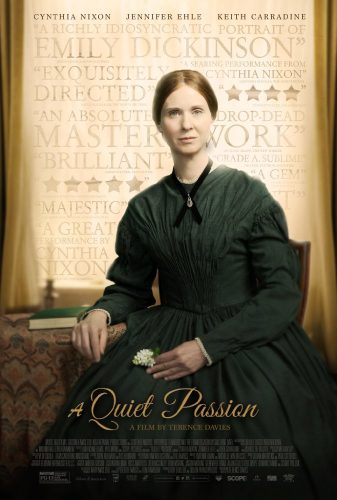
A Quiet Passion
by Terence Davies
Hurricane Films
A Quiet Passion is a strange little movie about Emily Dickinson. It works best if you don’t think of it as a biopic but rather as a meditation on the life of a prickly, strange, and brilliant person. This movie came out in limited release early this year and is finally available on iTunes for those of us who missed it on the big screen.
A Quiet Passion kicks off with young Emily, played by Emma Bell, defying her teachers at Amherst College and going home to her family. It then moves on to an adult Emily, played by Cynthia Nixon. The movie explores her relationships with friends and family, most of whom are women, her devotion to her poetry, her growing isolation, and her death.
With the exception of some early scenes at Amherst, all of the scenes take place either in Emily’s house or in the gardens outside the house, and not much happens. The movie doesn’t fill in blanks so it’s probably best enjoyed by viewers who already know something about Emily’s life. Since all I knew was that she was reclusive and poetic, I was confused much of the time. Threads that go unexplored are her possible romantic feelings towards both men and women (they are hinted at, especially in the case of a particular and inconveniently married Reverend, but largely left unexamined) and the many losses in her life.
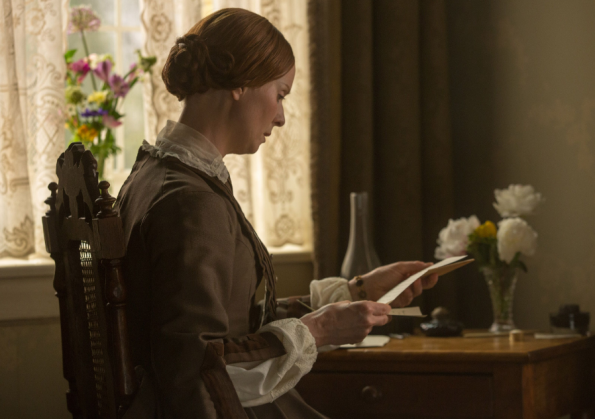
These omissions make Emily’s ultimate retreat to her room seem less like the act of someone undone by grief, frustration, and mental illness and more like an extended pout. To be clear, I know, and I hope all of our readers know, that people who suffer from any of the number of mental and physical illnesses Emily may have suffered from are not pouting. They are courageously struggling to survive. But the director fails to convey this in a comprehensive way.
The movie is well acted but strangely written. The characters, particularly Emily, her sister Vinnie, and her friend Vryling love to play word games with each other. They appear to never actually stop, so that every line sounds like someone saying something they practiced ahead of time. Luckily the lines are indeed very clever, and the characters take a charming delight in saying them and hearing them.
All the actors are excellent, including Cynthia Nixon, who plays the adult Emily. However, I thought the standout performance was the less showy but deeply passionate performance of Jennifer Ehle, who plays Emily’s sister Vinnie. Vinnie is clearly brilliant in her own right, and suffers the same losses and frustrations as Emily, but where Emily retreats to her room and makes nasty remarks to people across her doorway, Vinnie copes and is even often able to cope happily. Ehle brings energy to the increasingly dark and claustrophobic house and warmth even to the tensest scenes.
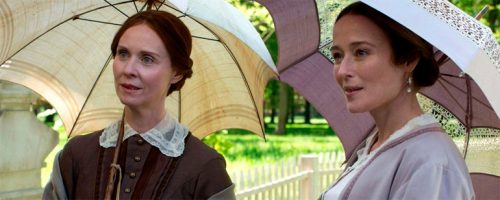
The movie does succeed in creating a beautiful yet claustrophobic world, one in which emotion and action are expected to be restrained in women. It also succeeds in showing the tension and strength in family ties. There’s a lovely scene in which Emily and Vinnie lie in bed on either side of their dying mother and soothe her as she slips away. I loved the sisters’ cranky aunt, and the sister-in-law who bonds with Emily over the topic of sexual frustration (“a certain kind of love”). I especially loved the many moments in which Cynthia Nixon reads Emily’s poetry aloud. Her voice is lovely and soft and steely at the same time.
I suspect that this movie would go over much, much better with viewers who are already Emily fans and who already know the details of her life. It’s a beautiful poetic meditation on isolation and creativity. It’s just not interested in being a traditional biopic, which means that some events seem pretty arbitrary. If you already know the background of those events, then you can enjoy the marvelous cinematography and music and clothes and of course the incredible acting. Just bring your own context. Because I had only a very sketchy knowledge of the poet, I was by turns engaged and frustrated. I’m grading this movie based on my own experience of it, but you will doubtless grade it higher if you just hit Wikipedia before you hit play.
A Quiet Passion is available for streaming on Amazon, Google:Play, & iTunes.

I actually loved this movie. It’s in the top three movies I’ve seen this year. The dialogue is definitely stylistic, but I enjoyed it. It reminded me a bit of Whit Stillman movies which are hit or miss for me, but in this case I enjoyed the style of dialogue. I did do a cursory looking up of Dickinson’s life before watching so that may have helped my enjoyment.
I saw this movie at a film festival last year and ended up feeling frustrated by it. The dialogue was so stilted and the focus on Emily’s darkness and unhappiness was odd. It left me annoyed at the director.
I agree that Vinnie was the best part of the movie and also wished I’d known more about the history.
I thought this movie was pretty terrible, and I was completely baffled that it was such a hit with the critics. Your review helped in wrapping my brain around that, a bit.
Nitpicky, but I think she was kicked out of Mt. Holyoke College, which at the time was a women’s seminary, not Amherst College.
Was it filmed in Amherst Mass or at The Dickonsen homestead? I live near there and don’t remember hearing anything about a movie shoot.
@Felicity Yes, the exterior shots were filmed at the Dickinson Homestead, but the interior shots were filmed in Europe.
Lily – correct, she went to Mount Holyoke, not Amherst (which was all male until the 1970s).
I grew up near Amherst, grew up reading Emily Dickinson, and am sad that this biopic sounds disappointing.
I mean, not even getting the college she attended right? That’s… not hard to look up, and makes me inclined to suspect the filmmakers just didn’t care.
Without re-watching the movie ahead of time I can’t be sure, but my guess is that the movie had the name of the school correct and I had it worng. I believe the movie is fairly factually correct but it’s more a stylistic piece than a straightforward biopic.
I’m really torn about seeing this. I’ve been reading Dickinson’s poems and letters since I was a young kid.
On the one hand: yay, ED!
On the other: it’s going to be disappointing, boo.
I to thought Jennifer Ehle was the best thing about the movie, in large part because she was the most natural. Many of the others seemed to declaim their lines rather than speak them.
S/b “I too thought. . .”