 Jennie Rothschild is a collection development librarian at a public library outside of DC. She talks about books for fun and for work all over social media and in places like Booklist and Library Journal. She’s also been on several award committees, including ALA’s Margaret A. Edwards award and the CYBILS. When she’s not reading or shouting about ebook pricing, she likes to knit, watch Mike Schur shows, and work on her definitive rankings of the best boxed wines. Jennie misses getting lunch with friends and browsing bookstores. She’s just finished reading Women in Black by Madeleine St John. She tweets @kidsilkhaze.
As we continue to stay home as much as possible, even the most die-hard “give me paper or give me death” readers have been dipping their toe into the ebook waters. And they’re discovering what long-time users have known forever.
Good news! You can get ebooks from your library!
But (bad news) only if you’re willing to wait for-EVER for the most popular titles.
Even for some of the less popular titles, wait times are much longer for ebooks than their print versions, and it’s just gotten worse as ebook popularity has dramatically increased this spring and summer.
Which leads to the following questions:
- Why do you have to wait for an ebook at all?!
- Why doesn’t my library just buy more copies?!
And the conclusion I’ve come to for both questions is: I think most publishers hate libraries.
I wish I were kidding.
When libraries and publishers entered the ebook landscape, they went with a model they knew and understood: they licensed library ebooks with a one copy/one user. While some other models have come out since then (such as cost-per-circ, where the library pays every time someone checks a book out, which you see with services like Hoopla) one copy/one user remains the most common way ebooks are sold for lending. However many licenses a library buys is how many people can read a book at a time.
So why doesn’t the library just buy more copies?
Because ebooks for libraries are really, really, really expensive.
Really expensive.
And then we don’t even get to keep them. Librarians pay wholesale for print books that can remain in circulation for literal decades, but ebooks are very different in terms of access and in terms of cost.
I’m a collection development librarian (aka, the person who buys the books for the library) and I realize that people know that libraries pay different prices, but last spring I tweeted out actual numbers, and it’s the closest to viral I’ve ever gotten. People knew it was bad, but not THAT bad.
So I started a project where every week I shared what was on the best seller list and how much those books cost. I shared specifically how much the library would spend to buy those titles in a paper book or an ebook and how much those same books (paper and ebook) would cost for a regular person. I kept the thread going for a year, and now I have data to play with.*
You may want to pour yourself a drink…

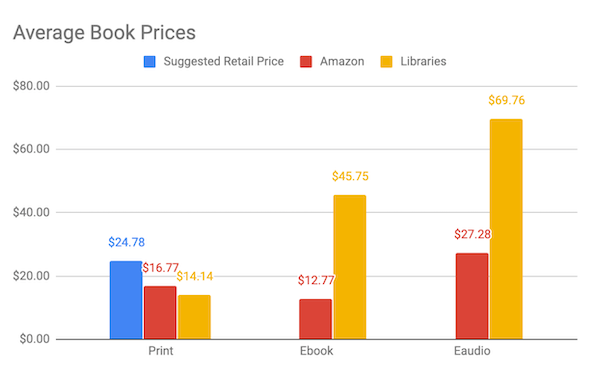
First, let’s look at averages for print, digital book, and digital audio.
On average, the Suggested Retail Price for a print book (aka the price that’s printed on the cover) was $24.78.
On average again, Amazon would sell you (a reading consumer) a paper copy of that print book for $16.77.
Your library could buy a print copy from their vendors for $14.14.
Looking for digital?
You could buy that same book on average for $12.77 on your Kindle.
The library had to pay an average of $45.75.
YES WE HAD TO PAY THAT MUCH. 3.5 TIMES MORE THAN YOU DID.
On average, this means that we (libraries) can buy 3 print copies for every single ebook license, and still have some money left over.
$14.14 + $14.14 + $14.14 = $42.42 for 3 print books in circulation
vs.
$45.75 for a single license of an ebook.
And then there’s audio.
If you’re curious, the average price to buy the book on Audible was $27.28, but for libraries to get it in digital audio? $69.76.
It’s graph time!
And that’s not some wonky prices skewing the averages.
Check out these sweet pie charts:
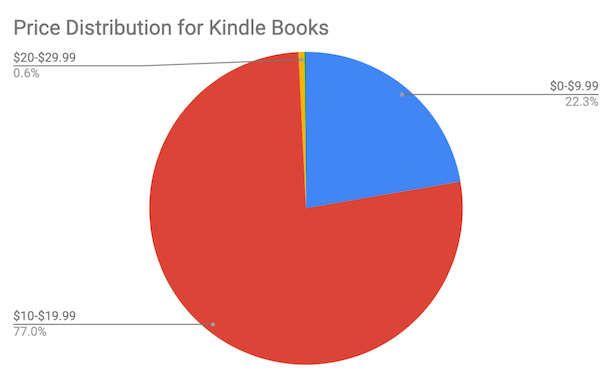
- 77% of the Kindle books tracked for the purpose of this survey are priced for consumers between $10.00 and $19.99.
- 22.3% of Kindle books for consumers are between $0.00 and $9.99
- .6% of Kindle books for consumers are $20.00 and $29.99.
So more than 3/4ths of popular titles in this data set were between $10 and $19.99.
That’s for you, the individual consumers.
Let’s look at library prices for ebooks.

Ebook library licenses are a very, very different story.
Of the popular titles included in this dataset:
- 44.3% of digital library books were between $50.00 and $59.99.
- 19.4% of digital library books were between $60.00 and $69.99.
- 18.2% of digital library books were between $20.00 and $29.99.
In other words:
64% of ebooks cost over $50 for libraries, but none of the titles included in this data set are that much for anyone else.
99% of Kindle books cost $19.99 or less, but only about 13% of library ebooks do.
So while wholesale prices for print acquisitions for libraries are usually lower on average, prices for ebook licenses are substantially more.
Pour yourself another drink, because it gets worse when the usable lifespan of these purchases is examined against the price per item.
86% of the ebooks from that list have to be repurchased on a regular basis, most commonly after 24 months, even if the book is never checked out.
This is why libraries can be reluctant to take an ebook chance on an unknown author.
When libraries buy the ebook, the terms of purchase are actually a lease. The publisher will take the book back after 24 months. If libraries want to still have that ebook available for checkout, they need to buy it again.
Publishers do this because, once again, they’re working off the print model, and print books don’t last forever. They get eaten by the dog or dropped in the tub or coffee gets spilled on them or after it’s been checked out a million times, it just wears out. And if people still want it, we’ll buy another copy.
But…(and this is a big but)
Remember how much libraries pay for print? ($14.14 on average, see above?)
How they pay even less than the average Amazon price?
The average price of an ebook that has to be repurchased is $49.48.
Wait, isn’t that higher than the average price of library ebooks?
YES IT IS.
The more expensive a book is, the more likely we have to rebuy it on a regular basis.
Only 1% of the books that cost over $50 don’t have to be regularly repurchased.
I know it doesn’t make sense.
Prices and terms for digital books are set by the publisher, and most publishers have broad rules that apply to all of their books.
And some very large publishers *cough* Penguin Random House, Macmillan, and Hachette *cough* have set high prices for books that expire quickly.
Why would they do this? Because they can. If libraries want to provide what our users want, we’ll pay their prices on their terms, no matter how ludicrous, because what choice do we have?
Remember that sweet pie chart from 3 paragraphs ago examining Price Distribution for Print Ebooks for libraries? Let’s grey out all the parts that represent books that will need to be regularly repurchased.
I’ll try not to cry.
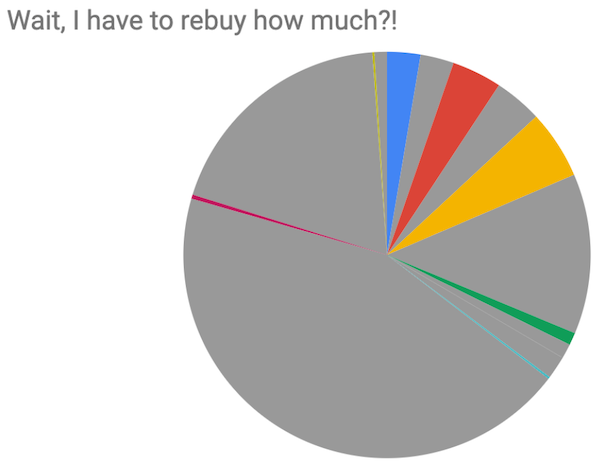
All of the greyed areas: ebooks that need to be repurchased because they are sold to libraries under a limited license.
And of course, this assumes that libraries can even get the digital version of a book!
(At this point, my liver can’t take another drink, so I’m switching to ice cream.)
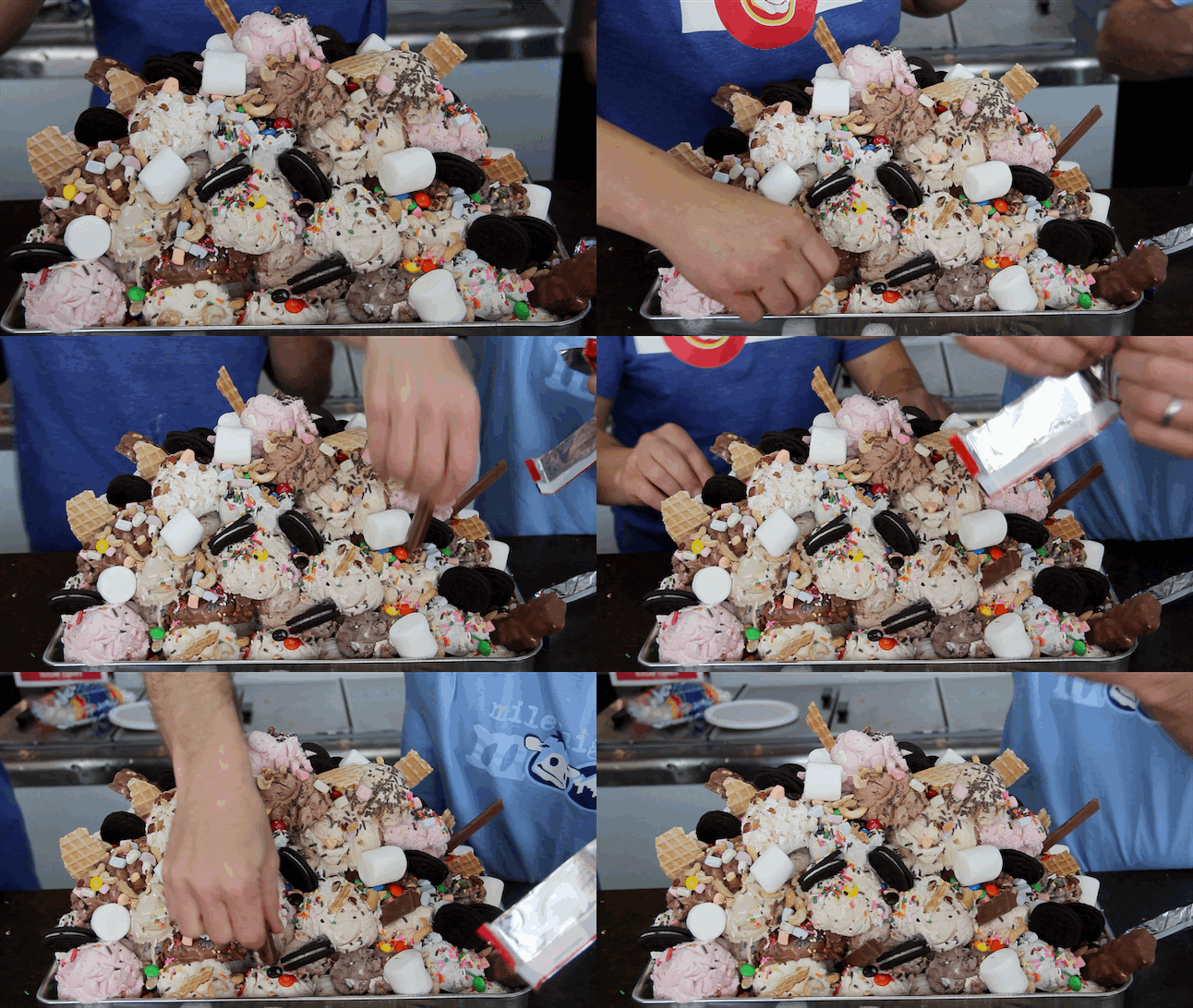
Some publishers refuse to sell digital formats to libraries.
Major side-eye to every single Amazon imprint and company, which includes Lake Union, Audible, and more. All of those wonderful Audible exclusive audio books? Are Audible exclusive, which means libraries cannot acquire them.
Some self-published authors don’t make their stuff available on OverDrive, and if they’re part of Kindle Unlimited, they’re not allowed to.
How big of a problem is this?
Libraries were unable to buy 1.5% of this year’s bestsellers in ebook.
It’s worse for audio–libraries were unable to buy 15% of this year’s bestsellers in eaudio.
This is literally the reason why your library doesn’t have Rise of Magicks by Nora Roberts on eaudio. Or the new Sarah J. Mass: the publishers refuse to sell them to libraries. (This does not include books where the publisher opted not to do a digital format–these numbers are just for items individual consumers can buy, but libraries cannot.)
And all of this has huge ramifications for the library, but also publishers (and readers) in general.
If libraries have to pay that much money for an ebook and can only keep it for 24 months, they’re going to concentrate purchasing power on titles they know will circulate heavily, to get the most bang for the limited buck. Which means lots of blockbuster sure-bets, and less midlist or new authors.
For romance readers, fans of Avon and Harlequin are in luck, because they’re both HarperCollins imprints. HarperCollins charges Suggested Retail Price and libraries can keep the ebook for 26 checkouts. As with most romance publishers in mass market paperback, most of their ebook titles are $7.99 and libraries can keep them until they use up all 26 checkouts. While it’s still not as good as print (which libraries would pay less money for and which usually last far longer than 26 checkouts) it’s still the best pricing offered by any of the major traditional publishers.
But St. Martins is Macmillan, and Macmillan charges $60 for new ebooks (regardless of Suggested Retail Price) and their ebooks expire after 24 months, even if no one checked it out. Berkley is Penguin Random House, and they charge $55 for new ebooks that libraries can only keep for 24 months.
That can be really hard math to justify! With our vendor discount, libraries usually pay $4.95 for a mass market paperback with a Suggested Retail Price of $7.99, so they can buy a full dozen print copies for the same price of a single ebook (and that ebook expires after 24 months)
$4.95 + $4.95 + $4.95 + $4.95 + $4.95 + $4.95 + $4.95 + $4.95 + $4.95 + $4.95 + $4.95 + $4.95 = $59.40 for 12 print books
vs.
$60 for a single ebook license that expires in 24 months
In many ways, a lot of the big publishers are pricing themselves out of the library ebook market, with terrible consequences for libraries.
Libraries have long struggled to find the right balance between user demand for ebooks and tight budgets, and COVID-19 just made it a whole lot harder. The economic impact of the pandemic is also going to hit local governments, which fund libraries, very hard.
At the same time, demand for ebooks has skyrocketed. Anecdotally, I know many libraries have seen this demand start to trend down a bit, but most of us who buy digital books for libraries are not expecting levels to ever drop back to where they were pre-pandemic.
So what does this mean?
With shrinking budgets and outrageous prices, libraries are unable to provide all the ebooks users want, or to get a good handle on wait times.
As a result, users see the library as being out-of-touch with reader needs, so they don’t fight for more funding.
So funding gets cut more, so libraries can provide even less and are seen as even more out-of-touch and the cycle continues.
So, what can library users do?
Don’t stop reading ebooks.
And don’t feel guilty about reading them.
Don’t yell at authors if their publishers have bad terms.
Do contact publishing house executives about their bad terms.
Do be patient with your library if the wait times are forever or if they don’t have every book you want.
Be nice to your very stressed out librarian.
Most of all: do advocate for your local library when budget season rolls around.
Find out who is your library’s funding body (this varies by location, so you may need to ask the library) and tell them how much you value your library. Tell your neighbors and friends how much you value the library and ask them to also champion the library’s budget.
EveryLibrary is a nonprofit that lobbies for libraries across the country–help them with their efforts and let them know if your library needs their help.
Libraries are used to trying to get the most value possible out of every dollar, but sometimes they just need more dollars.
Also, after all that, I’m out of bourbon and ice cream. Please fetch me my smelling salts.
*Here’s the nerdy fine-print methodology section about my data set: I looked at the following New York Times Bestseller lists: Hardcover Fiction, Hardcover Nonfiction, Combined e/print Fiction, Combined e/Print Nonfiction. I also looked at adult titles that appeared in the Top 30 of the USA Today Bestseller list. Each title is only counted once, so even though Becoming by Michelle Obama was on multiple lists every single week in the past year, it’s only represented once. Also, this was an evolving project, so I started with the NYT lists on 7/25/2019, the USA Today list on 8/11/19 and started looking at audio book pricing on 11/6/2019. The data includes information about 645 titles, 381 of those also have audio data.

Very interesting. I’ve had steady results for library checkouts of my classic small-town mystery from D2D for Hoopla, Overdrive, Bibliotec etc. I love libraries ever since I vowed to read each book in my local library when I was a kid. I checked out as many books as my arms could hold. My most prized possession as a child was my library card. I still have my local library card around my neck with my lanyard lol. Of course, now it’s barcoded but I remember the thrill of the librarian letting me change the date stamp on the end of her pencil. I loved to see how many people had read my book before me on the old library inserts. I’m still a voracious reader. About 2000 physical books and 3500 ebooks. Alas my local library still is physically closed. One misses the simplest ordinary things.
[…] “Hold on, ebooks cost HOW much? The Inconvenient Truth About Library E-Collections” Smart Bitches, Trashy Books […]
news flash CEO at McMillian is parting ways with the board. Very Interesting.