

One of the delights of my circle of friends is having people in my life who are as into nerdy historical cooking as I am. You remember Abigail, who helped with the quince paste? She also put in a request for helping make a ridiculous pie with a hot-water paste crust (she claims to remember it differently, that I was the one who said “pie!” and she said “okay!” but really it was the other way around).
So we blocked out an entire day to make this GIANT PIE from Lobscouse and Spotted Dog ( A | BN ).
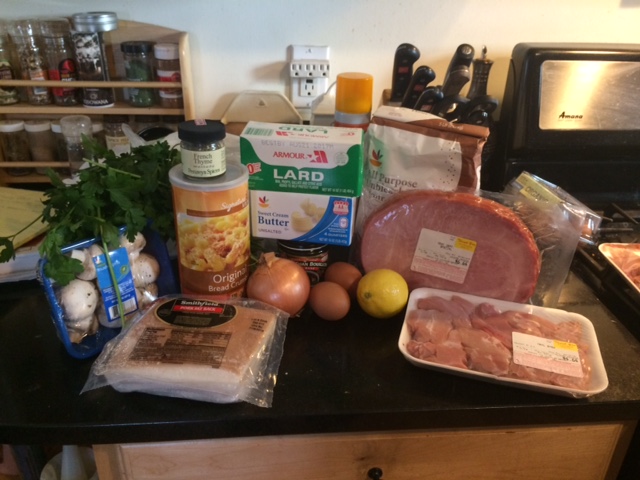
Now, this isn’t as ridiculous as it could have gone- there’s a “Sea Pie” in LaSD that’s got levels on it, which we WILL be doing next year some time. But this has over four pounds of meat, is lined with forcemeat, and is a pie that is Not Fucking Around and was ridiculous enough.
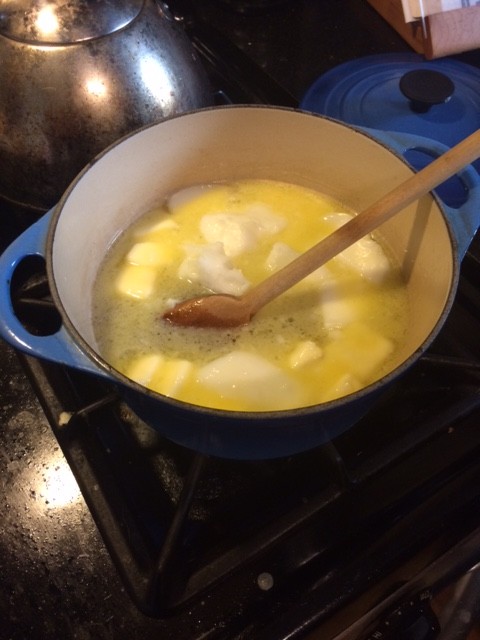
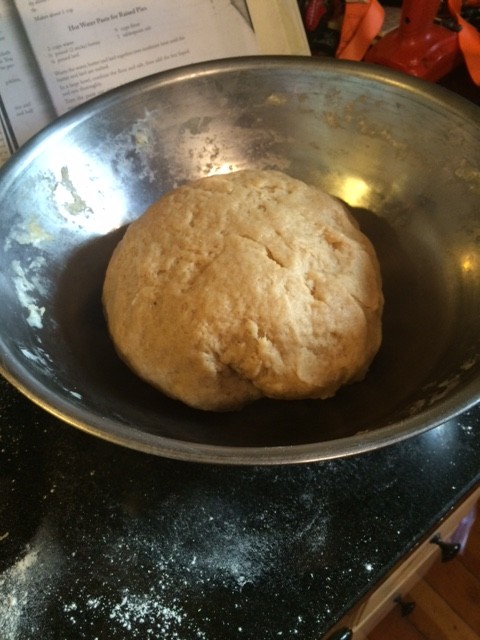
The crust for this pie is a raised coffin style made with hot water paste. It’s not light and fluffy and flakey like a modern pie. It’s designed to be thick and solid and hold its shape without a pie plate. This recipe called for half a pound of lard and half a pound of butter (melted into a cup of hot water- hence the “hot water paste”) to go into 9 cups of flour. It’s like playing with Playdoh.
This pie is right in the transitional culinary period between when coffins were a cooking and storage vessel (made with lard and flour and a LOT of salt) but not for eating, and folks were moving towards an edible crust.
This is fine, but there’s not much too it. It’s heavy, not flakey, and WAY more emotionally satisfying than trying to cut cold butter into flour for a flakey light crust. This you get to knead! And if you overwork it and it gets weirdly tough or whatever, it doesn’t matter, because it’s not for eating anyway!
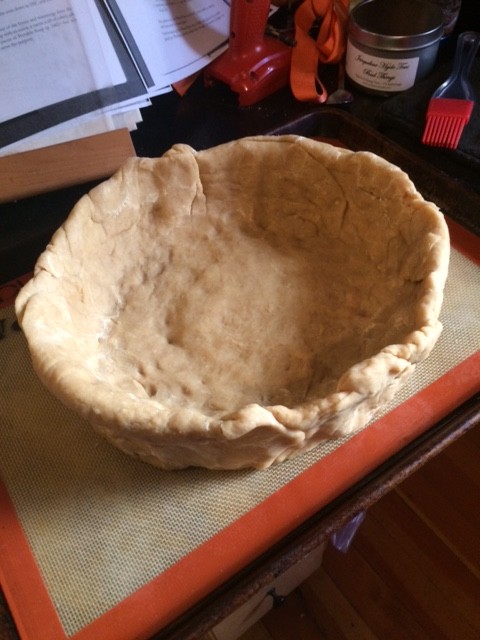
Before you fill it, though, you make a forcemeat lining. Forcemeat is where you take a lean meat (say, for example, veal) and a fatty meat (fatback bacon) and mix it together with a binder (in this case, breadcrumbs and eggs and a bit of mushrooms and onion). Sausage, meatballs – these are both examples of forcemeat.
What it does here is help seal the paste and keep all of the meaty goodness from exploding all over your oven. Or your friend’s oven.
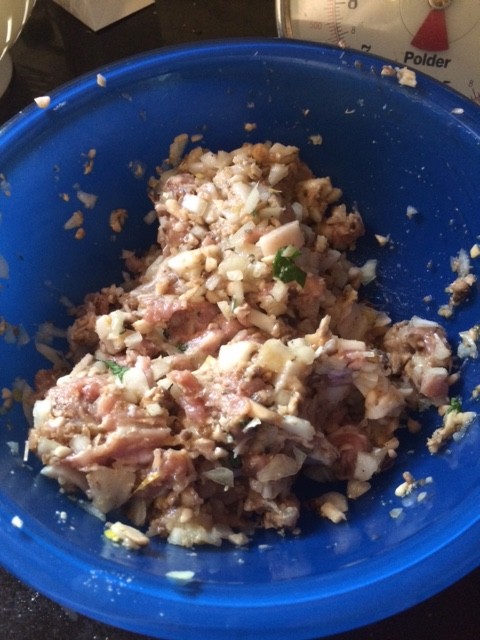
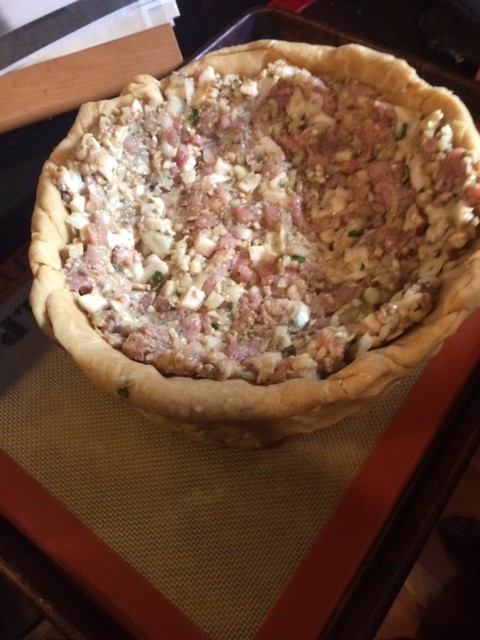
In LaSD, the directions are to mince the veal, bacon, onions and mushrooms (I probably didn’t mince the bacon small enough) and mix in the breadcrumbs, salt, pepper, sage, savory (if you have it – we didn’t) lemon zest, and egg, and then spread a thin layer of the glop in the coffin.
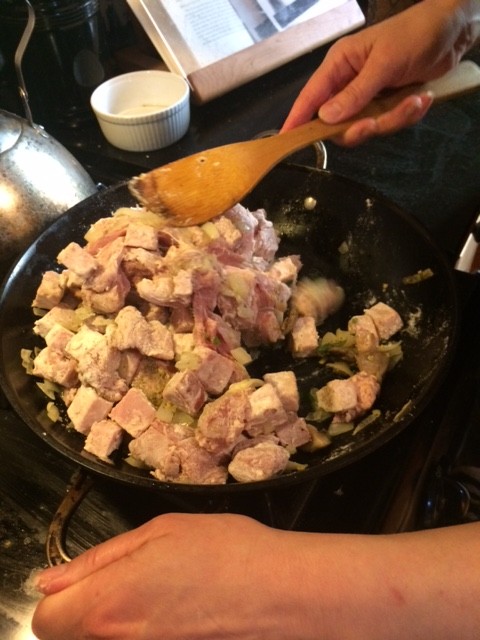
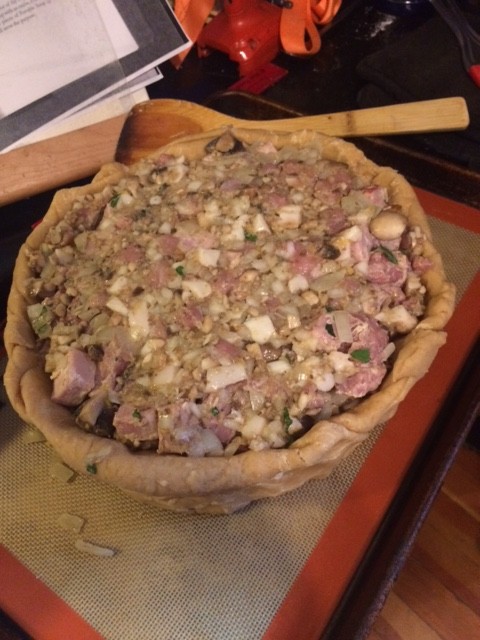
The filling is chopped onions, quartered mushrooms, a pound of ham, and a pound and a half of veal. You sauté the onions and the mushrooms in butter, then mix in the chopped meats that have been dredged in flour, plus salt, pepper, sage, parsley, and lemon zest.
Put them in the case/coffin, smear the remaining forcemeat on top, and put on the lid (which has a hole cut in top, and any decoration you may want to add with the scraps of dough).
The lid seal is reinforced by an egg wash glue.
Once the lid is on, you put in, through the hole in the top, as much hot beef stock as you can (I used a store-bought stock, but you can make your own, if you want). It needs to go into the oven right away or or the liquid could melt the crust.
Bake in the oven for 15 minutes at 450F, then an hour at 350F. (Then you know, check to make sure the meat is heated through enough because salmonella is BAD.)
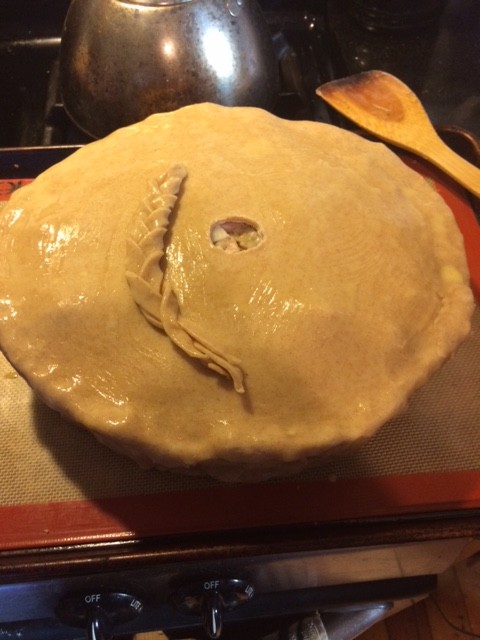
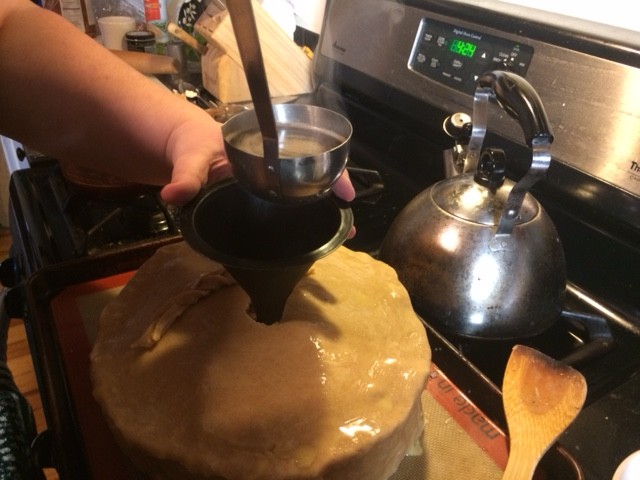
Abigail had a moment of “maybe we should have something to catch things if this goes badly and we have a structural integrity problem?”
But I, perhaps foolishly, had faith in the recipe that if we just did what it said, nothing could possibly go wrong. (Abigail would also like to point out that I am not always the best at reading all of the recipe before we start, and that without her adult supervision, it could have been a mess.) (She is perhaps not wrong.) (By which I mean she’s right.)
Anyway, we had a minor leak (due to my terrible sculpting skills) but the coffin held just fine.
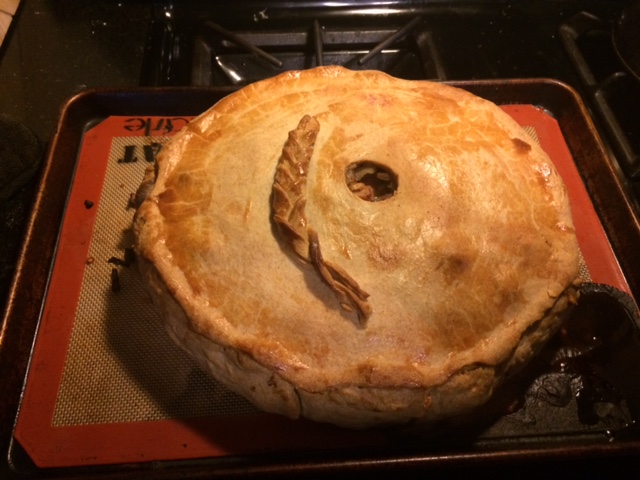
This is really fucking good. I mean, REALLY. It’s moist and delicious – it’s a bit heavy on the lemon, but the meat is juicy and tender, and the crust isn’t necessary for eating but it’s good.
Now, medieval pies were not designed to be eaten in slices, and this… could… maybe…?
But we were all pretty dubious about the ability of this pie to keep its shape should we cut a slice, so we just scooped out the filling and chowed down.
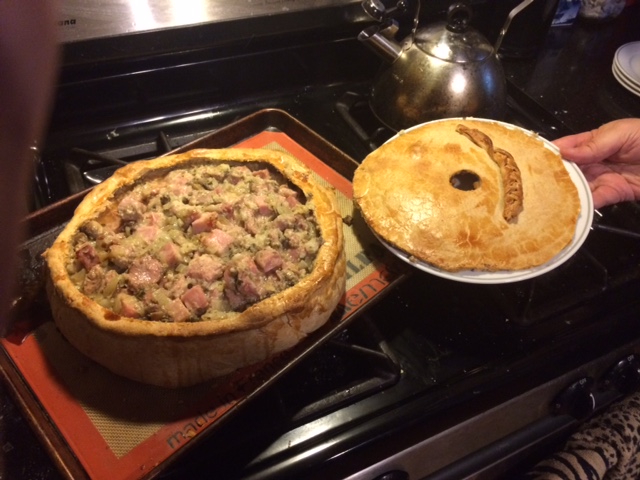
This is involved but worth it, if you have several hours to chop and mix and chill and bake.
Next year, we’re gonna try a even more ridiculous pie, but as a start into the world of GIANT ASS MEAT PIES, this is pretty much ideal.

I think a key trick is to let the pie cool to at least room temperature, if not slightly chilled. These were intended as a way to use the little bits of meat leftover from a larger piece of meat. When the pie cools, the stock is going to set up into gelatin. This would allow the pie to be sliced without turning into a major mess. Think of it as an early ancestor of meatloaf in a sense.
I think that traditionally, the coffin pies weren’t formed into rounds, but into a rectangular loaf shape. The shape’s resemblance to that of a burial coffin is one explanation for the name. This would be easier to slice for a portable leftover meal than a round shape.
I love these posts. I think Virginia is right about homemade stock setting up into a gelatin or aspic as it cools, making the whole thing more stable for slicing.
If you need an even more ridiculous pie to try for next year, or even if you just enjoy other people’s historical cooking adventure, google planet money cooked peacock.
I have made meat pies before, they are delicious and the husband loves them. But because I am not historically correct I just use a refrigerator piecrust. Structural integrity it has not. 🙂 Pie is a GREAT way to use up the holiday smoked turkey – or ham.
I agreee with Virginia E and Cathy that you would expect to eat the pie cold. You still see pies like this in the chilled counter of good delicatessans in the UK. I was shocked to enounter a warm pie made with hot water pastry at a Pie and Pea supper when I moved to Yorkshire, hot pies like this being totally alien in the south nof the UK! If you are not an expert it is advisable to shape your hot crust over something suitable so you can get it thin enough, even quite thin this is a strong crust. Hot water crusts are used for pork pies and while most are machine moulded these days, they still do it by hand for a traditional Melton Mowbray pie.
I’ve a recipe for a gooseberry pie made with a hot water crust that I mean to try this summer.
That looks amazing.
I’ve never been tempted by this before because I feel like this is traditionally how you serve your enemies the flesh of children, and that isn’t an appetizing association for me. Ymmv.
But it just looks so damn yummy.
Wait a minute, people still eat veal? Love meat, but can’t justify veal.
I was going to ask if someone had an alternative to the veal ingredient because I really want to try this. Also, I did not know about the non-eating pie crust so can I now call my kids extremely retro for not eating their pie crusts?
If the purpose of the crust is to serve as a vessel, why do you suppose butter is an ingredient?
I would quite happily watch a musical entitled FORCEMEAT! (Alternative title: The Coffin Tales)
This vegetarian found your post very interesting and informative. Thank you for embarking on a giant ass meat pie adventure for the rest of us!
“Coffin lined with forcemeat” has got to be one of the most WTH?!!? things ever to appear at the Bitchery, amirite?
Forcemeat (I can’t stop saying it) aside, the pie itself looks delicious! I’d be willing to give this a try.
Urk this so needed a trigger warning – contains suspicious meat, may make you loose your breakfast.
I know, my fault, I should have stopped reading at veal.
For the people querying veal – in the UK, at least, as long as it’s ethically produced grass-fed rose veal, and not crated milk-fed white veal (which I agree, we should definitely not be eating), we should all eat much more veal. The dairy industry produces huge numbers of unwanted calves each year, which aren’t considered suitable for becoming full-grown beef producing cattle, but produce good veal. In the UK, rose veal is high-welfare, and it’s a good way of utilising something that is being produced anyway (unless we all stop eating cheese and milk).
Squimbelina has said exactly what I wanted to say. In the UK if you drink milk or eat any dairy product you really should eat veal as it is an integral part of the milk production process. It is simply wrong to think that you can use milk and milk products without supporting either the killing of all male calves at birth or the production of veal; personally I go for rosy veal. If you are not in a country where you can buy rosy veal your only honest choice if you object to the cruelty of veal crates is to become a vegan whie campaigning for rosy veal production. Sorry to be brutal about this.
Aw yeah, raised pies, in Wodehouse there’s always one in the larder on a “cold slab” (marble shelf) and the hero sneaks down for a midnight slice.
Also, of course, this is what Glenda Sugarbean improves on in Unseen Academicals.
Back in the Day, which would be mid 80’s – 90’s, my BFF and I luuurrved Old Skool romances. Our favoritest author was Catherine Coulter. Her historicals set in the UK were rife with appalling, yet accurate, cuisine. Sooo many things made with organ meats and a mention of something called Stargazy Pie. Have you heard of this, RedHeadedGirl?
I’m with the other veal eaters. It’s important to know where all of your food comes from – there’s no dairy without killing bull calves, sorry to say. Better that they have a good, albeit short, life and eaten than wasted.
For more reading:
http://www.redonline.co.uk/food/editors-choice/why-you-should-eat-british-rose-veal
http://www.telegraph.co.uk/foodanddrink/foodanddrinknews/10770703/Why-its-time-to-welcome-back-veal.html
So i dont know if you habe heard of this show but if not plwase xheck it out. Very interesting ☺
http://www.bbc.co.uk/programmes/b06vn7sq
Wow my phone hates me tonight sorry about spelling! Also the show is called Victorian Bakers