
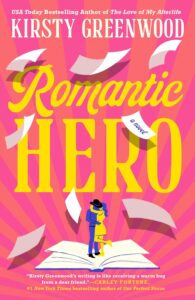
 My guest this week is Kirsty Greenwood, whose new book Romantic Hero is out now everywhere, all over the world.
Kirsty writes what she calls “speculative romantic comedy,” and I really loved her first book, Love of my Afterlife.
We discuss SHOCKING topics like deleting the first book she tried to write, the character journeys in Romantic Hero, dealing with writer’s block, and punching people in the face.
Want to watch this episode? Find us on YouTube!
New! I’m posting clips from Romantic Times Rewind on TikTok!
❤ Read the transcript ❤
↓ Press Play
This podcast player may not work on Chrome and a different browser is suggested. More ways to listen →
Here are the books we discuss in this podcast:


Make sure to disable your ad blocker to see all the books.
You can find Kirsty Greenwood at her website, KirstyGreenwood.com, and sign up for her newsletter. You can also find her on Instagram and on Facebook at KirstyGreenwoodBooks.
You can also listen to us discussing Love of my Afterlife in Episode 622. The Love of My Afterlife with Kirsty Greenwood.
We also mentioned:
- The Unlikely Pilgrimage of Harold Fry
- The Heated Rivalry Unauthorized Parody Musical
- My review of The Heated Rivalry Unauthorized Parody Musical
- Merrily We Go Along on Broadway
- The first performance after Jonathan Groff won the Tony for this performance (TikTok)
And I forgot to mention that today’s joke is a combination of jokes from Victor882 and Murseman1964.
If you like the podcast, you can subscribe to our feed, or find us at Apple Podcasts, Spotify, or wherever you listen to your favorite shows!
❤ More ways to sponsor:
Sponsor us through Patreon! (What is Patreon?)

What did you think of today's episode? Got ideas? Suggestions? You can talk to us on the blog entries for the podcast or talk to us on Facebook if that's where you hang out online. You can email us at sbjpodcast@gmail.com or you can call and leave us a message at our Google voice number: 201-371-3272. Please don't forget to give us a name and where you're calling from so we can work your message into an upcoming podcast.
Thanks for listening!
Transcript
❤ Click to view the transcript ❤
[intro]
Sarah Wendell: Hello and welcome to episode number 725 of Smart Podcast, Trashy Books. I’m Sarah Wendell, and my guest this week is Kirsty Greenwood! Kirsty’s new book Romantic Hero is out now everywhere, all over the world, and we are going to discuss shocking topics like deleting the first book she tried to write, the character journeys in Romantic Hero, dealing with writer’s block, and punching people in the face.
Now, if you’re not familiar with Romantic Hero, I have a brief summary that I wrote in a somewhat snarky fashion, and of course you can look at the book in the show notes at smartbitchestrashybooks.com/podcast. But basically:
An extremely successful romance writer who is allergic to identifying assholes is dumped by a tiny, shallow, selfish, insecure dipshit, which complicates her progress writing the last contracted novel in her series. Then the hot cowboy villain of her series appears in her living room, upends everything in her life, and causes her to question why she centers everyone but herself. He needs to get back to his life, she needs to finish her book, but they have pants feelings.
Let me know what you think of that summary.
I have a compliment this week. This compliment is for Rebecca R.
Rebecca: So many smiles begin with someone thinking of you? And this happens so often that every day you make the world a more joyful, friendly place to be.
If you would like a compliment of your very own or you would like to support the show, patreon.com/SmartBitches. We have the most wonderful, supportive community. The podcast Discord is wonderful. There was a very serious discussion about silicon spatula recommendations. Y’all, it was extremely important information being exchanged, and I might have ordered a few spatulas. Patreon support keeps me going, and in return you get wonderful community benefits – whole issues of RT magazine – and it would be delightful to have you join us. And do you need the address again? ‘Cause I’ll give it to you: patreon.com/SmartBitches.
All right, are you ready to get started? Let’s discuss Romantic Hero with Kirsty Greenwood. On with the podcast.
[music]
Kirsty Greenwood: I am Kirsty Greenwood, and I am an author of romantic comedies that usually have a magical twist to them. I live in the UK. My last book, The Love of My Afterlife, was out in 2024, and my new book, Romantic Hero, is out in a few weeks. In America and Canada, it is June the 16th.
Sarah: And it is already out in the UK, right?
Kirsty: No, no, no, it’s not out until next Thursday, so the 4th.
Sarah: Oh, okay! ‘Cause I –
Kirsty: Yeah.
Sarah: – had googled it, and I had seen – so it actually says on Google that your book was published on March 12th, 2026. Did you know this?
Kirsty: Really? No, I did not know that…
Sarah: Yes! [Laughs] Your book has been out for months, girl, so…
Kirsty: Wow. [Laughs] Sales are bad!
Sarah: Yeah, I, I, I love –
[Laughter]
Sarah: I love how Google’s like, you know, I don’t need to be accurate anymore. It’s fine. I’ll just put whatever the hell I want on screen. Yeah –
Kirsty: Yeah.
Sarah: – if I google it says March 12th, 2026…
Kirsty: Well, that’s going to, that’s going to really annoy me now until I get that changed somehow. It’s just going to –
Sarah: Listen –
Kirsty: – niggle me.
Sarah: Listen, I understand completely. That would bother the hell out of me. So it’s out on Thursday here and –
Kirsty: And 4th of June, so next Thursday here –
Sarah: Next Thursday.
Kirsty: – and then, and then, yeah, 16th of June, which is a Tuesday, Tuesday publications in America.
Sarah: Yeah, we do Tuesdays.
Kirsty: Yes. So –
Sarah: That’s so –
Kirsty: – 16th there.
Sarah: That’s so exhausting to have two separate release dates.
[Crosstalk]
Sarah: Is that better?
Kirsty: It is in terms of, like, having – it’s funny because a lot of US authors, when they sell their books to the UK, the cover is the same, like, the, the copy is the same, and it’s generally like just all kind of, you know, the UK taking their lead from the US. But because I’m British –
Sarah: Mm-hmm.
Kirsty: – but I have a, a US deal, I have two very separate teams? So the covers are different. Like, I –
Sarah: They are!
Kirsty: Yeah, the, the edit process – I mean, they edit together, but then I have to do a separate copyedit for each to Americanize and then – like, one version, which is bonkers, actually.
Sarah: I completely agree with you.
Kirsty: …agree.
Sarah: The fact that we can’t, we can’t read things like sidewalk versus pavement and people are like, That’s not the right word! Or the extra Us – like, just get on board, folks.
Kirsty: I know, I know! But in terms of touring and doing the publication events and promotion, actually, it’s really nice to have that little –
Sarah: Preparation.
Kirsty: Yes, yeah. Because I’ve got events in the UK, and then I think I have like just a couple of days to just oof! And then I get to really fully be present in the US, rather than worry about doing UK promo at the same time?
Sarah: I mean, it’s like you get to focus on one area and then take a nice long plane ride and then focus on another area. So what are you doing?
Kirsty: Exactly.
Sarah: What all, what all are you doing to celebrate the release?
Kirsty: So in the UK, I’ve got events in, in England and Wales, and then in – which yeah, I’m really excited about. And then in the US, I’m doing like a pre-publication party in New York, which is going to be hosted by my friend, the author Ali Rosen?
Sarah: Oh, I love it!
Kirsty: Yeah, she’s hosting a little party at her apartment, which is going to be lovely. And then I have, I’m in Indiana, Franklin, Indiana; Cincinnati, Ohio; and then over to Houston, Texas.
Sarah: Ooh!
Kirsty: Yes. And then back to New York for, like, a, like, a bit of theater probably, and then back home.
Sarah: That’s a good, good trip, too. And you get to do –
Kirsty: Yeah!
Sarah: – two events with Ashley, Ashley Poston!
Kirsty: I’m so, so excited. I did a bunch of events with her for Afterlife, and it was the most fun. I don’t know if I mentioned this last – had I come back from tour last time when I spoke to you?
Sarah: No, I think you were about to go, because I was telling you places to go.
Kirsty: …to go. Yes, yes. So it was really fun to be with Ashley and to see, her readers are feral.
Sarah: [Laughs]
Kirsty: They’re feral for her. It was just, it was incredible to see? Like, the joy that she brought them was just, I was like, I want that! It was just, it was, it was amazing, like, as a reader as well, to just be in that kind of atmosphere. Yeah, it was very, very cool. So I’m doing two events again with Ashley in the US, and then she’s in the UK for a tour, and I’m chairing her event in Liverpool?
Sarah: Ooh! Fun!
Kirsty: Yeah, yeah! So that’d be fun.
Sarah: Well, I mean, you guys fit together as conversation partners, because there’s a lot of like –
Kirsty: Yeah!
Sarah: – similar tone, and –
Kirsty: Yeah.
Sarah: – you get the same sort of vibe from your books? I’m actually interviewing Ashley a week from today?
Kirsty: Oh really!
Sarah: Yeah.
Kirsty: Have you interviewed her before?
Sarah: No! I’m very excited.
Kirsty: She’s so, she’s amazing. She’s –
Sarah: I was, like, nervous ‘cause, like, I, I was like, Hey, would she like to be on the podcast? And I have a friend of mine from college –
Kirsty: Yeah.
Sarah: – who always goes to, there’s a Southern festival called YALLFest, which is YA festival.
Kirsty: Ohhh, oh, I…
Sarah: I’m going to say it’s in Charleston, but I could be wrong about that. And I went to college in South Carolina. So my friend –
Kirsty: Yeah.
Sarah: – from college is like, Oh my gosh, I hung out and talked with Ashley Poston, and I was telling her about you, and she said, Oh my God, I would love to be on their podcast. And I was like, She knows who I am? What?!
Kirsty: She would love you! You two would get along really well, I think.
Sarah: Really? I think the three of us –
Kirsty: I do.
Sarah: – might need to meet up.
Kirsty: Don’t, right, you, you up for coming to Indiana?
Sarah: I mean, sure.
Kirsty: [Unclear, laughs]
Sarah: Sure! You know. How many hours is that? It’ll be like, it’s like nine hours; it’s fine, I can drive that.
Kirsty: [Laughs] Yeah, you just get in the car, it’s fine. But I do, I think she’s so lovely and so –
Sarah: Oh, I’m so excited!
Kirsty: – sparky and, and, and smart. Yeah.
Sarah: I’m, I’m very excited to interview. I was shocked she knew who I was and was like, Oh, I’d love to be on her show. Like –
Kirsty: Oh, I, oh no, I bet she’ll be all over your podcast and your site!
Sarah: Oh, I’m so excited!
Kirsty: I think you two, you two have, like, a similar vibe, I think? Like, I don’t know, like just lovely warmth, kind of a little, little quirky. Like, yeah.
Sarah: Lot quirky. Yes. Thank you!
Kirsty: Lot quirky, yes! [Laughs]
Sarah: That’s a really nice compliment. Right back at you!
Congratulations on Romantic Hero. I need to tell you that I read this book in a pool, and I highly recommend that everyone else read this book in a pool. It was a –
Kirsty: I love that!
Sarah: – perfect experience. I laughed out loud. I was, I was weepy. I was, like, on, on a van going to an excursion on vacation, and I’m, like, in the back, just, like, wiping my eyes, and the driver’s like, Are you okay? I’m like – [tearfully] – Yeah, it’s fine. It’s just my book. It’s fine.
Kirsty: [Laughs]
Sarah: Your book made my vacation so lovely, so thank you.
Kirsty: Thank you!
Sarah: I laughed and I cried.
What was your entry point? Do you remember where you started with this book?
Kirsty: I, it was, it was odd, because – and we’ll probably circle back to this later, but I’d had trouble writing the book after Love of My Afterlife.
Sarah: Ohhh!
Kirsty: So I’d written, I ended up writing like thirty thousand words of, of that book? And deleting it and just being like, this is not good enough. It was very painful. And then –
Sarah: That’s a big delete!
Kirsty: Ugh! It was, yeah, it was horrible, but I do, have done this in the past as well. Like, for the first thirty K, I just, like, pretty much generally hate everything I write.
[Laughter]
Kirsty: Like, no, I don’t like it; it’s not good enough. And then I, I’d thought, I’d had an idea for a film, so for a film script a long time ago, which was what if there was, like, this really bumbling crime author, and their murderous serial killer character came into the real world, and this bumbling author had to, like, help kind of catch them; like, thrown into this adventure. And I loved the idea, but I, I don’t write crime, and I’m, I’m contracted for a romance book. And then I just thought, what if – well, first I thought, what if it was a romance writer, and then, like, a historical romance writer, and it was a rake, like a rake character who came to real life? But then at the time I’d read a couple of cowboy romances, and then I was like, oh, imagine if it was a cowboy, and imagine if he was dropped into, like, a Notting Hill, Four Weddings and a Funeral-esque London? And just, because I’d had trouble writing the book before it, I was just, as soon as I thought of that I was like, oh, I really, that just sounds fun? I just want to write something really fun.
Sarah: Yeah!
Kirsty: Yeah. And that’s, and, and then I, I wrote like fifteen thousand in one weekend, and…
Sarah: Oh damn!
Kirsty: I know! I never write that fast, and I wrote, I was just, like, obsessed, and I sent it to my agent, and she was like, All right, you’ve got to, you’ve got to carry on with this one. So yeah, that’s how it, that’s how it came to be!
Sarah: That’s very, very cool. Is your agent the basis for the agent character in this book?
Kirsty: [Laughs] Oh, it’s really funny, because she’s called Hannah, and I think, I think originally that character was called Anna in my, in my draft, in my original draft, and she was like, This sounds very much like me. She was like, I think you’ve, like – am I in this book?
Sarah: Maybe!
Kirsty: Like in Euphoria, where they’re like, Is this play about us?
[Laughter]
Kirsty: And she was, she was like, That sounds very much like me, but, like, no pressure. Like –
[Crosstalk]
Kirsty: Just like, very gently, How are you getting on? Anyway, I adjusted it a little bit. I gave, I gave the agent red hair? Actually, no, my agent has red hair. Oh God, it’s basically my agent…
Sarah: It’s basically your agent.
Kirsty: [Laughs] Yeah.
Sarah: I loved how good the agent character was at very delicately just, Hello! How are you? Very cautiously managing feelings, very, very gently, like, Hello, hi, have you made progress? What’s going on? Hello! It was very true to life.
Kirsty: Very. Like, this is, I think every agent is just like, is kind of kid gloves. Whether you’ve got a tantrum-ing author or not, you’re just, like, creeping in like, very like queen of, I call my agent queen of diplomacy.
Sarah: [Laughs]
Kirsty: And every time I even, I have any diplomatic question, I go to her and, like, run it past her and be like, Is this a reasonable thing for me to say in this email? [Laughs]
Sarah: Oh, people who can, people who can decode what you need to say into diplomatic terms that are clear but inoffensive? Because my first instinct –
Kirsty: Yeah.
Sarah: – is to be like, Okay, now, look. [Laughs]
Kirsty: Yes! [Laughs]
Sarah: For fuck’s sake. [Laughs] You need, like, I –
Kirsty: Absolutely!
Sarah: Developing the diplomacy language is such a skill. No wonder they’re agents.
Kirsty: It’s such a skill! I do not have that skill at all. It’s like, I was talking to my friend the other day, and she was saying about people being passive-aggressive, and I was saying – or pass-agg, as she called it –
Sarah: Oh!
Kirsty: – and I was like, I’m great at pass, I’m great at agg, but I can’t do the passive – I don’t have a sense of social tone sometimes? But my agent has a really good sense of it. She’s so professional. Like, she just knows how to behave professionally, which I do not. [Laughs]
Sarah: So it’s like, it’s like happy hour time where you are, right? So she’s somewhere out right now, having a drink, and her ears are burning, and she’s like, Who’s talking about me?
[Laughter]
Kirsty: Yes! I hope so; I love her. I love that woman.
Sarah: So in this book, you mentioned you have a cowboy coming into the modern world, dropping into the middle of a writer’s flat, and River is a side character in this author’s series. He’s just –
Kirsty: Yeah.
Sarah: – sort of the antagonist to the main character who speaks to Gertie and through, through the whole series is following.
Kirsty: Yeah.
Sarah: But he is, of course, the lead character of his own life, which is –
Kirsty: Yeah.
Sarah: – part of what Gertie needs to see. (This is not a spoiler.) Were you thinking a lot about side characters generally as you wrote this? Because I loved the idea of taking a side character who’s really just there to needle somebody or piss them off or advance the plot a few degrees because they’re being antagonistic, and you made them a whole other person. Were you thinking a lot about side characters?
Kirsty: Yes, I was! I, like, I’d seen this quote which was, it was saying, like, even, I think it was – I can’t remember who it was from, but it was saying Villains are the good guy in their own story.
Sarah: Yes!
Kirsty: And I thought that was really interesting. And at the time, like a couple of years ago, someone had said to me that, in a non-complimentary way, that I had main character energy, and they said it as if they thought it was like a, a bad thing.
Sarah: Who are they? Can I smack ‘em?
Kirsty: [Laughs] I know!
Sarah: That’s not a nice thing to say!
Kirsty: Yeah. Go give him a knuckle sandwich. But it was, and he got to me because I thought, wait a minute, surely you should be the main character in your – like, who wants to be the sidekick in their own life?
Sarah: No!
Kirsty: You know. I mean, I tend to, or I wa-, I did used to fall into that pattern often of being a sidekick in my own life. And then, you know, I think we write these roles for ourselves, and other people write these roles for us, and then when we start to change and, and, and grow, people get very uncomfortable with that.
Sarah: Oh yes.
Kirsty: Yeah! And I just thought it was really interesting how Gertie, because she was a little quieter than her sister, wasn’t as sparky and maybe not as successful or intellectual as her partner, she just felt like her job was to revolve around them. And she needed River, who I think very much has main character energy – you know, he has his own law, he refers to himself sometimes in the third person, but not in a dickish way, in a cute way –
Sarah: Yeah.
Kirsty: – you know, and, and, and she needed him to kind of show her that it was okay to make herself the leading lady in her own life!
Sarah: Yes. And he knew who he was at all times, where Gertie was still trying to figure out who she was in and of herself, not in relation to other people.
Kirsty: Not just in relation to your, your, your relationships to other, other people! Like –
Sarah: No! You are in and of yourself a, a person.
Kirsty: Yes! Yeah.
Sarah: And also, the idea of main character energy, I think that gets thrown around and is confused with what I term as theater kid energy. Theater kid energy is different than main character energy. Main character energy is that it, is, is, as you noted, a negative! It’s like you are, you are the main character even when you are at someone else’s event? That’s not who you are! You’re just a theater kid.
Kirsty: No!
Sarah: That person’s a douche. Let me just, let me just…
Kirsty: Yeah! It –
Sarah: That person sucks! I don’t like them!
Kirsty: No! It was, it was really weird, because it was like, I think I did spend so long trying to, and it’s still something I’m talking about in therapy, where I’m like, it is very much my urge to revolve around other people.
Sarah: We’re conditioned as women so hard to do that, right?
Kirsty: Completely! Completely! And it’s like we are there to augment someone else’s life, usually a man’s, and it’s, you know, and it, it’s, it’s, it’s ridiculous! And so trying to, like, kind of be somebody who stands up for themselves and is very clear about what they want and is openly ambitious, people sometimes don’t like that, and they term it as things like, You, oh, you think you deserve that? And I’m like, Yes! Yeah, I do! Or, or –
Sarah: Yeah, it’s actually –
Kirsty: – I’m going to try! You know?
Sarah: I totally do. I also think there’s a really interesting cultural dynamic that I think about constantly that was definitely present in the book and what you’re saying. It’s the poppy/squeaky dichotomy? So in the UK, the tall poppy gets the cut –
Kirsty: Yes!
Sarah: – right? In the United States, our culture is very extroverted, and here it’s the squeaky wheel gets the grease. You have to make noise to get attention! You have to make noise and stand out. That’s part of our culture. Like, it is –
Kirsty: Absolutely!
Sarah: – normal to stand out and be theater kid/main character energy in the, in the US.
Kirsty: Yes!
Sarah: Like, that’s our culture. We’re very extroverted and, like, you know, standing out is like a, like a normal thing for people to want to do. Whereas culturally in the UK and in, and especially in, like, I know in Australia as well, the tall poppy gets the cut. It’s not okay to stand out. You’re not, you’re not supposed to get above yourself, I think is the phrase, right?
Kirsty: Don’t get above yourself!
Sarah: That’s the phrase!
Kirsty: Yes. It’s vulgar to be ambitious, openly ambitious.
Sarah: Yep.
Kirsty: This is what I like about Americans is that you know where you, where you stand. And it’s like, of course there are so many of us who are ambitious and, and, and want to be successful and, and want to, and stand up for ourselves, but we, it’s almost, like, seen as, like – I don’t know if it’s a class thing as well.
Sarah: Oh yeah.
Kirsty: It’s just not polite? It’s just –
Sarah: Definitely…
Kirsty: – not polite, and it’s – oh, God. You know?
Sarah: Yeah, it – you don’t get above yourself, you don’t break out of your, you know, this is where your station is, this is where you should stay.
Kirsty: Yes!
Sarah: And I think of it as the poppy/squeaky dichotomy, which is a dumb name.
Kirsty: …completely. No, I love that! And it’s –
Sarah: Yeah.
Kirsty: – exactly right!
Sarah: And it, and it’s in the book, too, because River is like, And why should you not celebrate your success? Where Gertie’s like, Oh, you know, I’m just a writer. I just write romance.
Kirsty: [Laughs] Yes!
Sarah: I love that Gertie has a popular series. She has multiple books, she has a series that is coming to an end, she is under contract for a very anticipated book, and she does not see any of her accomplishments. She just does not see them at all and has to be like, like – the thing that I love – this is a mild spoiler, but I won’t tell you when it happens. Well, I mean, you know; you wrote the book. When –
Kirsty: [Laughs]
Sarah: – when she gets pissed off because someone is being a genre snob and that is what gets her going, I was like, Okay, girl, yep, mm-hmm! Get him. Get him!
Kirsty: [Laughs] At last!
Sarah: She can’t see her own success, and –
Kirsty: Yeah!
Sarah: – and that continues for a really long part of the book before she realizes, Oh, wait a minute, wait a minute! Was that inability to recognize her own achievements something that you’ve noticed in romance or in writing generally?
Kirsty: I think, yes. Definitely for me, and as a romance writer, because I think if, when people are mean or snobby about my books, I tend to – [sighs] – it gives me like a kind of sad reaction. Whereas when people are mean or snobby about my readers, then, like Gertie, I get really angry and I get –
Sarah: Oh, it’s on!
Kirsty: – fighty. Yes!
Sarah: It’s on!
Kirsty: And I’m just like, How dare you? And it’s, it’s an odd thing, because I don’t really think of success and what I’ve achieved, and I wonder if it’s because I’m worried to rest on my laurels. I’m worried that if I take a moment and, and assess and think, oh, okay, this is, this is good, that I kind of, it’s such a saturated industry, and it’s very competitive, and it’s –
Sarah: [Hollow laughs]
Kirsty: – so up and down, you know, and the market’s changing all the time that I’m just like, if I stop for a moment and think, oh, I’ve done, I’ve done really well, then maybe, like,
I won’t work as hard? I don’t know.
Sarah: I, I don’t think that’s true. Just –
Kirsty: I don’t know. It had not, it had not occurred to me, though, that Gertie hadn’t really acknowledged what she’d achieved.
Sarah: No! She –
Kirsty: [Unclear, laughs]
Sarah: And I’m like, Girl, you have a, you have a series! Do you know how hard it is to have a series? Some people only get two books out of three, and it was a planned trilogy! Like, girl, you got a series!
Kirsty: I mean, I can’t even write a series. I’ve never written a series. Go on, Gertie!
[Laughter]
Kirsty: …thank you flowers!
Sarah: Right?
Kirsty: Yeah!
Sarah: And this is something that I think that structurally, as a writer, I think you pulled this off so well, and it’s a very hard thing, because – so in the beginning of the book, Gertie has sort of shrunken herself smaller and smaller to, you know, make peace with a person who has mammoth insecurities, and she does not see how she centers this other person and puts herself on, in her own margins. She’s not even the main character or a side character of her life: she’s, like, marginalia.
Kirsty: [Laughs]
Sarah: And this whole book is such a delightful indictment of people-pleasing behavior, which I found very savory, and like I said earlier, many women, we are so conditioned to make sure everyone else is okay and people-please everyone else, put ourselves last.
Kirsty: Yeah.
Sarah: And for Gertie, refusing to cater to this other person and to center her needs over his would make her a villain in her mind. Centering herself would make her a self-centered villain like River. And that character arc where she is really shrinking herself down and then realizing, Wait a minute, maybe I don’t need to be like this, and doing the really difficult work of undoing that programming –
Kirsty: Yeah.
Sarah: – was that, was that character arc really difficult to write? Because it seems to me that it would be, because it’s a, such a tricky balance. There are several notes in my file where I’m like, Okay, the degree to which I want to smack Gertie is currently at a three out of five.
Kirsty: [Laughs]
Sarah: Sometimes it gets to four out of five, but we never hit five, but we were close. That’s so hard.
Kirsty: It is so hard!
Sarah: So hard to write. So was it difficult? Was it cathartic? What was that like? ‘Cause I know –
Kirsty: It –
Sarah: – that had to be something you were considering when you were writing.
Kirsty: …it really was and is now? So I, it was cathartic and difficult because I am a colossal people-pleaser.
Sarah: [Laughs]
Kirsty: To the point where it’s an issue, to the point where – and this is how ridiculous it gets: I was in a cafe the other day and I was overhearing a conversation, and a woman said the words, “I just don’t know what to do,” to her friend. And it was almost like my ears pricked up; it was like a bat signal. I wanted to go over there and immediately be like, Right, what’s the problem? Let me help you –
Sarah: Yep!
Kirsty: – I’m going to fix this. Like, I don’t want you to be upset. Don’t want you to be upset –
Sarah: Yep.
Kirsty: – in my vicinity. And I was thinking about this, and it’s not always out of altruism that I want to please people. It’s because I hate conflict so much that the thought of it occurring anywhere near me makes me so ugh that I’m just going to do everything I can to prevent that before it happens. And it’s something I’m talking about with my therapist as well, because I’m saying to her, like, To put other people first feels like a morally good thing, and to put yourself first, to me, feels, like, morally selfish. And she’s like, Logically, you know, that’s not true. And I’m like, Logically, I do know that’s not true, but I don’t quite believe it yet. And I think part of me wanted to explore that through Gertie and have her do the things that I am still unable to do in terms of really learning to put herself first and, and for that to be okay and for that to be a very positive part of, of a human’s growth!
Sarah: Yes.
Kirsty: You know? And so it was cathartic in that way, ‘cause I’m like, how is she, if she can do it – I don’t have much hope that I’ll ever do it. I’m trying, I’m trying! But yeah, the, the people-pleasing is, it’s really, it’s very, very real with me. And it is, it makes you, it’s funny because seeing the reaction from readers is they’re getting annoyed with Gertie. And even that is making me think, yeah! Okay, that, that in itself is helpful, because it’s making me see, like, how unreasonable it is for her to be that, like, secondary to what –
Sarah: Yeah.
Kirsty: – everyone else needs.
Sarah: She’s like, she’s, like, made of putty. She will bend herself around what everyone else needs and put her own discomfort last.
Kirsty: Yes!
Sarah: But, and she has to learn that centering yourself in your own life is not villainy. It’s not bad.
Kirsty: It’s not bad…
Sarah: You’ve been told it’s bad because it’s better for everyone else that you put yourself last, that your energy belongs –
Kirsty: Exactly.
Sarah: – to everyone else because you are walking around in a femme-presenting body.
Kirsty: Well, exactly that. Exactly that. And isn’t that horrible?
Sarah: It blows! I hate it.
Kirsty: Yes, it blows!
Sarah: So I would just say that at a point in the future, you may come to perimenopause or menopause. I’m, I am…
Kirsty: Oh, it’s already happening, babe.
Sarah: Okay.
Kirsty: It’s already happening.
Sarah: Okay.
Kirsty: [Laughs]
Sarah: The reason I, I articulated to ask for home, hormone replacement therapy was –
Kirsty: Mm-hmm.
Sarah: – I love my husband very much. I like him. I want to kill him. I want to kill him every day. I want to kill everyone, everywhere, every day. All the time. I’m angry, all the time. And this is unpleasant. And I realized that part of what I was angry about were things where I felt trapped in my own life by decisions that I had made? And then I had to be like, Okay, you don’t like this, so let’s not do this anymore. And the feeling of being like, oh, I can stop doing something that I’ve done for ages and ages that I don’t want to do anymore. I can just stop? Like, yeah! Yeah, I can just stop. I can be done…
Kirsty: It’s so liberating.
Sarah: Like, oh!
Kirsty: It’s such a liberating moment. Yeah.
Sarah: What’s going to happen? People be mad? Oh well. I’m already mad. Be mad with me! [Laughs]
Kirsty: And the thing is that you didn’t really – it feels like the decisions that we made about the ways we live in the past weren’t really decisions. They were just part of the culture. They were what were expect-, what was expected of us at the time, the normal thing to do and the normal way to be.
Sarah: Mm-hmm.
Kirsty: It’s only now, I think, in this very specific period of time and at this age – like, I’m forty-three, so I’m kind of, I’m also getting those perimenopausal rages. I’m actually quite enjoying them? [Laughs]
Sarah: Oh yeah! And listen, I mean, I have, as an, as an American person with a uterus, I got plenty to be angry about. And –
Kirsty: Yes!
Sarah: – it’s, it’s very fueling. Actually, I think one thing politically that people who are, you know, political analysts are underestimating is how angry people are. So angry. And I think the same thing is true in the UK; I think people are pissed.
Kirsty: Really. Yes, no, and I think that’s just going to grow and grow and grow until something explodes and something changes. Like –
Sarah: Ah!
Kirsty: – it’s just, it’s too much. It’s too, too much.
Sarah: I think my favorite part in this book was when Gertie got mad. That was my favorite, my favorite scenes! Like, yes, Gertie, burn! Fuck ‘em up! Yes!
[Laughter]
Sarah: Like, when she finally got mad and realized the injustices that she had been enduring and, you know, with River standing there, Yep, keep going, keep going.
Kirsty: Yes, yes, yeah! [Laughs]
Sarah: ‘Cause you know he was ready to fight on her behalf.
Kirsty: Oh, absolutely, absolutely.
Sarah: He was ready to throw down. [Laughs]
Kirsty: I, I kind of wanted him to, but then I was like, I was talking to, I think it was my agent or my editor, and it was just like, Oh, like, let’s not, let’s not, like, have him be violent. And I was also like, Please let him punch him in the face, but let Gertie punch him in the face at least? [Laughs]
Sarah: One aspect of this book – I won’t get into specifics – was channeling! When you, when you write, are you transcribing a movie you’re seeing in your mind?
Kirsty: Absolutely, yes –
Sarah: That’s so cool.
Kirsty: – I can see it. And especially with this one, it was very much there. And sometimes, like, when I’m writing, I do feel like I go into a sort of fugue state.
Sarah: Me too.
Kirsty: Yeah, and you can see it! And sometimes it is so very vivid. Like, I can smell the tarmac, and I can feel, you know, the rain in the air, and I can feel it with everything! And I’m like, surely this has happened before. This must exist in somewhere, like, because it’s set out for me! It’s just right there!
Sarah: It’s so real. Yeah.
Kirsty: And it is so, so very real, and I’m like, my brain doesn’t feel like my brain is equipped to kind of come up with those things so quickly and so readily, like just fully formed? ‘Cause people say you’re just transcribing, you know, a movie in your mind. It’s like, what if she’s transcribing something that already is happening or has happened?
But interestingly, it, that wasn’t a part of the initial draft, because what had happened is, it was very much that River was a fictional character only, and during a conversation with my editors we were like, It’s a bit grim that he doesn’t necessarily have agency. It’s a bit grim that he –
Sarah: Doesn’t really –
Kirsty: – is just fictional and made up.
Sarah: Doesn’t really exist. Yeah.
Kirsty: Doesn’t really exist. Like, there’s no longing to it, there’s no yearning, there’s no – so we had to come up with some kind of way to make him real –
Sarah: Yeah.
Kirsty: – which was why, kind of, we came up with the – you know, I don’t want to go too much into it ‘cause I don’t want to spoil, but it’s why we came up with the whole channeling thing. And actually, you know, necessity is the mother of invention. Like, I, I love that part, and actually it’s something that has come up a lot when, when it got optioned, the conversations with the movie producers. That was all, the thing that came up was that they loved the concept of, you know, Mr. Darcy and, and Elizabeth Bennet having existed, and Jane Austen just transcribing that, and, you know, these characters being real somewhere else.
Sarah: That is very cool, and certainly an existing theory! Like, absolutely, people exist that believe that we exist in multiple timelines and multiple –
Kirsty: Yes!
Sarah: – ‘verses, which is very cool and very creative thinking. I, I, I think it’s so neat, because my writing process is the same. When I was writing –
Kirsty: Yeah.
Sarah: – Lighting the Flames, my Hanukkah novella, I was transcribing what I was experiencing in my head. I was watching characters. I, I put them in a place that was familiar to me so I could describe it easily? But –
Kirsty: Yeah!
Sarah: – they kind of do their own things, you know? These are really only conversations you can have with another writer. Like, okay, so the voices told me –
Kirsty: [Laughs]
Sarah: I was watching the characters in my head. Like, these are not things that, like, non-writers say.
Kirsty: Well, this is it!
Sarah: It’s a totally normal conversation for people who write. The worst is when I’m, like, cooking, you know, handling raw chicken, and all of a sudden they start talking. I’m like, I cannot write dialogue right now! I have chicken hands.
Kirsty: [Laughs]
Sarah: I have chicken hands. I cannot salmonella-ize my kitchen trying to find a pen because y’all started talking! But that happens –
Kirsty: They get noisy!
Sarah: They get noisy. Like, Oh, we have an idea! And I’m like, I’m busy!
Kirsty: Yes! This is exactly it!
Sarah: Yep.
Kirsty: People think it’s a bit naff when you say, Oh, but the characters dictate the story.
Sarah: Nope! They do!
Kirsty: They, they do, and this is why I don’t like to plan too much in advance, you know. With, with my US publishers, they want to see, like, a quite extensive outline before, beforehand. And I’m really reluctant, because I’m like, But the characters will, they’ll change it. They’ll change the hell out of it, and, and no matter –
Sarah: Mm-hmm.
Kirsty: – what I want to happen, if the character doesn’t turn out to be that person, like, they’re just like, No. No, I’m not going to do that, you know, and, and even if you try and force them through, it starts to –
Sarah: It doesn’t –
Kirsty: – feel very wrong.
Sarah: It doesn’t feel right.
Kirsty: It doesn’t. They shout at you and –
Sarah: Yeah.
Kirsty: – you know, they, they shout at you while you’re trying to, when you’re handling raw chicken and –
Sarah: Yes! And I got gooey –
Kirsty: Yeah.
Sarah: – I got gooey giblet hands.
Kirsty: [Laughs]
Sarah: I remember one time I, I read a piece of writing advice that really worked well for me when I got stuck? That if, if, if I was writing in a, in a scene and it wasn’t going the way I wanted, to just switch point of view? Because I was doing dual point of view characters.
Kirsty: Yes!
Sarah: I had both points of view, which I know is not the trend right now, but was the trend back then. And that worked really, really well because it was like, No, I actually need to be telling this part of the story. Like, they’re, this is cool, but I need to be in charge of this part. Okay, now they need to be part of telling you this part. And I was like, Oh, this really does happen, doesn’t it? They just start talking and telling you what to do!
Kirsty: Yes! That’s really interesting. I’m going to try that, actually!
Sarah: Isn’t that a good piece of advice?
Kirsty: Really great, because even if they’re not even in the scene, just kind of switching into another perspective –
Sarah: Mm-hmm!
Kirsty: – at the very least you’re going to get a real insight into another character who isn’t necessarily the main character, and –
Sarah: Yep.
Kirsty: Yeah, that’s, I love that! I love that.
Sarah: It’s like, it’s like switching cameras. Like, instead of the, the –
Kirsty: Yes!
Sarah: – the, the, the camera to your face, it’s a camera that’s showing everybody, and let’s try the camera on the other side, showing everyone from this angle!
Kirsty: Yes!
Sarah: Yeah. And you don’t have to worry, if it’s in your mind, you don’t have to worry about the grip or the lights or anybody holding a mic; like, they’re not there! This is just your movie!
Kirsty: Well, that’s it, and that’s what’s so lovely about writing is you can make up whatever the hell you want!
Sarah: Right?
Kirsty: You don’t have worry about budget, you know? Like, I’m –
Sarah: Yes!
Kirsty: – writing a musical, and one of my friends is a director, and she keeps saying, But you can’t, the budget needs to come down. You can’t really do that, and you, you know, that would need this kind of lighting rig, and that’s too expensive. And I’m like, In a book, you can just make whatever the hell you want. Like –
Sarah: Yeah, absolutely.
Kirsty: – whatever.
Sarah: And also my, my feeling – this is very American – go big or go home!
Kirsty: Well, that’s what I think, too!
Sarah: You know, like, if you’re –
Kirsty: Yeah!
Sarah: – if you’re going to write a musical and you’re going to write expensive lighting rig, you’re, you’re, you’re basically manifesting. Like, I, this is, this is where I’d like to end up. As close as we get to that, we’ll be good.
Kirsty: Well, exactly, and I think the creative process, the very early creative process, is not the time to be hemming yourself in.
Sarah: And don’t think about money. Don’t think about money at that point.
Kirsty: Nooo!
Sarah: Just go ham.
Kirsty: Don’t think about anything practical, really, I don’t think at that point.
Sarah: Yeah. So can you, can you tell me a little bit about this musical you’re writing? ‘Cause that’s cool.
Kirsty: It is cool! It’s, it’s called Joy Is Your Friend, and it’s about a, a very reclusive young woman who is put into mandated therapy after an incident in, in her work life. And the therapist realizes that she doesn’t have any friends and she’s never had a friend.
Sarah: Oh!
Kirsty: And he gives her a task and he says, I’ll only sign you off to go back to work if you make the first five friends you’ve ever had by the time you turn thirty. And she hates people.
Sarah: No pressure.
Kirsty: No pressure. She, she hates people. She’s a lone wolf. It’s kind of similar to Love of My Afterlife in some ways. And so she has to make these, these five friends against her will in order to get her job back. Yeah, so that’s where it’s at, and I’m working on that with my friend Naomi, who is, so I’m doing the book and the lyrics, and she does the music.
Sarah: That’s so cool.
Kirsty: It’s so lovely, and we’re to go on a writing retreat, I think in July, and try and nail, like, a couple of songs, and yeah! I love –
Sarah: Okay.
Kirsty: – I love that whole process.
Sarah: You mentioned the adaptation for Romantic Hero, and I know Love of My Afterlife was optioned too. First of all –
Kirsty: Yeah.
Sarah: – congratulations. That is so cool.
Kirsty: Thank you!
Sarah: That is actually a massively huge success, so I hope that you, like, savor that every so often, ‘cause that’s so cool! How is the process going? What’s going on?
Kirsty: Yeah, I spoke to the, for The Love of My Afterlife, I spoke to the producers the other day, and they are very close to having a director. I, they’ve not, like, formally signed anything, so I can’t say, but it’s, like, this really amazing director that I’m dead excited about. And then with Romantic Hero, that script’s being written at the moment by Pete Chiarelli? He wrote –
Sarah: Oh wow!
Kirsty: – The Proposal? And he co-wrote Crazy Rich Asians movie. And we had such a great chat on the, on Zoom, and he totally got the book. He was just, like, had a very interesting take on it and, and how it would work as a movie. Like, I completely trust him. Like, it’s – and I’ve read the script for Love of My Afterlife as well, which is also amazing, which was, Vicki Jones wrote that, and she was the original director of Fleabag, and she wrote a series for HBO called Run, which was incredible.
Sarah: Holy crap! [Laughs]
Kirsty: I know, I know! It was like, what?! And I’m like – yeah, and it’s cra- – when things like that happen, I’m just like, holy shit. Like –
Sarah: Yeah! Like, what, me? Huh?
Kirsty: Yes, yes! It’s, it’s bonkers. So I’m hopeful. Like, the whole, you know, the whole process is, it’s quite slow moving, and it’s very uncertain. But…
Sarah: Very slow moving.
Kirsty: Yeah, it is a snail’s pace, it really is.
Sarah: Anything go wrong, like, you can have everything ready to go, and then nothing.
Kirsty: Well, exactly. Exactly.
Sarah: Yeah.
Kirsty: I do feel like with, with Romantic Hero that the team who are behind that are very, motivated, I think –
Sarah: Yeah.
Kirsty: – to, like, move that forward, and everyone seems, like, genuinely excited about it, and, yeah. I mean, I, yeah, I hope it happens.
Sarah: My fingers are so crossed, ’cause that’s so cool?
Kirsty: Thank you. Thank you. Yeah, it would be amazing.
Sarah: Now, I want to ask you – and if you don’t want to talk about it, because that’s fine; some people don’t like to talk about this topic, but you mentioned that you had writer’s block and that you were really struggling with this book. Do you want to talk about that a little bit? Like, what was, what was that like for you? And how, how –
Kirsty: Yeah!
Sarah: – how did you manage these feelings? ‘Cause I have been there, and it is miserable.
Kirsty: It is really such an awful thing. I think if you…
Sarah: Like, where did my words go? Where did my words go?
Kirsty: Yes, yes!
Sarah: Yeah!
Kirsty: And they’re such a part of you, and I think for a lot of us, the way that we, we make sense of the world, and when it’s gone, it’s just like you’re at a loss. When I’m not writing, I, my mental health suffers! Like –
Sarah: Yeah.
Kirsty: – my husband says he can see a marked difference between me when I’m in writing mode and when I’m, when I can’t write or I’m not supposed to be writing. Just get a bit sad. [Laughs]
But with this, it wasn’t that I couldn’t write at all. It was just that everything I wrote was just, it was hokey, and there was no truth in it, and it felt like I was, you know, I felt quite a lot of pressure, I think, after The Love of My Afterlife, to create something that would also connect with readers. So –
Sarah: Yeah.
Kirsty: – I was writing, but I was writing, very actively writing – it wasn’t just crap, because all of my first drafts are crap. It was just –
Sarah: Ugh! [Laughs]
Kirsty: They really are. But it was just like, it, it didn’t feel meaningful to me. And I was like, if it doesn’t feel meaningful to me at this point, it’s never going to feel meaningful to my readers. And –
Sarah: Yeah.
Kirsty: – you know. So it’s, it was hard, and it was only because I ended up just turning back to, like, what do I want to write that is just really fun, first and foremost? That I’m like, there is a lot of juice to get into with, with the themes and with the plot, and it feels meaningful, and it feels fun and funny. And that’s what kind of brought me out of it?
But yeah, it’s weird. Like, I’ve never had the block where you can’t write anything. Have you?
Sarah: Yes, right after I had COVID. I had nothing. I was just an, I, I was just empty. Like, I didn’t have any energy, my brain didn’t work –
Kirsty: Yeah.
Sarah: – and I could not write. Like, I could think of the idea that I wanted to say, but assembling the words –
Kirsty: Yeah.
Sarah: – like, it took probably six to eight weeks before my brain was fully back online, which is why when I –
Kirsty: Wow.
Sarah: – you know, when I hear people talking about Long COVID, I’m like, That’s fucking terrifying, because I was just –
Kirsty: Dreadful!
Sarah: – it was just cobwebs in there. Just nothing. Just – meh!
Kirsty: I can’t imagine anything more terrifying…
Sarah: It was mortifying. Like, the, the, A, this is my job. And, and B, like you said, it is, it’s, it’s deleterious to my mental health! It makes me feel shitty!
Kirsty: Absolutely!
Sarah: Yeah.
Kirsty: Absolutely. Oh my God, so how did you get out of it?
Sarah: I waited and waited and waited, and I’m not really good at being patient? Like, I want now or also now. Those are my choices.
Kirsty: [Laughs]
Sarah: Very not good at patience. And I just waited and told myself, this isn’t permanent, and the more you try, the harder it will be. You’re – like, I remember –
Kirsty: Yeah.
Sarah: – one of my doctors saying, You cannot work out after COVID. You must rest for at least six weeks, up to eight, ‘cause that’s bad for your heart, ‘cause it does things to your cardiovascular system. And I thought, okay, well, maybe the same is true for my brain. Let’s put my brain and my, my cardiovascular system on that same timeline, and then we’ll just rest –
Kirsty: Yeah.
Sarah: – and we’ll chill. You can watch whatever you want; you can do whatever you want; you can, you can do nothing; you can do something; you, whatever you have energy for is fine; but let’s –
Kirsty: Yeah.
Sarah: – we’re just, we’re just resting. We are determined to resting. It sucked so hard. Oh my God, I was so miserable!
Kirsty: [Laughs]
Sarah: It blew! I hated it! But eventually I was like, Oh – like when, in the book, with Gertie she’s like, Oh my God, they’re back! Like –
Kirsty: Yes!
Sarah: – Ooh, I have an idea of something I want to say! Oooh!
Kirsty: Yeah! I –
Sarah: I can very quietly sneak over to a keyboard and see if I can hit the keys to make it happen! [Laughs]
Kirsty: Yes! I can’t, I can’t imagine how hard that would have been to have to wait as well. So, so sensible, and well done for doing that. I don’t –
Sarah: Thank you! I suck at it!
[Laughter]
Kirsty: I think trying in that mode as well just would have made things worse. Trying and failing over and over again. It’s like sometimes –
Sarah: Yes.
Kirsty: – you do need to stop –
Sarah: Yes.
Kirsty: – live a bit of life –
Sarah: Yeah.
Kirsty: – like, relax; like, be, be a person in the world and then, you know –
Sarah: Yeah.
Kirsty: – trust that your brain will be like, all right, I’m ready now.
Sarah: And the way that my brain loves – like, I’m very motivated, I’m a very determined person. You know, like, I made up my own job! So, you know –
Kirsty: [Laughs]
Sarah: – my general attitude for a lot of things is, oh, that would be cool! Who’s going to stop me? Nobody? Great! Okay, let’s go!
Kirsty: Yes!
Sarah: Being that motivated and determined, and then making myself not? I eventually had to tell myself, Okay, you’re not actually, like, not engaging the problem? You’re just kind of going around it in a sneaky way, so –
Kirsty: Yes.
Sarah: Like, I framed it to myself as, you are sneaking around the problem to get to the solution; just move slowly so it doesn’t notice? That was much more –
Kirsty: [Laughs]
[Crosstalk]
Kirsty: …psychologically tricking yourself!
Sarah: Yes! Like an absolute psycho, I was. Like, truly just delulu all the way down. Like, you’re –
Kirsty: [Laughs]
Sarah: – you’re not actually, you’re not actually doing nothing; you’re just, like, slowly sneaking around the problem. But it worked! Thank God!
Kirsty: It worked!
Sarah: [Laughs]
Kirsty: It’s funny; when, when I have to take time off, my, my husband, because I don’t like doing it, and my husband tells me that he, he has to reframe it as like, This is your job for today? Like –
Sarah: Yes!
Kirsty: – it’s productive of you to take time off. Like, you have to –
Sarah: Yes.
Kirsty: This is your job.
Sarah: This is quite, quite an indictment of, of our, our working culture mindset that we have to make it into a job? But yes, I am the same way: Your job today is Sit.
So I always ask what books people are reading, but I also want to ask you what theater you might want to squee about if you’ve been out to the theater.
Kirsty: I – well, I’ve not seen a load of theatre recently. I did go and see The Unlikely Pilgrimage of Harold Fry –
Sarah: Ooh!
Kirsty: – which was on, on the West End. And my friend was associate director of that, and it was lovely. Starring Mark Addy. I don’t know if you know him. He was in The Full Monty.
Sarah: Yes!…
Kirsty: Yeah, the king in Game of Thrones.
Sarah: Yes.
Kirsty: And that was fantastic. And then, I don’t think I’d spoken to you when I last went to New York and I watched Merrily We Roll Along.
Sarah: Ohhh, awesome!
Kirsty: I know, and I watched it with Jonathan Groff and Lindsay Mendez – well, the orig- – well, I guess there’s only one cast. So I watched it with the core cast, and it was the best theatre experience of my entire life.
Sarah: Ah!
Kirsty: As soon as the overture started, I was just weeping with joy. That per-, those perfect orchestrations. Oh! And then when it just came out, it came out in, in the cinemas here. So I went once on my own, and then I went once with another bunch of friends, and then I took my husband as well. So I saw that, like, all in all, I’ve seen that four times, and I’m listening to the –
Sarah: Oh!
Kirsty: – cast album the whole time. So I’m still obsessing over that, really. Like, I just, yeah, I’m, I’m sad that it didn’t come to London, but I think it’s one of the best things. Did you watch the pro shoot?
Sarah: I have seen clips of it. I haven’t watched the whole thing –
Kirsty: Yeah.
Sarah: – front to end. But the thing I love about that particular show and that collection of actors is that you can just tell that they are having the best time. Like –
Kirsty: Absolutely.
Sarah: – this is the, this is so great. And especially with, with, what’s his name? Daniel Rad- –
Kirsty: Daniel Radcliffe.
Sarah: Daniel Radcliffe! Wow, that name was not coming out of my brain.
Kirsty: [Laughs]
Sarah: Daniel Radcliffe, there’s, it, there’s that sort of, there, every now and again you’ll see him just sort of, like, look around like, Holy shit, am I really here? And it’s part of the show, but it’s also, like, it seems very genuine where he’s like, Holy shit, am I really here? His career just makes me happy.
Kirsty: Me too! He’s taken all of the money and success he’s had, and then he’s just like, I’m going to do whatever the hell I like now.
Sarah: I’m going to do weird-ass shit. I’m going to be –
Kirsty: Yes!
Sarah: – I’m going to be Weird Al, in fact.
Kirsty: He was Weird Al…he was so good at it!
Sarah: So good! Oh yeah!
Kirsty: And then he actually stopped the show when I was in New York watching that live. He stopped – he does this patter song, “Franklin Shepard, Inc.” It was incredible, and it completely stopped the show? People were just applauding and wouldn’t stop because everyone was just like, Whoa – not just because it was Daniel Radcliffe, but because outside, even amongst, like, you know, the top Broadway actors, Jonathan Groff and Lindsay Mendez, who are incredible, he just completely – ugh! – he, he held his own and then some. It was – oh! – amazing, amazing. But that’s why I would suggest watching the whole thing, because when you see him do “Franklin Shepard, Inc.” it’s –
Sarah: Okay.
Kirsty: – mind-blowing.
Sarah: I will do it.
Kirsty: So good.
Sarah: Well, thank you! I appreciate the, I appreciate the rec.
What books are you reading that you want to tell people about?
Kirsty: I have just finished a book called Good For You, by my friend. So she’s my friend, Lucy Vine, and it is fantastic. It’s very similar, actually, it’s a similar premise to my musical. So it’s about a TV therapist, a popular TV therapist who is caught on camera having a meltdown at a restaurant when she breaks up with her other half –
Sarah: Ohhh.
Kirsty: – and she has to go into anger management therapy. And it’s so funny. It’s very – like, we were talking about women being angry. It’s very interesting on, like, women’s rage and, like, allyship and, like, kind of a call to arms? And, like – but it does that, that is kind of woven in amongst a very funny and entertaining romantic story. It’s just, yeah, that was absolutely brilliant. Highly recommend that.
And then the other thing – I mean, everyone’s read it or is reading it anyway, but Famesick, Lena Dunham’s memoir, which I absolutely adored.
Sarah: Ohhh!
Kirsty: Yeah.
Sarah: Tell me!
Kirsty: It is just fantastic? I mean, I really, I think she’s just such a wonderful writer? Very raw, very honest, all of the behind-the-scenes of her becoming famous and becoming internet famous as well, and, like, the, just the, the vitriol that was directed towards her?
Sarah: Oh, just a bit!
Kirsty: Yes! The chronic illness that she was going through at the time. She has a lot of the same physical conditions that I do? So, like, fibromyalgia and Ehlers-Danlos syndrome. And just, I think just seeing someone talk about that and be completely open and vulnerable. She’s so truthful. She doesn’t try to position anything as anything other than what it is, and, and I don’t know. Like, I can’t, I’m not eloquent enough to explain the power of, of that book. I just thought it was absolutely marvelous.
Sarah: It really hit you! Really hit you.
Kirsty: It really, really hit me and, yeah. Even as I’m reading it, I was just like, This is amazing. This is amazing…
[Laughter]
Sarah: So my final question is always where can people find you if you wish to be found?
Kirsty: I am pretty much just on Instagram these days. I do have a Facebook account; I don’t really go on it. I abandoned Twitter. I don’t do TikTok! Yeah, I’m not very good. But I am pretty much always on Instagram. I like Instagram, and, and my handle is kirsty_greenwood on there. You can get in touch with me via my website, kirstygreenwood.com, and I have a regular newsletter as well that you can sign up for on my website, where I, I send bonus material and updates about what I’m up to and what I’m working on.
Sarah: Yes! I am excited, and excellent having a newsletter. Good job! Yes! I used –
Kirsty: …They, they say you should absolutely have a newsletter, but it’s really, it’s lovely! And, like, people reply to the newsletter, so I get into, like, email conversations –
Sarah: Isn’t that the best?
Kirsty: – with my readers, and it’s lovely!
Sarah: I had to move the Smart Bitches newsletter, and so I was sending out email to people on the list, like, Hey, I’m going to move it. You might notice something weird, and if you notice something weird or it’s not looking right, just please hit Reply and let me know. I’m, I’m, I’m doing this myself; I might screw up. If I do, I’m sorry. And I got so many email messages from people going, I can reply?
Kirsty: Yes! [Laughs]
Sarah: I’m like, Yes! You legitimately can hit Reply, and it’s like me, and I will totally write back? ‘Cause I’m, like, totes…
Kirsty: Exactly!
Sarah: It’s so fun!
Kirsty: …couple of people be like, Is it actually you? And I’m like, Yeah! Who else is it going to be? [Laughs]
Sarah: For reals! For reals, for reals, man! I’m here! I used to give a whole workshop on social media for authors where I would explain that, like, if you envision yourself as the center of the universe – which you should be – you are the sun. And the –
Kirsty: Yes.
Sarah: – three closest planets to you are the items you have the most control over in terms of your business. And those three items, in any order that works for you, are personal appearances, your website, and your newsletter. Those properties belong to you. Everything else you put on social media belongs to them. That’s part of the terms of service.
Kirsty: Yes.
Sarah: What you put on Instagram, it belongs to Instagram. They can do whatever they want. They want to shut down your account? They will!
Kirsty: Yeah.
Sarah: But those three, the newsletter, the website, and your personal appearances, you own –
Kirsty: Yeah.
Sarah: – that property. So it’s so important –
Kirsty: …say to, like, all of my author friends I say, get your newsletter going. It’s yours –
Sarah: Mm-hmm!
Kirsty: – and, and some publishers like to do the newsletter, the author newsletter through their systems, and it’s like, Nonono, you, you must keep that data for yourself. They’re your readers.
Sarah: This sucks, but you have to own the system. You have to own the news mailing list, and you have to put it somewhere where you have to pay for it.
Kirsty: Yeah.
Sarah: But it’s annoying, yeah.
Kirsty: Yeah.
[outro]
Sarah: And that brings us to the end of this week’s episode. Thank you extremely to Kirsty for connecting with me across many, many, many time zones. And Patreon members, we have a bonus episode coming up where Kirsty and I have a very spoiler-y conversation about some lines in the book; we talk about fanfic; it’s a whole thing. So if that might be an incentive to join the Patreon, come on in! This bonus episode will be a lot of fun.
I will have all of the books and links we discussed in the show notes at smartbitchestreashybooks.com/podcast.
And as always, I have a bad joke!
You want to hear a joke about time travel?
Oh, never mind. You didn’t like it.
But your descendants, though? They think it’s hilarious.
[Laughs] I just, I just imagine, like, the eye rolls and the groans, and that also cracks me up! Your descendants like it; you don’t.
On behalf of everyone here, we wish you the very best of reading. Have a wonderful weekend, and we’ll see you back here next week. And in the words of my favorite retired podcast Friendshipping, thank you for listening. You’re welcome for talking!
[end of music]
This podcast transcript was handcrafted with meticulous skill by Garlic Knitter. Many thanks.
Remember to subscribe to our podcast feed, find us on Apple Podcasts or wherever you listen to your favorite shows.