
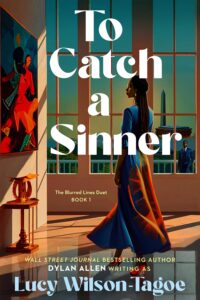
 My guest this week is Dylan Allen, and Lucy Wilson-Tagoe, who are conveniently the same person. Dylan Allen is a bestselling author of contemporary romance, while Lucy Wilson-Tagoe’s newest book To Catch a Sinner, is out now.
It’s a mystery and a romance set in DC that focuses on art repatriation and the cultural minefield therein. So we’re going to talk about art, writing, the DC of her imagined world in the book, and about the romances that shaped her writing. We also talk about her choosing a new pen name and why that was so meaningful for her.
You can find this episode on YouTube if you’d like to watch our conversation.
❤ Read the transcript ❤
↓ Press Play
This podcast player may not work on Chrome and a different browser is suggested. More ways to listen →
Here are the books we discuss in this podcast:




Make sure to disable your ad blocker to see all the books.
You can find Lucy Wilson-Tagoe at her website, LucyWilsonTagoe.com, and on Instagram.
You can find Dylan Allen at her website, DylanAllenBooks.com.
We also mentioned:
- Dylan Allen’s interview with Jillian Stein of Blue Box Press (YouTube)
- The National Museum of African American History and Culture
- Luvvie Ajayi Jones: Winning at SOTU: Miss Edith Childs. Losing: Kim Davis’ Mullet | Awesomely Luvvie
If you like the podcast, you can subscribe to our feed, or find us at Apple Podcasts, Spotify, or wherever you listen to your favorite shows!
❤ More ways to sponsor:
Sponsor us through Patreon! (What is Patreon?)

What did you think of today's episode? Got ideas? Suggestions? You can talk to us on the blog entries for the podcast or talk to us on Facebook if that's where you hang out online. You can email us at sbjpodcast@gmail.com or you can call and leave us a message at our Google voice number: 201-371-3272. Please don't forget to give us a name and where you're calling from so we can work your message into an upcoming podcast.
Thanks for listening!
Transcript
❤ Click to view the transcript ❤
[intro]
Sarah Wendell: Hello and welcome to episode number 736 of Smart Podcast, Trashy Books. I’m Sarah Wendell, and my guests this week are Dylan Allen and Lucy Wilson-Tagoe, who are conveniently the same person. Dylan Allen is a bestselling author of contemporary romance, while Lucy Wilson-Tagoe’s newest book is To Catch a Sinner, and it is out now. This is a mystery and a romance set in DC that focuses on art repatriation and the cultural minefields therein. So we’re going to talk about art and writing; the DC of her imagined world in the book, which I adored; and about the romances that shaped her writing. We have very similar tastes, so it’s very fun. We also talk about her new penname and why that was so meaningful to her.
I will have links to where you can find Dylan Allen and Lucy Wilson-Tagoe in the show notes at smartbitchestrashybooks.com under podcast episode 736. I’ll also link to all the books we discussed, because I would never ever neglect to link the books. That’s the most important part!
I have a compliment this week, and I’m very excited. This is for Carrie M.:
Carrie, your hoodies are everyone’s favorite hoodies to steal because, like you, they are a soft, warm cocoon of love and relaxation, and there are often snacks in the pocket.
If you would like a compliment of your very own, please have a look at patreon.com/SmartBitches. You can join and support the show, make sure every episode has a transcript from garlicknitter – howdy, garlicknitter! – [Hiya! – gk] – and you can help us continue each week to deliver all of the mayhem that we provide in this show, which is a substantial amount.
If Patreon support is not in your cards, may I please request that you review the show? It is still the way to make a podcast reach more people. You’d think we’d have done something different, but no! It’s just reviews. That’s all. It’s very, very retro, isn’t it?
If you are in the Patreon, thank you, thank you, thank you for your support.
All right, are you ready to get started? Let’s do this: on with the podcast with Lucy Wilson-Tagoe.
[music]
Lucy Wilson-Tagoe: Hi! I am Lucy Wilson-Tagoe. I am a writer, a reader, a lover of books, and I’m here in my capacity as author of a new book called To Catch a Sinner, which is book one in a duology called The Blurred Lines Duet. And yeah, I, I, I love words. That’s what I do.
Sarah: I too love words!
Lucy: [Laughs]
Sarah: I’m glad you’re here! Let us, let us build, let us say many words while discussing other words.
Lucy: …write as, I also write as USA Today bestselling, Wall Street Journal bestselling author Dylan Allen.
Sarah: Woohoo!
Lucy: So yes, just so y’all know.
Sarah: So I’m talking to both Dylan and Lucy.
Lucy: Yeah, but really Lucy. It’s like Lucy’s free, so you can talk to her all the time. She’s always been there. [Laughs]
Sarah: Wonderful.
Lucy: Yeah.
Sarah: Well, let’s talk about Lucy’s book! Congratulations on To Catch a Sinner. What will readers find –
Lucy: Thank you!
Sarah: – inside this book?
Lucy: They will find a romantic suspense, friends-to-lovers romance that is set in Washington, DC, that follows a very dogged and determined journalist named Sin Sackey and a mysterious and, you know, somewhat elusive lawyer named Kwame Palmer, who are, they meet one night, you know, just sort of as the Fates may have it. They meet, and it turns into something much more than they could ex-, they could expect. They have a lot in common and sort of fall around, fall in love around that. But the story she’s writing and the very complicated family he’s a member of are in conflict with each other, and so that conflict creates – you know, and the reader is more aware of it than the, than the characters are, because this is a first person dual point of view. So you – and that heightens the tension.
And it’s just a fun, it’s a, it’s a fun good time, a sexy good time, and make you think a little bit, you know, frustrate you a little bit, excite you, all sorts of things, I hope. [Laughs] I hope.
Sarah: I particularly love how Kwame is, like, very close to the vest. He is not –
Lucy: Yeah.
Sarah: – giving away a lot of information. And I know –
Lucy: Yeah.
Sarah: – that you can sort of tell through their dialogue that that, like, Sin finds that both extremely annoying but also incredibly alluring?
Lucy: Yeah. Well, because she’s so cur- – she’s like, she’s a curious person who likes a challenge. And he has been raised to see vulnerability as handing someone the keys to kind of destroy you, right? So –
Sarah: Yep.
Lucy: – he’s very – and it’s, whether it’s from experience or just what his parents have told him or shown him the world to be. And so he is not trusting of, and he’s, you know, he’s, he, they’ve grown up in very different worlds. And one, she’s grown up in a world where family’s safe and you can kind of take them for granted, and they get on your nerves a little bit, but you can still always go home. And he is trying to get as far away from home as possible.
Sarah: And it’s, it’s very interesting when two people who have very, very different dynamics with their own families –
Lucy: Yeah.
Sarah: – in real life and in books –
Lucy: Yes!
Sarah: – it is so interesting when they connect with each other, because –
Lucy: Yeah.
Sarah: – one side is like, What do you mean you tell your family everything? That’s, like –
Lucy: Yeah.
Sarah: – dangerous. And the other one’s like, What do you mean you don’t talk to your family? Are you okay? And, and both of these perspectives are valid adult decisions based on knowledge that they have about themselves and their backgrounds? But when they, those two oppositional attitudes towards family meet, there is always this moment of, Wait, seriously?
Lucy: Mm-hmm.
Sarah: Seriously? Like, your parents are, like, nice to you? Really? Yeah.
Lucy: Yeah. Or, or, yeah, or the exact opposite. Yeah! Yeah.
Sarah: So in this story, Sin’s story, as I say, you know, the, the story that she has been telling herself about her life, it ends with a near-death experience. No spoilers: this is all in the beginning.
Lucy: Mm-hmm.
Sarah: I try very hard not to spoil a book. Like –
Lucy: Mm-hmm.
Sarah: – I know the book, but I’m only talking about like the first –
Lucy: Yeah, and this is actually in the blurb, so not…
Sarah: Yeah, this is, this is, this is not a spoiler.
Lucy: Yeah.
Sarah: She has a near-death experience, and living through it really just wipes clean the whole slate or whiteboard of her life that she –
Lucy: Mm-hmm.
Sarah: – has been writing up to this point.
Lucy: Yeah.
Sarah: And I was listening to an interview you did with Jillian Stein at –
Lucy: Ooh!
Sarah: – Blue Box Press, and you talked about your decision to write this book under a new name that aligns more closely with your own heritage. And I just wanted to ask, ‘cause that seems like a wonderful parallel: What led Sin and also you to start a new narrative for yourself as an author, alongside your character starting a whole new narrative for herself in the book? I mean, like, you know, low stakes, no big deal.
Lucy: [Laughs] Well, you know, so I am naturally someone who is always looking for – I don’t sit in things that don’t serve me long. I will never be uncomfortable. I will, I’m always, lots of changes. I change my hair; I’m, I’ve moved lots of times. Only thing I have not changed is my husband, and, you know, honestly, it’s just, that’s really a testament to him? But I am sort of, you know, my whole life is a series of second chances. I started over so many times. And for me, it feels almost like the natural progression of my life is that, you know, I get to a place and I sort of, I reimagine myself in it, you know, and maybe it’s not what I expected, and so – so yeah! And, and Sin, Sin, I think, is more like most people that you have to, like, wait for the whole wall to come down before you realize that you need to make a change.
I am not that way, but it is, you know, but a lot of, a lot of people are, and I think it’s a very common experience, especially when the lore of your life has been written and told for you that you are supposed to, the definition of success is this. And you –
Sarah: Yes.
Lucy: – are responsible for not just achieving it, but also then modeling it for your younger siblings.
Sarah: Yes.
Lucy: And so, so it’s, it’s, it would take, it would require sort of near death and absolute sort of clarity that comes from, you know, usually just something being blown apart. But in a way that if she’d been paying attention, she probably would have seen coming. Right? So, there is, for me, I’m giving Sin some of – she has to have the experience. But for me, the, the wisdom and the freedom to decide, okay, I’m going to, I’m going to, I trust my own counsel so much, in fact, I’m not going to tell anyone I’m doing this. I’m just going to do it. Because last time I told them I was doing something, they all talked me out of it, and look where I am now. Every time I have – and that is very parallel for me.
In my career, I wanted to change my penname in 2019, and everyone I mentioned it to was like, Oh my God, no, you’re being dramatic. I think you, Dylan is so great, and you don’t need to change your penname. And I, and I listened to them, because they were my publicists; they were my good friends, who were successful authors; they were, you know, other professionals, agents. And, you know, and I listened to them and I wish I had not, right? And so I’m giving Sin some of that, just the wisdom of keeping your own counsel and trusting yourself, ‘cause life has shown you, right?
So that is, yeah, there’s a parallel there for me. There was a point for me to, it was so cathartic to write that, to watch someone make a decision and decide and go to lengths to make sure no one could interrupt it. I mean, she went to lengths, right? So I love that, ‘cause I’ve learned that and I, so I’ve given – so yes, the parallels exist. This, in this journey to Lucy, this time I didn’t tell anyone until I had my logo, my website –
Sarah: Wow! You didn’t tell anybody!
Lucy: No, except for my husband.
Sarah: Well, I mean.
Lucy: Yeah. And even him, I just kind of, like, got my domain name before I told him. But I told my mom, because I wanted to, I – Wilson-Tagoe is a family name of hers, and I wanted her permission to use it, because it’s very culturally specific. Like, anyone who, when they hear that, if you know the name, then everyone’s going to know exactly who my family is when they hear it –
Sarah: Wow!
Lucy: – if they’re, they, if they know the name, right?
Sarah: Can you, can you talk more about that, about the origin of these names? Because I think that the –
Lucy: Yeah, sure!
Sarah: – the names we give ourselves are so meaningful, because, you know, your name usually comes from another –
Lucy: Yes, yes.
Sarah: – person.
Lucy: Mm-hmm!
Sarah: And to be able to name yourself is a –
Lucy: Yeah.
Sarah: – really powerful act of, of self-determination and actualization of yourself.
Lucy: Yeah. It’s actually, it’s actually in, I didn’t even know. ‘Cause I was picking a penname.
Sarah: Right!
Lucy: And my pen-, the penname was, at first it was going to be something really cute, like – Lucy was always going to be there, ’cause Lucy’s my real name. I’m, you know, it’s a good, it’s a good penname for writers, whether you’re writing romance or thriller.
Sarah: Yeah.
Lucy: It’s very popular. She was like, That’s…
Sarah: Short, familiar, easy to say. Yeah.
Lucy: Right! And it’s, and it – so I knew it was going to be Lucy, but it was going to be something like Lucy Ivy Tate. Lucy, something that, and it was something I could alliterate, something I could take the letters. And then I was like, But, you know, that is also again a name that is going to begin to feel like Dylan Allen did, which is not me.
Sarah: Yeah.
Lucy: You know, in a way that doesn’t – when I’m writing stories of first-generation Ghanaians, of first-generation Black people in general, like, does Lucy Ivy Tate sound like the name that should be on those books? And so I started thinking about using a name that was culturally specific. ‘Cause my, you know, my, and the, the, the problem with being a Black person in the diaspora is that you are more likely than not carrying the name of a colonizer, right? And your last name, and my legal last name is Portuguese – [laughs] – girl. So I was like, I, because of, I’m from Ghana, and Ghana was first colonized by the Portuguese.
Sarah: By Portugal.
Lucy: So I wanted a name that was, that said exactly, I am a woman from, my family is from Cape Coast; I am Ghanaian. We inherit for, we are, we’re one of the, the few truly remaining matrilineal ethnic groups in the world –
Sarah: Yes.
Lucy: – that still, are still practice our matrilineal heritage. And so I wanted to represent my grandmothers, and I wanted, when people heard that name, who anyone who would know it would know exactly where it’s from, and if anyone googled Tagoe, they would know it was from Ghana very specifically. And it is, and I didn’t know until I, I put the names together and I called my mom to say – ‘cause these are both from her, like, two branches of her family – to ask her if I could use them. And then it was real, and I was like, this is the truest name I’ve ever had. This feels like it, this says, this is me. And I, and it’s such a, I can’t even believe I got, I mean, honestly, it’s like I, how often do you get to name yourself?
And in the book, you know, Kwame, Kwame, like, is a name that is uncommon here, but in Ghana is a very common name, because we have seven names for boys and seven names for girls, depending on the day of the week you were born, so every seventh boy in Ghana is named Kwame. You know, every, you know, that was born on Saturday, right? So it is a very, it’s a name that, you know, doesn’t feel like, he, and that’s how he feels about it. It’s like, well at least your parents gave you an, picked another name and didn’t just give you the name that is whatever. But it’s also, for some people, like, it is, my cousin who was bore, was born with a different name uses Quaku because it tells people where he’s from. Like, he doesn’t – you know, so I think it there’s so much power in it.
Sarah: Yes.
Lucy: And, listen, it’s, I feel unleashed, and I feel entitled to tell the stories I’m telling.
Sarah: Oh, I love the idea of being unleashed because –
Lucy: Yes.
Sarah: – you know, your name embodies a change –
Lucy: Yeah!
Sarah: – for you and the direction –
Lucy: Yeah!
Sarah: – that you’re going.
Lucy: Yeah, it’s like, almost like a superhero name, like something – I get it now. I get why you give yourself a name and –
Sarah: Yeah.
Lucy: – and it just fe-, like, it’s, like, unlocks a character. It’s an – or you! For me, me, as a writer, as a storyteller.
Sarah: Yep. And I love asking authors about character names and where they come from, and do they just sort of appear in your brain, or do you have a list of names that you love? But also the act of choosing a penname –
Lucy: Mm-hmm.
Sarah: – is always such a varied story. And like you said, there is such a powerful dignity and gravity to naming yourself, especially when you’re taking this name with, with, the way that you’ve assembled your name, your name is like a clue.
Lucy: Yes!
Sarah: If you get it, you get it. If you know, you – oh, hang on, I know a lot more about this person based on –
Lucy: Yes.
Sarah: – three words.
Lucy: Yes.
Sarah: I know about, a lot about this person because I speak that language.
Lucy: Yeah.
Sarah: Like, not specifically a language –
Lucy: Yes!
Sarah: – but I am fluent in that culture.
Lucy: Yes. Yes. Yeah. And that’s, and that was the point. It was – you know, and also for anyone who cares to look it up will see where I’m from. I just wanted it to be clear.
Sarah: Yeah.
Lucy: Because I don’t look like I’m from Ghana. You know, I don’t sound like I’m from Ghana. My name is Lucy, even though Lucy is a very – it is my great-grandmother’s name. I have like two cousins Lucy, and my mom’s – but it’s a very popular name in Ghana, but, you know, in general, right? You wouldn’t, to the rest of the world, no one – it’s not Ajua; it’s not Kwame; it’s not Ama. It’s Lucy, which is a little girl’s name in England, probably – [laughs] – if you’ve thought about it. So – you know what I mean? So I had to find a way to say on my fa-, on, like, you know, the bare what is it? The prima facie case of, of me is –
Sarah: Yes.
Lucy: – right, you can see it right away.
Sarah: And this is who I am –
Lucy: Yeah!
Sarah: – in three words, yes.
Lucy: Yeah, this is, that’s the, that’s such a great – thank you for that question, because I don’t think I’ve ever had the opportunity to explain it that way. I feel so happy that I’m able to take that name and bring it to life for people, women who did not have the glory they should’ve had in their own lives. Like –
Sarah: Yes.
Lucy: – I hope I bring that name so much glory, you know, for them, because they made me. They, even though I didn’t know them, I know them; I know them.
Sarah: Yes!
Lucy: I’ve, I, I cook their food, I know their less-, the lessons they taught. I mean, I’ve been raised by them, so I’m very happy ‘bout, about it.
Sarah: I love thinking about this, even though it’s, for some people, like, talking about medical things is a little gross. The egg that became you was in your grandmother –
Lucy: Yeah!
Sarah: – because babies are born, babies with ovaries –
Lucy: Yes!
Sarah: – are born with –
Lucy: Born with, yes!
Sarah: – all of the egg, what will be an egg intact. So the being, the little tiny cells that became you go back two generations.
Lucy: I know.
Sarah: Which means your grandmother was present in her great-, her grandmother! And that’s, that’s like five generations already, just, just from two people –
Lucy: Mm-hmm.
Sarah: – and two, two birth spans.
Lucy: Yeah.
Sarah: The, the way in which generations overlap, and how sometimes the generations behind you, they just disappear. Like, no –
Lucy: Yeah.
Sarah: – no one, no one remembers anything about that.
Lucy: Yeah. No, not here. And not in our family, you know, the oral history. I’m, and I’m also a historian. I studied history.
Sarah: Oh, cool!
Lucy: Like, my degree, my first degree in, was in history, and I, and I wrote my thesis in particular postcolonial West African social history. And I –
Sarah: Oh wow!
Lucy: Really, I mean, that was my –
Sarah: Small topic.
Lucy: So for me, I’m, I’ve always been interested in the story of people –
Sarah: Yes!
Lucy: – you know? And in my, and in my family, I’m the family archivist. I mean, I keep, I keep the records. I have pictures of my mom when she, from when she was in college and she, when I show her, she’s like, Where’d you get this from? I’m like, Oh, don’t worry; I have my sources. I mean, I, I collect the stories! I lay next, I sit with my aunts and I, and I, and they, I listen to what they tell me, and I write it down, and I’ve, I have kept, I know allll the family’s secrets. I know all the lore, and I’m sharing it with my children, my nieces, my nephews, because I really believe that, you know, they’re worth sharing.
And in the same way in this book, you know, our Sineway is a journalist because she’s a storyteller, and they’re stories that she believes she is uniquely qualified to tell. And –
Sarah: Yes!
Lucy: – she wants to make sure that even if, like, they’re not sensational and, you know, that they are important enough that she wants to make sure there’s a record of them. But all my writing is so personal. All of it, even, even when I’ve written characters that are not Black, that are not, you know, that – all of my characters are, are immigrants or the children of immigrants. You know, all, almost all of them, no matter where they come from.
I’m just so glad that I get to do this, and I get to do it as Lucy and Dylan, ’cause Dylan is, is also very real too now. You know, she has a personality and a voice, and now, but now I get to be a whole –
Sarah: Get to be a whole new person.
Lucy: Yeah. [Laughs]
Sarah: While still being yourself and carrying all your knowledge. It’s not like you’re in a, you know, in a Harlequin Presents and you got hit on the head, and you got amnesia, and you don’t know –
Lucy: [Laughs]
Sarah: – who the baby daddy is, and why am I a millionaire? How did I get pregnant? I have read, by the way, Who’s the Daddy?
Lucy: No! I hope one day I have the –
Sarah: Who’s the Daddy? is a real book! [Laughs]
Lucy: You know, I really hope one day I have the opportunity to write for a Harlequin, or, like, to write a romance like that. I, that’s actually one of my goals. I know that I, I write more, like, you know, big romances, but I want one day to write a, a sixty-thousand-word Harlequin romance that is about a woman – something like that. Because I, that’s, those are the romances I cut my teeth on.
Sarah: Oh, me too!
Lucy: You know, when I – yeah!
Sarah: Oh!
Lucy: Like, when I was, when I was twelve and thirteen, I was reading Harlequin romances and just being like, Wow! You know, and I loved soap operas, and I loved – I mean, but I really loved the storytelling where women had choices. And –
Sarah: Oh yes.
Lucy: – and, and, and men went out of their way to, to make them love them and to love them and to make their dreams –
Sarah: Yes.
Lucy: – come true. I mean, I loved it! You know, even if it meant, you know, hitting them over the head and dragging them onto a pirate ship and taking them. I mean, ‘cause I, you know, I grew up on Johanna Lindsey.
Sarah: Yes! Oh my gosh, Johanna.
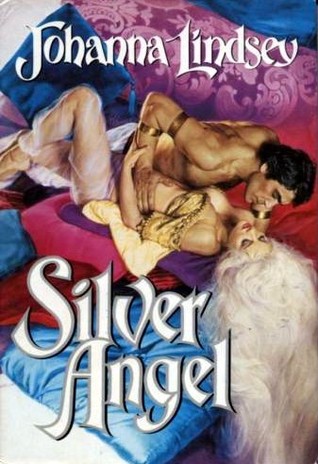
Lucy: Johanna Lindsey! Silver Angel was the first romance I ever met, right?
Sarah: Oh my God, I talk about that book all the time!
Lucy: Yeah! It’s the first romance –
Sarah: That book –
Lucy: – I ever read.
Sarah: Like, you start to describe the premise of that book, and people just look at you like –
Lucy: [Laughs] I know! I know!
Sarah: – You read what?
Lucy: I know! It’s like she was, she was, she was kid-, she was kidnapped in a white slave ring and her…
Sarah: And her name is Chantelle.
Lucy: …where she made, where she became his love interest, but it was his twin, and his mother was there, and she was also kidnapped and made to be – I was like – then I’m like, Oh, never mind. Never mind! You would, you just had to read it to get it.
Sarah: You just, you just have to truly –
Lucy: I still have it.
Sarah: You, you have to be there.
Lucy: I still have that book. It’s at home in my parents’, in my childhood bedroom, but I still have it. That –
Sarah: I –
Lucy: And the cover’s torn off, ’cause I had to hide it from my mom. [Laughs]
Sarah: Oh, I mean, if you had the cover with her in the little yellow bolero jacket and her white hair spilling –
Lucy: Yes!
Sarah: – over the side of the bed, yeah, that was very clearly about what was about to happen. And he had like a ring on his bicep and everything. Like, it was about, it, it was about to happen.
Lucy: I just take the cover off.
Sarah: Ugh!
Lucy: Yeah.
Sarah: I’m so sorry, ‘cause that cover art is –
Lucy: Anyway, so yeah! No, I mean, that’s the romance that raised me. And I, and I still feel like so, so many people have, like, complained – not complained, but the, the cliffhanger has been, you know, the number one complaint of this book, of people being like, Oh my God. And I just, I’m like, you know, I’m trying to bring it back. I, the contemporary romance, too, that I cut my teeth on, all of them had cliffhangers.
Sarah: Oh, if it was a series, forget it. You knew, you went in knowing that you were, the ending was to come.
Lucy: Brutal!
Sarah: Oh yeah.
Lucy: Yeah, I love it! Let’s do it again. [Laughs]
Sarah: One of the things I really like about To Catch a Sinner is that the mystery that runs through the book begins with, you know, art theft, smuggling, the black market for art, but for specifically African art in the diaspora that has been stolen and is being recovered. What led you into that world? What did you learn about it? There’s this wild synchronicity happening for me because I just did an interview with Jo Piazza, who wrote The Parisian Heist, which is also about smuggling and fraud and counterfeit and the black market. So I feel like the world is telling me I need to know everything about art right now. [Laughs]
Lucy: Well, because, and I, and honestly, for me, one of the things I hope people, we will integ-, interrogate our relationship with art that is in museums.
Sarah: Yes.
Lucy: Because, you know, the theme, one of the themes in the book is, you know, who gets to tell this story, this thing, or who – whatever, you know, the little tagline. But the real sort of thread under that is about who gets to call something art. What is art? Who gets to own it? Who – and, and what does it mean when we stand, go to museums and, you know, and enter and look at something and call it beautiful, call it art, when it is really not art? It is somebody’s heritage that has been removed in a way that has deprived them. The tapestry of their lives has –
Sarah: Yeah.
Lucy: – forever been changed in a way that their parents can’t, you know, they can’t interact with, you know, this statue or this carving or this, you know, stool. And, and so, yeah, I mean, I think that for me it is that. It’s, I love museums, but in the same way that I went to SeaWorld once and I realized, this is really wrong. And then I watched Blackfish, and I was like, Oh my God, I can never participate with that again. I’m not saying people should stop going to museums, because not everything in museums is stolen, but also a lot of the things that are, I think that we should be more, we should be advocates for the cultures that we get to enjoy when we go to museums. We should ask questions about where things come from, and we should find out how we can support the move to repatriate.
Not just, I mean, it’s not just African art; it’s things from all over the world. And it’s not just art: people’s bones, skulls, Bibles, family Bibles, you know, family jewelry. You know, there’s this boat race, it happens in this small village in Cameroon, and they have this big thing, this big piece of wood that goes at the end of the boat, and it’s like a, an ancestral sort of marker, and it’s so meaningful, and they’re, so many of them are missing. And they do this thing every year, and there are all these boats that don’t have – I mean, there’s, these are, these are important things, but ‘cause it’s in a museum somewhere. I’ve been in people’s homes, rich people’s homes, who have, have pieces of things in their homes that, that belong somewhere, you know, that have been removed –
Sarah: That’s wild.
Lucy: …and, and it feels violent to me. So I just want us to think about it. And I want us to ask questions, and I want us to, in our own way, you know, just be more responsible consumers of culture.
Sarah: Yes.
Lucy: You know, all culture, not just art. And to give credit to the things that inspire us as well.
Sarah: It is so interesting –
Lucy: You know?
Sarah: – ‘cause I, I mentioned I did an interview with Jo Piazza about The Parisian Heist –
Lucy: Yes!
Sarah: – and we talked about art thievery and the black market. And we talked about how people love a heist, especially, you know, art being stolen or moved because it –
Lucy: Yeah.
Sarah: And I, and she says, Well, you know, people think of it as a victimless crime, but we are all the victims, because we do not get to see that piece of art anymore. And what is fascinating about your angle and the way that you’re looking at this exact same problem is – one of the things that Jo Piazza talked about was the fact that the things that we describe as art are usually done by dudes, probably dead, probably white, the famous artists.
Lucy: Mm-hmm.
Sarah: There’s a lot of men, a lot of white men, and a very narrow group of people got to say, This is art. The rest of this is nothing, but this is art.
Lucy: Mm-hmm.
Sarah: And with the artifacts that you’re talking about in To Catch a Sinner, the labeling of it as art is part of the justification –
Lucy: Mm-hmm.
Sarah: – of stripping it away from the culture in which –
Lucy: Yep.
Sarah: – it belongs.
Lucy: Right.
Sarah: So the, the labeling it as art is almost an act of violence because it’s like –
Lucy: Yes!
Sarah: – Okay, this is so valuable that I need to own it in my house? You can’t have it for your, you know, annual event; your, your, the way you use it culturally; the way you use it religiously. You can’t have that ‘cause this is so valuable. I need to have it?
Lucy: Yeah.
Sarah: ‘Cause it’s art? Like, art –
Lucy: Yeah.
Sarah: – labeling it as art is almost like a, a weapon of colonizing.
Lucy: It is! It is! It is! There’s a fantastic book I’m reading right now called Silencing the Past. It’s not new, and Adriana Herrera recommended it to me, and I, and I already know, I’m already halfway through and I know it’s going to be an automatic reread – that talks just about this narrative of who gets to, who, the decision of what is language, what is literacy, what is art, what is music, what –
Sarah: Yes.
Lucy: – is fashion, what is beauty? All these things are very deliberate, and the answer to that is it’s different in every place you go, and trying to universalize art and say –
Sarah: Yes.
Lucy: – is like, you know, I’m – Chimamanda Ngozi Adichie said in her, the, you know, she had that TED Talk about “The Danger of a Single Story”?
Sarah: Yes.
Lucy: It’s dangerous.
Sarah: Yes, it’s very dangerous.
Lucy: That is because, because, well…because behind that art is a lore about a group of people who are real, who have to then live with the consequences of you telling a story about them, so that, like, when I moved to America, every, the only story anyone ever told about Africa or any part of Africa was that, you know, it was poverty and, you know, famine. And so people, I just remember being so startled that people were shocked that I knew what Coca-Cola was or that I – [laughs] – you know, that I had a, I had a car. And I didn’t understand. I was like, Well, do y’all not have cars? I don’t under- – and then I found out that there was just this one story of Africa.
Sarah: Yes.
Lucy: And, and, and, and –
Sarah: Probably the Ethiopian famine.
Lucy: …a certain way!
Sarah: Yeah.
Lucy: People made assumptions about my ability, about how I could read. And I was a very, very early reader and a very, very –
Sarah: Yes.
Lucy: – big reader from the time I was little, but I came to a country where people just assumed I didn’t even speak English. [Laughs] You know, it was very crazy. So I think for me, you know, representation in fiction is important. It’s important for us to tell the stories. You know, I, I, not everybody has that calling, but for me, my calling is to tell the stories, just like Sin, I feel uniquely qualified to tell. They’re fiction, but they carry in them a lot of truth –
Sarah: Yes.
Lucy: – and a lot of people’s real lived experiences, with some fun thrown in so that we can enjoy them. We can enjoy the story of people that – yeah.
Sarah: Now, I am dying to ask you about the romances that have played –
Lucy: Mm.
Sarah: – such an important role in your writing career.
Lucy: Yeah.
Sarah: I know that you mentioned that Seven Years to Sin by Sylvia Day –
Lucy: Oh yeah.
Sarah: – was an impactful book for you, and the Pennyroyal Green series was impactful for you. Please tell me everything about how these books affected you and what other romances are really big sort of signposts on your narrative that have influenced who you are. Because I have, I am – like, we just talked about Silver Angel, and my whole body lit up.
Lucy: [Laughs] Yeah!
Sarah: I can’t, like, recommend that to a person who has just started reading romance? You need a high degree of fluency to embark on that much problematic content.
Lucy: Yeah!
Sarah: But –
Lucy: Or, or none.
Sarah: – that is –
Lucy: [Laughs]
Sarah: – or, or none. Or none! Just go in without any idea! But that is a fundamental book for me, for Sarah as a romance fan. That and Midsummer Magic by Catherine Coulter. Like, there’s some bonkers historicals that made me who I am.
Lucy: Yeah.
Sarah: And I, I, I own that, you know?
Lucy: Yeah, and I, and I think that what is, for me, because I’m, and I’m sure you too, is, you know, that I’m a very broad reader, and I understand the role – I, one, I understand it’s fiction, all of it. But it’s also an insight into the way someone sees the world, right?
Sarah: Yes!
Lucy: Or someone imagines it or fantasizes it, and, and sometimes it’s a con-, you know, it’s a conduit to, like, finding out, you know, that you’re not alone in this, oh my God, I love this little weird thing too! This is something that excites –
Sarah: Yep!
Lucy: So, you know, I read, Seven Years to Sin was, I, I just really loved the second chance nature of that story. And of the way, how kind of scandalously it began. Yet there was this, I loved the instant connection in that book. In that book, they, the first time they see each other, he is making love to somebody else, and their eyes connect in that moment. And that, I mean, I think it just is, it talks, to me, it talks, it really speaks to the transcendency of, like, of connection.
I love Fated Mates. I mean, Kresley Cole’s Immortals After Dark for me is seminal as a romance reader. It just is like love is possible anywhere between anyone, ‘cause love is such a, it, you know, it, it can intervene in a way that almost nothing else can.
So I love Loretta Chase’s Lord of Scoundrels?
Sarah: Yes.
Lucy: With Dain and Jessica, to me is the most perfect enemies-to-lovers ever? And I just like high stakes. I like when people go too far and still get a chance to have what they want.
Sarah: Yes.
Lucy: I love when people go too far and meet someone who’s like, Yeah, go further! And I love romances that give characters, give people exactly the partner they deserve.
And I, like, Pennyroyal Green, for me, I just found that world that she wrote so intriguing. And I loved – have you read it?
Sarah: Oh, oh, oh yes!
Lucy: Yeah! So yeah, right.
Sarah: Ohhh yes!
Lucy: So you know what I mean. And it was so smart. The writing was so smart. I remember reading, I think it’s the second or third book in this series – How the Marquess Was Won, maybe? And it was so clever. There’s this wonderful banter, and then there’s family drama and this secret. Everyone thought the families clashed about one thing, but it wasn’t about that at all, and you didn’t really find out, but you kind of knew, and it was so scandalous what the thing was! And then there was – I mean, and it was all the kids and all the people coming to this town, and the town was a character. I love that. And I want, but I wanted to create a more diverse aspect of that, and for me, I think – like, I love Kristen Ashley; I love Kennedy. All my early romance reader, reading things were, you know, were when people wrote big stories. Kennedy Ryan, Kristen Ashley.
Sarah: Yes.
Lucy: Kennedy Ryan’s Soul series rewired my romance expectations and what I thought a romance could do and how it can make me, how it can make me feel. The writing was just so gorgeous! The story was so angsty in a very unapologetic way. Like, these characters were so flawed and yet still so – I mean, I loved it.
And Kristen Ashley the same. I write big stories ‘cause she does. I loved her – they’re bonkers! Like, nuts! Like, I mean, it was like – but I love them, and I love, I just, you know, I – there’s Laura Kinsale.
I mean, honestly, I’m so grateful to live in the time where indie romance exists, ‘cause it introduced me to so many Black writers that trad –
Sarah: Yes.
Lucy: – shut out, right?
Sarah: Yes.
Lucy: So, like, I love Love Belvin; there’s Joan Vassar; there’s Christina C. Jones; I mean, Alexandria House. And you know, right now it’s such an amazing time for, you know, to, to be reading across the diaspora. There’s First People romance, lots of first gen romance all over, from all over the world. And so for me, I just, I just want a good story, and I want one that was written in, with the intention of being a good story and not necessarily just fashionable at the time.
Sarah: Yes.
Lucy: I mean, sometimes the two converge?
Sarah: I mean, I look at, I look at Kennedy Ryan’s success right now, and every time I see an update I’m just like, Yes! More?
Lucy: Yeah!
Sarah: Yes, more! This is happening! Like, I –
Lucy: …getting it right.
Sarah: – I’m just, like, cheering all of the time, whenever I –
Lucy: Yeah.
Sarah: Like, her career just keeps getting bigger and bigger –
Lucy: Yeah!
Sarah: – and I’m like, This is glorious.
Lucy: Yeah, it’s glorious, because it’s, because she’s worked so hard and she deserves it and, and it’s very intentional. This is – and it’s inspiring, right? But, and, and –
Sarah: Mm-hmm.
Lucy: – but it, but it’s also, feels very, like, this is a, so many authors who started in the year having moments like that and careers like that, and you know the –
Sarah: Yes.
Lucy: – she’s having lots of sort of, you know, golden ticket moments. But in general, I think that the opportunity to do whatever you want right now as a storyteller is, the moment exists right now.
Sarah: Yes. And I think that –
Lucy: Yeah.
Sarah: – I find that in my own career –
Lucy: Mm-hmm.
Sarah: – when I am very clear about my, my purpose, my why –
Lucy: Yeah.
Sarah: – I find the next thing that I’m meant to do a little easier. Do you know what I mean?
Lucy: Yeah!
Sarah: Yeah. I, I actually have it in my journal. I have a quote –
Lucy: Oh!
Sarah: – that I wrote down from Luvvie Ajayi Jones, and –
Lucy: Oh yeah, Luvvie! Yeah!
Sarah: I love, I’ve, I have followed her all the way back to the Democratic National Convention when there was a – gosh, her name just flew out of my head. She is the, I want to say the Black Democratic delegate from South Carolina. I think she’s in her nineties, and she was at the State of the Union, and Luvvie did a whole post about how fabulous she was, and that was how I found her. So the Democratic con- – no, it was the State of the Union with President Obama. So that’s how…
Lucy: Oh, yeah, yeah, yes, yes, yes. But Luvvie is amazing.
Sarah: But she said – I have it right here in my journal:
>> Don’t attach your confidence to the outcome. Attach your confidence to the mission and the purpose and the why.
When your confidence –
Lucy: So profound, yes.
Sarah: – is attached to the purpose –
Lucy: Yeah.
Sarah: – it’s a little easier to spot, Oh, this is for me.
Lucy: Yeah.
Sarah: This is what I meant to do next.
Lucy: Yeah. Absolutely. She’s, I mean, I find her really smart and, you know, very honest in a way that is vulnerable and flawed, but just so –
Sarah: Yes.
Lucy: – so, like, I, I have a lot of respect for her. And –
Sarah: Yes.
Lucy: – and I think that’s very good advice. I agree. ‘Cause the, the outcome, what is it, anyway? Like –
Sarah: Yeah!
Lucy: – you know, when is the journey over? And I think that’s the thing is, like, the journey is the, the destination is the journey –
Sarah: Yes.
Lucy: – you know, and I used to be such a destination-oriented person. Like, I used to be really focused on where I was trying to get, and I –
Sarah: Me too! And –
Lucy: Yeah, you know?
Sarah: – and it can really give you tunnel vision!
Lucy: Yeah, of course! And, and, and also have you missing out on opportunities and blessings and people. And you know, in Song of Solomon, Toni Morrison says something – I don’t think she’s the original, original person in the quote; I think it might be the epigraph. I just can’t remember the originator of it, but it says if you surrender to the air, you can write it?
Sarah: Yes.
Lucy: And I am such a control freak. Like, I need – and, but I, in order for me to do this job and retain my sanity, I had to surrender. And boy, I have been taken places I could not have taken myself –
Sarah: Yeah.
Lucy: – if I had tried to control it. I’m so glad I let go. And I’m scared a lot of the times, and sometimes, you know, I get a little dry – [laughs] – you know, the windlets that I have to fight. But, but I am, it’s amazing. And so yeah, I think that for me, the letting go and letting the stories, like really doing my, my purpose, finding my purpose in the –
Sarah: Yeah.
Lucy: – thing I’m doing and not necessarily where I think I want to go has –
Sarah: Yeah.
Lucy: – been where I have found all my best things.
Sarah: I think you and I are also very lucky in the era of romance that we –
Lucy: Yeah.
Sarah: – have existed in, because we started reading in an era where there was a very specific, narrow definition of successful author and how you became an author. You wrote a manuscript, you queried an agent, you got an agent, you got a contract –
Lucy: Yeah.
Sarah: – and then you were the author of that house, and they would, you know, maybe build your career. And then we had indie publishing. And the way to publication is now such a varied and open path that –
Lucy: Yep.
Sarah: – on one hand, I, I too am a control freak –
Lucy: [Laughs]
Sarah: – but I also have to acknowledge that I made up my own job.
Lucy: Yes.
Sarah: And, and every other indie author has made up their own job –
Lucy: Yep.
Sarah: – and so there isn’t just one definition of what success looks like.
Lucy: No. And there’s so many different kinds of successes happening and, you know, and I, I mean, we all want, hope that it’ll, the success will mean a lot of sales, but sometimes it’s other things. And –
Sarah: Yep!
Lucy: – I think when, you have to, your why is important for that reason, because that is how you, you don’t get lost in comparison, which is –
Sarah: Yes!
Lucy: – really dangerous, you know, for your growth, because you cannot compare your – it’s a, you, if – there’s no way to do it healthily or safely or accurately, because you can take two people, put them in the exact same place and give them the exact same tools and give them the exact same time, and everything will be different.
Sarah: Everything.
Now, I have to thank you very personally for something about this book.
Lucy: Oh!
Sarah: In this book, like you said, that, that Washington, DC is like a character. Like in the Pennyroyal Green series, the world is the character, and in, in this book, DC is a character! I saw on your website you wrote,
>> My DC has a Black woman behind the Resolute Desk and is a place where everyone is acknowledged and welcome.
And –
Lucy: Yeah!
Sarah: – oh my God, did I need this vision of DC. Like, I didn’t know I needed it, and then I was like, Oh, that’s, that’s what it was like when we first moved here ten years ago. We got a small taste of how gorgeous it was and how it could have been.
Lucy: Yeah.
Sarah: How did you approach writing about this area to make it as vivid and visible to the reader in a place that unfortunately is, like, really the opposite right now? The vibes are so bad. And you wrote vibes that are just gorgeous!
Lucy: Well, first of all, my intention was to, was to bring back the vibes that are…
Sarah: Yes!
Lucy: Because I, I mean, I lived in DC in the best time. I lived here in the Obama years from – we, I was, we were, from 2007 to 2014 we lived here for the first time as a married couple when there was just nowhere – I mean, we only left because my dad got sick, right? But I loved DC, and I went to law school here as well. So I just knew when we came back this time in 2022 – 2023, 2? Whatever? I don’t know. One of those years, ’cause those years are a blur – we were living near Baltimore, but, you know, I, I, for me, DC is just to – I was living in Texas; forty-five minutes is nothing to drive to get –
Sarah: Oh no, my, my son goes to college in Texas, and it’s like nothing.
Lucy: Yeah. Everything, yes. So I, I get down there a lot. I love, you know, and, and so I just wanted, I wanted, I, I was, I was devastated when the, I found out the Dean & DeLuca was gone in Georgetown because that was such a, like a place in the time of the time, right? So I brought back the Dean – I almost took it out of, of the manuscript, but I’m so glad I didn’t. So many people have been so happy to see it? I just, I, and also, you know, I went to all the places in the book. I went with my phone, and I just would drive down the street, just so I could, because I wanted to make sure that, you know, yes, I’m bringing back some things, but I also really want to capture what it feels like right now…you know, and I – and so I have, my phone is full of videos of all the neighborhoods: NoMa, Georgetown, McLean. I took my, I used to take my kids to Clemyjontri Park in McLean when they were little. So I, and my, one of my best friends grew up in McLean, so she helped me talk about what it was like to be a teenager in NoVA at the time. One of my other best friends grew up in Fairfax.
So I just, I just did my research. I spent my time in the places I was writing. I went to the NMAAHC – that’s the Museum of African American History and Culture – a lot and, you know, just walked around. You know, sat in the grass, smelled the air. Just really did my, my – but that was, that’s the fun part for me, because what a beautiful place.
Sarah: Oh, it’s…
Lucy: What a – and even though, you know, the air is not as fresh as we like it right now and there’s smell of sulfur coming down from across from McPherson Square a little bit, it is still DC. It is still Chocolate City. It’s still got such a vibe. And the people are still making it that way. I mean, you can just go down to, you know, near the convention center on a Satur-, random Saturday afternoon and walk into a street festival in Chinatown or, you know –
Sarah: Oh yes.
Lucy: – anywhere, you know, near the – I, I mean, I take my kids to the National Portrait Gallery at least once a quarter, you know, just to go see what’s new. And you can still do that! And on –
Sarah: Oh yeah.
Lucy: – on the way there, you usually walk through some sort of music or food thing going on. And the weather, there’s all the four seasons; the weather’s – I mean, there’s just nowhere else that’s so pretty in spring, I think. So for me, it was just a matter of paying and then giving us all just a taste of what we were hoping for. Well, most of us – well, maybe not most of – I don’t know what’s going on – but giving us a taste of what it might have been like to live in a DC that was led by someone who loves – I mean, do you remember in the Obama years, there were, like, jazz festivals at the, at the White House?
Sarah: Oh yeah.
Lucy: There was a garden where you could actually take your kids to grow things at the White House! An Easter egg roll –
Sarah: Yeah.
Lucy: – at the White House. My kids went to the – my oldest, not my baby, but went to the White House for Easter egg roll like three times! You know, we went, my, one of my friends from law school worked in the White House for all eight years that he was there, and she would invite us over to, like, to go bowling. I mean, not – that was special access, but the public in general! It was open!
Sarah: Well, there was an affection. Like, one thing I keep saying, like, I feel like this, this administration hates Americans. They hate us!
Lucy: Yeah! Yeah!
Sarah: They hate us for being alive and needing health care and wanting to have jobs and houses. Like, they hate every one of us who isn’t them.
Lucy: Yeah.
Sarah: And I miss –
Lucy: That’s right, they do! And they hate D-, they hate everything that’s beautiful that we love, because, you know –
Sarah: And they hate DC. They hate DC ‘cause they can’t control it.
Lucy: But they also love it, because they can’t – I mean, it’s amazing, right? So they want to, like, make it their – but they can never have it.
Sarah: Nope.
Lucy: They can – I, I, listen, I don’t know, I, Ghana, you know, I come from a country that has been through a coup, that has had dic-, a dictator ruling it for twelve years. We have come on the other side of it. It’s one of the most peaceful places in the world. It is a choice, and as soon as people realize that we can choose and we have the power, everything will change, and I believe that will happen.
Sarah: I do too.
Lucy: I do believe it will happen. I just hope it happens sooner rather than later. But I – people like them can never have anything good. And this is a good place.
Sarah: This is a wonderful place.
Lucy: This is a wonderful place!
Sarah: It’s a wonderful – we moved here ten years ago. I’m originally –
Lucy: From where?
Sarah: – from Pittsburgh.
Lucy: Oh! Okay.
Sarah: I’m originally from Pittsburgh, but I moved here from Montclair, New Jersey, because for years and years my husband and I both worked in Manhattan. So I moved from Montclair to Silver Spring.
Lucy: My…was there! Oh my God. Yeah, sorry, keep going. But I love Montclair; it’s so pretty…
Sarah: I love Montclair too! Also –
Lucy: Yeah.
Sarah: – a diverse place. Also –
Lucy: Yes!
Sarah: – filled with people who are terribly creative and wonderful.
Lucy: Yes!
Sarah: Like, half of publishing lives in Montclair, in that area.
Lucy: Yes! Yeah!
Sarah: And I remember moving down here and that, like, my favorite cultural difference is that, you know, in New York, in, in Manhattan, it needs to be like actual livestock, like cows need to be falling from the sky before you think maybe, maybe I won’t go to work today. Snow?
Lucy: Right! [Laughs]
Sarah: Don’t care.
Lucy: Right.
Sarah: Torrential rain, an actual hurricane. No, no, no. Go to work.
Lucy: [Laughs] Yeah.
Sarah: And here, because so many people are feds, they have –
Lucy: Yeah.
Sarah: – like, duty hours!
Lucy: Yeah.
Sarah: And when they’re not working, they’re not working. And –
Lucy: Yeah.
Sarah: – like, we moved here and I’m like, people have hobbies! They, like, do things?
Lucy: Yes, yes.
Sarah: And when you go into D- –
Lucy: Regularly!
Sarah: Yes! Like, they bike, they build!
Lucy: Yes!
Sarah: And when you go into DC, every weekend there is something to learn or do.
Lucy: Yeah.
Sarah: And my favorite thing is, you know, you go to a museum like, Oh, we’re going to go to this museum. Between the metro and that museum, you’re going to walk by like two other museums that you might not have heard of?
Lucy: Yeah.
Sarah: So you can add those to the list.
Lucy: And almost all of them are free. The Smithsonians, all free.
Sarah: [Sings] All of them are free! Yes!
Lucy: The Smithsonians are all free, people.
Sarah: Love it, love it, love it. I loved your DC. It was such a pleasure to be in, and I just, I have to say thank you –
Lucy: You deserve it!
Sarah: – because I wanted that so badly. And it, like, I, I feel sick to my stomach when I think of what opportunity we have missed out on. And I hope we can, I hope we can make changes to bring back what could have been.
Lucy: It’ll take intention and the people in power –
Sarah: It will take intention and effort.
Lucy: – and the people in power wanting that too, but we can do it!
Sarah: I hope so.
Now, can I ask you about the cover of To Catch a Sinner? Because it is exquisite. Oh my gosh. Like, every time I look at your cover, I notice something different.
Lucy: Yeah. Oh my God! Yeah, it’s got –
Sarah: Like, I didn’t, I didn’t notice at first that the hero is off on the side –
Lucy: [Laughs] Yes!
Sarah: – looking through the window.
Lucy: And that’s so cute.
Sarah: It’s – and his –
Lucy: That’s Jillian’s idea.
Sarah: It’s a brilliant idea!
Lucy: Oh yeah.
Sarah: Also, the pose with one hand in his –
Together: – in his pocket –
Sarah: – and –
Lucy: Yeah.
Sarah: Let me verify before I speak out of turn.
Lucy: [Laughs]
Sarah: Yes, we do need to bring back the three-piece suit! We do need to have the three-piece suit make a solid comeback for everybody, ‘cause that is, that is gorgeous.
Lucy: Very, very, very Kwame.
Sarah: Very stylish. But then you have this gorgeous, isolated figure of your heroine. Her skirt is gorgeous, her posture is gorgeous, there’s movement, and she’s looking at art and things that are significant in the story. Is, is she – okay, when you saw this cover, did you have to put your head between your knees?
Lucy: Yeah.
Sarah: How much, how much did you see the development of this cover? ‘Cause, I mean, everyone who –
Lucy: Okay, so –
Sarah: – everyone involved did a gorgeous job.
Lucy: So the first dr-, the first cover, when we talked about it, I think they, there was something like cherry blossoms, and I was like, You know, no, I really think we need to have her on the cover because it’s Black romance and, you know, that is very important to this readership and to me. And so I gave them some comps of covers I really liked, and my number one favorite was Sweet Heat by Bolu Babalola? She’s a Black British romance writer, and he sent back several drafts. Literally, that was his first draft of that cover. He sent back several options; that was one of them. And when I saw it I was like – [gasps]. I think our dress was a different color. It had the White House instead of the museum on it. It had – yeah –
Sarah: You don’t need that.
Lucy: …that off. I was like, Please get that off. And off, please get that off. Just get it off. And then also I it didn’t have the stool there, and I still – but literally, that was his first dra- – I mean, everything else, the composition. He just really listened! I mean, I wanted there, the art to be clear, her to be clear. She has braids in the story; he gave her braids. I mean, it’s perfect. So yeah, I really did, and we all knew, even though there were several other covers, everybody, when it came, when it went, made the rounds, everybody was like, Oh my God. Well, obviously that’s the one.
Sarah: Yes.
Lucy: Yes. Oh yes! So happy that you love it!
Sarah: Oh my gosh. I – gorgeous. And when I do the video for this, I’ll –
Lucy: Oh, you’ll stick –
Sarah: – I’ll stick it on the screen. Don’t worry, I will make sure everyone sees how beautiful this is.
Lucy: Yes, it has –
Sarah: I think my favorite thing – in addition to three-piece suit; everyone should wear them – I love that in the background, the Museum of African American History is in front of the Washington Monument, which –
Lucy: Yes!
Sarah: – I mean, makes sense, but it is putting Black history in this country ahead of the national history.
Lucy: Yeah! Well, it, yeah, well, it’s making it, it’s showing, I mean, it’s –
Sarah: It’s foregrounded.
Lucy: Yeah! It is, it is at the foreground. And honestly, that is, a lot of it is a love letter to the Black diaspora in DC, just as the museum is? The museum is just, it’s like, you know, it, the, the brass plates come very, very, very directly from the brasswork that you find in Charleston and New Orleans by –
Sarah: Yes.
Lucy: – and it’s done by, you know, formerly enslaved blacksmiths. That’s one of the ways that they’ve, they built their lives and their businesses after slavery was abolished. And so –
Sarah: I went to college in South Carolina –
Lucy: Oh, you did?
Sarah: – a women’s college, and my very best friend, who – we still talk – she did her senior thesis – she was an art major – she did her thesis on the symbolism and the ironwork of all of the wrought iron gates all over Charleston, and I think some in Dillon as well. So I got to watch her build a project about these wrought-iron gates, and it – I mean, I graduated high, college in 1997. I think about this all the time. That ironwork is so rich in history.
Lucy: You graduated college in ‘97?
Sarah: Yes, ma’am.
Lucy: So did my sister. I graduated in ‘99, but my sister, my sister also went to an all-women’s college that she graduated from in ‘97.
Sarah: There are so few of them left, but I credit the, the all-women environment. I didn’t know that it would be so impactful, but it was definitely impactful.
Lucy: So did she. She’s trying to get her daughter to, to, to – she went to Wellesley College, which is really, really beautiful, but it’s also, like, really, really out in the middle of nowhere, so. Anyway, but that’s so cool about the art and that you’re, you know, so you know what I mean about the –
Sarah: I know exactly what you mean.
Lucy: – the, those wrought – I mean, and, and, but the shape of the museum, that, that sort of corona is –
Sarah: Yes.
Lucy: – comes from a Yoruba sculpture tradition, and the chief architect is a man from Ghana. It’s very much, it’s very much a diasporic love story in itself and so important. And it’s where, the scene, it’s the scene of the crime; it’s where the story begins –
Sarah: Oh yeah, the –
Lucy: – and –
Sarah: – the museum is practically a character too!
Lucy: It is! It is, and it, and it had to be, because, for me, it was the one place I felt also – besides, the Museum of African Art is also there, but this is a history museum.
Sarah: Mm-hmm.
Lucy: And so it felt like the one place where, that had the right to hold the artifacts who they belong to would entrust the NMAAHC to be the place where they might be on display.
Sarah: Yes.
Lucy: And that’s true: if you go to NMAAHC, you’ll see a lot of West African sculpture and artifacts and tools –
Sarah: Yes.
Lucy: – that are there, you know, with permission of the people they belong to, which is very important.
Sarah: Very important.
Lucy: Mm-hmm.
Sarah: One of my favorite things to think about, and if I had the inclination to do more fiction writing, I would probably want to write about this? So I love the Works Progress Administration. The entire idea –
Lucy: Oh!
Sarah: – that the federal government was like, We’re going to pay people to make art. We’re going to pay people to make art –
Lucy: Yeah.
Sarah: – during the Great Depression. And this was one of the most diverse and inclusive federal programs at the time? They hired and gave money to artists all over the country, with the Latino artists, Black artists, immigrant artists, women, queer artists, and they were making art and murals and things.
Lucy: It’s amazing.
Sarah: All of the art commissioned by the Works Progress Administration belongs to the United States and is property of the citizens of the United States, ‘cause our tax dollars –
Lucy: Yeah.
Sarah: – paid for it. But it’s, a lot, a lot of it is in private collections, because some of those artists went on to be very famous, and all of a sudden this thing that they made and the, you know, for the WPA is worth badrillions of dollars.
Lucy: Are you serious?
Sarah: Totally serious. So there’s a division of the Secret Service whose job it is to find, source, and recover Works Progress Administration pieces from private collections, from auctions. They scour, like, eBay and auction sites, and they’re like, That’s a WPA piece. And they go in with a warrant, and they take it back, and they give it back to the American people. Like, that’s their whole –
Lucy: …thing that is so interesting to me about all, about art is that the law enforcement apparatus is so robust…
Sarah: It really is!
Lucy: – and yet! And yet, the, the black market trade in everything is so persistent! And –
Sarah: And it’s billions!
Lucy: Yes! And, and honestly –
Sarah: It’s billions of dollars!
Lucy: – I, I wrote To Catch a Sinner the way I did is that, like, this is not a one-person job, and it is not a private enterprise. [Laughs]
Sarah: No, it is not.
Lucy: Right? And that’s so interesting!
Sarah: Isn’t that fascinating?
Lucy: That even that has now – but that’s the thing! That’s the thing, though. And, you know, the, the heist at the Louvre, you know, there was a lot of weeping about the things that were stolen. I’m like, Yeah, but they were, y’all stole them first. [Laughs]
Sarah: Yeah, they weren’t, they weren’t yours to begin with, right?
Lucy: So when you, when – yeah – when you commoditize that which is not a commodity, you turn it into, of course it’s going to be stolen, and it’ll never not be until it’s returned to where it belongs. And then, and even then, you know, by now it’s been so corrupted that even the people who are the, now the generation of people who should be the custodians understand the value of it, and a lot of them sell it!
Sarah: Mm-hmm.
Lucy: I mean, honestly, that, that, it’s very, I mean, I, I wish I had the time and the focus to write a story like that about, you know, non-, a nonfiction story about sort of the pipeline –
Sarah: Yes.
Lucy: – of these things, and what –
Sarah: Yes.
Lucy: – and the impact of their absence.
Sarah: And it’s such a microcosm of everything that is going wrong –
Lucy: Yes!
Sarah: – right now because –
Lucy: Exactly!
Sarah: – the power is consolidated with a very small group that has a truly eye-watering, staggering amount of money –
Lucy: Ugh!
Sarah: – and that insulates them from consequences for generations.
Lucy: Yeah. And that’s it. That’s it.
Sarah: Yep! That’s it.
Lucy: And that’s the truth.
Sarah: So what is next for Lucy and for Dylan?
Lucy: [Huff-sighs] You know, I – so of course book two in this duet is, is next. It’s done; I’ve written it. I need to sit down and work on the edits, and that will come out whenever it comes out, whenever Blue Box decides it’s ready, as soon as, I guess – anyway. So that’s, that’s next.
And then I, there’s a side character in this book that’s really intrigued me that I’ve started getting a story together for that I think I want to write. Yeah. Pal- – it’s not a secret. It’s for, it’s, what do you think of Paloma? I know everybody hates her, but I, I’m, I’m quite obsessed with her. I think she’s very interesting. And –
Sarah: She’s tremendously interesting! Whoa, what a character she would make. That’s – oh.
Lucy: I agree. And I, and I think that, you know, I’m going to really experiment with her. I don’t know how, I don’t want to say how, but I want to experiment with her, like, just in terms of what her character arc looks like. Because I think she’s tough enough to take it. [Laughs]
Sarah: Oh!
Lucy: She’s so tough.
Sarah: Oh yeah.
Lucy: Right? So that, and then I have a wome, like a women’s fiction that I really want to try and sell that I, I’ve started writing the, you know, working title of a myth, myth, The Myth of a Motherland, which is really sort of the theme of, you know, what is home and, you know, who’s, who, who gets to call a place home and, you know, like –
Sarah: Yeah.
Lucy: – whatever. So I, you know, I, that, and then Dylan Allen, you know, is on, I have a Rivers Wilde book – well. I think I’m going to make it a standalone ’cause I don’t, I want to give it a, a, a funner title than Rivers Wilde will let me, and I can do whatever I want because it’s going to be an indie release! And so I’ve written that, and it’s probably, I think, the most emotionally sort of harrowing story I’ve ever written. And so – [laughs] – get ready for that, guys. Anyway.
Sarah: Yay!
Lucy: Yay! So lots of things. I mean, I’m, you know, I’m, I’m just, I’m back. I took, this is my first book in almost five years, my first full-length novel. So I’m back in the game for the long haul. So I have lots going on! You just have to watch this space!
Sarah: Yes, ma’am!
Now, I want to ask you real quick about your website. You have something on your website that I find so charming and clever. You have a little section with images of your character pairings that allow readers to meet your couples, and you tell a little bit about each person and what book they’re in and what their deal is. And I’m like, this is genius! First of all –
Lucy: Well…
Sarah: So genius! What inspired that? It’s so clever!
Lucy: Well, I know. It was not my idea. It was MJ Rose, God rest her beautiful soul…
Sarah: Oh! May she rest.
Lucy: – one-third of Blue Box Press, such a brain, such a genius, one day said to me, You know what would be really cool is if you made this an insider guide. She gave me the idea. She’s like, Now, it’s going to be a lot of work, but I think it would be good for you to sort of, you know, to create a- and I made it, it’s an eBook! Actually, you can download the eBook, but it’s also on my website. And I think, I don’t remember if the, if the By Character was her idea, but it was certainly how I felt inspired, because that’s how the char-, that’s really how all the books form is, like, the characters are the reason.
Sarah: Right!
Lucy: It wouldn’t matter if it wasn’t them. And so I want –
Sarah: Of course!
Lucy: Like you said, it helps people see them. And so, you know, identity is such an, such a big part of romance, and so for me, it just made it very straightforward. Like, you can go see who they are, see what other books they’ve been in, and just, you know, learn their origin story; everybody’s heritage; everybody’s, you know, sort of family structure. And, and then there’s a little five-question Q & A that is not just random. You know, I really tried to be thoughtful about each of them. It took, it was so much work. And honestly, like, it was like if you’ve ever, like, tried to climb a really tall building and you, using the stairs, and you get halfway there and you’re like, Oh my God, I still have halfway to go, but you’ve come so far you can’t go back. That’s what that project was like.
Sarah: Oh, oh, I bet. That’s a lot.
Lucy: I was like, Oh my God!
Sarah: Why did I write so many books?
Lucy: Yeah, but also…
Sarah: God, why did I do that?
Lucy: – I also, I also kept going ’cause I recognized what a good, what a good resource it would be when people found it. And that, now I can just add to it every time. I don’t, you know, once it’s done it’s done. I don’t have – but building that…
Sarah: Maintenance is always easier.
Lucy: – Why haven’t other authors done that? I’m like, Because it took me twenty-five months. That’s why. [Laughs]
Sarah: It’s, it’s hard. That’s why: it’s hard.
Lucy: It’s fun though! I loved it. I’m glad I did it. No regrets. I would do it again.
Sarah: And it’s so smart, because I think for a lot of readers, the subtitle of any romance is the name of the characters.
Lucy: Yes.
Sarah: You know, Lord of Scoundrels is Jessica and Dain.
Lucy: Yes!
Sarah: You know? And –
Lucy: The best, by the way.
Sarah: – Silver Angel is Chantelle and Who’s-His-Face? The guy who’s not really the Sheik, but he’s the secret Lord Prince guy – you know, him.
Lucy: Yeah. [Laughs]
Sarah: Like, the, the, the subtitle for so many romances is the name of, names of the couple, and that, like, that little gallery, that little slide on your site, like, oh, this is genius. Thank you for that. That was so –
Lucy: You’re welcome! So much –
Sarah: – clever.
Lucy: Spread the word! I mean, it’s free. And I feel like every time people come across it, this is the reaction. But I’ve, like, I don’t think I’ve explained it properly, but I made, I made an eBook so you can actually download it to your Kindle or your iPad or your Kobo or whatever, and you can look through it. And the, all the links, they all work to take you to –
Sarah: Love it!
Lucy: You know, they take you –
Sarah: Yeah.
Lucy: – into her book. So it’s like, this is someone’s brother, and it, you click on there, and it’ll take you to that character, and then who their partner is and who their mother is and who their sister – it’s, ’cause I love Easter eggs. My worlds are all interconnected.
Sarah: Oh yes.
Lucy: Who their agent is, and who their blah-blah – you know, they’re all over the place.
Sarah: Absolutely.
Lucy: Thank you for, for, for that.
Sarah: Oh no, thank you. I, I was delighted. I had, like, a really good time playing with all of that.
Lucy: Yay!
Sarah: Where can people find you if you wish to be found?
Lucy: I want to be found. You can find me at dylanallenbooks.com or lucywilsontagoe.com. And on social media, if you just look me up, Dylan Allen or Lucy Wilson-Tagoe on any platform, I have an account on Threads, I have an account on Instagram, I have an account on TikTok that I don’t use very often, but I, there’s content there and lots of information.
And my newsletter, sign up for my newsletter. I, I used to be really much better about sending it out, and I’m about to be again, ’cause, you know, I’m back on the scene. I send recipes and some pictures and stories. I love to cook. I love to cook, sew –
Sarah: Oh, me too.
Lucy: – and bake. So, yeah.
Sarah: And I always ask this question.
Lucy: Yes.
Sarah: What books are you reading that you might want to tell people about?
Lucy: [Sighs] Oh my gosh! So right now I just finished a book called Masquerade by O. O. Sangoyomi that was out of this world. It’s a fantasy romance with, it’s like Hades and Persephone retelling, but West African lore and medieval history. It was amazing. The writing – that’s how my face was the whole time I was reading it. The writing is so good. I was like, Oh my God, please make, never let this end.
And then I’m currently reading a fantastic book, like the book of my dreams, called Where the False Gods Dwell by Denny Bryce. And honestly –
Sarah: Denny!
Lucy: – I started reading it ‘cause Denny is my friend. I did not know it was going to be so damn good. And I got the audio, and I am so entertained, I can’t even contain myself. It is so good. Denny’s voice – I always love her writing, but this story is so good and messy? And I, I just find myself just, I can’t wait to get into bed so I can continue listening tonight and get in the car so I can – ’cause I, it’s on my, I’m listening on audio. And I told Denny, I was like, The, I feel like the, the cover does not in any way communicate what a banger of a story this is. Are you a Denny fan? You said, when I said her name you were like –
Sarah: I have known her for a long time, just around romance and –
Lucy: Yeah.
Sarah: – through the, I think it was the Baltimore Book Festival. She was the romance organizer, I think, for a couple of years. Yes, I do know, I do know Danny. It’s been a long time, but yes.
Lucy: Yeah, no. Where the False Gods Dwell, it is so good. I am enjoying it thoroughly. I highly recommend it if you love to read. I don’t care what genre; it’s got it all. And it’s so good! It’s just so interesting. The characters are deliciously frustrating, but you really want, I cannot wait to see what they are actually going to do. It’s fantastic. Set in Jamaica, set in 1930 Jamaica and in, in Chicago. It starts in Jamaica, but everybody’s making their way to Jamaica where I feel like, that’s when it’s all good. That’s when it’s…everything’s going to kick off, ’cause every, everybody’s on their way to this place, to this moment, and I can’t wait. It’s so good.
Sarah: Thank you so much for doing this interview.
Lucy: You’re welcome!
Sarah: I’ve had the best time. I’m so excited to edit this.
Lucy: Oh my God, thank you!
Sarah: Thank you.
[outro]
Sarah: And that brings us to the end of this week’s episode. Thank you tremendously to Lucy, who I had a ball talking to. You can find all of the books we mentioned at, like I said, smartbitchestrashybooks.com/podcast under episode 736. And of course you can watch us on YouTube at our YouTube channel at Smart Podcast Trashy Books.
I always end with a bad joke because I am a terrible person and I love bad jokes. This is from u/ilikesidehugs. I don’t know how I feel about side hugs, but I do know I love this joke.
Did you hear about the guy who got into the bubble wrap industry thinking it would make him filthy rich?
Yeah. He ended up a pauper.
[Laughs] Popper!
On be- – [still laughing] – sorry. [Clears throat] Serious podcaster voice. [Laughs more] Nope, never mind.
On behalf of everyone here – [laughs] – we wish you the very best of reading. Have a wonderful weekend, and we will see you back here next week for the ads and features from RT Rewind. Until then, in the words of my favorite retired podcast Friendshipping, thank you for listening. You’re welcome for talking!
[end of music]
This podcast transcript was handcrafted with meticulous skill by Garlic Knitter. Many thanks.
Remember to subscribe to our podcast feed, find us on Apple Podcasts or wherever you listen to your favorite shows.


Thank you, Sarah and Lucy, for that wonderful conversation and for the mentions of all those old favorites. And, yes, the cover of To Catch a Sinner is lovely! All good wishes for its success, Lucy!
I really enjoyed this interview as someone who grew up in the DC area and who has an art history degree. It was such an interesting conversation. And I can see why you were so enthusiastic about the cover of To Catch a Sinner, it is lovely! I just ordered a copy of the book. 🙂
I also wanted to say that if you’re interested in stories about art heists and repatriating art, Portrait of a Thief by Grace D. Li is a wonderful book about those themes.