
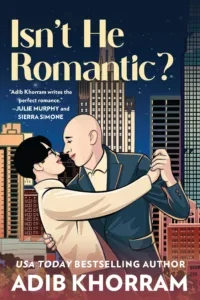
 Adib Khorram’s new book, Isn’t He Romantic, is out this week, so of course I wanted to ask many questions about it.
This is the third in a trilogy about three queer Iranian American friends, and our conversation touches on some of the themes of the book, such as aging and ageism in the gay community, reclaiming fun games from your youth, and about trends in m/m romance currently.
❤ Read the transcript ❤
↓ Press Play
This podcast player may not work on Chrome and a different browser is suggested. More ways to listen →
Here are the books we discuss in this podcast:


Make sure to disable your ad blocker to see all the books.
You can find Adib Khorram on his website, AdibKhorram.com!
We also mentioned:
- Podcast: Adib on the Culture Study podcast discussing heartthrobs
- YouTube: Adib on The Gaily Show
- Interview: Adib on the APALA site
- Stonewall Sports!
- We Need Diverse Books
- Romancing the Craft
- Clair Obscur: Expedition 33
- Young the Giant: Victory Garden
If you like the podcast, you can subscribe to our feed, or find us at Apple Podcasts, Spotify, or wherever you listen to your favorite shows!
❤ More ways to sponsor:
Sponsor us through Patreon! (What is Patreon?)

What did you think of today's episode? Got ideas? Suggestions? You can talk to us on the blog entries for the podcast or talk to us on Facebook if that's where you hang out online. You can email us at sbjpodcast@gmail.com or you can call and leave us a message at our Google voice number: 201-371-3272. Please don't forget to give us a name and where you're calling from so we can work your message into an upcoming podcast.
Thanks for listening!
Transcript
❤ Click to view the transcript ❤
[intro]
Sarah Wendell: Hello and welcome to episode number 738 of Smart Podcast, Trashy Books. I’m your host Sarah Wendell. This week I am joined by Adib Khorram. Adib’s new book Isn’t He Romantic? is out this week, and so, of course, I wanted to ask many questions about it. This is the third in a trilogy about three queer Iranian-American friends, and our conversation touches on some of the themes of the book such as aging and ageism in the gay community, and reclaiming fun games from your youth, like kickball. We also talk about celebrity and trends in male/male romance, and I ask about some of the quotes he’s given in other podcasts because I’m terribly nosy.
I will have links to all of the books that we talk about and all of the places on the internet that you might like to go, and that will be at smartbitchestrashybooks.com/podcast under episode 738.
I have a compliment this week, which is so fun! This is for Etta K.:
Etta, kittens have social media, and they share pictures of you to make the other kittens squeal about how cute and wonderful and adorable you are, so there are many pictures of you making many kittens very happy. Nice job!
If you would like a compliment of your very own, I invite you to join our Patreon: patreon.com/SmartBitches. This is the nicest group of humans on the internet, or at least one of the nicest groups. There are many nice humans, and a lot of them are in this Discord and in this Patreon! The Patreon keeps me going and makes sure that every episode has a transcript from garlicknitter – hi, garlicknitter! [Hiya! – gk] Your support means a tremendous amount, so if you’d like to join, patreon.com/SmartBitches!
And as an added benefit, not only do you get things like full PDF scans and access to this lovely Discord, but coming soon, it will be time to do our Holiday Wishes episodes, where I talk to members of the Patreon, and we all talk about the books that we’ve read and wishes for each other, and I know that these are very popular. If you would like to join, come and hang out in the Patreon with us, and we can talk in real life on Zoom. I swear I’m not scary. I, I promise I’m not scary. [Can confirm! – gk] It’s a very painless experience. People get very nervous about this, but I’m like, Nonono! It’s fine! You’re just talking to me! No big deal! So it’s not scary, I promise. Really, really – I, I’m insisting too much, aren’t I? All right, I’m going to drop it. You believe me though, right? Yeah, okay, of course you do.
[Y’all, I’ve done Holiday Wishes interviews with Sarah twice, and they are SO MUCH FUN. Plus I love transcribing them, the more the merrier, so join in if you can! – gk]
All right, are you ready to talk about Isn’t He Romantic? On with the podcast with Adib Khorram.
[music]
Adib Khorram: Hi, I’m Adib Khorram. I am a queer, Iranian-American author of books for readers of all ages, but particularly, in this context, adult romances about queer, Iranian-American millenials drinking a lot of wine, boning a lot, and falling in love.
Sarah: I would just like to say that right on cue, the mic is live, the cat is here. So I’m going to have to –
Adib: Perfect.
Sarah: – throw treats at the cat in a minute. So before we started recording, we were talking about RT and how you had missed the heyday of RT as a magazine and as a conference, and I’m genuinely sad, because I think you would have loved it.
Adib: I have so many friends in romance that are like, Oh, I met so-and-so at RT one year; I met so-and-so at RT one year.
Sarah: Yes.
Adib: We’re best friends because we both got, like, trapped in the worst taxi ride ever on the way to RT one year.
Sarah: We were in the coffee line. Oh yeah. There, every year, sometimes the hotels would turn a men’s room into a women’s room because there were just so many more of us, and sometimes you would get in the line for the ladies’ room and that was a good twenty to twenty-five minutes. The line for coffee, you would meet, like, anybody: Nora Roberts, Charlaine Harris. I bumped into Charlaine Harris at a conference and I, I almost fell out of my own body. Like, it really was just everyone’s hanging out in the same space.
But there was also the mangeant, and I’m sad that you didn’t get to experience the mangeant. There was a Mr. Romance pageant, and this goes way, way back. This ended before the conference did. I want to say the last mangeant was early 2010s, maybe? I’d have to look it up. But basically, men would come to the conference – Fabio was a Mr. Romance; John DeSalvo was a Mr. Romance champion – men would come and compete to be Mr. Romance, and the prize was a cover model contract with Dorchester, which is a publisher that doesn’t even exist anymore.
Adib: Whoof!
Sarah: But the goal was – this is so incredibly heteronormative – the goal was for the contestants to charm and woo all of the attendees with courteous behavior, holding out your chair, you know, opening the door for you, being a romance hero in the flesh. Now, there’s a, there’s a large portion of women who believe that feminism means that I get to sexually objectify people now – [sotto voce] – it’s not what it means – but there were also –
Adib: [Laughs]
Sarah: – there were also men who were like, This is going to be a big step for my career. And there was an actual pageant? They had to do you know, interaction scenes, modeling, and then it would be voted on. Like, Nora Roberts was a judge one year. I have friends who were on the judging panel, and they would win a cover model contract, and it was a big deal! I’m genuinely sorry you didn’t get to experience it. Maybe I should invent time travel.
Adib: I’m, I’m really worried about the ripple effects of time travel? I think we just have to get one of these, like, kind of the new generation of romance conventions to bring back washboard abs. That’s all we really want.
Sarah: Listen –
Adib: And I don’t think they should be romance heroes anymore, ‘cause sometimes that means doing a kidnapping, and I feel like that’s really legal murky ground.
Sarah: You don’t want that.
Adib: I also do think, like, the, getting so far away from photographic covers is a shame.
Sarah: Oh. Okay.
Adib: Like, I love, I love the covers of my romances, to be clear. But also, I mean, those Fabio covers were classic for a reason. Like, the hair, obviously. Your listeners can’t see my beautiful head of no hair, but, like, imagine that with –
Sarah: [Laughs]
Adib: – golden flowing locks blowing in the wind, a goose flying right at me, but I would dodge it.
Sarah: Of course!
Adib: That was a hilarious day, even pre-internet, when Fabio got hit in the face by a goose.
Sarah: That, that, that –
Adib: Like, what a random thing to happen.
Sarah: Truly random, and Fabio is a mystery. It is – I don’t know if, if people truly understand the depth of the construction that was Fabio and the amount of marketing and work that went into making Fabio. I was a guest on a podcast hosted by a guy who is a former journalist who did a lot of celebrity interviews. He was brought in to do a, an article about Fabio in People magazine and sat down for days with Fabio and his manager, and they just basically explained to him how they constructed Fabio. It was incredible! The, the amount of PR and image-building that has been sustained on one person’s hair and abs is truly incredible. Like, there is just that one Fabio, and it’s, it’s decades of that. Like, how does that, how does that happen? That never happens!
Adib: I think, you know, it’s like whiskey distillers. Their goal is that every year the whiskey will taste the same, no matter what the growing conditions for the crops were that went into the mash –
Sarah: Yep.
Adib: – or the temperatures in the – like, the goal is a consistent product.
Sarah: Yep. And Fabio? Consistent product.
Adib: Mm-hmm.
Sarah: Well, you are…
Adib: One could argue he is, he is himself a distilled product as well.
Sarah: Oh my gosh, you are –
Adib: Distilled romance hero.
Sarah: – so right, he is the distillation of romance hero. Oh! Even though, like, John DeSalvo and other cover models have outpaced him in terms of number of covers, we all still like, Oh yeah, Fabio. It’s Fabio!
Adib: Okay. I have a question for you, which may be outside the scope of this, but I’m really curious. Having, like, I feel like I kind of came in when photographic covers were, like, just mostly gone.
Sarah: Yeah.
Adib: Do you think the celebrity that used to be attached to cover models has in some ways transferred to narrators?
Sarah: Yes.
Adib: ‘Cause I sometimes see, like, wild gaggles of people following narrators around conventions. And I’m like –
Sarah: Absolutely.
Adib: – Can my voice do that to people? [Laughs] Obviously not, clearly, but –
Sarah: Whoo! My brain just exploded. Yes. I absolutely think that it has transferred to narrators and to some cover artists, especially if –
Adib: Ooh!
Sarah: – those cover artists do fan art? Like, Leni Kauffman has a fandom. I don’t know if her fandom would be equal to, like, the Fabio fandom back in the day; the man had his own fan club. But yes, and coupling that with the fact that voice is so intimate? Like, I talk about this a lot as a podcaster. People recognize me by my voice? But if you think about the actual biology of listening to a podcast, it’s on little buds in your ears. My voice is next to your brain. Like, if you’re listening to this with pods – I’m trying, I’m not trying to freak you out – but I’m, it’s very, very intimate. And so that, plus the fact that romance traffics directly in making you feel things, both physical and emotional, and the fact that we don’t necessarily have a fandom for cover models anymore: absolutely narrators. Hundred percent; you’re right about that.
Which is wild, because – um – I really struggle with having male voices read me sex scenes? Unless it is a queer romance and the char-, and all of the characters are men. I’m like, all right, that, that doesn’t – if it’s a hetero scene, a lot of hetero scenes – I’m going to go say most, but I’m going to have to think about this – but I think most are written from the POV of the woman? It’s not often that you get a heterosexual sex scene that’s written from the point of view of the man. And so I really struggled with – [laughs] – having a male voice read me these sex scenes that were deep female P-, P- –
Adib: [Laughs]
Sarah: Like, wait, what? [Sputters] Sir, you’re not supposed to be here in this moment. [Laughs]
Adib: I think that makes sense. I also think sometimes – I don’t want to yuck anyone’s yum.
Sarah: Oh, never.
Adib: I feel like sometimes narrating and acting are different –
Sarah: Mm-hmm.
Adib: – and sometimes if a book, like, if a narrator skews a little too close to the acting during a sex scene in particular, I’m like, I don’t – uh –
Sarah: Oh yeah.
Adib: – it tickles my brain wrong. I was like –
Sarah: Yeah.
Adib: – I was like, Pull back, pull back.
Sarah: Yeah, yeah.
Adib: Widen the lens.
Sarah: Nonono. We don’t, we don’t need a very specific character. We need just the, the, the story. The story is the character, yes.
And it’s so interesting to listen to narrators talking about their jobs in that way, because each of them has such a different approach to it! Especially then you get into dual narrators. That’s a struggle, because then both narrators are doing both voices, so you actually have two voices for the same character, one from one narrator and one from the other. And there’s always, like, a, All right, I like this one’s Bob, but I like that one’s Joe, but I don’t like that one’s Joe; I like this guy’s Joe. That, that is too much for my brain sometimes, I confess. And I know people who absolutely adore dual narration. It is such an interesting growth of how fandom operates, isn’t it?
Adib: It is. I love a dual narration. I don’t mind that there’s different, like, vocal expressions –
Sarah: Mm-hmm.
Adib: – for the characters. What bothers me is if the character has an accent and then the two narrators do the accent differently?
Sarah: Oh yes.
Adib: That bothers me more than just a different voice. I recently have started, like, I feel like duet narration is becoming more of a thing? Where, like, you know, for instance, it’s the female main character’s POV, but then every time the man speaks, it’s the male narrator’s –
Sarah: Yes.
Adib: – voice, but then the woman adding the dialogue tags back in?
Sarah: Yeah.
Adib: I feel like when I listen to them, sometimes it sounds like they’re not recording in the same room, because their energies don’t match and they’re, like, not playing off each other. And to me, if you’re going to do that, you have to be in the same room, because the beauty is how they can meet each other’s energies and really bring these scenes to life.
Sarah: Completely agree.
Adib: And that’s my theater kid, my theater training coming out. Like, you’ve got to be in the room!
Sarah: You have to be in the room. You have to, and the energy has to match. I’ve –
Adib: Mm-hmm.
Sarah: – definitely heard, Oh, y’all were really – sometimes in the middle of a sentence I can tell, oh, that’s a different recording session, ‘cause your energy –
Adib: [Laughs]
Sarah: – is totally different!
Adib: Yep!
Sarah: Did you have a bad day? Like, whoa, bro! [Laughs]
Adib: Right. But gosh, I have so much respect for narrators.
Sarah: Oh, it’s exhausting!
Adib: I narrated, I narrated my like two-hundred-and-fifty-word picture book, audiobook, and that was like a two-hour recording session, and I was wiped out for like a week. It was very intense.
Sarah: It’s really hard. I mean, speaking of theater kid, it actually takes a lot of energy to sustain your voice and your energy and the, the level of performance that you are at the start all the way to the end? Whoo! That, and especially imagine over multiple days and multiple hours. Oh –
Adib: And with no audience giving you anything.
Sarah: Oh no! You’re just alone in a booth. Maybe there’s a person behind the glass, maybe there’s not. Who knows?
Adib: At least if there’s someone behind the glass, there’s, like, a little bit coming back to you.
Sarah: Yeah.
Adib: If it’s like –
Sarah: Sometimes you just –
Adib: I don’t know how people do it, like, alone at home?
Sarah: Oh!
Adib: Like –
Sarah: I’ve tried it, and it’s so –
Adib: Like in a personal sound booth? That seems –
Sarah: – so hard.
Adib: – like a nightmare.
Sarah: I just end up – I, I was working on the audiobook of the novella that I self-published a bunch of years ago, and I ended up just talking to myself: No, Sarah that, we need to do that again. Okay. Like, I, I, I have to cuddle…
Adib: …your own producer.
Sarah: – [laughs] talking to myself!
Adib: [Laughs]
Sarah: Which is really healthy, and I’m sure a very normal thing to do. Huh!
Adib: I actually think that makes a lot of sense. Like, you’ve got to make the process work for you somehow or another.
Sarah: Absolutely.
Well, you are here to talk about Isn’t He Romantic? Congratulations on your new book! I’m very excited to –
Adib: Thank you.
Sarah: – talk to you about this. What will readers find inside this book?
Adib: They will find more queer, Iranian-American millennials –
Sarah: [Small squee]
Adib: – more Kansas City, more barbecue, the world’s most perfect rescue dog, and a lot of sex toys, weirdly, in this one. Isn’t He Romantic? is the story of Arya Nazari, who is the self-proclaimed slut of his friend group, who is dragged, kicking and screaming, into falling in love via a fake dating scheme with Ben Lu, a sexy cellist who wears slutty little glasses and has moved to Kansas City to escape his horrible ex. And as anyone logically would do, they make rules for their, how their fake dating is going to work out, and of course the rules are very quickly abrogated, and then they bone a lot and fall in love.
So that’s a romance, and that’s –
Sarah: Okay!
Adib: – all I want out of a romance is boning a lot and falling in love.
Sarah: That is, I was just about to say, And isn’t that the entire point of why we’re here? Bone a lot, fall in love. What could go wrong?
Adib: Truly.
Sarah: Truly! Now I know this is the third and the last book of a, of a trilogy, and I wanted to ask, you know, what have you learned while writing these books? And were you sad to say goodbye to the characters? Although I know you finished the manuscript like months and months and months ago, so you said goodbye a while ago. What was the process like for you? What did you learn while writing these?
Adib: You know, I have, a lot of my author friends – I should say I come to romance from writing contemporary Young Adult –
Sarah: Mm-hmm.
Adib: – and picture books first. And so a lot of my friends are, were writing Young Adult, and particularly Young Adult fantasy or sci-fi series, and so I had lot of, lots of friends to talk to about, like, writing a trilogy and, like, what to do and what not to do. And they’re like, Yeah, you should make plans and know that whatever decision you make, you’re going to have to stick with it, ’cause you can’t go back and retcon things the way you could if, you know, you were just editing a standalone. And so I was very deliberate and very thoughtful and very careful about the choices I made. Even so, I would get to the next book or two books down and be like, Boy, I wish I had made a slightly different choice there. Because, you know, we as writers, we as humans are constantly growing and learning, and I was a better writer by the time I got to book three than I was at book one. And so I was like, Boy, if I hadn’t made this choice in book one, boy, what an amazing choice I could make now in book three and really pay off this one tiny detail from book one that I have only grown enough now as a writer to, like, know how to execute that?
But I think in general I’m not a person given to a lot of regret, and I, I’m really proud of every book and proud of what it represents about, like, me as a person and as a writer and where I was in that time and that place. And so I don’t know that I would go and actually change anything? I think we’ll always just have a few, like, what-ifs.
Sarah: Yeah, I, I am constantly telling myself when I look back at choices that I’ve made where I, it would have been much better if I’d done something else now, I always tell myself, Sarah, you have to honor the stages of your life. You have to honor the stages of your journey, even if you made choices that make you cringe now.
Adib: [Laughs]
Sarah: Back then, that, you were doing what you had. The, the, writing a trilogy has always seemed to me to be one of the most difficult things, because over such a large expanse of time in terms of writing, you are having one larger arc with three sets of conflicts built in. That is quite an undertaking. And I remember when romance was nothing but trilogies. Trilogies everywhere! Everyone was writing ‘em in sets of three. And I, I’m actually delighted that you’ve written a trilogy, ‘cause I feel like I haven’t had one in a little while.
Adib: All of my, like, favorite romances – I should say, you know, I read romance off and on growing up, but I got really into it during the pandemic, because I was –
Sarah: Mm-hmm.
Adib: – horribly depressed. And I just went to the library –
Sarah: Oh –
Adib: – and I think I read like, I was reading a book a day. Like, it was so healing to me to just read there. And all of my favorite things were trilogies. I think, like – or I guess technically some of them were quadrilogies – but, like, Alexis Daria’s Primas of Power, like one of my favorites; Adriana Herrera’s Dreamers, absolutely incredible. And so I felt like I wanted to, like, be in that cool kids club with, with –
Sarah: Oh, sure!
Adib: – all these people writing my favorite trilogies.
Sarah: Absolutely!
Adib: And – oh, I, you asked about, like, am I going to miss the characters? And I’m not trying to plug anything, but I do have a Patreon where I periodically release, like, bonus content.
Sarah: You can plug –
Adib: Including literally bone –
Sarah: – whatever you want all the time. [Laughs]
Adib: Oh, I appreciate that. Including a monthly bone’us scene – like B-O-N-E apostrophe U-S – featuring characters that we know and love boning it out. Except they’ve already fallen in love, ‘cause they’re all, like, past the end of the novel.
Sarah: Boned, boned…
Adib: There’s also fan art. When I say fan art, there’s art that I pay someone to draw it and pretend like they’re a fan of me.
Sarah: Adib, I need you know how pissed off I am that I have never thought of bone’us content. I am beside myself with rage that I never thought of this? Friggin’ genius! Oh my goodness!
Adib: I appreciate it. Listen, it’s not trademarked? I’m not the Cockygate lady. I won’t –
Sarah: [Laughs]
Adib: – begrudge anyone else using bone’us. What was the other one? What was the recent trademark kerfuffle?
Sarah: Oh –
Adib: Ooh, was it like Hot Girls Read or something?
Sarah: Yes, it was Hot Girls Read.
Adib: I just want to know who at the trademark office is not doing their due diligence to be like, This is a widely used phrase or a widely used word and is therefore ineligible for a trademark, which is part of the law and the purpose of trademark.
Sarah: Yep.
Adib: I, I just, I have notes.
Sarah: Oh, I have many notes.
Adib: Like the judge in the Tracy Wolff, like the first judge in the Tracy Wolff thing that was like some ninety-year-old guy that’s like, I’m not going to read three thousand words of, or three thousand pages of romance.
Sarah: Okay, so –
Adib: And then finally they got –
Sarah: – do your job, dude!
Adib: – a young judge who, like, read them all in a week and then was like, Yeah, these books are completely different, and you cannot copyright Hot Boys with Angst.
Sarah: I mean, if we could someone would be extremely wealthy or broke, given, you know, defending that trademark, whichever one it is.
Adib: Right. It would be really, yeah, it would be exhausting.
Sarah: Well, I appreciate that you’re not going to come after me for trademark, but please know that bone’us is friggin’ brilliant. My day is made. I can just go back –
Adib: Thank you. Please, I share it.
Sarah: Thank you!
Adib: We’ve got to get it into –
Sarah: So generous!
Adib: We’ve got to get it into Merriam-Webster.
Sarah: Yes! Yes, we do. Oh my gosh.
Now, two things that you have said have lived in my brain personally. And I know that when you are brought into podcasts, when you’re brought into speaking engagements, that a lot of people want you to talk about being a man, a gay man writing gay romance. Like, that’s, this is like people inviting me onto things and asking me why do people like romance so much? And I’m like, Again this question; okay! And I don’t want to ask you about being a gay man writing a gay romance, but I do want to tell you that you, you’ve lived in my brain very, very permanently since about December of last year. You were a guest on Culture Study on the expansive world of queer romance, and I was on vacation, and I, ‘cause I’m a middle-aged lady, I brought my quilting equipment, so – my little portable iron –
Adib: Oh, that sounds amazing!
Sarah: Oh –
Adib: I love, I love a good quilt.
Sarah: Ah! I’m a quilter; it’s great. It’s one of my favorite… Seriously, you make your own puzzle out of fabric; you sew a straight line; it’s amazing. So I’m quilting, got my little i- – ’cause a lot of quilting is honestly ironing – I’ve got my, a hot iron. And you said:
>> People are rarely harmed by someone sharing a joy that is not their own, but are often harmed by exploiting a pain that is not their own.
And I had to put the iron down because I was going to drop it on my own foot, because Ka. Boom. Thank you for saying it that way. I have been trying so hard to articulate some of the tensions within the, the gay romance community since it has exploded into being. That is the clearest distillation of one of the things that I struggle with in terms of what is happening in this community. So first of all, thank you. That was incredible. What was it –
Adib: You’re welcome.
Sarah: What led you into that perfect little phrase?
Adib: I, if I recall correctly, I recorded that podcast – you said you listened to it in December, and I think I recorded it in like June of 2025.
Sarah: Oh sweet Lord, I’m asking to go way back in time. My bad! [Laughs]
Adib: No, no, it’s okay! It was, I, you know, sometimes, you know, sometimes they record, like, close to when they’re released and sometimes they record, record, you know, farther apart from when it’s released, just depending on their schedule at Culture Study. But I, you know, to go back to my days in YA, I kind of came of age in publishing like in the aftermath of the founding of We Need Diverse Books. We Need Diverse Books was founded in 2014.
Sarah: Yes, it was.
Adib: I started writing the book that became my debut novel, Darius the Great Is Not Okay, in 2015; it was published in 2018. And so I was – and this was back when Twitter was not the Nazi-infested cesspool it was, it has turned into. And so it was, I got to, like, kind of have a, not a front-row seat, but, like, like, solid orchestra seating to a lot of, like, solid discussions about what representation means. We often talk about Rudine Sims Bishop talking about books being windows, mirrors, and sliding glass doors.
Sarah: Mm-hmm.
Adib: And I also got to witness a lot of kind of closeted queer authors be forced out because of people having, like, really horrible discussions about their books. I was kind of confronted with my own biases about what I thought about people who, you know, are not visibly queer writing queer stories and how even offhanded comments I had made in the past may have, in fact, inadvertently perpetuated harms on them.
Sarah: Oh, hard same.
Adib: And so I had had, you know, eight, ten years to think about this. And queerness and race operate very differently, but at the end of the day, power always operates in the same way, which is that those who have it are not destined, but poised to use it to perpetuate harms, and you have to very deliberately not wield your power in a way that causes harm. And so I guess my evolution to that framing came from really thinking about how power operates and how we can use power to mitigate harm –
Sarah: Yeah.
Adib: – as much as possible.
Sarah: I also want to thank you for saying that spit as lube is not healthy, safe, or loving. Thank you.
Adib: [Laughs]
Sarah: Also had to put the iron down for that one because yes, it has driven me absolutely bonkers to have seen that so many times. It is as pervasive as the idea that the hymen is somewhere two miles up the vulva or up the v- – like somewhere deep, deep, deep in the vulva is this little, like, wall that you’ve got to break through. That went through thousands of romance novels before someone was like, Time out! That’s not how it is! [Laughs] Thank you.
Adib: Right. It’s when the doctors started writing romance.
Sarah: Yes, exactly.
Adib: I’m always –
Sarah: All right, listen –
Adib: – really excited when –
Sarah: – got enough lawyers here; going to have some doctors. Yeah. So, also –
Adib: I’m always excited when you find out, like, romance authors’ various either, like, pre-romance careers or, like, current day jobs. ‘Cause then it’s like, Oh yeah, I’m a dentist; I’m a doctor; I’m, like, a Ph.D., and I was like, Really, I, I have three questions for you, but I don’t think I’m allowed to ask them right now because we’re not in a clinical setting. But –
[Laughter]
Sarah: Some of the, some of the most –
Adib: But if you make house calls –
Sarah: Right? Some of the most incredible people I know in the romance community also have incredible, incredible careers.
Since the first book of this trilogy came out, or since you started writing it, what changes, positive or not, have you noticed in the conversations and discourse around the male/male romance community? ‘Cause it’s been a, a period of time, and the way we talk about gay romance, I think, is a very important indicator of how we talk about other genres as well. And I was curious if you’ve noticed, what changes you might have noticed.
Adib: I think the biggest change I’ve noticed, which is I think emblematic of a lot of changes in romance, is the influx of a huge number of people unfamiliar with romance to romance readership via BookTok.
Sarah: Mm!
Adib: These – I’m like, it’s great that people are reading, but they, you know, one of the first things someone, my agent Molly told me when I said I wanted to write a romance, she’s just like, Never claim to be the first to do anything ever. Someone will prove you wrong with some self-published book from like 1999.
Sarah: Yep!
Adib: Like, you will be wrong.
Sarah: Yep.
Adib: And second, like, remember it’s a community with a decades-long history with established structures and with, like, established, like, norms of, like, how you’re supposed to treat your readers, how you’re supposed to treat your colleagues, all that. And so I think, you know, thankfully I came, again, from Young Adult publishing, which is similar: like, it’s existed for many decades; it has its, you know, norms, so I was aware of that.
And a lot of these readers are new to romance and do not know the history of romance, do not know even simple things like you’re just, it’s really rude to tag an author in a bad review. Like, they’re like, Whatever, I’m making content! And so I think many of us who’ve been in this for years or decades have been talking about representation, have been talking about the importance of both sort of queer stories from, like, lived perspective; queer stories from adjacent perspectives; queer stories from imagined perspectives. And then this, like, tidal wave of people came through, and they picked the one gay, white story that made them feel the most pants feelings, and they’re like, This is the epitome of all gay romance, and every other gay romance will be held up to this litmus test. Never mind that it’s very, very white; very, very kind of politically gross; and –
Sarah: Kind of heteronormative in a lot of the roles within it?
Adib: Sometimes, yeah. And, and again, I think I mentioned this on Culture Study as well, someone who’s never seen a butthole.
Sarah: Yeah, yes! [Laughs]
Adib: Like, like – and so I feel like a lot of the, the work that we were doing to really push the boundaries of inclusion and imagination really in queer romance –
Sarah: Mm-hmm.
Adib: – have now been fighting this tide of new readers who kind of didn’t get to live that history, and so their imaginations haven’t blossomed into, like, how wild and beautiful the world of queer romance can be.
Sarah: Yeah.
Adib: Also just, you know, the entire media landscape thought that all queer people and all brown people died on November 5th, 2024, and no longer needed any sort of media, and that’s been a really terrible thing too. Just the number of books by Black and brown authors has gone down, the number of books –
Sarah: Way, way down.
Adib: – by queer authors has gone down.
Sarah: TV shows, movies.
Adib: The Publishers Weekly deals are just –
Sarah: Everything.
Adib: – ominous now.
Sarah: Yeah. It’s very, very – like, I know that it is a pendulum. I’m old enough to have seen it swing back and forth, and my God, the swing back just suuucks!
Adib: Mm-hmm.
Sarah: And what’s so funny with all these new people entering romance through TikTok is, like, we have been here before. Twilight brought a huge influx of readers. And then we had Fifty Shades of Grey, which ushered in a whole era of BDSM, another area of romance, I would like to add, that was not necessarily educated or responsible in the way that it portrayed the sexual activities in the book. These were, much like people who’d never seen a butthole, people who had never been –
Adib: [Laughs]
Sarah: – to a BDSM, like, environment. That, that influx, and then the way the genre sort of absorbs and changes, it happens, I was going to say every five to ten years, and we’re just, we’re in another one, and this time it’s –
Adib: It’s been really – yeah.
Sarah: – hockey!
Adib: Yep.
Sarah: Lots of hockey.
Adib: This is my first time, like, with a front-row seat to it, though.
Sarah: It’s, it’s wild, right?
Adib: Which I guess, which is interesting. Yeah. And I do feel like, you know, there’s been a different but a similar pendulum swing in, in Young Adult literature where, sort of, people who loved Young Adult literature as actual young adults grow up and don’t move on? And so they kind of drag YA literature older and more mature and older and more mature, and then people start complaining, Where are the books for actual children and teenagers? And then eventually the pendulum swings back. But it feels like because of all the money from BookTok, the pendulum keeps going higher and higher and higher and is, like, refusing gravity to come back down.
Sarah: Yeah.
Adib: So hopefully it will –
Sarah: Absolutely.
Adib: – sooner or later.
Sarah: I hope so! The, the biggest, the biggest problem I have is the number of lines and departments of publishing houses that have shuttered and laid people off with all of this institutional –
Adib: Mm-hmm.
Sarah: – knowledge walking out the door? Like, that is going to harm the genre for ages and ages, and it, you can’t get that back. It, that’s, that’s, like, a major bummer.
Adib: Back in March my, like, my entire imprint with, that all of my, like, YA books had been with shuttered. Dial Books for Young Readers at Penguin was shuttered?
Sarah: You were part of Dial! Oh my God, I’m so sorry…
Adib: Our sixty-five year history, had won every major award multiple times and, like – not me, but the imprint – and gone.
Sarah: Why?
Adib: And then two weeks later my editor at Macmillan also was laid off as part of the restructuring, and I was like, Boy, it’s just not Adib’s March at all.
Sarah: No, it’s horrible. It’s just horr-, horrible. I’m really sorry. That, that sucks for you and everyone involved. Ugh!
Adib: It, it did. You know, my editors are, my former editors are doing okay, and –
Sarah: That’s good.
Adib: – I know they are talented, brilliant people and amazing things still lie in their futures.
Sarah: It used to be that editors would all switch houses when someone rings a bell. Now someone rings a bell and half of them have to leave. I’m like, This, the earlier way was much better. Just go, go from house to house. This is, this is terrible, because I, I notice it in the books! I, I’ve noticed the shift toward the focus being on marketing of romance over the craft of romance, for example. A lot of the focus for authors is Here’s how you sell; here’s how you market; here’s how you trope; here’s how – and I’m like, you, you, you can’t do any of that till you have the book, and the craft is important.
And going back to conferences like RT and RWA, I really think that the ending of those conferences was, in 2018 and then in 2020, when RWA collapsed, that was a major marker of the shift from a craft-driven system of education to a marketing-driven system of education, and that has changed the books themselves. Which is very frustrating for me, ‘cause it’s like I, I – [sputters] – I don’t need, I don’t need you to string tropes together. That does not do anything for me. Like, I love Only One Bed, but there has to be a reason why it’s only one bed is a problem! You can’t just be like, Oh, and there’s one bed! Sleep next to each other! You didn’t go on field trips when you were a kid? Or, or sleep next to your cousin? It’s fine! [Laughs] Get in bed and go to bed!
Adib: My…The only one that has to come to me at the moment of, like, peak tension?
Sarah: Yes!
Adib: Like, they have to not be able to keep their hands off each other. And kudos to all the people who can write something where they can’t keep their hands off each other, but also it was a mistake? I can’t – once they, once they touch each other for the first time it’s like, nope, they’re just going to bone regularly, and it’ll always be different and express different parts of their character arcs, but I’m not a, I’m not someone who usually wants the characters to go backwards in that way?
Sarah: No.
Adib: I’m like, nope. We’re going to Plow forward with a capital P.
I would like to briefly shout out any, first of all, any listeners who are, like, romance writers or aspiring romance writers or, as I like to say, pre-published: Romancing the Craft is a new convention that happens either once or twice a year. It’s only one day right now –
Sarah: Yep.
Adib: – and it’s a wonderful thing that it’s back. And to any of your listeners that are maybe independently wealthy, trust fund babies or anything, it’s a nonprofit organization, and you could donate to support Romancing the Craft and, like, increase the number of days of programming they have; support scholarships for writers to go attend Romancing the Craft. So if anyone listening to this is rich, give money to Romancing the Craft.
Sarah: [Laughs] Yes, if any of you are, are rich, you’ve probably not enjoyed me griping about billionaires. Sorry about that!
Adib: Listen, you, it is possible to live a life with a lot of money that does a lot of good. Dolly Parton –
Sarah: Yes!
Adib: – has proven it.
Sarah: Yes! Saint Dolly has proven that a hundred percent. You’re right.
Adib: You could be the Dolly Parton of romance!
Sarah: Oh, wouldn’t that be fun?
Adib: Mm-hmm.
Sarah: Oh wow. Listen, if all that money landed on me, universe, I would be doing so much good with it, I promise. [Laughs]
Adib: I’m same. You know, I have all of my, like, my list of things that I would do with fuck-off money.
Sarah: Oh my God, I’d – and you would never hear from me again. If, if all of, if, if the, the, that kind of a windfall hit me, I would not be doing anything in my – you, you would never hear from me again. I would fuck off so hard –
Adib: Oh really?
Sarah: – I would leave a crater in the Earth, and there would just be anonymous funding of sooo many things? It would be like, Wow, where did all this come from? You’ll never know. I will leave. I don’t want that kind of attention.
Adib: I would, I would say at least once I would show up with the giant check just because I think they’re so –
Sarah: Oh hell yeah!
Adib: – like, ostentatious and hilarious?
Sarah: One giant, one giant check.
Adib: At least once I would – [laughs]. I don’t know if you watch Ted Lasso or not. I don’t know if you’ve seen the most recent episode –
Sarah: No!
Adib: – of that in- – okay, I won’t spoil anything.
Sarah: Okay.
Adib: But there’s a giant check in it, and it’s just a really, it’s a really funny scene involving a giant check for charity. It’s delightful.
Sarah: And the giant check is kind of a cultural relic!
Adib: It really is. These people –
Sarah: Like –
Adib: Like, so many people don’t remember Publishers Clearinghouse.
Sarah: People don’t even remember what a check is! [Laughs] Like, I had to teach my kids –
Adib: That’s fair.
Sarah: – how to write one. They’re like, What the hell is this? I’m like, Oh, this is old tech, isn’t it? Sorry, give me a second.
Adib: [Laughs]
Sarah: And I type so much now I, I run out of hand stamina trying to write a check. Like, One dollar and 70 – okay, I’m so tired now. [Laughs]
Adib: Oh, I still do a lot of, like, longhand writing when I’m, like, writing. So, like, I usually write in like twenty-minute sprints, but before I do that I’ll, like, take a minute and, like, write longhand –
Sarah: Mm-hmm.
Adib: – what I want to write?
Sarah: Oh yeah.
Adib: – ‘cause I feel like it unlocks a different part of my brain to do that?
Sarah: Oh, I completely agree.
Adib: So I –
Sarah: I completely agree.
Adib: – so I have decent – I also, like, got, became a fountain pen person, and I do feel like they’re so much gentler on my wrist? So yes.
Sarah: I got all of mine! I got all mine right here. Yep.
Adib: Oh, nice.
Sarah: My, my favorite new toy is a digital, digital notepad? It’s like a reMarkable –
Adib: Ooh!
Sarah: – but it doesn’t require a subscription. It’s called a Supernote? And it is – here, I’m going to show it to you, ‘cause I keep it next to my desk. It’s a little digital notepad.
Adib: Ooh!
Sarah: It’s a, it’s an e-ink screen. It’s very satisfying to write on, but depending on the setting, if I have it enabled, it will take my writing and then translate it to text. [Sotto voce] Sometimes not well, ‘cause my handwriting is not great.
Adib: [Laughs]
Sarah: But it will translate it into text, so I can take a bunch of notes on something, translate it into a text document, and then clean it up? And you’re totally right: it really activates a different part of your brain. Am I switching the way I grip the pen a hundred times? Yes. Because –
[Laughter]
Sarah:: – it’s been a while!
Adib: That’s valid.
Sarah: Now, I, I wanted to talk to you about Isn’t He Romantic? I know we took a very large question first, but in, specifically with this book, which by the way, I, I really, really loved it. Like, I just love this trilogy.
Adib: Oh, thank you!
Sarah: But this, this one in particular, I just, I just love these people? One of the major themes in the book is aging and ageism in the gay community. The characters are conscious about how they look. Arya’s attitude towards his own aging and towards aging affects him personally in ways that he’s sort of, like, waking up to. He is – this, this is not a spoiler. I don’t, when I talk about a book that I’ve read, I try to keep my comments to the first, like, maybe two or three chapters?
Adib: [Laughs]
Sarah: So this is not a spoiler. He is – [laughs] – he’s struggling, trying to reconcile being what he, as he calls himself, a slut with running out of people to be slutty with, because people set age limits –
Adib: [Laughs]
Sarah: – on the, on the apps for the hooking up. And he’s like, Well, how am I supposed to be a slut when I’ve got like two people to choose from because they all set their cap at thirty-five and I’m forty? Was it, was it your intention to intertwine sort of conversations about aging and sexuality in the story? Because I loved this part so much. It was so thoughtful.
Adib: Thank you! It definitely was. I mean, you know, I started writing these when I was, I guess, thirty-seven?
Sarah: Mm-hmm.
Adib: Yeah, and, and I’m now forty-two. Like, I kind of went through what the characters are going through as kind of facing my own forties. And yeah, I’m a gay man over forty, and I have definitely seen the way, kind of, my peers have felt about aging. I’ve seen the way that young queer people talk about aging. I’ve seen – it’s really weird, I think, being my particular generation of queer man, because I’m, I guess, sort of an elder millennial. And I think elder millennials and kind of young Gen X –
Sarah: Mm-hmm.
Adib: – really bore the brunt of losing such a large swath of our elders to the AIDS crisis. Like –
Sarah: Yes.
Adib: – I think we’re the ones that are really, really struggled to, like, find –
Sarah: Yeah.
Adib: – those queer people that were like ten, twenty years older than us to sort of guide us.
Sarah: Yeah.
Adib: And having, like, lost that, I’m really passionate about, like, intergenerational queer friendship –
Sarah: Oh yes.
Adib: – and intergenerational queer community, and to find so many young people be like, Ew, old people are gross, and like, Old queer people are just fat and sad. I’m like, No, we are, we are resilient. We are the people who have survived –
Sarah: Yeah!
Adib: – Ronald Reagan trying to kill our entire community. Like, why don’t you want to be part of this, like, beautiful community? And not all young queer people like that, are like that, and also I feel like when you’re in your twenties, you just have to do your own thing for a little while and then come back, and be –
Sarah: Yeah.
Adib: – stop being such a little shit. I was a little shit. It’s fine.
Sarah: [Laughs] I was a monster in my twenties!
Adib: Right.
Sarah: You can’t tell people in their twenties anything. They already know it all.
Adib: I know, right?
Sarah: My kids are now entering their twenties, and I am screwed.
Adib: Godspeed to you.
Sarah: [Laughs]
Adib: But so, yeah! I, like, that was really at the front of my mind. And I think coming to romance from Young Adult literature, like, I’m not writing for young people, but there’s always some part of me in the back of my mind that’s like, well, what if a young queer person picked this book up and it was their first exposure to queer romance or queer sex? Like, am I telling them a story that’s going to help them in this life? And so I think that was an, you know, talking about kind of queer legacy and, and yeah! Being queer in your forties and that there’s still lots of really quality boning ahead of you just because you’re past forty was a big part of it.
Sarah: I mean, quality boning ahead of you is very important. I am, I am fifty-one, so I have the five in the front? And granted I am a, I am a cisgendered white woman who lives in the suburbs, but aging is friggin’ dope. I love it. It’s a privilege. Every day I get to do it is great. But the attitude that I had towards my own aging, I had a, I had to do a lot to overcome that and be like, no, actually this is great. This is not bad. You do have to slow down. A lot of aging is how did I get here and why do my knees hurt?
Adib: [Laughs]
Sarah: Right? But aging is –
Adib: Right.
Sarah: I love aging, and I –
Before I forget – I cannot forget to tell you this. So one of the podcast episodes that I’m working on right now is with a creator named Jess Rothschild, and she has a documentary podcast called Finding Fire Island. It is two seasons; the second season I think just wrapped up. Okay, this is entirely your jam, it sounds like, because she is a longtime visitor and summer resident of Fire Island, Cherry Grove, the Pines. And she did a pri-, she did a prior docu-podcast about the cult of Soul Cycle, so that’s entirely my jam.
Adib: Ooh!
Sarah: But in Finding Fire Islands, Finding Fire Island, she’s basically sitting down with the people she knows and just getting an oral history of the history of Fire Island, which is the history of a lot of gay Americans over the, since like the ‘40s and ‘50s, when it started being this sort of little enclave off the shore of New York. But one of the things that one of the
guests said that I, just stuck with me was that, you know, you can’t talk about Fire Island without talking about the AIDS crisis and how one of the most holy places on Fire Island is the Meat Rack, which is the woods between Cherry Grove and the Pines, where it was anonymous hookups, no, no lights, no talking. But people who were dying asked that their ashes be spread there. So as much as it is this place of incredible amounts of sex and repression and release and freedom, it is also a memorial and a holy ground, and it’s this very unique space. And one of the people talking was like, You know, I have watched the twinks become daddies and the daddies become grandpas, and it is the grandpas that I love to talk to. And I was like, well, obviously, ‘cause there are so few, but also this sort of capture of this intergenerational legacy of this one place through it being basically gay summer camp, it’s wonderful, but it also, I think, would really resonate with you in terms of the things that you talk about and value. You would really like it.
Adib: Oh, I’m going to check it out.
Sarah: It, you can watch it on YouTube, but it’s, it’s very much an audio production, and the video –
Adib: Okay. I hate a YouTube podcast.
Sarah: Okay.
Adib: I’m so basic! [Laughs]
Sarah: No, it’s, it’s –
Adib: I refuse to give Google as, I try to give Google as little money as I can.
Sarah: You know what’s so weird as a podcaster? I’ve been doing this – so we, the podcast started in 2009, and I took over editing in 2011, so I’ve been doing this a long time. And I have only, like, this year started to cross-post video to YouTube because people just want to listen on YouTube. That’s fine; that’s your jam; that’s great! The video part is honestly much, much harder than the audio part. And with Finding Fire Island, rather than make it like a talking camera with the lighting and the people and the – it’s all audio with stock footage images, historical records –
Adib: Ohhh!
Sarah: – so pictures. So the people aren’t necessarily in it? It’s an audio with visuals as sort of like an, an accompaniment, like a bonus. So that, that part was kind of cool.
Adib: Oh, okay!
Sarah: But as audio, I was driving at one point and I’m, and I’m, I’m from Pittsburgh, so I’m like…
Adib: Where The Pitt happens.
Sarah: [Laughs] Yes, where The Pitt happens. The Pittsburgh accents among some of the nurses are top tier. I adore them.
Adib: [Laughs]
Sarah: But there’s a point where I’m like, That, that can’t be Billy Porter. And then I hear Jess go, This is Billy Porter. And I’m like, I’m going to drive off the road right now. I’m listening to Billy Porter tell me about Fire Island. What is my life right now?
Adib: [Laughs]
Sarah: It’s incredible. You will love it.
Adib: I can’t wait.
Sarah: One of the things in your book that really resonated with me that I really want is a kickball league. Thank you. Thank you for the kickball league. Again, not a spoiler, but the idea that you are healing middle school gym.
Adib: [Laughs]
Sarah: Amazing! Thank you for that!
Adib: You’re welcome!
Sarah: Please tell me –
Adib: I can’t take credit.
Sarah: – you have a kickball league. You have a kickball league…
Adib: There actually is, it’s called Stonewall Sports. It’s an entire, like, queer sports –
Sarah: ‘Course it is.
Adib: – league in Kansas City, and there’s not just kickball, there’s several other sports. And I was like, This is one of the most amazing things that our community has, so, like, what if we all tried to heal our middle-school trauma by going and playing sports? And it’s, it’s delightful and, and I love Kansas City and I wanted to, to share that part. I also think kickball is a just, like, a specifically kind of hilarious sport, ‘cause it’s like –
Sarah: Even the sound the ball makes –
Adib: – what do we do with all the kids that are bad at sports?
Sarah: Yes! [Laughs]
Adib: Go have them – [laughs] –
Sarah: Play ball!
Adib: – play baseball with their feet with this big red bouncy ball.
Sarah: [Laughs] Yes, the one that makes that perfect boink noise.
Adib: Yep, yep.
Sarah: Well, first, I just googled and there is a Stonewall Sports near me, so I’m very excited about this.
Adib: Excellent.
Sarah: Now I get to tell everybody. But also the idea that you’re going to heal middle school, which is such a terrible time for so many people, and especially queer kids? I, I love that because it’s also a theme of the trilogy in a way. Things are really good now. That doesn’t mean that they were bad before? It might have meant, meant that for some, some of them it was bad before. Things are good now, and it gets better. Like, everything is, is quietly emotionally leveling up in a way that’s, like, almost, like, startling for some of them. Like, Arya is very bewildered by a lot of –
[Laughter]
Sarah: – a lot of the things that happen in this book!
Adib: He truly is.
Sarah: He really is.
Adib: Yeah, how he – he really is How did I get here and why do my knees hurt?
Sarah: Why do my knees hurt? What, what is going on? And why is this cellist so hot?
Adib: Mm-hmm.
Sarah: Also, hot cellist and slutty little glasses, outstanding.
Adib: Thank you.
Sarah: One of the other things that happens in this book that I really appreciated is that – and no spoilers – how hard it is to confront people that you care or cared about when they are hurting you. And I really appreciated how very, very carefully your characters were treating the feelings of those around them, even to their own detriment. And I think that’s something that is almost universal. It is really hard to tell people who you care about that they’re screwing up. But at the same time, the way that these characters interact, they’re so dedicated to being, if not the best versions of themselves, then the most authentic and whole version of themselves, like, complete version of themselves, that it, it, it’s almost like as the reader, I just want to give them encouragement. Like, yes, you should say it. You should say it! You could say it! Go, go, go, go, go! Do you have that feeling when you’re a writer, like this, this isn’t going to happen yet? This conversation isn’t going to happen yet, but you’re, yes, you’re going to have that hard conversation. Do you feel that sort of hesitance and incomplete, like, tension when you’re writing as well?
Adib: I, I think I do. I actually, the hardest thing for me to ever write is two people arguing. I don’t like it. It makes me –
Sarah: Oh, that’s interesting!
Adib: – it makes me feel bad. Like – [laughs] – like, because I’m having to make them feel bad, I’m always just like, why can’t everyone get along? And then my agent will just be like –
Sarah: [Laughs] Let’s just –
Adib: – Adib, books need to have plots, and –
Sarah: That’s so annoying.
Adib: – plots require conflicts.
Sarah: Yep.
Adib: It is annoying. But I also think most of the people I know, our lives have been defined not by big blowout fights, but by, like, small, quiet, emotional fights.
Sarah: Mm-hmm.
Adib: And I don’t know, it felt, it felt true to me –
Sarah: Yeah.
Adib: – to write the scenes that way.
Sarah: Yeah.
Adib: Even though they’re maybe not as kind of bombastic as, like, a really – I don’t –
Sarah: Big explosion fight, yeah.
Adib: Yeah! Or, like, you know, they might not be the trope-iest fights, but they are real and human?
Sarah: Trope-y fights.
Adib: And I do not say that there’s anything wrong with trope-y fights? But –
Sarah: You’re totally right.
Adib: ‘Cause sometimes those are what the story calls for, but I think that would go, like, against, sort of, my thesis, which is, I think that real people just have real problems, but with love you can solve them.
Sarah: That’s true! That’s actually a really good thesis.
Adib: Thank you!
Sarah: I want to, I want to go back to your interview with, on Culture Study, ‘cause you also appeared on an episode – I swear I’m not a creeper – about heartthrobs…
Adib: Culture Study is an amazing podcast.
Sarah: It’s great. And also I just sort of, when I, when I prep an interview, I try to look at all the interviews that you’ve done and, like, make sure I’m not repeating questions, but also sort of tease proj-, topics –
Adib: Mm-hmm.
Sarah: – that seem to really engage you. And you were talking about how so many men are heartthrobs and sex symbols, but that’s not exactly the same thing. And I’m really excited personally to see so many of those roles in pop culture filled by queer men. Like, we have Jonathan Bailey and Lee Pace, who are queer men, but are occupying, I think, a very sex symbol, if not heartthrob status, through, especially through playing various roles. What do you think this says about fan attitudes toward queerness? ‘Cause I remember queer actors saying, Oh, I’m never coming out because I would never get another role again. And I feel like that’s starting to break? Although Hollywood is weird. What do you think this says about fan attitudes towards queerness?
Adib: I – [sighs] – I have my uncharitable answer, and then I have my charitable answer. I think –
Sarah: I would love to hear both.
Adib: My uncharitable answer is that if there’s a white man with abs, it doesn’t matter who he’s fucking. People love to see a hot, conventionally attractive white man do hot, conventionally attractive white man things, whether it’s running from dinosaurs or having a naked fight scene in a sci-fi show, which if anyone hasn’t seen that scene from Foundation, like, that’s a, it’s a great, it’s a great fight scene. More fight scenes should actually be naked. In fact, someone should sue Christopher Nolan for making the unhorniest Odyssey ever. Like –
Sarah: Oh my God, you’re so right. [Laughs]
Adib: Like, what? But I think my, my charitable answer, and I think, I think both of these forces are at play, which is that kind of despite, you know, the results of election 2024, culturally we are more accepting of queerness and value other attributes in the actors we admire. We admire the work that they do, their talent, their fashion senses. And as more and more people kind of let go of sort of rigid ideas we had about masculinity, the more room there is for more different kinds of heartthrobs and sex symbols.
Sarah: My, my more uncharitable action – I’m going to piss off a lot of people – is that I also think that there is a certain subset of male celebrity that co-opts queerness for profitability and drops it as soon as it is no longer necessary, the same way child stars tend to move through a period of, of adopting a Black persona and then discarding it when they have successfully transitioned the public’s view from them. Miley is not the only one who has ever done that. And so I look at –
Adib: No. Ariana Grande perfected that recipe.
Sarah: I mean, yes! How many different cultures has she been now? At least three that I can think of.
Adib: Right?
Sarah: Oof. Goodness.
Adib: Okay, but also, sometimes there’s also the, like, evangelical Christian phase that they go through as well.
Sarah: Yes, what’s that about? [Laughs]
Adib: I –
Sarah: It’s so strange, right?
Adib: I also, I wonder if, like, part of it is, like, the need for some sort of hierarchy and stability in life that is different from Hollywood, which is –
Sarah: Wow, that’s…
Adib: – extremely chaotic.
Sarah: That is a very good theory, yeah. ‘Cause if you think about it, super-duper-duper-duper famous people, like the, the time that I call, the level of fame that I call Target fame, which is you are a target, and also you can’t go to Target anymore, ‘cause someone will identify you and –
Adib: Yeah.
Sarah: – there’ll be a mob at the Target. Like, Taylor Swift, not going to Target. Rihanna, not going to Target. However, if I did go to Target with Rihanna, it was about the only time I would go to Target because I don’t know Target anymore. I don’t know who that is.
Adib: Fair. You could go to buy an umbrella.
Sarah: Oh my God, buying an umbrella with Rihanna. How has someone not done this? Taking Rihanna umbrella shopping? I would watch that for literal hours. I – [sputters] – why are you –
Adib: I think especially –
Sarah: – not a producer of television? [Laughs]
Adib: – there would be – to me, though, to me, the most, like, to me the greatest comedy in it would be you keep thinking they’re going to play the song?
Sarah: [Laughs]
Adib: And it just, it keeps getting more and more uncomfortable that they’re not playing the song –
Sarah: [Laughs] Yes!
Adib: – and then finally they have to play the song.
Sarah: [Still laughing] I love this so much! I, I think that there is an opportunity and a, and a way in which a lot of celebrities, and I think you can sometimes tell, where they use queerness as an accessory to make them seem, make themselves more avant-garde or edgy or, or unique because they’re playing with gender, and then they go right back into the gender-y gender that you ever gendered in your life.
And then there’s some people who are like, Oh, I’m free to really explore. This is fun; I’m into it. Like, I think Alexander Skarsgård is having the greatest time in the world showing everybody how good his deltoids are. Right?
Adib: Mm-hmm. I still think that was the weirdest prosthetic dick I’ve ever seen, but –
Sarah: [Laughs]
Adib: – but yes.
Sarah: Yeah, they can’t all be winners. [Laughs]
Adib: Actually, no, that’s a lie. The Pitt had the worst prosthetic penis.
Sarah: I missed The Pitt prosthetic penis. Is it really bad?
Adib: Have you, have you seen season two yet?
Sarah: I have not seen all of season two.
Adib: Okay. This is –
Sarah: I missed the dick. I can’t believe I missed a dick!
Adib: Okay. So this guy, well, so this guy comes in with priapism, and so they have to, like, drain his dick of blood with needles. And, you know, it’s fake, and so, not to gross – like, I don’t know how many, what percentage of your listeners have seen a dick or enjoy talking about dicks, but you know, the skin of a dick moves?
Sarah: A little bit, yes! I’m familiar.
Adib: Like, there’s, there’s some movement there.
Sarah: Yeah.
Adib: As there is with, like, most parts of a human body. Like –
Sarah: Yeah.
Adib: And, but when it’s a fake dick, no. It was, like, it was just – like, the skin didn’t move.
Sarah: Nooo!
Adib: And I was like, I was, it was just, it was the uncanny valley of the dicks!
Sarah: No, not an uncanny valley dick! Oh nooo.
Adib: Yep.
Sarah: That’s bad.
Adib: But yes, going back to Alexander Skarsgård, I think he, I wonder what, like, what part of this is just being, like, European – [laughs] – and –
Sarah: Oh!
Adib: – but, and less puritanical? But yeah, he has embraced queer roles. I think even going back to his work on True Blood, he was never, like, hypermasculine? There was always something –
Sarah: No!
Adib: – about, it was like, oh yeah, he’s probably fucking all these people. His work in Murderbot has been delightful.
Sarah: You’re, you’re as obsessed with Murderbot as I am. Did I read correctly?
Adib: Oh yes.
Sarah: Oh my God.
Adib: Oh yes.
Sarah: Oh my God!
Adib: Oh yes. I finally, after many years, met Martha Wells at the Tucson Festival of Books this year, and I was like – [gasps] – Be cool, Adib; be cool, Adib; be cool – [laughs] – be cool, Adib! She was very, every bit as lovely as you would imagine. Like, just a really nice person. And a talented writer.
Sarah: I did an interview with her; I did a very spoiler-y and for, an interview with her about a month and a half after Platform Decay came out. And I was like –
Adib: Oh, nice.
Sarah: – I want to ask you all the spoiler-y questions; is that cool? And she’s like, Yes. And you can hear in my voice how utterly uncool I am. My inner thirteen-year-old is –
Adib: [Laughs]
Sarah: – having a ball. Like, Oh, I’m talking to Martha Wells! I’m talking with Martha Wells! And I’m like, Okay, be cool. Be professional. You can’t just squee for an hour. I mean, I could, but yes. Is it not, is she not amazing?
Adib: [Laughs] She really is, and I admire her so much for her craft and also for, I, to me she really epitomizes the career of a writer who stuck it out and kept writing.
Sarah: Yeah!
Adib: And you know, the Murderbot books were like twenty years into her career. She had the Raksura series and –
Sarah: Love that series.
Adib: – the Ile-Rien series; like, all those other series, and then this one is what hit because she, like, really stayed true to herself and wrote the books that delighted her –
Sarah: I know.
Adib: – and, and struck light – no, struck gold. There we are.
Sarah: Struck gold. Lightning and, lightning, lightning is in a, in a, in a bottle. That’s right.
Adib: Yeah, there it is.
Sarah: My other, my other favorite thing about Martha Wells is that it’s like, Oh, did you like the Murderbot books? How do you feel about matriarchal, polyamorous, flying lizard people for like five books? Does that sound good?
Adib: [Laughs]
Sarah: ‘Cause I got a, I got a whole bunch of books for you. Like, you don’t, I, I read those two. I read Murderbot and I’ve read Raksura, and I’m like, Okay? This is written by the same author, and I can see the same themes, but they are so different. So different. And the same with Demon King as well. They’re so different, but the themes of what’s it mean to be a person are the same.
Adib: Yes. But De-, I also, I don’t know if you were really into The Untamed during the pandemic?
Sarah: Oh!
Adib: As I, and, and Martha were. Like, that’s how Martha Wells and I became, like, internet friends is we were both, like, sharing Untamed GIFs. Like –
Sarah: Yeah!
Adib: – [laughs] – that’s how we, we just all fell down that rabbit hole. And so you could, like, you can also see the love of The Untamed in –
Sarah: Yes.
Adib: – in Witch King and Demon, and Queen Demon. I was like, Oh, there’s a little bit of Wei Wu Xian in there too. I love it, yes.
Sarah: Just a little bit, yes. And –
Adib: Yes, I love it!
Sarah: And the, and the way in which the, the, the GIF sets from The Untamed, there’s, like, acting with just one facial feature, like your chin, and Alexander Skarsgård does the same thing in Murderbot?
Adib: Mm-hmm.
Sarah: And, like, wow, the, there’s just, there’s just layers of similarity here in how those characters who are so still evoke so much emotion with, like, one eyebrow.
Adib: Right. Speaking of range, does it ever, like, freak you out that the producers of Murderbot are also the people who made American Pie?
Sarah: Absolutely yes. How?
Adib: I’m like –
Sarah: How? How?
Adib: It’s like, like, good for, like, good for them, but also, like, they did write a movie where someone drinks jizz beer. Like –
Sarah: And fucks a pie!
Adib: Yeah, and fucks a pie!
Sarah: Like, and fucks a pie! [Laughs]
Adib: Right? And yet, and, and now we’re here!
Sarah: And now we’re here.
Adib: With Murderbot.
Sarah: With some of the greatest –
Adib: Which I think is terrific…
Sarah: – social commentary. Yep. Amazing. Yep.
Adib: Truly.
Sarah: Truly humans contain multitudes.
Adib: Mm-hmm.
Sarah: Now, I want to thank you for mentioning fashion a little bit ago, because that is something I wanted to ask you about as well. Part of the self-consciousness and the self-awareness of, of your characters is, I, I noticed the joy that they find in decorating themselves, of which I love? Nail polish to match your suit. Outstanding. It’s even in your promo image, which I love so much!
Adib: [Laughs]
Sarah: There’s a promo image of Arya in a green suit with green nails. And I wanted to ask you, that made me think a little bit about how when we were talking about celebrity, that there are a lot of subversions of gender expectation just in fashion right now. And I wondered if you had any thoughts on that and you wanted to talk about it a little bit.
Adib: I don’t know that thoughts are that smart, because I am not particularly fashionable myself. I am from the Midwest, the khaki capital of the world.
Sarah: I’m from Pittsburgh, which is in a Mid-Atlantic state, but is the Midwest.
Adib: Yeah.
Sarah: Very, very Midwestern culture. Yeah.
Adib: But I think fashion as a, a point of expression and particularly as a point of queer expression is not only the way that we sort of create ourselves to make ourselves happy, but is also the way that we signal to our community that we are part of it?
Sarah: Yes.
Adib: And I think that’s a really beautiful thing about it. I also think, you know, my, kind of my three main characters, Farzan, Ramin, and Arya, have all had kind of different relationships to their fashion? And I think Arya is the one that thinks the most about it, and part of that is ‘cause he had a, he works in a, like, a corporate-facing job where he has to deal with corporate clients all the time, and he had a mentor that was like, You should be a sharp-dressed man, and so, like, wear suits. And Arya’s like, Fine, I’ll wear suits, and I will paint my nails because that makes me happy and makes me look amazing. And I think queer people don’t tell them-, don’t look in the mirror and tell themselves I look amazing as often as we should?
Sarah: Mm.
Adib: I mean, obviously there’s some, plenty of people posting abs for Likes online, but I don’t think, like, the average queer person with sort of an average American body looks himself in the mirror and, and says, You look good today, often enough. And I think I’m guilty of this myself.
Sarah: Oh, for sure! I mean, we’re, we’re subjected to so many messages of everything that’s wrong with us, so as to sell us a product to make us better.
Adib: Mm-hmm.
Sarah: It’s very hard to look in the mirror and say nice things to yourself. Although I have noticed, even though I feel a little weird doing it, when I do that, I feel great for hours because my brain recognizes me saying these things. And instead of my brain saying negative things, I’m like, You are awesome! You look so great today! You’re going to have an awesome day; this is going to be great! Like, it’s a weird, it’s a weird feeling, but it actually works, much like the engagement of your brain when you’re writing –
Adib: Mm-hmm.
Sarah: – talking to yourself in a mirror is a very –
Adib: …it does.
Sarah: – really makes a big difference!
Adib: My favorite thing is if I’m, like, walking by a mirror, and then I will back up and be like, Who’s that?
Sarah: Yes! [Laughs]
Adib: That really, that really gets me going. That’s like my number one –
Sarah: Like –
Adib: – like, boost-myself thing.
Sarah: Oh yeah!
Adib: Kind of like Rebecca’s, like, make herself big in Ted Lasso, where she goes – [hisses]
Sarah: Yes!
Adib: Like, that’s my, that’s my version of that. Who’s that?
Sarah: Who’s – ooh, dang, who’s that? I look good today!
Now, what, what pop culture are you obsessed with right now?
Adib: I mean, I feel like we’ve touched on a bunch of it. I’m loving Ted Lasso.
Sarah: Oh…
Adib: Ooh, I, I love, I’m excited for the second season of Murderbot and was really happy for their Hugo win for the first season.
I am, I love Star Trek, and I don’t think Strange New Worlds is perfect by any means, but I love it for what it is, and I also love –
Sarah: Mm-hmm.
Adib: – Hot Spock, who, listeners who’ve heard me talk other places will just know that Ethan Peck is just the inspiration for Noah Bartlett in It Had to Be Him. I was like, yes, a hot, a hot white man. There it is.
I really, I do love The Pitt. I have watched both seasons many times through now?
Sarah: That’s a rough show to watch. Like, I, there’s parts of that I’m like, I can’t put this in my brain right now.
Adib: So intense?
Sarah: It is so intense!
Adib: And I don’t even like medical shows, but for some, like, it’s – but it’s very cathartic. Not enough television is made to give catharsis anymore, because they’re all like six-episode seasons.
Sarah: Yep!
Adib: And, and the –
Sarah: I completely agree.
Adib: And The Pitt is fifteen episodes and once a week. And, like, I, I feel like we need that time between episodes to really appreciate them.
Music-wise, Young the Giant released a new album, Victory Garden, which I think is my favorite –
Sarah: Ooh!
Adib: – of theirs so far, and I have long, I have loved every Young the Giant album to date, but I think Victory Garden is my favorite. I got to see them when they came through Kansas City at Starlight Theater, so that was really exciting.
I’ve also been listening a lot to the Clair Obscur: Expedition 33 soundtrack and playing that as a new game plus for the first time. For, for those of you unfamiliar, it is a videogame set in a sort of dystopian Belle Époque setting where there’s this goddess called the Paintress who paints a number on a monolith once a year, and everyone older than that number vanishes.
Sarah: Ooh!
Adib: Like, dies. And the number has been counting down from a hundred. And at the beginning of the game, it changes from thirty-four to thirty-three, and so everyone older than thirty-three dies. And every year they set out on an expedition to basically figure out why the Paintress is doing this. And it’s a really beautiful game made by an indie studio, and it’s a beautiful meditation on, on grief and life and, like, finding meaning? And God, I can’t get too much into it without immediately getting spoiler-y. But it’s been really delightful.
But I have paused that because I was playing on PlayStation, and I think we’re trying to boycott PlayStation right now until they roll back their, like, digital-only policy for the future? ‘Cause I love, I love –
Sarah: Oh God, I didn’t hear about this.
Adib: – I love my, I love me a disk? I love owning physical media. It’s a whole thing.
Sarah: I did not hear about that…
Adib: But eventually I will go back to that. I’m so upset. Meanwhile –
Sarah: I don’t blame you!
Adib: Right? Meanwhile, for, for the, I think the first time in about twenty years, Microsoft is doing a good thing and they’re like, If you own the physical game, guess what? You now have access to a digital version as well.
Sarah: Right?
Adib: I was like, That’s how it should be.
Sarah: That is how it should be! You should have a digital copy of –
Adib: Can’t believe – we’re like, Microsoft? Microsoft got it right? Oh, this is like – I love The Good Place, so, like, what, the time that Jason gets it right?
Sarah: Yes.
Adib: Oh God, sorry. Spoiler alert! It’s been years now; if you don’t know –
Sarah: It’s fine. If you can watch it –
Adib: – the twists of The Good Place –
Sarah: – on an airplane, it’s not a spoiler, in my opinion.
Adib: Yeah. But yeah, the show’s like, Jason got it? Jason figured out? Oh, this one hurts; this is a low point. [Laughs]
Sarah: Microsoft? We’re giving – you people are making me praise Microsoft?
Adib: Yes. Yes. Yes.
Sarah: I don’t want to praise Microsoft. It’s like rooting for –
Adib: Yes. Heartbreaking.
Sarah: – GM!
Adib: Worst company you know just made a good point. Like –
Sarah: Yeah! [Laughs] Yes!
Adib: ‘Cause I live in Missouri and, like, once a year Josh Hawley will, like, do something I agree with, and I’m always mad. [Laughs]
Sarah: Oh, it’s so frustrating when they do that, right?
Adib: Like, he’s the, just the worst, but he’s right, and I happen to agree with him this one time, and I’m going to be mad about it for a while.
Sarah: I’m sorry you have to manage with Josh Hawley, though.
Adib: Yeah.
Sarah: That’s real, real, that’s real stinky.
Adib: Thanks. It’s rough. I was really glad to see the flags at half-mast for Dolly?
Sarah: Me too.
Adib: And then I remembered that, the scene from Parks and Recreation where Ron Swanson is like, Half-mast – after Li’l Sebastian dies, he’s like, Half-mast is too high. Show some damned respect!
Sarah: [Laughs] Yes, abs- –
Adib: That how I felt about Dolly. I was like, Yes –
Sarah: Hundred percent.
Adib: – half-mast is too high.
Sarah: At, at some point in the future, I’m not going to start crying every time I see somebody share a memory of Dolly Parton. That day has not come yet, but someday that day will be. But I’m still crying like twice a day when somebody posts something, and I’m like, Oh my gosh!
Adib: I’ve read the letter she writes, like, the letter for all the Imagination Library graduates like five times, and every time I cry at the end. ‘Cause I’m like, she, you can just feel how much she loved humanity.
Sarah: Yeah!
Adib: That’s, we don’t see a lot of examples of that kind of –
Sarah: No.
Adib: – powerful love anymore.
Sarah: And beneficence, and just –
Adib: Mm-hmm.
Sarah: – constantly trying to be and do good. Like, that is, that is the point. And –
Adib: It is.
Sarah: And to tie that to romance a little bit, one of the things I love about romance is that we are treating intimate emotions and sexuality as valid and important, and that happiness is one of the most paramount things that humans can experience, and that it’s important to have it? That’s why I always will defend romance, even, even when it pisses me off.
Adib: [Laughs]
Sarah: Because we are trying to create happiness for readers. We are trying to create an, a reminder that yes, you also deserve a happy ending, and you deserve to be loved the way you are. There’s an author named Racheline Mart, Maltese who said a long time ago, and I still think about it – you can see how many things just sort of embed themselves in my brain. It’s like a bran muffin with raisins –
Adib: Mm.
Sarah: – that romance has a compliance wing where the characters will bend themselves to find their joy, and it has a rebellious wing where the characters will bend the world to find their joy.
Adib: Mm-hmm!
Sarah: And a lot of romances fall within that sort of binary. Nothing’s ever a true binary, but that, a lot, you know, there’s the conforming and the I will, I will adhere to the rules of the world, and I will bend myself to find my joy. And then there’s the fuck the universe and the world! I’m going to find my joy! And I, I think that’s one of the things that a lot of queer romance readers love, that we are going to bend the world in, in whatever way we need to to be ourselves and be happy. And that is, that is just like the most pure distillation of happiness and, and authenticity. I know that’s a word that has no meaning anymore. Is there a better word for authenticity?
Adib: I –
Sarah: [Laughs]
Adib: I think it’s, I think it’s the right word. And I think –
Sarah: But you know what I mean, how it’s overused? It’s like a marketing term now? [Laughs]
Adib: It, it is, but I don’t think that means we should give up on it.
Sarah: True. Very true. We could, we could still keep it. It’s ours.
Adib: Mm-hmm.
Sarah: What books are you reading that you want to tell people about?
Adib: I am obsessed with Julian Winters’ Find My Way Down to You, which is a sort of queer, Black Orpheus and Eurydice retelling almost?
Sarah: Ooh!
Adib: But also not. Like, it’s really, been a fan of Julian Winters since his debut in 2018 with Running with Lions, and I think this is his best yet. And I feel like I say that every time, but this time it’s like he really leveled up in a really amazing way.
I am listening to Laura Piper Lee’s Pot Shot on audiobook, and that’s been absolutely delightful.
What else have I read recently? I even, like, made a note to myself to write down all the books you’ve read recently, and you know what I did? I left it in the other room.
Sarah: Of course! Well…
Adib: ‘Cause I am a smart, prepared podcaster.
Sarah: Listen, literally a book blogger, and people will ask me, What’s, what, what books you been reading lately? And I’ll just be like, What’s a book? My brain just – whew! – gone. Absolutely gone.
Adib: Yep. I’ve been reading Tessa Gratton’s The Shape of Monsters, which is high fantasy, and it’s the second in her Moon Heresies series about the power of sex magic to destroy colonialism.
Sarah: Ooh! Okay!
Adib: Which is really delightful.
I feel like I’m forgetting something else that I really liked recently.
Sarah: I have found –
Adib: Oh! I remember; it was –
Sarah: Yes, tell me.
Adib: – sorry – Abdi Nazemian’s Exquisite Things, which is a YA romance about two boys that sort of accidentally become immortal and get trapped in a centuries-long love story.
Sarah: Oh, I hate when that happens. Isn’t it just the worst?
Adib: It’s so, it’s so – it’s a, like, really beautiful exploration of queer history and, and love and life. It’s, it’s great.
Sarah: I love that. I love that. You know what has gotten me out of my writing slump?
Adib: Ooh, tell me!
Sarah: Okay, so Hoopla Digital, which you can access through your library, has an incredible treasure trove of vintage Harlequin Presents. And they are over the top, super, super trope-y. Like, they are unhinged in a way that we don’t see so much anymore, and they’re little itty-bitty; it’s a very small novel. So some Harlequin Presents are just setting my brain on fire. It’s just like I, I don’t know why this is working so well, and it’s, it’s one of those things where I’ve been reading the genre so long where I read something and I’m like, Okay, I would not ever, ever recommend this today. But a book from twenty years ago? Okay! Yeah, I see what was happening here. And they, and they are so – the writers who are good at things like Harlequin Presents, the super soapy, over-the-top books? When they are good, they – like, Sarah Morgan writes great romances, and her Har-, Harlequin Presents are very, very fun. And while they rely on some really, really basic, like, powerful man, innocent young woman! Like, so many people talk about their virginity in ways that no normal human has ever discussed their own virginity ever, ever, ever –
Adib: [Laughs]
Sarah: – but in a Harlequin Presents it’s like elevator conversation. So, did you lose that pesky virginity today? No, not yet! Like, it’s wild, but because it is so far afield from what I have been reading lately, it has really helped jumpstart my, my slump from exiting so I can get into reading as a habit again.
Adib: That’s exciting! I love that.
Sarah: It’s very weird.
Thank you so much for doing this interview. I’ve really, really enjoyed talking to you. It was a, it was –
Adib: Me too!
Sarah: I was very excited to speak with you. Thank you.
Adib: This has been a, a delight, and I think it will be for your listeners as well, ‘cause –
Sarah: Oh, I hope so.
Adib: – I think we’re pretty hilarious.
Sarah: I think we’re friggin’ hysterical, so thank you!
[outro]
Sarah: And that brings us to the end of this week’s episode. Thank you to Adib for hanging out with me, putting up with all my nosy questions. I am forever and ever jealous that I did not come up with bone’us content? Like, I’m going to be mad at myself for years. That’s just genius.
I will have links, as I mentioned, to all of the books and places on the internet that you might like to go, and of course I will have links to all of Adib’s books.
I end every week with a terrible joke, and this joke got, actually got me a thumbs-up because it’s that bad. All right, this is from u/anxious-today8489; anxious-today, I hope you’re not anxious today.
Why should you never complain if your hotel room is full of yams?
I can hear y’all going, What? I’ll say it one more time, ‘cause that’s a weird one.
Why should you never complain if your hotel room is full of yams?
Because it means you got an upgrade! Those are suite potatoes!
[Laughs] That was really bad! Thumbs up! Ah, sweet potatoes! I really hope you tell me how much that one made you groan, ‘cause that was, that, that seemed pretty special to me.
On behalf of everyone here, we wish you the very best of reading. Have a wonderful weekend, and we will see you back here next week. And in the words of my favorite retired podcast Friendshipping, thank you for listening. You’re welcome for talking!
[end of music]
This podcast transcript was handcrafted with meticulous skill by Garlic Knitter. Many thanks.
Remember to subscribe to our podcast feed, find us on Apple Podcasts or wherever you listen to your favorite shows.


The link seems to be going to last week’s podcast.
Between putting Friday Videos up on Thursday and grabbing the wrong link, I am on a ROLL Over here. All fixed – sorry!
Also the link (in the “here are the books we discuss” section) that is supposed to go to “Isn’t He Romantic?” actually goes to a box set of “The Curse and the Crown” series.
We’re all fine over here. Just fine. All fixed. 🙂
Oh I love the Rihanna-umbrella-shopping idea. I hereby nominate Tom Holland to take her here – https://www.james-smith.co.uk/ – preferably on a very, very rainy day. x
Will there be a transcript for this one?
Absolutely. It’s in progress right now!
The transcript has arrived!
That was an enjoyable conversation, so thank you, Sarah and Adib. And thank you, garlicknitter, for the transcript.
Okay, can we really lean into the brief but IMPORTANT discussion of romance craft over romance marketing? Because YES. I’ve been feeling lately like I’ve been seeing a ton of trope labels slapped on books but the actual writing of romances has been not good. Plot is poorly developed, characters are flat, I’m feeling stupider for reading it, and the book just isn’t satisfying. Stop setting up plot points and then not developing them or just glossing over them! Ugh, I just feel frustrated because I’m reading a lot of fan fiction that is much better than published books I’ve paid actual money for. (Props to those fanfic authors for their skills. These paid authors need to take notes.)
I don’t want to have to go back and read older romances because we know that can be a minefield, but a lot of current authors need to up their craft game, especially those who started writing because they started reading romance and then writing it during/post-COVID. I’ve also seen some TikTok thing where apparently, it’s not uncommon for people to only read the dialogue in books and skip the rest and that’s bizarre to me, but it also feels like those are the people these authors are writing for.
Oh, hey, it’s time for another of Sarah’s Half Baked Theories – I’ve been pondering this one for awhile and would love your thoughts.
Your comment about readers only reading the dialogue supports my HBT that for some folks, reading is a second screen. I’ve seen a few articles and comments (this Guardian article is from Jan 2025) that big streamers like Netflix are commissioning scripts with the assumption that the tv is the second screen folks are paying attention to, the first being their phones. The scripts are meant to be very obvious, with clear tropes and motivations, and the characters restate the conflict all the time (“We can’t let grandma’s car wash/cupcake bakery/bar and grill close!”) to remind the folks who are watching but really paying half attention.
I am wondering if reading has similarly become a second screen activity and some books are aimed for that purpose. Skimming, reading only the dialogue, perhaps expecting the motivation restated and the tropes to be very prominent all seem to support the idea that some books are being written for an audience that is half paying attention. I know I’ve stopped reading a few books because I felt like I was being fed the plot with a ladle. One book restated the conflict or the motivation at the end of every chapter and I was so bored. Thinking about whether some books are aimed at readers who aren’t paying full attention made sense of some of these trends I’ve noticed.
Again, this is an HBT, so I welcome your perspective.
@SB Sarah: It could be that the authors who are writing this way are writing what they know. This is their lifestyle — one eye on a phone at all times, only half their attention on whatever else is going on. Then that carries over into their writing choices.
Writing to tropes and SEO is the other part. It seems that most books are almost fungible. There’s nothing to distinguish one from another. Readers who are paying only partial attention probably don’t even notice. I wonder, too, how much is AI crap. Feed it some tropes and a bare-bones plot and call it done.
I’m a dinosaur. I’m not on social media, and my phone is a tool that I use when I need it. When I read, I read. When I watch TV, I watch TV. My focus is on what I’m currently doing. I wonder if this about to become a lost art, and if we’re going to be the worse for it.
Sandra, this is such a good analysis my mind is blown. Thank you.