I had a cold recently and while it did not constitute a major health crisis, it did give me an excuse to watch some television. Six hours later I’ve seen all of the first season of AMC’s Into The Badlands and although there are flaws galore in the show, the martial arts scenes are simply sublime on a visual level. Rather than write a review, I’d like to focus on where the story goes right and where it goes wrong. The story has some great acting, wonderful visuals, and lavishly choreographed fight scenes. It’s also of interest to romance fans, because the story hinges on a romantic relationship. Unfortunately, the romance isn’t developed convincingly. The failure to adequately invest the viewer in the romance reduces the emotional stakes, and all the visuals in the world can’t make up for lack of emotional connection.
Into the Badlands takes place in the far future. As described in the show’s introduction:
The wars were so long ago nobody even remembers. Darkness and fear ruled until the time of the barons, seven men and women who forged order out of chaos. People flocked to them for protection. That protection became servitude. They banished guns and trained armies of lethal fighters they called Clippers. This world is built on blood. Nobody is innocent here. Welcome to the Badlands.
This is a feudal society. The Cogs can be thought of as slaves, in the sense that they can, apparently, be bought and sold, and they can be killed if they try to leave their Baron. They can also be thought of as serfs, in the sense that the Baron owes his or her Cogs protection from the outside world – but there’s no external or superior force that can protect the Cogs from their Baron. Cogs do all the work. Cogs can rise in the world by becoming Clippers (fighters). To be the Regent (the best of the Clippers) is a position of high status – and yet the level of freedom does not change. Clippers are better fed than Cogs, they get better clothes, and they have more status, but they can’t leave or disobey their Baron.
The lead character of the show, Sunny, is played by Daniel Wu. He plays the Regent of an evil Baron, Quinn. Sunny is a laconic, stoic action guy. This is a tough kind of character to play, because there’s a fine line between looking like you are wooden in the sense that you can’t act, and looking like your character is trying to appear wooden whilst inwardly seething with repressed emotion. Daniel Wu has mixed results here – he also has a problem in that his character gets the absolute worst lines in the show. On the other hand, as the only actor in the show who is a trained martial artist in the Hong Kong style, his physicality is amazing – not just in the sense that he’s pretty (which he is) but in the sense that his movements are confident and precise in a way no one else can match.
Here’s a sample fight scene – NSFW because of lots and lots of blood. As you can see, this is the same kind of martial arts you’ll see in something like Crouching Tiger, Hidden Dragon – very balletic and shot in a very stylized manner, with a lot of wire work.
Other crucial characters include Sunny’s girlfriend, Veil; his Baron, Quinn; his protégé, M.K.; and Quinn’s nemesis, The Widow, who has her own protégée, Tilda. The other important characters are Quinn’s wife, Lydia, and his second wife to be, Jade. I could write reams about Lydia and Jade – every conversation they had was more suspenseful than all of Sunny’s swordfights put together. The cast is matter-of-factly racially diverse with strong roles for men and for women.
Writing action is a lot like writing romance. First of all, you have to figure out what your goal is. There’s nothing wrong with entertaining eye candy explosions and there’s nothing wrong with well-written sex scenes devoid of emotional context – both will please the viewer for a short time. However they unlikely to stick in the viewer’s mind. They can entertain, but not enthrall, because they lack emotional power. In a really great romance novel, every sex scene serves a purpose in terms of building character and relationship and plot. In a good fight scene, the same thing happens: the fight scene looks good, but it also shows the viewer something about the characters and their relationships to each other.
The fight scenes in Into the Badlands are bloody and beautiful. However, many of them lack emotional stakes. There are exceptions, and they really take the viewer’s breath away. The first time we see The Widow fight, we learn everything we need to know about her place in the world and who she is. The fight excites the viewer by appealing to our curiosity. The first time we see Tilda fight we realize how conflicted she feels about her role. That fight engages by telling us something about new about a character’s emotional life. And any time M.K. and Tilda are in conflict with each other the fight is terrifying (more on this later). The rest of the fights are just cool on a superficial level, which is great, but doesn’t stick. Essentially, I think the problem is that this show builds its premise around romance that it fails to deliver.
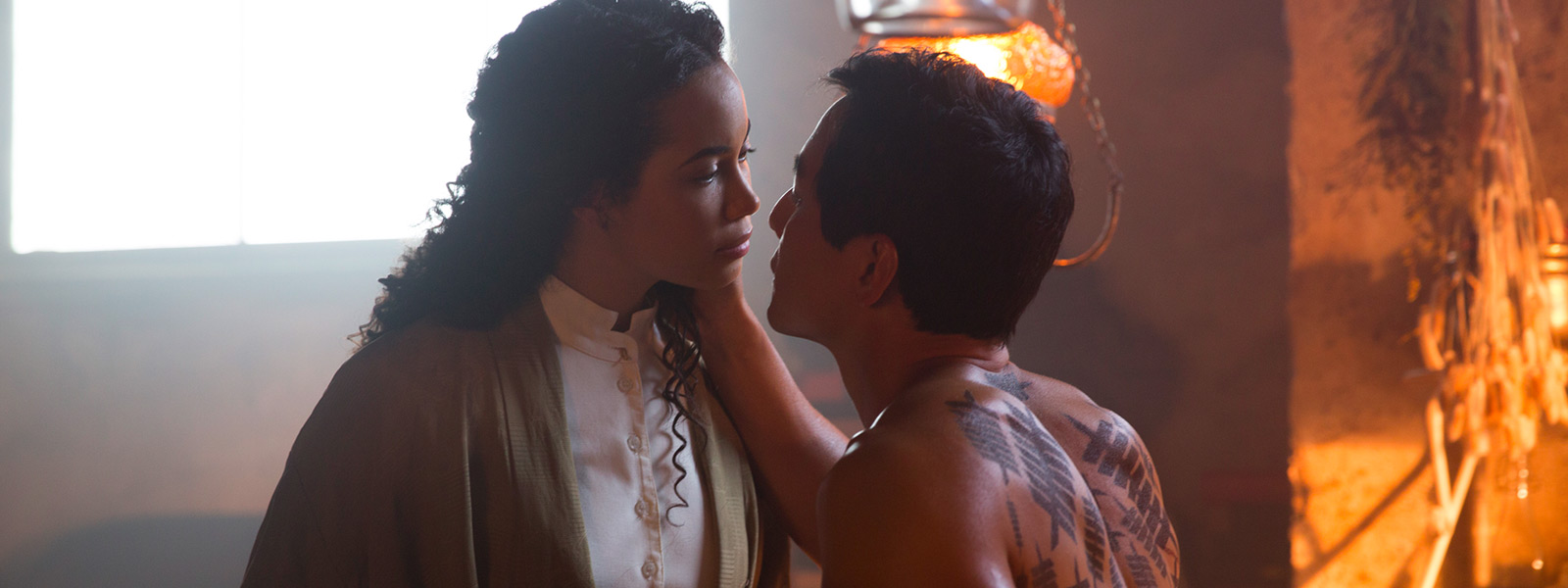
Sunny and Veil are supposed to be so in love that Sunny is willing to risk everything to get her to safety. The plot is set in motion when Veil tells Sunny that she is pregnant, and Sunny vows to escape the Badlands with Veil in order to protect her. The whole show is built around this catalyst. But while I adore the actress who plays Veil, their relationship doesn’t feel that passionate or committed. There’s no sense of why they love each other. There isn’t great chemistry between them. We don’t see their relationship develop, nor is there any back-story or sense of a shared past. Veil’s parents are more convincing as a loving couple, and they only have a few moments onscreen. We are told that Sunny and Veil are in love, but we don’t see it.
Some of this is a writing problem, some is a directing problem, some might be a casting problem – this wouldn’t be the first time that two perfectly good actors lack chemistry in a show. But some of it is a completely natural and plausible by-product of the world the characters live in.
In a powerful love story, the people who are in love care about the well-being of their loved one more than they care about anything else. They might be willing to sacrifice their lives for that of the greater good, but their primary emotional tie is to their loved one. In order to survive a violent, constrained, and unpredictable world, every character in the show cares primarily about these three things:
- Power
- Security
- Freedom
The characters experience love, lust, friendship, and hatred, but those are all secondary to their need to obtain some combination of power, security, and freedom. The characters differ primarily as to which priorities they set and the tactics they use to achieve their ends. For instance, Sunny’s Baron is named Quinn. Quinn thrives on conflict because it makes him feel powerful, and he justifies his need for power by claiming that power makes everyone in his domain safe (but not safe from him, of course). Quinn wins the obedience of Cogs and loyalty of Clippers by demonstrating power (he is a ruthless killer himself and orders his Clippers to kill anyone who opposes him, regardless of rank) and promising safety (he promises the Clipper trainees that if they can become Clippers, they will be part of his “family” and thus under his protection). The Baron is able to rule because his subjects are willing to trade freedom for security.
Quinn’s nemesis is a new Baron, The Widow. The Widow claims to offer freedom and safety to her Cogs and Clippers. She fights Quinn with physical displays of power, but presents a more compassionate face to those she rules. She claims that she want to increase her power so that she can use it to make the world safer for people, especially women. But we can’t trust her, because she also seems willing to manipulate people for her own ends. The Widow calls her Regent, Tilda, her daughter, but she never promises Tilda love. She promises her safety (“I said I would make you strong”). Both Quinn and The Widow play on themes of family and belonging, but they never mention love and affection. In this world, family isn’t where you are loved, it’s where you are safe – and even then, you have to fight for status within the family lest you lose that safety.
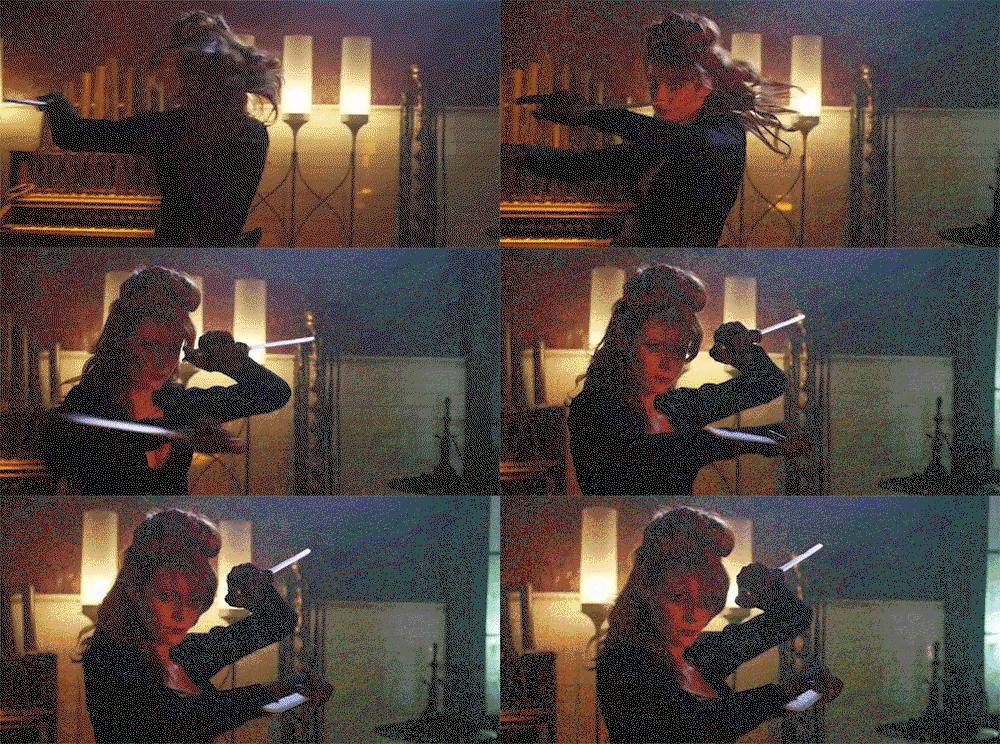
It’s established early in the show that this is a world in which women are at a severe power disadvantage, not because they lack fighting skills but because they are not respected. Yet the women in the story, whether they are physical fighters or whether they plot in different ways, exercise far more agency than poor, confused Sunny. Sunny wants safety. Sunny has built his whole life around achieving a kind of stability. As Regent he knows his place in the world. He’s protected by the Baron’s power and his own matchless ability to kill anyone who crosses his path. But both Veil and Sunny’s mentee M.K. want freedom, and they want Sunny to help them get it. Sunny cares about safety so much that he’s virtually paralyzed all through the series, and his feelings of being torn in different directions would be harrowing to watch if we really believed that he had room in himself for actual love. Without the audience believing that Sunny is completely emotionally invested in his relationship to Veil, his conflict seems hollow and his actions don’t make any sense, especially since it’s never clear why he’s so loyal to Quinn and why he seems invested in helping Quinn maintain his status.
The one convincing couple in the show is Tilda and M.K. I’m not a big fan of M.K. and I think Tilda deserves better, but I can’t deny that these two lethal teenagers are as adorable as any two super lethal people can possibly be. This romance works, and part of why it works is that the characters are so young that we expect them to be confused and slightly insane. Remember your first serious crush? It probably happened fast and wasn’t based on a lot of substance, it was probably confused and slightly deranged, and probably all that internal and external confusion occurred even without the complicating factor of your parental stand-ins constantly ordering you to kill each other. M.K. is being mentored by Sunny, who serves The Baron. Tilda is being mentored by The Widow, who is The Baron’s archenemy. In a world full of people who know what they want, M.K. and Tilda aren’t sure what they want except that they really, really don’t want to kill each other.

Because we actually care about M.K. and Tilda, any fight that involves M.K. and Tilda being in close proximity, whether they are fighting on the same side or in opposition, is heartstopping in a way that fights involving Sunny are not. Every one of Sunny’s fights tells us the same thing about him over and over again – he’s really good at killing people. But every fight that involves M.K. and Tilda accomplishes a storytelling goal. Every time they are in proximity they story moves forward and their relationship grows more complicated. It’s not that their fight scenes are technically the best. It’s that their fight scenes matter.
I find it a bad sign that at the end of the season I realized that even though the show is ostensibly about Sunny and M.K., I am not terribly interested in their fates. I think Veil will be just fine without Sunny, in fact I think she’s much better off without him, since I don’t believe that their romance is that real, and since Veil has initiative to burn and Sunny does not. The characters I’m interested in are the women, and that’s not just gender bias. The women in this show are simply more interesting. They are more complex. We know more about their backstories. They have more varied ways of dealing with conflict, ranging from ass-kicking to intrigue. The structure of the world is such that their lives necessarily revolve around their alliances and enmities with powerful men, but they have their own desires and dreams and agendas.
Season One of Into the Badlands was only six episodes long, and you can entertain an audience with interesting concepts and beautiful fight scenes for six episodes pretty easily. But if the series is going to succeed in the future, it will have to do a better job of incorporating character and emotion into the fights. We know these people can act, and based on the dialogue Lydia and Jade get, we know these writers can write. So whether the next season (a renewal is likely but not confirmed) is built around romance or not, let it be built around emotionally powerful relationships of some kind, and let the fights carry the emotion, just as in the best romance novel the sex scenes further the relationships. If we don’t feel empathy with the characters, if we don’t believe in their relationships or care about their lives, then all those gorgeous battles are just eye candy.
If you are interested in how fight scenes can reveal character, I touched on it very briefly in my post about the women of the MCU. Also, I can’t recommend this essay by Max Gladstone highly enough, “Jessica Jones Has Better Fights Than Daredevil”, not so much because I’m sure that JJ does have better fights than Daredevil but because Gladstone does a great job of looking at multiple films and movies and showing how a good fight reveals character.
YES YES YES!!! I was so thrilled when Into the Badlands premiered. Like Penny Dreadful, the first season is flawed, but it has such an amazing concept with such good roles for women that I wholeheartedly root for it.
I LOVE that The Widow’s methods are deeply flawed too, morally, it makes her more than just a feminist mouthpiece, and an actual three-dimensional character which is so much more useful and interesting.
The problem with most Hollywood/American action films and tv shows is that they’re always poorly shot and lit (christ, why does everything have to be so dark, America?), but Into the Badlands takes its cues (and its stunt coordinators are all from the world of Hong Kong cinema— maestro Stephen Fung) from Hong Kong action cinema and wuxia films, so they know how to block, shoot and direct action sets to its best effect.
I agree with the flaws that have been pointed out— I love Daniel Wu, but his character, and MK’s, are stock action hero characters, which kind of works against them, funnily enough, even though we are so used to that type of character. Perhaps it’s because we don’t usually get female characters in the world of action, that the writers are somehow able to really run free with the women. It’s not just the female characters— but also their relationships with one another—- The Widow and Tilda, Jade and Lydia, Jade and Veil, The Widow and Zypher that are all so fascinating and multi-faceted.
Into the Badlands is such a genre/niche show, but it hits all my sweet spots as someone who grew up watching wuxia films, plus it has fantastic female characters— the writing needs work for sure, but like Penny Dreadful (I’m also a Victorian Gothic Horror nut) I hope that it does get a second season and the writers can keep developing the full potential of its concept and characters.
I watched the first episode of Into the Badlands with very high hopes. I took up martial arts a couple of years ago (I have a green belt with potential to test for purple in the next few months), and really wanted a well-written show with excellent martial arts stunt work, and I got half of that. :/ The way I explained it to someone the next day, I liked the fight scenes and didn’t care about anything happening between them, for pretty much all the reasons you mentioned. I keep meaning to go back and watch the rest of them, but truthfully, not that motivated. There are other shows with good fight scenes and stunt work that are far better written (Arrow and Agent Carter spring immediately to mind, and I just end up watching those). I just hope maybe they can work out how to fix some of their writing problems. They’ve got the bones of a good show. They need the flesh.
I stopped watching during a fight scene where the Widow entered wearing ridiculously high stiletto heels (and a corset, natch). I thought: surely they’re not going to make her fight in those insane boots, which would destroy your centre of balance and hugely reduce your athleticism? And of course they did, because SEXY – but every time you saw the stunt double landing, she was wearing flat-heeled boots BECAUSE YOU CAN’T FIGHT PROPERLY IN STILETTOS. And then they finished the scene with the Widow’s boots magically turned back to stiletto heels, one of them planted on her prostrate adversary. I was laughing so hard at this point that I just switched the television off. If you’re going to insist on women being bad-ass fighters, at least give them decent footwear to fight in. You’d never see Kara Thrace trying to kick somebody with those things on.
Thank God, other women have been watching the show. I could not agree with you more ladies. Now if all the male producers, executive producers and writers of the show could only read read the articles and the comments!
I can’t tell you how glad I am that it wasn’t just me who walked away from the first season saying “a valiant first effort folks, try harder to show real emotions next time.” Because everyone else was acting in circles around our poor lead. But considering his season-ending position, it may give him a chance to do a bit more acting than fighting. I’d really enjoy watching his character have an actual arc.
I watched this for the fight scenes, and gradually got interested into some characters. I still wasn’t sure whether I liked the show or not, and you’ve clarified a lot of the things I liked and a lot of those that were bugging me.
I will watch the second season, as a lot of the things this show does right are hard to find elsewhere: racial and gender diversity all over the power spectrum (for example, we know of three Barons: you have a white male that rose from slavery, a white woman who was once a prostitute, and a black guy)-
And there’s the time an old guy in a wheelchair beat the whiny “Chosen One” protagonist (look up on youtube Waldo vs MK).
And then there’s the women, each of them strong and ambitious in their own way.
I think I have more hope for Sunny than you do. I read his character as someone whose concept of love is stunted. He becomes more conflicted through the season as he realizes the depth of his attachment for Veil. Veil, who is more emotionally healthy, is frustrated that he can’t give her what she wants and is ready to walk, which is awesome and something you don’t see nearly enough in romance. It feels like it’s all coming to a head, the season ending with Sunny poised to throw off his old life and commit fully to Veil. I think once he does that, he’ll become a more active lead. I hope so anyway!