
B
Genre: Comic, Graphic Novel
Young Romance 2 is the second volume of an anthology of comics from the late 1940’s by Joe Simon and Jack Kirby. Why aren’t I reviewing Vol. 1? Because my library had Vol. 2 but not Vol.1. Either volume is a fun collection of a style of comic book that was once insanely popular and is now almost forgotten.
The introduction to this anthology, while brief, is absolutely fascinating. Simon and Kirby are most famous for creating Captain America. In 1947 they launched Young Romance, which was the first romance comic line. The “Romance Comic” trend became huge until the 1970s. The introduction to Young Romance states:
“Created by Joe Simon and Jack Kirby, co-creators of Captain America for Timely comics, for Timely comics, Young Romance was an equally important development in comic book history, and a book they stayed with much longer. The team worked for Timely just long enough to produce 10 issues of their patriotic hero’s book, whereas they poured their energies into Young Romance for over 100 issues, and into its sister title Young Love for another 73. Indeed, their romance output exceeded that of any of the genres they handled in their nearly 20-year partnership, though others are more celebrated. But then most creators today are male, and Young Romance was designed for female readers.”
Young Romance 2 includes issues from 1947 – 1949 (The first volume contains issues from 1947 – 1959). Simon and Kirby launched the series because they wanted to write comics that would appeal specifically to women. They also wanted to make money. In the earlier 1940’s, pulp magazines that published romance did very well until the pulps were pushed out of the market by comics.
All the stories follow more or less the same arc, and they only have a few pages to do it in so things move at a dazzling speed. The beginning of the story starts in one of two ways: 1) Everything is Awesome (this often involves discussion of dear mom and dad) or 2) Everything sucks, here’s a quick flashback of how everything used to be awesome.
For example, in “War Bride”, the story begins with Janine, a woman from France, falling in love with a soldier and moving to America to marry him (with many fond farewells to mom and dad).
From this point things escalate quickly in a downward direction. Janine gets off the boat in America and searches the dock for her fiancé! He runs towards her – just as a cargo net breaks over his head, killing him! Immigration says she can’t stay in America because she’s a widow! There is much sadness!
In some cases things just stay sucky until Our Hero comes to the rescue; in others, there’s a triangle to solve. Rich man Aristide offers to marry Janine so she can stay in America, but she falls in love with his brother, Tony! Dare she love again? And if she does, what about poor Aristide?
And then we have a resolution in which everything is happy. Janine dreams that the dead fiancé encourages her to love again, and even Tony’s mom thinks the match is great and that Aristide will be fine. Cue kissing.
 These comics were marketed for adults, as broadcasted in their very first issue, “I Was a Pick Up!” According to the introduction, being a “pick up” was slang for being someone who would be willing to have casual sex.
The heroine of “I Was a Pick-Up!” seems pretty innocent although there’s plenty of room between the lines. Toni lives with her strict grandmother. She’s not allowed to date or even spend time with friends outside of school, because her mother was “bad” and her grandmother is afraid that Toni will end up the same way.
Toni finds a dress of her mother’s tries it on, and:
How can I explain what I felt? Was it the dress or was I growing up? This day seemed to be different from any other…it was spring, 1945…and the breeze seemed to whisper a strange temptation through my very being…”
Toni accepts a ride from a guy who whistles at her and uses this incomparable pick up line: “Pardon the greeting, lady…but it’s not everyday I see a dream…floating by….”
Bob takes her on a series of dates, including one at a roadhouse, which is raided by the police. Bob abandons her, saying, “Let that little tramp take care of herself! She’s just a pick up!” Luckily a gangster at the club, Stan, helps her escape from the cops.
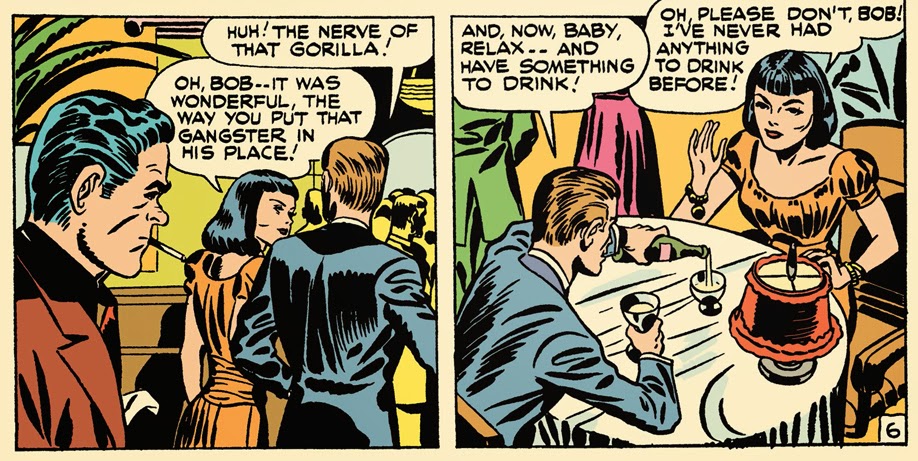
Toni falls in love with Stan, but he leaves town to protect her. The next summer, she resumes dating, and a guy named Jerry tries to rape her (as in, he claims to have run out of gas and then says, “I heard about your reputation …taking pick-ups and running around with gangsters! But I don’t care…kiss me, Toni!”) Toni runs off and walks for miles until she gets to a gas station. GUESS WHAT! YOU WILL NEVER GUESS!
STAN OWNS THE GAS STATION! Stan has turned legit, and since he’s redeemed himself he hopes he can ask Toni to marry him. She says yes and they have smoochies. From start to finish this roller coaster of slut shaming, gambling, drinking, organized crime, possible child abuse, attempted rape or at least attempted forced kissing, redemption, and marriage took 13 pages.
 I was going to say that once I read a few of these I never need to read another one again, and then I realized that without noticing it I had finished the entire collection in one day. These comics are like Cheetos – cheesy, cheesy Cheetos left out in a bowl on a desk, and there you are thinking that Cheetos are not very good and suddenly you’ve eaten the whole bag and you’re hands are marked with the Orange Dust of Shame and (in this case) you are speaking in italics and bold letters (“Why yes, Glen…I did change the kitty litter…I did it for you!).
There’s something so addictive about the sheer soapiness of the stories and the rapid pace with which they unfold, and I can’t wrap my mind around the weird combination of feminism and sexism in the stories. All the women are independent and intelligent and admired as such but it is vital to the stories that ultimately they find the love of a man, often as a result of being rescued, and they give up any career aspirations in favor of staying home (because this is right after WWI and we know what happened to women in the workplace, at least we do if we watched Agent Carter).
It’s infuriating and yet a little bit of a rush, because the women are seen as deserving to have a good time and deserving happiness regardless of their sexual pasts. Just because Toni has a reputation of being “easy” does not entitle her date to kiss her. One woman was a convict who served time because of her boyfriend, and although she thinks she’s ruined, her new boyfriend disagrees (“Unwanted”). Many of the women get great speeches. I’m especially fond of this one, from “The Man I Loved Was a Woman-Hater,”
“I understand you perfectly, Mister Self-Righteous Hermit! You’re just a big, self-pitying baby! I don’t know what Kay Norman has done to hurt you, but that’s no reason to vent your bitterness on the people about you! People who could like you if you gave them half a chance!”
If you’re wondering how this remarkable speech came about, see, it’s very simple – Karen is swimming at a lake resort when she has a cramp, and a guy saves her, but then he’s really rude to her. But the above speech makes him realize that he loves her and by the end of the assigned number of pages they find true love because OF COURSE THEY DO.
I don’t know that I’d recommend this collection to the average reader, but it’s fantastic if you are interested in the history of comics and/or how romance has been portrayed historically. Also THE CLOTHES! THE HAIR! THE ART! Look at the art!
This is a collection that is very reasonably priced for an art book but much more expensive than the average romance purchase, so if you aren’t really into comics or collection, see if your library has it. The grade involves the Cheetos effect and the historical interest, but it’s very much a mileage-will-vary title. I enjoyed it for the history, the crazy sauce, and all those retro clothes.
This book is available from:

As an Amazon Associate we earn from qualifying purchases.
We also may use affiliate links in our posts, as well.
Thanks!

Cheetos and the Orange Dust of Shame. Thank you, Carrie.
I did not know that the much-vaunted Kirby did all those romance comics. I wonder how many of the more *ahem* vociferous comic book gatekeepers know about this time in history.
I am glad I did not read these as a girl though. I’d have identified with the feminist bits but bristled at the “always getting married” bits…until I was worn down. Better to read when I’m older and can sort the feminism from the dated sexist shenanigans. And to know when I am in the mood for the Cheetos.
I think you mean WWII not WW1. Agent Carter is WWII.
As for the odd combo of sexism and feminism, a lot of romance today is exactly like that.
“All the women are independent and intelligent and admired as such but it is vital to the stories that ultimately they find the love of a man, often as a result of being rescued, and they give up any career aspirations in favor of staying home…”
@Emily you are correct – I made a typo! Agent Carter involves the aftermath of WWII, not WWI, and the particular issues collected in Young Romance Vol. 2 deal with the immediate post WWII period.
However, I have to disagree with the rest of your comment re “romance today is exactly like that.” Romance is a genre that depends on 2 people (or, in the more daring romances, more than 2) falling and staying in love. however, since the 1990’s heroines are just as likely to rescue the hero as they are to be rescued by him, and it’s not a norm for them to give up their careers. There is an over-used trope in which the heroine who couldn’t have babies or didn’t want babies suddenly realizes that she can and she wants to, but otherwise romance is much more diverse in how it treats women and careers and women and being rescued. It’s not even true that romance is always about a woman falling in love with a man – see the incredible number of f/f and m/m romances on the market.
Call me terrible but I can’t stop laughing about Janine’s dockside tragedy. I mean, what are the odds? Probably about the same as walking through the woods and arriving at a gas station owned by a former gangster.
Pretty! This has been a really wonderful post. Many thanks for providing this info.
you are in point of fact a good webmaster. The website loading pace is incredible.
It seems that you are doing any unique trick.
In addition, The contents are masterpiece.
you have done a great task on this subject!