
 One of Carrie’s popular features in Smart Bitches After Dark are her movie reviews and recaps, which we’ve given the Very Original name, After Dark at the Movies.
Carrie is usually very excited to recap from her couch, but she was determined to see Guillermo del Toro’s Frankenstein and share it with the After Dark community.
Trying to figure out where to see it led to this post.
…
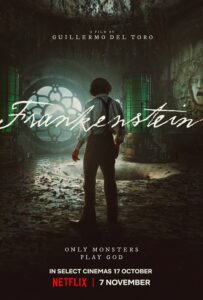
I’ve been very, very excited about Guillermo del Toro’s film version of Frankenstein. It will be released on Netflix on November 7, 2025, and is being shown starting on October 17 in limited theatrical release. Honestly, I didn’t think it was likely to play in my town of Sacramento, but it turns out that it is playing in Sacramento, albeit not until the weekend of October 23rd. It’s even playing in a theater that I can visit – a big chain theater as opposed to the local arthouse.
Here’s why I can’t see it in the local arthouse.
Frankenstein is playing in, among other places, one of Sacramento’s oldest, most historic theaters. This location shows old movies as well as new, mostly independent movies. The theater is a local treasure. Because it’s an old building, I would not expect it to be fully accessible. I’m not an expert on the details of the Americans with Disabilities Act, but I assume that some allowances are made for historic buildings, and I understand why this might be the case. But my recent experience with this theater was stressful, embarrassing, and dangerous.
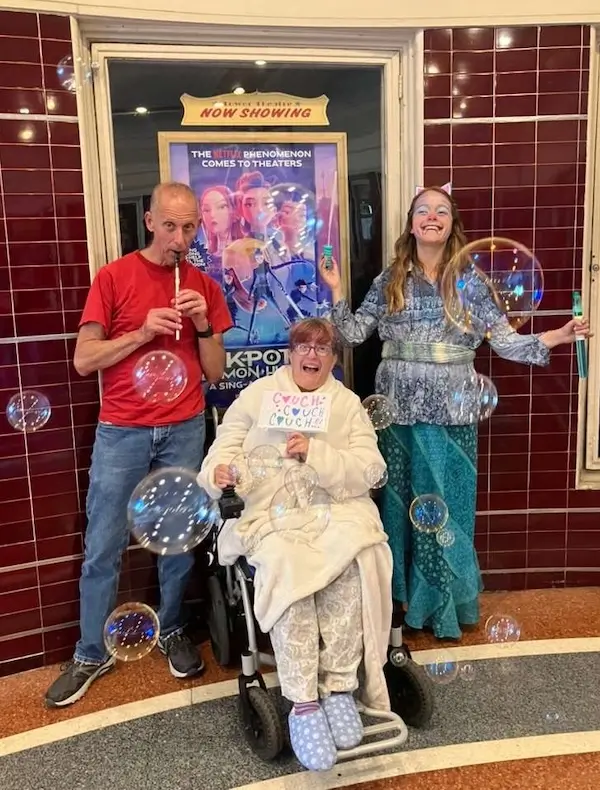
I’m sharing this not to wreak my vengeance upon the theater in question but rather because it is a perfect example of how a business can create “accessibility” on paper while remaining utterly inaccessible in practice. It’s also a good example of how we don’t notice barriers until we run smack into them ourselves. I haven’t gone to a movie theater in ages so it was a rude awakening when I tried to see KPOP Demon Hunters Sing-a Long as a wheelchair user – my first time at the movies as a wheelchair user.
We got our tickets and made our way into the theater viewing room. Inside, we found a wheelchair lift that was locked (you have to go up and down stairs to get to seats). My husband went to find an employee who had to find the key. The employee had to get a key from the manager. The employee, now armed with a key, activated the lift, and as soon as I rolled out, turned the lift off and began to leave with the key.
My husband and I pointed out that if she left with the lift locked, then if there was a fire or other emergency a non-ambulatory wheelchair user would be trapped.
Further, I was not only locked out of the lift, but I realized that the row it took me to was only a few rows back from the screen and that the seating was behind a short wall.
Both of these obstacles would make it difficult to see the movie.
Because I’m ambulatory and was accompanied by able-bodied people, I was able to leave my wheelchair in wheelchair seating and climb some steps to a better row. It was awkward, embarrassing, and painful.
But what makes me even more angry is that I had many different kinds of privilege that not all disabled people share. My experience was frustrating, but for others it would be actively dangerous.
It turns out that this is a problem in a lot of movie theaters. In fact, my local arthouse is ahead of the curve in that it does not force wheelchair users to limit themselves to the very front row. AMC, Cinemark, and Regal have both faced multiple lawsuits involving wheelchair access, including legal challenges that state that wheelchair users should have equal quality sightlines as ambulatory viewers.
A brilliant tumblr post by @urbancripple brilliantly states, “If You’re Gonna Make Something Accessible, Don’t Make It a Thing.” This post gives examples of situations in which something is accessible but awkward and situations when accessibility is not awkward:
The buses are wheelchair accessible but the driver has to stop the bus, take 30 seconds to lower the goddamn ramp, move passengers out of their seats, hook up the straps and then secure you in the bus. Sure, they’ve made the buses accessible but now it’s a thing.
And it gives examples of when accessibility is not a thing:
The train to the airport pulls up flush with the platform. I board with everyone else and sit wherever the fuck I want. Riding the train is accessible and not a thing.
I highly recommend the post for anyone interested in the complex world of accessibility.
What I experienced at the movie theater was A Thing.
It involved an employee, a manager, the search for a key, and, when that proved inadequate, my friends basically hauling me up some stairs so that I could actually see the movie I had paid for. On top of that, it was dangerous. And after all that drama, if I had stayed in the “wheelchair” seating, my view would have been obstructed by this weird-ass wall and by being so close to the screen.
I learned a lot from this experience. One thing I learned is how very difficult it is to see beyond your own level of privilege – a lesson I learn time and again. In the case of wheelchair access, before I used a wheelchair, I thought in terms of the most obvious accommodations, like ramps and elevators. I had no idea that not all ramps, or elevators, are created equal. I had no clue about the many odd frustrations that one encounters as a wheelchair user. Since I’m an ambulatory user, I probably miss a thousand other frustrations that I’d encounter as a non-ambulatory user. No matter how much you watch or read or think about, the only way to know what using a wheelchair is like is to sit in one – and even then every experience is different because every user is different.
I also got to see what allyship looks like in action. I’d love to tell you that, when this whole wheelchair lift drama was unfolding, I fiercely advocated for myself and fellow wheelchair users, but this was not the case. I did not feel fierce. I felt embarrassed. I wanted to hide. I wanted to go home. I do not like fusses being made over me. I don’t like putting people out.
Were I speaking to a friend in a similar situation, I would of course say, “You have no reason to be embarrassed. The theater created this issue and now they have to solve it. And your friends want to see the movie in your company, so unless they want to sit with you three rows or so from the screen, they are going to help you. Also, this situation is totally fucked and that’s not on you.”
But I’m sure I’m not the only person who talks one way to others and another way to the inside of my own head.
In the moment, it was my able-bodied family who came to my defense as allies – hunting down someone who could operate the lift, helping me on the stairs, and getting the lift unlocked again, not to mention expressing their displeasure to the manager and filing a complaint with their parent company and on ADA.gov (we have not received a response from either the theater’s parent company or the ADA to date). They really modeled for me what allyship looks like, and helped me get more confidence about advocating for myself.
It’s ironic that the movie I was trying to see was KPop Demon Hunters Sing-a-Long, a movie which discusses living as our full and total selves. It’s also ironic that the movie I won’t be seeing there is Frankenstein, given del Toro’s deep love for people and beings who are different, who in some way feel they are not fully accepted by society.
Accessibility can be difficult because no two people are the same, and because older buildings have great historic value but were simply not built with handicapped accessibility in mind.
Still, even given outmoded infra-structure, the theater staff could have handled this better.
They could have been polite (the manager with the key neither spoke to me nor looked me in the face).
They could have told me what future changes, if any, they had in mind.
They could have tried out the seating for themselves when they first installed the lift, and seen how poor the visibility was and either adjusted accordingly or, if it was simply impossible to work out something better given the age of the building, they could have offered a discount and an apology.
They could have treated me like a valued customer and not an incredibly irritating inconvenience.
So, friends, that’s why I won’t be seeing Frankenstein in the arthouse theater, unless of course it happens to open up in other local venues (fingers crossed!). I’m pretty sad, too, because that theater shows a lot of movies I’d enjoy seeing on the big screen.
However, I learned a lot about myself and my family and friends, I learned how to handle similar situations, and I learned that you can file a complaint with the ADA about disability accommodations at https://www.ada.gov/file-a-complaint/.
If not for the work of many disabled activists, I wouldn’t be going to any theater at all, but it seems likely that the megaplex will work out as a solution to my Frankenstein quest – I’ll report back!
Stay tuned, After Dark folks – Carrie’s review of Frankenstein will be up shortly! And if you’d like to join After Dark to help keep the site open for everyone, you can do that here!


Oh boooooy do I feel this. I had a disabling event a few years ago, and I suddenly really saw how the world is not accommodating. It took me almost a YEAR to get a button installed on the bathroom door in my office (an “Email miscommunication- sure, Jan) and meanwhile I’m noticing – why doesn’t EVERY door just have a freaking button? The office now has a button on the women’s restroom, but not the men’s, why couldn’t they have done that at the same time? What happens when a man in the office needs accommodation? Why do we have to request that?
I’ve found which restaurants and businesses in my town have buttons, and which don’t. Doors are HEAVY. I went to one location and I couldn’t even get in because they had accessible parking, but the ramp was on the other side of the building, facing on to a road.
And thats not to mention the cost of equipment and modifications. I am finally able to drive again after two and a half years, but the cost of training and equipment is prohibitive for many.
And I had two bad experiences at movie theaters, which turned me off for good.
But not everything is terrible. I went to a concert in a big arena for the first time since my disability. I was very worried, but the accessible seating was easy to find online, they had a fantastic wheelchair escort service (I am also ambulatory but didn’t think I could make it through the big venue on my own power), and clear accessibility information on their website. I realize not every business has the resources, but there should be staff training and basic respect for people. And the ADA is not followed or enforced enough.
Accommodations are helpful for everyone regardless of ability. The only reason we have cut curbs now is because some friends of a wheelchair user got frustrated and poured their own concrete to make an illegal ramp on a sidewalk. Everyone benefits from cut curbs – people with strollers, people out for a run, anyone. A lot of the products you see on infomercials were originally designed for people with disabilities. I wish and hope for kinder infrastructure, as well as kinder and more thoughtful people.
Thank you for posting this. My sister is a wheelchair user and she had a similar event at the Concord Pavilion – another place accessible on-paper only and had accessible seats …up a flight of three stairs. “Can’t you do just three stairs?” she was asked. Um, no. No, she cannot. At all. And how dare they ask. It was a nightmare for her, and we’re BOTH introverts so even as she was telling me about it I was dying inside at the thought. While her friends advocated noisily for her, I’m the older sister and wished I knew more how to help – so THANK YOU for sharing the ADA link with all of us.
“We meet accessibility regulations” vs “We are actually accessible” are so different.
Since January of 2024, I’ve utilized a walker so modern theaters are definitely an issue as there are stairs everywhere. The local Regal recently did a remodel. Previously the stairs were wide and I could fit the walker and climb. Now it’s two small and one wide and climbing is not possible because the rail is only on one side.
The “disabled row” has wheelchair spaces and companion seats. But when you try to buy a companion seat without buying a wheelchair space, the system gave you grief and required an override by a real HUMAN. I guess that issue received a LOT of kickback as recently is ONE notice that such seating is only available for so and so and if you aren’t then you can to asked to vacate the seat instead of needing an override by a manager. Previously the override issue meant I couldn’t use the kiosk or buy online but had to wait for a HUMAN who was also selling overpriced concessions and hopefully knew the override procedure.
And why oh why are all the ramps on the farthest side?
And most stage theaters want to TAKE the walker and store it so that it’s not blocking the aisle. I understand that but don’t take it and put is where I can’t see it or point to it for someone to retrieve for me — and since your ONLY handicapped seat is on the end I am blocking the aisle anyway as I can’t/won’t do the up/down up/down for the people who go back and forth all evening.
My daughter shattered (in itty bitty pieces) her tibial plateau back in February — and through her recovery has used a wheelchair, walker, crutches and a cane — and came to understand the issues I had been not so quietly b****ing about— “Now I get it Mom, all those things just make it so you don’t even want to try to go places.”
Thank you, @Carrie and commenters above, for educating me.
Movie theaters are a fucking crap-shoot when it comes to accessibility. Is there real accessible seating? If there is, how many seats are there? Where are they in the theater?
Having the wheelchair seats be _right up front_ is just nuts. I’m sorry you had to deal with that.
And the layout of the accessible seating is just _wildly_ patronizing when you think about it. It’s always a spot for the chair and then a seat for your “companion” (that’s often the word used on the seat to show it is reserved.) God forbid _two_ people in wheelchairs want to go to the movies together.
Thanks for the shout-out, by the way.
The worst part is the embarrassment and the way people talk to someone in a wheelchair. Got to experience that firsthand this year and we need to do better everywhere. I am grateful for the post and comments. Thank you, all.
I successfully won an ADA complaint, so don’t give up. I filed with the local federal office, but it was some time ago, so things may have changed.
As you said, some historical buildings are exempt by ADA, and some more recent pre-ADA buildings only have to comply with certain things if they start a renovation, because they complied with the Rehabilitation Act of 1969 when built.
We live in a world where ableism exists, and we have to continue to advocate for our rights.