
This month our Kickass Woman in History is a Canadian woman named Carrie Best. Carrie Best was the founder of The Clarion, the first Black-owned newspaper in Nova Scotia that was written and distributed specifically for Black readers.* Best used her platform to advance civil rights for Black people in Nova Scotia, and her work made Best an important leader in advocating for Black Canadians.
Carrie Mae Best was born Carrie Prevoe in 1903. She married Albert T. Best and they had one son, James Calbert Best, who grew up to be a union activist and a diplomat. Carrie and Albert also adopted four siblings as children: Berma (who became a teacher and who often gave talks and interviews about Best’s work), Aubrey, Sharon, and Mitchell.
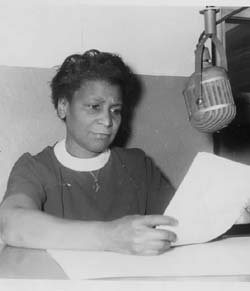
In 1943, Carrie and James went to the movies at the Roseland Theater. The theater was segregated, with Black patrons forced to sit on the balcony. Carrie and James purchased two tickets for seating in the downstairs section. They were arrested and lost a legal battle against the theater. This experience inspired Best and her son to found The Clairon.
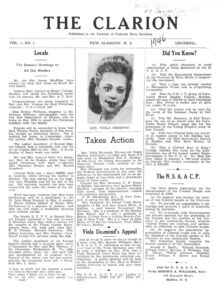
In 1946, Viola Desmond, another Kickass Woman, refused to leave the Whites-only section of the Roseland Theater. She was arrested and charged with tax evasion because of the one penny price difference between White-only seating and balcony seating. Best devoted the front page of The Clarion to the legal battle. Desmond’s actions were pivotal to the battle for civil rights in Canada, and covering the case prompted Best to move from a single page format to a multi-page paper highlighting the lives and the rights of Black people in Nova Scotia.
Best founded and hosted a radio show, “The Quiet Corner,” starting in 1952. It was devoted to music and poetry. She also wrote a column for Pictou Advocate from 1968 until 1975 which focused on the rights of Indigenous and Black Canadians. In 1956, The Clarion was renamed as The Negro Citizen with copies distributed all over Canada. She was an advocate for housing rights, fair taxation, and education. In 1974 she published her memoir, That Lonesome Road: The Autobiography of Carrie M. Best.
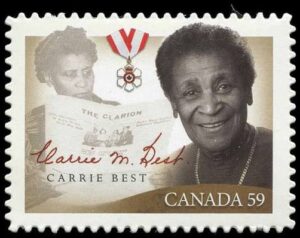
I’m happy to say that this Kickass Woman lived a long life (she died at the age of 98) and received many honors both during her life and posthumously. She received honorary degrees from multiple universities and was named an Officer of the Order of Canada. She was listed on the Nova Scotia Black Wall of Fame. Posthumously, she was awarded the Order of Nova Scotia and the Canada Post Office issued a stamp memorializing her.
Here is an interview that Carrie Best gave in 1977:
Additional Sources:
*Although The Clarion is frequently referred to as the first Black-owned newspaper in Nova Scotia, two other papers preceded it: The Atlantic Advocate and The Nova Scotia Gleaner.