The following review is for a book published in 1963 and this review, and the book, mentions some very questionable attitudes toward age differences, along with sexualization, paedophilia, and physical assault.
For a while there, I studied Anthropology at university. Why? I was curious. Reading this book felt like my own anthropological expedition, albeit 20-odd years after I studied the subject. I realise it is a sample of one, but it was a fascinating insight into the world of romance novels according to one woman in 1963.
I present to you: Forbidden Island by Sara Seale
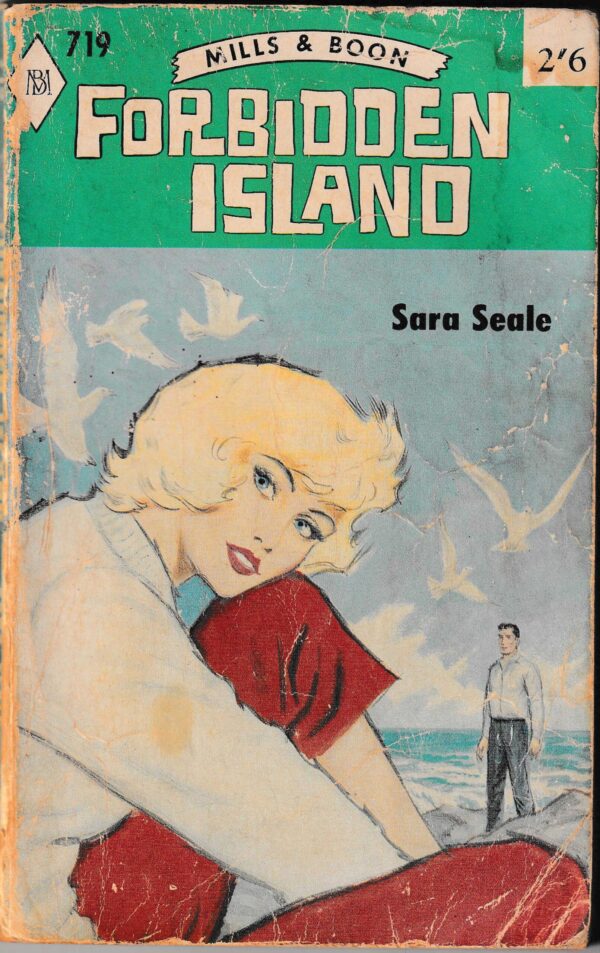
For the princely sum of two shillings and sixpence (British currency pre-decimalization), this book could have been yours 62 years ago. Converted to Pounds and Pence (by my father, relying on ancient memory alone) this is 25 pence. I have no concept of what it would be in today’s money. But this is a romance novel blog, not an economics one. Feel free to sound off in the comments with the answer!
I confess, I love this cover. The frank look of our heroine at the reader. The tiny man at the back. Nevermind that in the book our heroine has long hair and eyes the colour of peat smoke. And that our hero only wears kilts. Small details.
The blurb is a good one in that it gives you a good idea of what to expect.
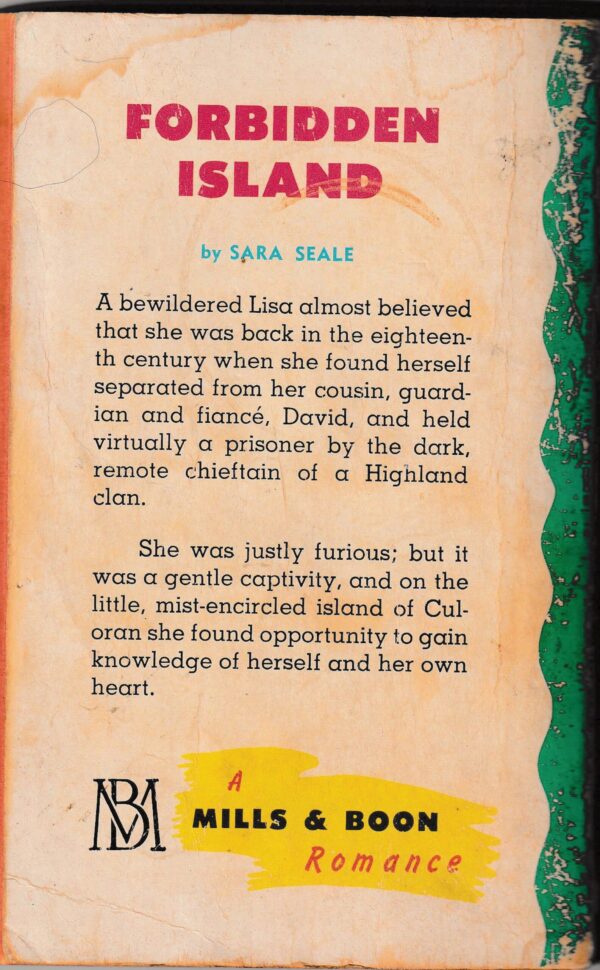
And here we have our first dose of WTF. David (not the hero) is our heroine Lisa’s cousin, guardian AND soon-to-be fiance. In the book, this is treated as a totally normal thing. No big deal! IN FACT, the deceased Uncle Toby (the original guardian) wrote in his will that if David and Lisa marry anyone other than each other, they lose out on the inheritance from Toby. Matchmaking from the grave! And this is just in the first few pages!
Lisa finished school and then spent a year in Switzerland at finishing school. After that, she moves back to London and stays in a series of hotels or with David’s friends. David doesn’t have a set abode. He is urbane, a bit neglectful and far more interested in having affairs with other women. This is something that Lisa looks upon with benign disinterest. She’s not bothered by Mrs Gilroy and her like. David and Lisa are planning to become engaged. Lisa has always been a bit infatuated with David and it seemed only natural to fall in with his plans.
They take a trip to Scotland to see the sights. At one stage, David is called back to London ‘on business’ (the man does NOT work: he’s called back by Mrs Gilroy) so he leaves Lisa in Scotland and off he zoots.
While Lisa was still in finishing school, David would send her letters. In some of these letters, he wrote most passionately about a small Scottish island called Culoran. Tales of the island were abruptly cut off, but Lisa’s fancy was caught. So having been abandoned in Scotland, she decides to travel to the island by herself.
Only once she gets to the island, the laird there, Sir Charles Kiltyre, decides to take her hostage. It seems that while David was staying there he ‘dishonoured’ one of Charles’ subjects and now David must travel back and make reparations by marrying the girl. So feudal! So fucked up!
The blurb is not wrong: Lisa’s imprisonment is gentle for the most part. She stays in the castle with Charles and his grandmother. There are a handful of loyal servants. And then of course the people that live on the island. They are all loyal to Charles and would not help Lisa escape.
Despite this, Lisa spends fully half the book trying to escape. She even has an escape attempt just before the end, but at that stage she is running more from her feelings for Charles than anything else.
Lisa is 19 and Charles is 34. That by itself is pretty gross, but it is made infinitely more gross by the constant talk of how Lisa is not yet a woman and still a child.
There is a particularly memorable line uttered by Charles (brace for ick factor) when he first sees Lisa:
“… and looked curiously at Lisa, seeing not the woman he had expected, but a child uncomprehending of adult ways, with her slight, sexless body and her indecent lack of skirts.”
(She’s wearing trousers.)
When they finally confess their feelings to each other, Charles shares:
“You’ve always been a woman for me, Lisa – even when you kicked my shins,” he told her with great tenderness. “Don’t be sorry that you are a child too, for I think I’ll always love the child the best.”
Either this is a book for paedophiles or conceptions of childhood v womanhood were very different then to what they are now. It’s startling to read with today’s perspective.
That shin-kicking Charles mentioned?
Charles and Lisa climbed the mountain on Culoran together and when they were at the top, Lisa was irritated with Charles and so kicked his shins but nearly fell off the mountain in the process.
What was his response?
“You daft little wild cat, you can’t play tricks like that in the mountains!” he exclaimed and before she was aware of his intention, he had dropped on one knee, thrown her across the other, and spanked her twice, very hard.”
I mean, what does one even say.
He eventually apologises for it, but…. Wow.
I’m a big fan of historical romance, but reading old contemporaries is a different way of approaching it. There were countless references in the book that underscored the time period. My favourite was this mention of accessories when Lisa was disembarking from a train in summer:
“She was aware that her new hat had slipped to the back of her head and that she had lost one glove in the train.”
To match the feudal lord’s views on a woman’s ‘chastity’, this is how Lisa felt about Charles towards the end of the novel:
“If you loved a man, she thought, then it was good that he should be father as well as husband, good that beneath the woman the child should never be lost”
And then just to add a little salt, her views on colonisation. Charles is saying that he’s proud to be Scottish.
“Perhaps,” she said demurely, “all conquered countries feel like that – to bolster their defeated spirits.”
To focus on the romance plot for a bit, there are instances where both Lisa and Charles are separately in peril and the other worries for them greatly. This is the full extent of any romantic feelings until the last page of the book. There is a kiss as punishment. There is softening towards each other, but riddled with perpetual misunderstandings. There is none of the deepening emotional connection that is common in today’s romance novels. I’m curious if this book is representative of the time in that regard. If Lisa falls in love with anyone in this book, she falls in love with the island. She is captivated by its beauty and wildness. That is about the only part of the book that would qualify as a romance today.
This book was a fascinating if grim insight into what 60 years of feminism can do for a genre. It’s also given me insight into what feminism has done for me. When I first read this book, I was little older than Lisa. At the time, I felt swept away by the romance of it. I read and loved this book when I was in my early 20s. I look back on it now, startled that I ever felt that way. For context, at the time, Wuthering Heights was my favourite book, so I was deeply in need of a feminist intervention. Thank heavens for university.

Thanks for this. Your review is so insightful and thought provoking. It really captures the lifelong reader’s experience with changing mores and standards of behavior in once beloved books. I especially appreciate your discussion of the way the MFC was infantilized and found the whole spanking thing more offensive because of that infantilization than because it was abusive.
I’ve experienced the shift of a former favorite book into wtf territory more than once (Spell for Chameleon, anyone?), but the most vivid instance was the movie McClintock! which I saw in a theater when it was released and which caused me full body cringes later in life due to its “humorous” public spanking scene.
I do think it’s valuable to examine older literature and media in light of changing social attitudes and with the awareness that change is not static or one-way. We need that awareness in order to nurture and protect social progress.
This made me think of the Dylan song Don’t Think Twice, which I believe was recorded around the same time. I remember asking my dad about the “I once loved a woman, a child I’m told” line when I was a kid. He sort of laughed and rolled his eyes. He said there was an ideal back then, very like manic pixie dream girl but with a bonus emphasis on purity. That women of that era had liked to think of themselves as innocents, and men had liked them to even more, and it was seen as a kind of measure of authenticity.
I can’t swear this was one of the approximately 9 million times he referenced Wordsworth but I am pretty sure there was a lengthy recitation of Ode: Intimations of Immortality.
There was also definitely discussion of how childlike was meant to mean wild and free (which we agreed was inaccurate) and how fey was similarly used as a descriptor of women as an othering/exoticisation/excuse.
So he wasn’t dating an actual child? I said. I was a kid myself at the time. The whole thing struck me as very unfair and icky, and as a kid I was extremely concerned with all things unfair and/or icky.
They were definitely young, he said, and there was probably a lot of family pressure insisting they were too young. Actually if the song’s about who I think it is, they really were too young. She left him and he’s rewritten history to seem all jaded and cool, which doesn’t precisely smack of maturity.
And that’s today’s installment of insights on being raised by wolves. I mean hippies.
This is fantastic; a wonderful analysis of growth and change!
I find some of the older Mills & Boon books weirdly fascinating, because I find there’s a disconnection between what I’m told I should be feeling as I read, and what the text actually says.
I think that it’s the lack of that developing emotional connection that Lara writes about. Having read through to the declaration of love at the end, I’ve sometimes gone back through the story and tried to find any clues that would point to affection or a sense of growing together of the couple. Instead, we’d have a heroine who came across as naive to the point of being dimwitted, paired with a hero who was angry, domineering and condescending. There was sneering, arguing, and non-consensual kissing, and I often wasn’t sure when – or how – they’d decided that they were now soul-mates
I’d be interested to know if there are any studies that look at how romance, and M&B in particular, developed alongside each other. The book Lara quotes feels very ‘women, back in your box’, and I’d love to read more about how authors and publishers pushed against, or moved forward with women’s rights.
So neat to see a really deep, vintage dive here! And yes, as kkw mentioned, the infantilization was very much tied into purity culture and was akin to othering/exoticizing back then. That, and it kind of ties into the idea that a woman was a “child” before she married, and only became a capital-W “Woman” afterward–it was less about age and more about sexual experience and sexual sophistication. (And sex before marriage was of course Bad™, and lesbianism and/or masturbation didn’t involve a man and his all-powerful penis, so they might as well have not existed or else didn’t count. OBVIOUSLY.)
There isn’t always a metric ton of ick to be found in really vintage romances, but they’re very hit or miss. And the march of time and social progress (thankfully) means the older they are, the more likely they are to be misses. But if you can stomach them (or else build up a tolerance, heh), they can be really fascinating looks into the history and evolution of the genre and culture as a whole.
Regarding the lack of emotional connection, though, Lara, I suspect you may have just gotten a dud. Unsurprisingly, references to sex/sexuality back then had to be far more coded (when the author dared to put them in at all), but plenty of romances from that time (and earlier!) succeeded on the emotional front.
I am enjoying these insights!
I am wondering something. To exclude possible power-balance issues with social status; and problems woth captivity….
Regarding the heroine’s age:
I know different cultures and countries have different guidelines. At that time and place, was 19 not considered an adult; or was 21 the metric for (if I recall), ‘reaching one’s majority’?
@PamG, years ago Jezebel did an article on spankings in film, with a supercut of spanking scenes. It was pretty tough to watch (since the woman is almost always struggling and screaming). https://www.jezebel.com/i-dont-know-whether-to-kiss-you-or-spank-you-a-half-ce-1769140132
The video in that link wasn’t working for me, so here’s a YouTube one https://www.youtube.com/watch?v=K1sr-NjFUEE
@Amy E.
I can’t speak for the UK, but this was definitely the case in the US for a long time–though, perhaps relevant to the conversation, a woman reached her majority either at 21 or when she married, whichever came first. As such, if a 17-year-old gal married her 19-year-old boyfriend and it was an election year, she’d legally be able to vote but he’d still have to wait.
Psst, 2/6 (two shillings and sixpence, or half a crown) is not 25p; it is 12½ p (an eighth of a pound).
Weird that 19 should be considered a child, when the canonical age for girls “coming out” into adult society was 17.
Two things: I knew women who married right out of high school in the late 60s, early 70s. It was no big deal. In fact, I was 20 when I married, and I was dumber than dog dirt, absolutely ready to make a lifelong commitment to another human being.
2nd thing: is the Like button working?
I think the like button server (it syncs externally) is down right now. I’m going to keep an eye on it. Thank you for the heads up!
Great review! I’m assuming the reviewer read this roughly when it was first published and so can’t dis herself for not catching onto the sexism at the time. It’s when I reread things from the 1990s – when we knew better – and see what I, a self-identifying feminist, blithely swallowed then. My gosh. And let’s face it, plenty of readers still love age gap romance where the younger party is also less than the older one in an exaggerated number of ways (height, economic, social status, self possession)
@SB Sarah, the like button is apparently working again. Just as well, as I’m liking these excellent comments.
Sara Seale frequently had a thing for writing teenage “woman-children” [aged say 17-19] who wind up married to cranky men in their 30s.
Oooh, this was a great article. I would love to see a broader survey of the disconnect between MCs in older novels — I can think of at least 3 gothic romances from the late 70s/early 80s where the female protagonist is paired with someone, seemingly at random, because the MMC turns out to be evil/dead/a dud. As in, on the very last page. Very weird for a romance. I’ve been tempted to put the Swiss ski chalet in to HABO, but I don’t remember much.
These peeks back into the past always make me want to spend some money with my own damn credit card in my own damn name that I pay for with my very own job.
Speaking of money, I like to read old books with these handy. Gotta know what that inheritance would be worth today!
https://www.bls.gov/data/inflation_calculator.htm
https://www.bankofengland.co.uk/monetary-policy/inflation/inflation-calculator
I think much of the popular culture becomes problematic as it ages because it will always remain in the social circumstances and conditions that created it while the world (in one way or another) moves on. When I think of all those bodice-rippers I used to consume by the gross back in the 1970s & 1980s…well, let’s just say it’s a chastening experience.
I remember one where the heroine is 15 and almost has consensual sex with hero in 20’s. She is agressor but he is not stopping her. When they are discovered in time, his parents/guardians send him away and it is treated as a great injustice to him. All grown up they meet again and it is explained their love has not died. Neither seems to think what happened was wrong. A schilling was 12 pence so price was 30 pence. About 3 dollars today.
Age of consent was 16 in U K
@Patricia But more importantly, 20 shillings were a pound. (And 21 shillings were a guinea, because England may have been the only place in the world that had a separate upper-class currency.) So one shilling = decimal 5p. In fact when the UK first decimalized, in 1970-ish, the new 5p coin was made the same size as the familiar shilling coin. Everything was resized in the 1990s.
Old cookbooks often refer to “the size of a shilling”. It’s almost identical to a North American quarter, which is similarly used as a size guide.
@Louise: I was born and raised in England and lived there before decimalization, and trying to explain the concept of the guinea to my American husband and kids was really hilarious: “Imagine if working-class and middle-class people purchased in increments of dollars but that upper-class people had their own currency expression that equaled one dollar and ten cents. The amounts would be the same, but the terminology would be different.” I always knew an item was not meant for my East-End family if the price was expressed in guineas.
Thanks for this. Like you, I remember the sixties…but not like that! Memory seems to have smudged out the worst of it and the feminism and new media of the last 60 years overwrote the rest. Never thought I’d see Mad Men as progressive!
@Anna Held
I know what you mean about older books where the heroine interacts with more than one MMC. Twilight definitely did not invent the triangle. Besides gothic romance, Mary Stewart often had two male potential love interests; so did Barbara Mertz occasionally. That’s where I learned always to root for the grumpy brunet. As for the emotional disconnect that occurred when the FMC ended up with someone she barely had a civil interaction with, that’s the price of telling not showing when it came to physical intimacy. Also, the “silent” generation still had a lot of influence on behavioral standards, so that closing kiss was as hot as it got.
@DiscoDollyDeb
I think “conventional wisdom” has a lot to answer for. It causes stuff that is not acceptable to become part of the wall paper. Hence, it’s only in retrospect we can recognize how loathsome that avocado & federal gold floral stripe really was. Occasionally, something will be pervasive enough to flip the switch though. I stopped reading Phyllis Whitney because her “heroes” routinely belittled and gaslit the heroine’s feelings–like personal growth meant getting in line with his POV. Yuck.
@Sarah
Just a heads up. The Like button is still acting up. I Liked something this morning and it loaded as normal. When I came back to read additional comments, it had vanished.
@PamG Haha one of the ones I was thinking of was Mertz/Michaels! The Thousand Rabbits one. And I do love a good Mary Stewart.
“her cousin, guardian, and fiance”?? WHUT? (Great review!)
This would be a fun series — having people re-read and review the first romance they read!
also I love that the title is in the SpongeBob Squarepants font
This is the closest I’ve come to understanding the difference between a pound and a guinea, so thanks for that!
“her cousin, guardian, and fiance”
I think of these as _Watch and Ward_ novels (after Henry James’ embarassing first novel)
https://en.wikipedia.org/wiki/Watch_and_Ward