
For a little while now, Harlequin Presents covers have looked a lot like Dancing with the Stars posters:
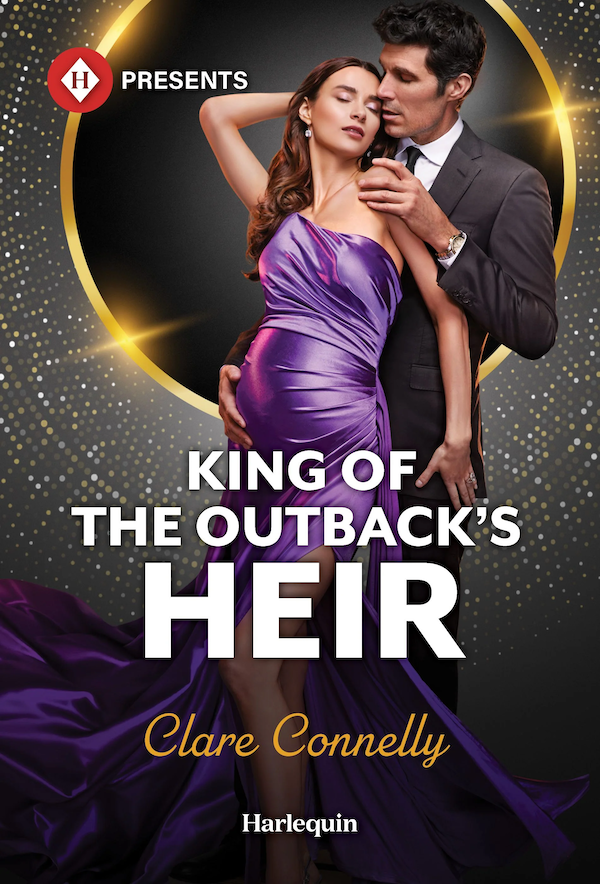
First, someone at the Australian Republic Movement is snorting HARD at the “king of the outback.”
Second, holy disco ball, right? It’s very cha-cha foxtrot we’ll be back right after these messages.

The Dancing with the Stars covers have been in use for a few years now, but today, November 18, Harlequin posted their new covers on Instagram:
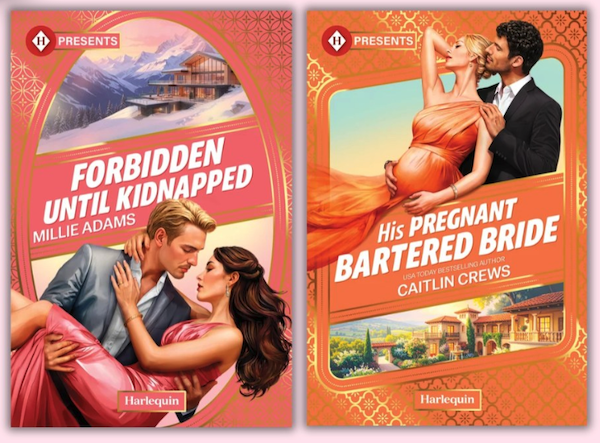
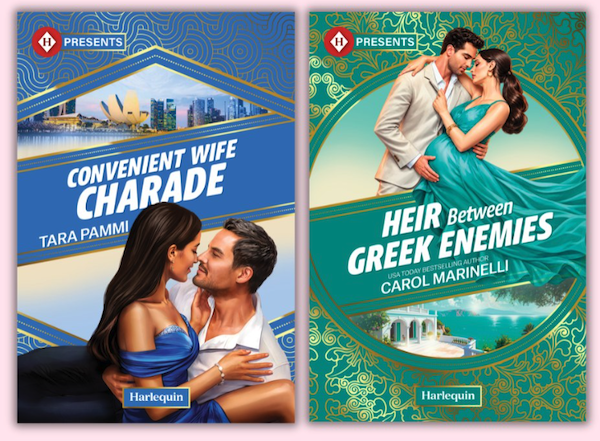
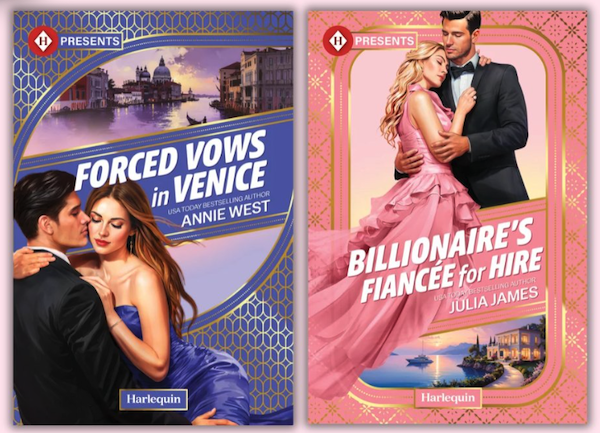
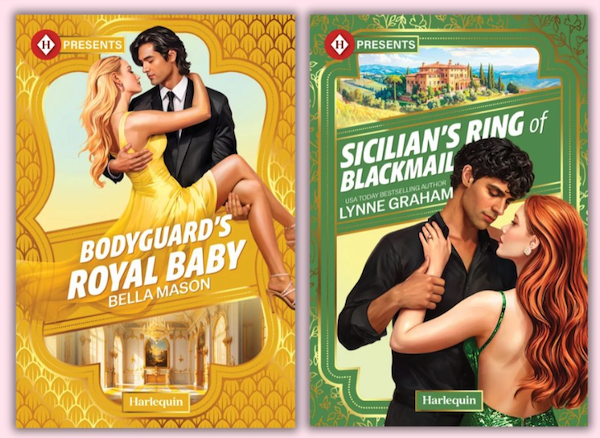
Those illustrations gave me pause. Like a “big pause in the middle of a show to argue loudly about a plot point” pause.
That art style is one I’ve come to associate with generative AI illustrations.

Now, I’ve said many times that I am not great at spotting gen-AI illustrations, but I’m not the only one questioning the art: an hour after posting on IG, nearly all of the comments (including mine) are asking about the art, whether it’s gen-AI, and whether they’ll share the name of the artists involved:
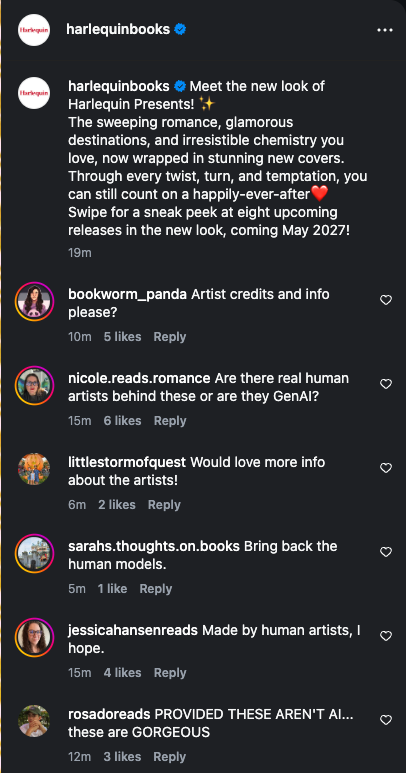
Harlequin has posted a follow up comment that they are not AI-generated:
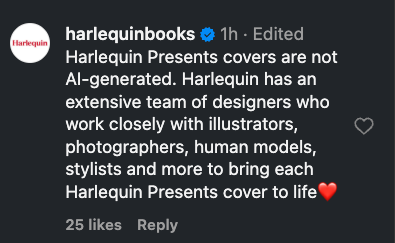
But as my comment and many others have asked: who are the illustrators? What are their names so we can credit them properly? At this time, that information has not been shared.
In a “Meet the Art Director” column on Harlequin.com, Senior Art Director Krista Oliver says that they were going for a “Newstalgic aesthetic,” and explained the development process:
As the concepts evolved through various iterations, we found ourselves navigating a constant tension between the retro and the contemporary. We ultimately struck the right balance by bringing together seemingly contradictory elements: photos of models we photograph turned by talented illustrators into old-school illustrated couples in sweeping, swooning romantic poses, and then paired with a bright, punchy colour palette and contemporary, lighthearted typography. (emphasis mine)
So like many old skool covers, they hold a photo shoot with models (sidenote: I would like to know more about the Harlequin ballgown budget for these covers – is it called the “ballgown budget?” I hope so) and, according to Oliver, those photographs were “turned…into old-school illustrated couples” by “talented illustrators.”
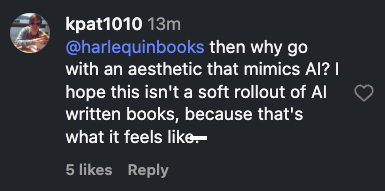
To quote kpat1010: why go with an aesthetic that seems to mimic AI?
Allegedly behind-the-scenes videos may be forthcoming to showcase the process, and the artists will allegedly be credited on the back covers (which aren’t available online that I can find).
But again, crediting them to begin with might have headed this commentary off – unless the notoriety and the kerfuffle was part of their marketing plan? My sympathies to those who handle the social media accounts and the general inbox if that’s the case. Yikes on tandem bikes.
Artist credits are showing up prominently in front matter, back matter, and on copyright pages to push back against generative AI art – a trend I personally love. We are regularly checking the preview on Amazon for a book to see if there are artist credits for the cover art.
Artist credits are even showing up on NetGalley: recently I was forwarded a NetGalley link for Too Hot to Wrangle by Timothy Janovsky because the sender was suspicious about the cover art.
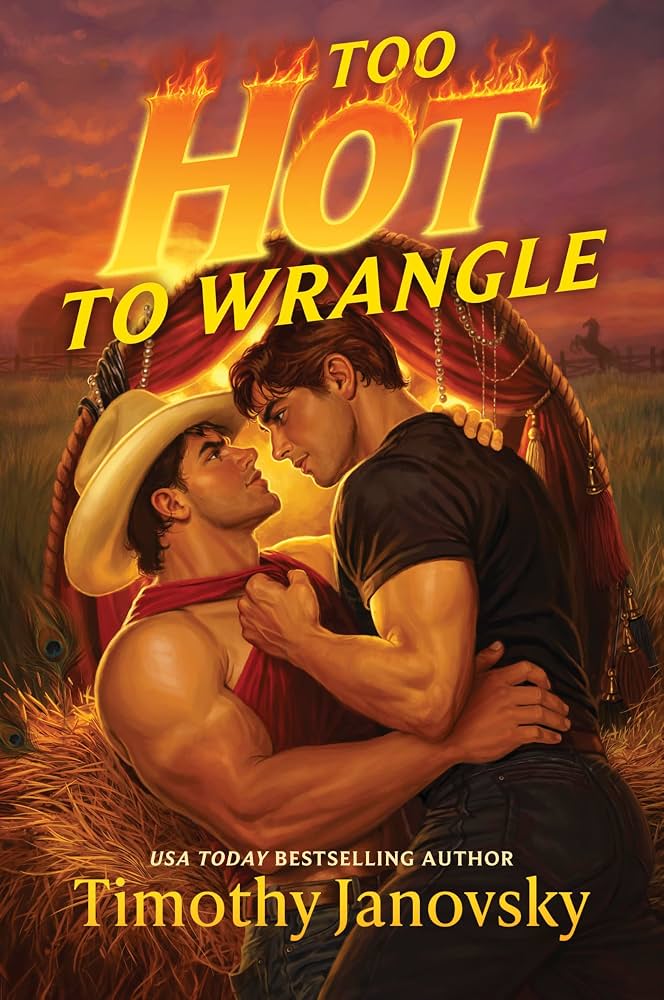
Currently there is an additional “Note from the publisher” that reads, “Cover illustration by Joey Macalle (IG @joeymacalle).” I do not recall that credit being present when I originally clicked the link, but it may have always been there. Not all of Harlequin’s NetGalley posts share the artist credit in the listing, however. And certainly author Timothy Janovsky has been very outspoken in his condemnation of generative AI.
My point here is not to shade any of these people, to be clear. My point is that crediting the artist is becoming an important step in pushing back against any questioning whether a book cover is generative AI. And, as a reminder, authors often have very little to zero control over the cover art. That decision is usually entirely in the publisher’s hands.
Honestly, I’m like that most excellent viral dude from Scotland confronting a right-wing bozo and saying, “Get your phone out. Show me the stats.” (Reddit link with video.)
Who are the illustrators? Why aren’t they currently being credited? I have reached out to the head of publicity at Harper Collins to ask for artist credit, and have not yet heard back.
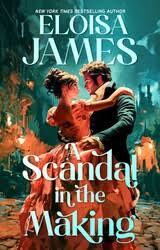
This would not be the first time that a cover that was credited to an illustrator turned out to include generative AI. In October, Eloisa James revealed the cover for her next book, A Scandal in the Making.
My apologies that I can only find a small version of this cover at present:
Originally this illustration was credited to Annick Poirier:
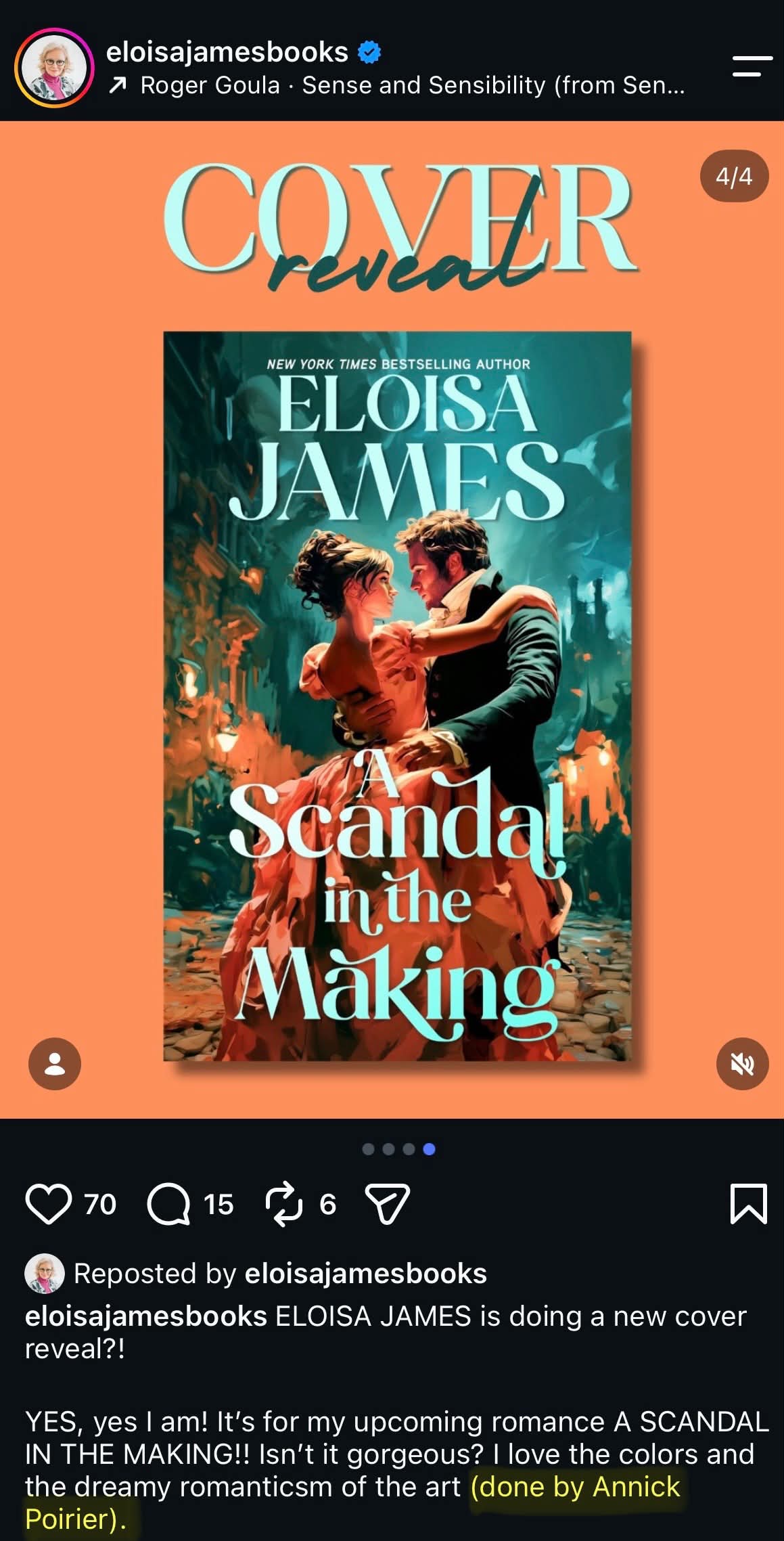
Readers immediately questioned the provenance of the cover art.
James told her readers that Simon & Schuster had assured her that the cover did not include generative AI. Readers including legallybookishserena then pointed out that Poirier is credited by one of her agencies as working both in “Illustration” and “AI.”
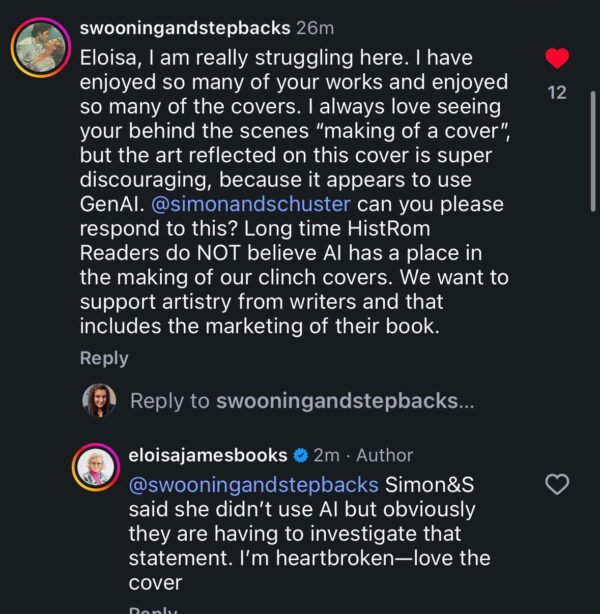
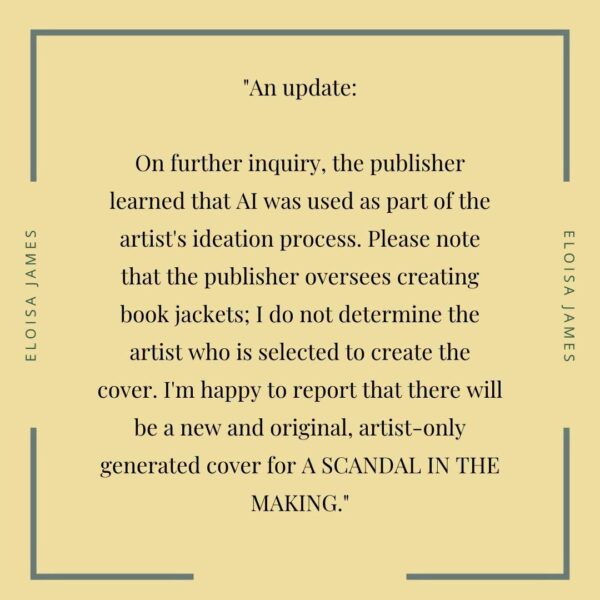
After Simon & Schuster investigated, James announced on her Facebook page that the cover was cancelled:
It would have made more sense, I think, for Harlequin to have had the artist names and their portfolios available to link when making the Harlequin Presents redesign reveal public.
As Courtney Milan put it, “Either they used AI which is terrible, or didn’t know that this looks like AI, which is worse, or they DID know it looks like AI and wanted to do it anyway, which is the pinnacle of bad decisions.” (Punctuation added for readability)
This is also not the first time that “Harlequin” and “AI” have been joined in holy SEO matrimony.
In January 2026, Eva Baron at Publishers Weekly covered the press release from the French Literary Translators Association condemning Harlequin’s French division for “severing its contracts with translators and outsourcing translation” to Fluent Planet, a company that uses AI for “part of their work.”
Further, as Mae Tang pointed out on Bluesky, Sam Spratford at Publishers Weekly reported in March 2026 that Harlequin had partnered with Dashverse, an AI entertainment company, “to Co-Produce AI-Generated Microdramas” inspired by Harlequin titles.
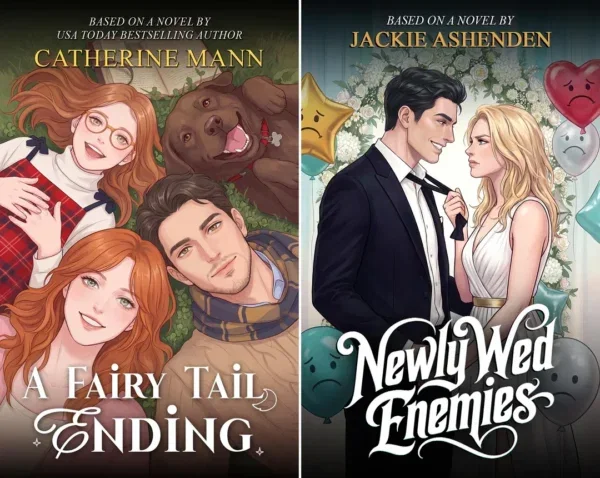
Dashverse is “an AI-native entertainment company building the infrastructure for the next generation of storytelling” through Frameo, an “AI-powered creation platform,” per Harlequin’s press release on the deal.
Tang wondered if the Harlequin Presents redesign was a deliberate visual reference to their microdramas:
They’re saying in the comments it’s not Gen AI. But I was thinking the characters have the look of vertical/short Gen AI dramas. Then I see someone has commented with a screenshot of this. So maybe even if it’s not Gen AI they are keeping to a similar aesthetic? But everyone hates slop! Bad choice.
KJ Charles commented, “Apparently these really aren’t GenAI, in which case I can only commend the human artist for copying the copy machine right back.”
I still have so many questions. Who are the illustrators? What are their portfolios? Were these images allegedly chosen because they resemble generative AI images? Was the selection of this imagery a deliberate choice?
Without the questions about the illustrated couples, these covers are rather lovely. While I wonder at the loss of the signature “circle” that has been a hallmark of Presents covers, I like the different colors that distinguish them from one another each month, and I like the nostalgic style, which is becoming very popular lately. The color palate, the filigree and gilt of the borders – it’s very appealing to me.
But not if the illustrations are generative AI.
Any use of generative AI in a book cover taints the book itself with questions of provenance.
Many readers, myself included, presume that if generative AI is used on the cover, it may be used to generate the book, and personally I am not interested. And I’ve written at length about AI narrators and allegedly AI-written books before. This is, alas, an ever-evolving issue.
I hope I get a list of names! I hope if these covers are entirely illustrated by humans that they get the credit and increased contracts for their original work. More money for artists, please!
I just want to know who they are, and the absence of that information seems like a choice at this time. And not a good one.
Thanks for your reporting on this Sarah! I hope they’re not AI — I really like them.
I do think it’s interesting that Harlequin has taken a more …shall we say … aggressive AI stance than other publishers.
Maybe they actually do use photographs, which are then digitally touched up after the fact (either by human or AI), but I gotta say, the villa in the background of Sicilian’s Ring of Blackmail is absolutely SCREAMING gen AI to me. The Amazon listing for the book has a relatively high-res image, and if you zoom in, there’s definitely some architectural nonsense going on with the windows and arches. :/
The thing that jumped out to me about the Sicilian’s Ring of Blackmail was that part of his hair is behind the title, part in front, and the author’s name is in front of his neck. I think that would actually require a lot of work with layers to pull off if intentional.
But it just looks sloppy.
Knocking wood that they’re not using Gen AI because man. I remember those beautiful hand-painted covers from the ’80s.