

Marlow Moss was an artist who defied conventional art rules as well as conventional ideas about gender and sexuality. Since she referred to herself during her life as “she,” I will do so here. However, critics today speculate whether today she might have defined herself as non-binary, gender-fluid, or transgender.
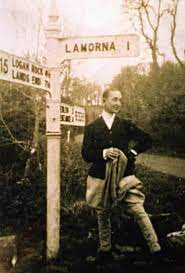
Marlow was born Marjorie Jewel Moss in 1889 in London. She loved music, but a miserable attack of tuberculosis halted her chances of becoming a professional musician. She also loved to dance. She studied at several art schools until 1919, when she changed her name to Marlow, cut her hair, and dropped out of school. At that time she also began wearing men’s clothing. Once she adopted her new name and her new style, she never deviated from it again.
In Paris, Marlow discovered the work of Piet Mondrian and became part of the Abstraction-Création art movement, which moved away from representational art. Moss loved mathematics and saw her art as partly an expression of numbers and geometry. She elaborated upon the ideas of Mondrian with her own innovations – for instance, double lines in place of single lines, and the inclusion of three dimensional elements. While she was inspired by Mondrian, he was also inspired by her, adopting his own version of double lines.
During her time in Paris, she also met Antoinette Hendrika Nijhoff, who remained her partner for the rest of Moss’ life. Nijhoff was a writer from the Netherlands. Moss had a warm relationship with Nijoff’s son from a previous marriage, an artist in his own right who studied photography under Man Ray.
‘I am no painter, I don’t see form, I only see space, movement and light.’
– Marlow Moss, quoted from memory by her partner A. H. Nijhoff
Moss was Jewish and had to flee Paris during WWII. Most of her work was either lost or destroyed during the war. She moved to Cornwall, where she spent the rest of her life in a cottage with Nijhoff, always buying a Christmas present for every child in the village. Moss and Nijhoff made many trips to Paris as well as the Netherlands, where Nijhoff kept a houseboat that was a haven for artists.
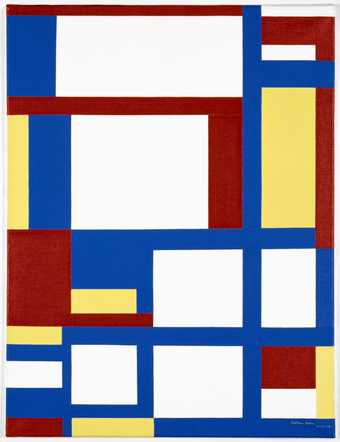
Moss was able to support herself as an artist, but she never achieved the kind of fame that Mondrian achieved. Her status as a woman, as a Jew, and as a member of the LGBTQIA+ community all contributed to her erasure, as did the loss of her early work and the fact that her later work was left to a family member who rarely allows it to be exhibited. Happily, an exhibit at the Tate Museum of Art in 2014 and a general resurgence of interest in gender and sexuality in art history has caused her to be widely rediscovered. The following articles discuss her life and work in more detail:
“Queering Constructivism: the Legacy of Marlow Moss” Art UK
“Marlow Moss: Forgotten Art Maverick” The Guardian
Marlow Moss and the Quest of “space, movement, and light”
Wow, this is someone I’ve never heard of who sounds fascinating. What a life!
Also, I’d like to say, Marlow Moss is an awesome name. Good choice.
A kickass person indeed, thanks for the introduction!
I agree, thank you for the introduction – Marlow Moss was an amazing person! I did a bit of web searching to find more images, including one with Antoinette Nijhoff. I also came across a reminiscence from one of the children in the Cornish village, who used to spy on the studio while Moss was working.
I thought I was pretty familiar with the art world, but I never heard of her!
This is my favorite series. I love th book reviews and sale roundups, but Kickass Women in History always makes my day!! Please keep doing these.
Carrie, thank you for introducing me to this fascinating artist.