This post contains:
SPOILERS FOR: Game of Thrones, Outlander, and Mad Max: Fury Road
HUGE TRIGGER WARNING FOR: Discussion of rape, also brief mention of torture, murder, imprisonment. But mostly for rape.
Also a lot of words. But that’s a good thing!
Recently I saw Mad Max: Fury Road (Our extremely positive review is here). Mad Max: Fury Road, which I’ll henceforth refer to as Fury Road, involves women escaping from sexual slavery. Meanwhile, during the week that Fury Road opened, Game of Thrones aired an episode called “Unbowed, Unbent, Unbroken” during which a major character, Sansa, was raped. During the same week, Jamie, the hero of Outlander, was raped and tortured during the episode “Wentworth Prison.”

I have not seen either the rape of Sansa in Game of Thrones nor the rape of Jamie in Outlander. I have no opinion on the scenes themselves. I don’t always think that it’s a bad thing to depict rape and without having seen the shows, I can’t comment on how well it’s handled. What I do find interesting is that whenever rape is depicted, many people offer reasons for why they think that it is not only desirable but also necessary to include it, and of course with two shows in one week featuring rape people were quick to proffer the usual defenses.
This prompted a mind-blowing tweet from author Saladin Ahmed (since deleted):
Note: FURY ROAD is an R-rated movie w/ a sexual slaver villain yet Miller & co. didn’t feel the need to include a rape scene.
Mind. Blown. It actually did not occur to me that Fury Road does not contain a rape scene, and now that Ahmed has brought it to my attention I can’t stop thinking about how powerful it is that it doesn’t. I do not always think that showing a graphic depiction of rape is a bad thing, but I do think that it’s over-used. Moreover, Fury Road shows why some of the most common arguments in favor of including rape scenes in fiction are flawed.
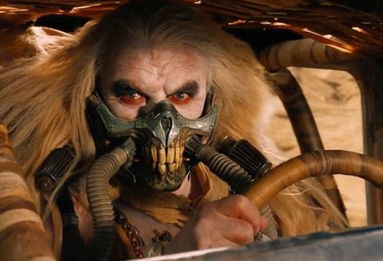
The plot of Fury Road is very simple. In the future, the world is a wasteland. A warlord, Immortan Joe, has five “wives,” women he keeps captive. He forces these women to have his babies – their only value is their fertility. Another woman, Imperator Furiosa, rescues the women with the goal of spiriting them to “The Green Place.” Max, a wanderer who is also trying to escape from Joe, allies with Furiosa. The entire movie is a road chase in which Immortan Joe hunts Max, Furiosa, and the wives in an attempt to reclaim his “property” (Joe’s word).

If ever a movie seemed tailor-made to include a rape scene, it’s this one, an R-rated movie with rape at its core. Yet the director, George Millar, who has included rape in his earlier Mad Max movies, did not show a single scene of sexual violence in Fury Road.
Why not? Let’s look at some of the things people say in defense of rape scenes and explore how Fury Road deals with them. Again, this is a criticism of arguments in favor of rape scenes, not a criticism of any specific scene or show.
- “It’s important to show rape because it’s historically accurate (or because it would be realistic given a certain setting).”
Fury Road is a science fiction movie that features a guy in long underwear on a giant truck made of speakers who plays a flaming guitar while hanging from bungee cords, so if ever a movie might be allowed a “realism” pass, it’s this one.
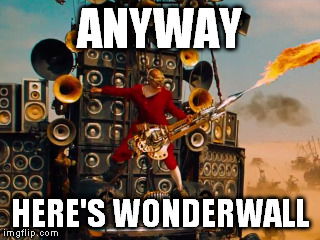
Still, the movie is realistic in suggesting that this is a world in which most power is wielded by men who rule by fear, and therefore rape is very much a part of this world. However, while rape is omnipresent, we (the audience) don’t have to see it. In fact, it’s BECAUSE it’s so omnipresent that we don’t need to see it occur. Of course it occurs. We know that rape exists in this world because the entire plot revolves around women trying to escape from rape.
Often, rape is used as shorthand for, “This person is vulnerable.” This is a criticism I have of Outlander, a show that I admire in many other respects. There are scenes of sexual assault in both the book and the TV show that are pivotal to the story and that arise organically from the characters and their surroundings. For instance, I have not seen the rape of Jaime so I cannot comment on how it is handled in the TV series, but I do understand why they chose to include that scene. In the book series, the rape and torture that Jamie experiences at the hands of Black Jack Randall is the outcome of a long character arc and has serious practical and emotional repercussions for everyone involved for years to come.
Rape is a problem in Outlander when it is used as an easy way to indicate that Claire is vulnerable. Yes, Claire is vulnerable to being raped. But that’s not the only way in which she is vulnerable. She has no money, no family, no clan nor connections. She has no way to travel or to provide for her own most basic needs. She doesn’t know the customs of the time and she doesn’t speak Gaelic. Sadly, the show tends not to explore these issues. Instead, every time Claire starts to think she’s got a handle on things, she’s threatened with sexual assault AGAIN.
“The Devil’s Mark” was something of a relief because it explored a historically accurate way in which Claire is vulnerable that did not have to do with rape. When, at the culmination of being tried for witchcraft, Claire is publicly stripped, her partial nudity is shocking and upsetting because it is an organic part of the story we’ve seen unfold. This scene was so upsetting to me that I stopped watching the show, but I didn’t find it gratuitous or offensive. It was SUPPOSED to upset me and it worked in a way that several “Claire in Peril” scenes did not because it was a seamless part of the story that combined the various characters, the setting, and the plot in a way that felt horribly inevitable instead of shoe-horned in.
There are so many reasons why the “it’s historically accurate” argument doesn’t hold water that I could devote an entire post to this issue alone, but ultimately the question of accuracy is irrelevant. In fiction, the story is everything. This is not a documentary. Every single thing in a fictional piece has to fit the needs of the narrative. Does showing a character being raped advance the story? Is it a logical outcome of the characters’ decisions and personalities? If the answer to either of these questions is no, then it doesn’t need to be there, accurate or not.
In Fury Road, showing the effects of rape culture advances the story, but actually depicting rape would not, because it would be redundant and it would damage the flow of the movie, which relies on almost non-stop forward physical and narrative movement. Miller trusts the audience to get what has happened, in all its horror, without being walked through every step, which allows him to get on with making cars explode.

- “It’s important to show a bad guy committing rape because it shows that he is the bad guy.”
Immortan Joe deprives women of freedom so that he can indulge in his own pleasure and procreation and he refers to them as his property. He tortures captives and turns them into eternal blood donors. He deprives people of water at his whim and distributes it wastefully so that everyone will cling to him in hope of abundance and stay weak because of deprivation. Also, see #1 – we know that he’s a rapist. Honestly, given the movie as it is, are you confused as to whether or not he’s the bad guy? Would actually seeing him rape The Splendid Angharad or Capable clear up some kind of ambiguity?
In Game of Thrones, before raping Sansa, Ramsay Bolton flayed prisoners alive after they were promised mercy, tortured Theon, hunted a girl with dogs and watched the dogs kill her, flayed some other people, and said many horrible things. Some commenters have said in discussions elsewhere that we needed to see Ramsay rape Sansa so that we would know how awful Ramsay is. Really? After seeing him chase a woman through the woods with a pack of dogs, some members of the audience were still confused about his moral standing? I have more faith in humanity – well, most of humanity. I’m pretty sure the majority of viewers were clear on the idea that a guy who lets a woman be ripped to death by dogs is probably not a paragon of goodness.
Fury Road trusts the audience to come to conclusions without having their hands held.
More on that here:
- “You have to show rape so that the audience will understand how awful it is for the rape victim.”
Here’s where Fury Road most gloriously puts its faith in the audience and in the actors. How do we know that being raped was awful for the wives? We know because of their desperation to escape it. We know because of how they cling to each other, how Splendid risks her own life to save her sisters, how The Dag hisses at her pursuers, how Toast the Knowing learns to load weapons, how Cheedo the Fragile creates an opportunity for Furiosa, and how Capable allies with Nux because she knows all too well what it means to be seen as a tool and not a person.
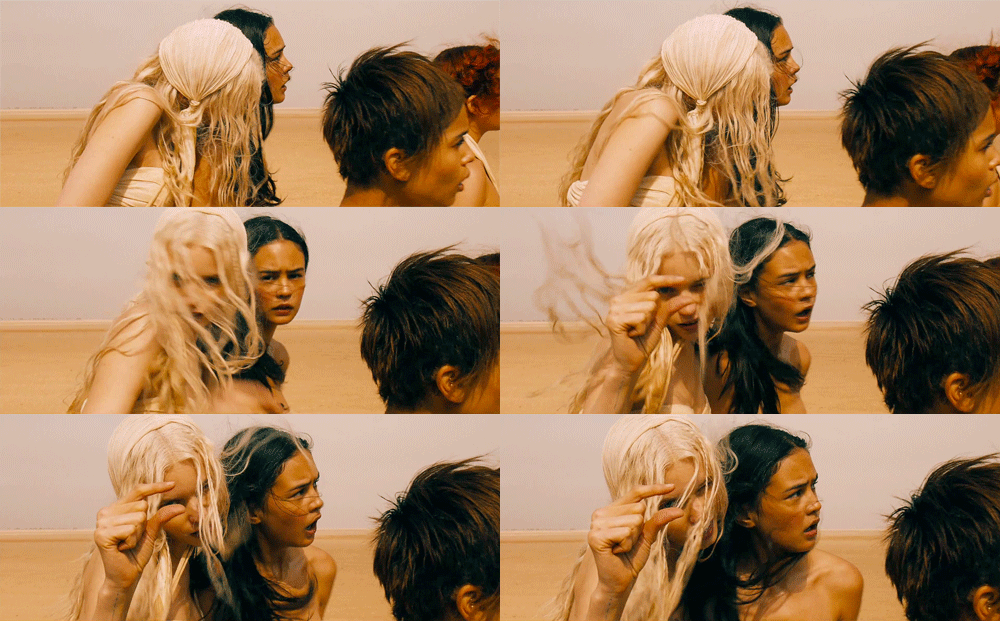
The wives in Fury Road are not hapless victims. They have agency. While they lack the combat skills of Furiosa and Max, they find ways to make themselves useful. Rape has affected them, but not destroyed them. It’s important that they are all affected differently, because in real life there’s not one single, universal response to being raped. They aren’t faceless tributes to Joe’s savagery. They are people. We know what they endured was terrible because we know what they will sacrifice to move beyond it physically and emotionally. It’s their story, not Joe’s. It’s not the story of how Joe is a bad guy, and it’s not the story of how they suffered. It’s the story of how they survive.
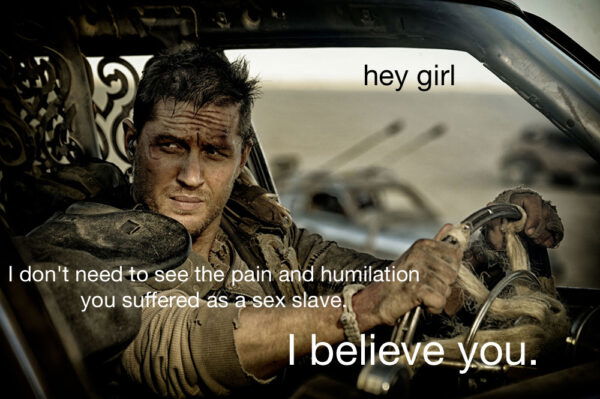
In short (too late) Fury Road’s omission of a rape scene highlights how unnecessary many rape scenes are. We don’t need to constantly show rape because of “historical accuracy” any more than we need to have heroes and heroines who are missing teeth and who have lice and nutritional deficiencies. We certainly don’t need to use rape to establish historical accuracy in a story that chooses to omit those other markers. We don’t need to use rape to show that someone is a villain if we have already established, either by showing or by telling, that they have done bad things. We don’t need to use rape as the only way to show someone’s vulnerability – it is one of many dangers that women (and men) face, but not the only danger. We also don’t need to show the rape itself to convey the impact of rape on a survivor. Rape deserves to be treated as an event that takes place in a certain context and which has powerful effects on the survivor, the rapist, and the people who surround them. It doesn’t deserve to be treated as a short-cut, a device, or a trick.
There are times when showing a rape is going to be the most artistically honest choice. But for this to be the case, artists need to stop falling back on the same excuses to use rape as a short-hand for “this person is vulnerable” or “this person is bad” or “this place and time is scary.” By choosing not to include a rape scene in Fury Road, Miller demonstrates how powerful a story can be when you trust the actors, the storytelling, and the audience, and when you keep the focus not on the actual moment of sexual assault but on the culture that permits it and on impact it has on survivors.
Well played, Fury Road, well played.

Unf. This article. Gets. It.
I quit Game of Thrones after season 4. I just could not with the show runners using rape and the threat of rape as shorthand for “this place is dangerous.” And, I’m beyond tired of the apologists who point to ‘historical accuracy’ (GoT is a FICTIONAL world), or the source material (HBO has added rape and violence to the show that was either not in the books at all, or was just alluded to in the books).
One reason I enjoy History Channel’s Vikings so much is that they don’t feel the need to show rape constantly…and “rape & pillage” is basically the Viking job description.
[…] Mad Max: Fury Road Makes Your Rape Arguments Invalid … http://smartbitchestrashybooks.com/I have not seen either the rape of Sansa in Game of Thrones nor the rape of Jamie in Outlander. I have no opinion on the scenes themselves. I don't always think that it's a bad thing to depict rape and without having seen the … […]
Great essay! I’d love to see a part 2 where you share your thoughts on WHY so much rape is a bad thing, too. My husband and I were just talking about this last night, and I was having trouble articulating to him why it’s so problematic and what it does to individuals and to culture as a whole.
Yes. This. As a survivor of sexual violence, this really speaks to me. I haven’t seen any of these shows (way too triggering) but I’m glad this article exists.
And this quote also gets at why I disagree with @Tristan’s comment re telling the story of rape victims without telling the story of their rape. In my experience, the thing that convinces people of the horror of sexual violence usually isn’t hearing graphic descriptions of the violence, it’s hearing honest stories of the difficult aftermath – the nightmares, the flashbacks, the shaming by supposed allies, the struggle to feel safe, etc, etc. More than one person had told me that they didn’t think CSA was that big of a deal before I shared (some of) my struggles to recover.
Great article! I loved Fury Road, but hadn’t even thought about how the rape wasn’t shown but was still a factor until reading this. All around good storytelling.
As for Game of Thrones, yes, obviously there are scenes of gratuitous sex, rape, and violence for no other reason than titillating the audience, but I don’t think Sansa’s scene was for those reasons. It was not necessary to show the audience how evil Ramsay is, but until her wedding night, Sansa is ignorant of how awful he really is. This scene is about her learning exactly what her new husband is capable of. It’s also important to note that during that scene, the camera is focused on Theon and his reaction. This intimacy with her torture is a catalyst for their relationship growth during the rest of the season. It was not necessary to show her rape, but it was necessary to show Theon’s reaction. From that point, he starts questioning his loyalties – he confesses to Sansa that he never killed her brothers (thereby making her one of the only people in Westeros that knows they’re alive), and at the end of the season, he saves her life and tries to escape with her. Would he have done that if he had not witnessed Sansa’s daily horror? Who knows! But at least her rape scene made the storyline develop. This cannot be said at all for the earlier scene of Jaime and Cersei at Tywin’s wake. That was gratuitous, the camera was actually on the action the whole time, and it, so far, has had no ramifications – their relationship seems to be exactly the same and doesn’t seem to have effected the plot AT ALL.
This is so annoying and EVERY rape victim is going gush gape mouthed over it. For decades we have been taught by the trigger happy that rape is not about sex but about violent dominance and control. Well . . . is it or isn’t it? Get your victimization straight because every time you drag it out to harm everyone else with your efforts at extending your collateral damage you just make it worse.
I haven’t starting reading yet, I will, but I will add that show Hannibal does what the movie did as well: they don’t show us rape or sexual abuse, the implication is already there and enough.
I’m not against showing or writing about rape or a rape scene if it goes with the context and it makes a purpose more than SHOCK VALUE! bullshit.
@Linette, the Outlander books are much worse though than the TV show Game Of Thrones when it comes to depicting rape over and over again.
SPOILERS!
In addition to Jamie pretty much every mayor character in those books has been raped. There has been brutal gang rape and rape of a child, and that’s not even all rapes that take place. The author of those books has a serious rape kink.
@Marion
I haven’t read the Outlander books because I’m not fond of time travel romances. So I don’t know just how prevalent rape is over the course of the series. I decided to watch the tv series out of curiosity and also to see if it might get me interested in reading the books. In any case, the article is about the decisions of film-makers to include rape scenes or depict them in graphic detail. Generally, I don’t like rape scenes and skim/fast-forward through these scenes or avoid reading/watching them if possible. But if I think such a scene is organic/necessary to a story, then I forge ahead and read/watch it.
That’s how I felt about Jamie’s rape scenes. To me, they were horrific and not the least bit eroticised, romanticised or what have you. For one, his bloodied, mangled hand ensured that I was always aware of how much pain he was in. For another, his helplessness and confusion reminded me constantly that what he was enduring wasn’t just sexual abuse, but also psychological and emotional torture.
I also think the use of flashbacks was very effective. By structuring the episode that way, the writers and director implied that those scenes were necessary to the narrative and so I decided to stick it out. And they followed through because as I said in my previous comment, I better understood Jamie’s confession and warped perspective of what had happened to him and sympathised with him far more than if he’d simply narrated his experience to Claire. That would have distanced me from what happened. Showing his torture and rape in detail bridged that distance and put me squarely on his side and had me rooting for him to heal and learn to overcome the trauma of it all.
On the other hand, I gave up on the Song of Fire and Ice series because I felt the stories had started to meander and the violence on all levels was a bit too much for my taste. I decided to watch GoT to see how well the books would be translated to the small screen. To their credit, the writers managed to tighten up things story-wise and actually tone down the violence, both physical and sexual. But I still think they should rein in the frequency and degree of these scenes. It’s starting to pall and I’m tempted to switch off on the tv series as well.
@Linette, to each their own. Especially that last rape came across very eroticised to me. Jamie was moaning and obviously feeling pleasure. I felt it was porn. And so did my husband, who kept shaking his head at what he was watching.
Thanks for writing this article. It hits home on so many key points.
I’ve seen some arguments (that have some validity) that suggest that GRRM writes a world where those old chestnuts of fantasy (medievalness! dragons! pillaging heroes! helpless wimmins with crowns and speshul powahs!) get played out to their logical, depressingly realistic, ends (people are douchey, and go out of their way to be douchey to other people, and then you die. horribly). I don’t, however, think the showrunners are showing this anymore. I think they’re caught in “let’s see how much shock we have to deliver next week to top our Twitter trends” mode).
I never finished Outlander (was not my bag), but the way even the fans are describing the Jaime-rape make me wonder if the same sensitivity and care would be given to a Claire-rape and aftermath. Plus the fact that the actual *story* in it isn’t the rape, it’s the aftermath–the survival, the overcoming, the (sometimes) succumbing, the feelings about himself. You don’t need to see people being tortured to know that torture is bad and tortured people have a journey to recovery.
And I can’t even start on Sansa/Theon-Reek etc. I gave up on GoT midway through season 1 due to boob and violence fatigue, but I know enough story to really wonder if Theon-Reek isn’t just a sociology experiment to see just how repellent a character the writers can get the audience to root for/excuse. *Sansa’s* rape is needed for *Theon* to figure out that whatsisname is a bad guy? Did Theon’s own abuse not clue him in?
My ponderance is the perennial conflict that artists always seem to have: we show the world as it is, but we also show the world as it could be. I’m not being too pollyanna or shirking reality by showing worlds in my stories where the Signature Move against a female character is something other than the Flying Rape Combo right out of the cage. I think we can do better as a society, and I think part of that is modeling fictional instances where you don’t have to use the rape-hammer over the viewer’s/reader’s head to make them understand that Bad Things Happen and This Character Has Vulnerable.
What scifigirl1986 said at #16, great insight.
Sadly, there is a rape depicted in Fury Road. You can’t really see the rapist, but you can clearly see the pain being caused in the bride’s face. Furiosa sees it for what it is, just after she’s seriously wounded in the final leg of the conflict. The women lock eyes. An attempt to show them supporting each other in their pain? I have to assume so, though I really need to watch it again. It’s almost a ‘blink and you’ll miss it’ moment, not really a ‘rape scene.’
There was no rape in that moment. I believe you’re talking about the moment where Toast is in Immortan Joe’s car after being snagged by a polecat, and she’s looking at Furiosa with a “this is going so badly” expression. Furiosa has been mortally wounded. Toast can’t escape, and the end result of all of this for her will be rape, probably death, and definitly pain. She can have that expression without being raped (that’s kind of the point).
In addition, Immortan joe is driving, and he’s clearly got some capabilities, but even he can’t drive at high speeds, direct the offensive, froth with scenery chewing rage, and rape Toast all at the same time. No one else would dare touch her in that way (that’s kind of the point, too). There was no time and everyone was concerned with the battle at this point. There was no rape.
I wonder, if rape is necessary for Sansa to figure out just how evil a person Ramsay is, why does this need to be *her* rape?
Alternative scenario : Ramsay has non-violent, consensual sex with her to consummate their marriage. Afterwards, as Sansa lies there thinking, “well, that wasn’t as bad as I thought it might be”, Ramsay drags Reek in and rapes him. Cut to Sansa’s horrified, agonized face.
This would serve as a reminder to Sansa of what could happen to her if she steps out of line, without actually (in Ramsay’s mind, anyway) traumatizing her to the point where she tries to escape or even commits suicide. And Sansa and Theon could still bond over their shared suffering. It’s just that this way, if rape is the only thing that can open Sansa’s eyes, it’s a man being raped rather than a woman.
[…] Mad Max: Fury Road Makes Your Rape Arguments Invalid. […]
I think when they say “historically accurate” they actually mean they believe that rape is normal and natural. Otherwise, since there are dragons, and this isn’t Earth, there’s no reason to assume people would always rape each other.
It assumes rape is always going to happen among humans. So in the words of the proverb, we should just lay back and enjoy it. Bleargh.
@Redheadedgirl
I could see Immortan Joe at the wheel, it was one of his favored boys in the backseat. I don’t think, at that point, IJ was as concerned about the ‘purity’ of his remaining wives: she wasn’t his favorite, he probably saw her as partially responsible for the death of his favorite, and he did put a gun to her head not long after.
The oddness of that initial moment will likely continue to bother me until I can see it on br.
[…] – How Mad Max: Fury Road makes your rape arguments invalid […]
[…] poi chessaràmai – la violenza e la brutalità in GoT sono storicamente accurate – a meno che non lo siano affatto, nel qual caso è ugualmente ok perché tanto è fantasy. […]
[…] creativity. Mad Max: Fury Road, the plot of which revolves around a sexual slavery narrative, managed to not include one single rape scene and still made its […]
[…] creativity. Mad Max: Fury Road, the plot of which revolves around a sexual slavery narrative, managed to not include one single rape scene and still made its […]
Well done and thank you.
[…] strength. Iowa man shoots women for reporting him for sexual harassment. Mad Max: Fury Road makes your rape arguments invalid. “Why I’m no longer comfortable calling Louis CK a […]
[…] “Mad Max: Fury Road Makes Your Rape Arguments Invalid“, by Carrie S on Smart Bitches Trashy Books […]
[…] Your weekly reminder that Mad Max: Fury Road is the best movie of the year: it’s about women escaping a rapist, but it never includes even a hint of a rape […]
[…] good commentary on rape in Mad Max: Fury Road vs Game of Thrones AND Outlander (I also recommend their […]