
D
Genre: Novella, Historical: American, Inspirational, Romance
This RITA® Reader Challenge 2016 review was written by Linda. This story was nominated for the RITA® in the Romance Novella category.
The summary:
Julia Broeder is only six months shy of graduating from the Women’s Medical College of Pennsylvania when one small decision spirals out of control and results in her expulsion. Hoping to travel the world as a missionary doctor, her only choice is to return back home…or throw herself upon the mercy of Ashton Carlyle.
Formal and straight-laced, Ashton Carlyle is not pleased to see an expelled Julia arrive at his Manhattan office. His position as a junior attorney for the Vandermark family’s world-famous shipping empire entails taking care of the Broeders, longtime employees of the Vandermark family. But Ashton has no intention now of using his employer’s resources in defense of Julia’s impulsive and reckless actions.
What Ashton did not expect was a scathing reprimand from none other than the Vandermark family patriarch or the bewildering resistance from Julia herself when he’s forced to change his tune. At an impasse, Ashton and Julia never anticipated the revelations that arise or the adventure that awaits them.
Here is Linda's review:
I picked up “Toward the Sunrise” fully expecting to enjoy it, but ended up wanting to hurl my Kindle into the ocean like a frisbee of rage.
On its face, this is actually a well crafted novella with strong characters, emotional nuance, and a premise that seemed almost tailored to bring me joy. I genuinely believe that most people who read this will rate it highly—as the other SBTB reader who reviewed it did—but I am personally just thankful it was a relatively short experience because by the end I was forcing myself to read past my anger and nausea. Because unfortunately, underneath the charming plot (strong female protagonist! learning humility! baby goats!) and wonderfully stiff hero, was a backbone of unremitting Orientalism and historical revisionism. It makes me sad that Camden’s depictions of women are so progressive and thoughtful, but she seems to have entirely missed the boat on intersectionality.
Essentially, the two main characters spend an inordinate amount of time bonding over their shared love of the Orient. Julia is planning on moving to Asia to be a medical missionary and Ashton has regrets about deferring his youthful dreams of climbing the Great Wall for the practical reality of taking care of his aging father. Not a page goes by without some reference to this shared love of this idealized vision of Asia.
If you’re not sure why this Orientalism is troubling—and I don’t blame you, it’s not really part of mainstream conversation—this essay is a more eloquent primer than I could ever write.
That said, if “Toward the Sunrise” had just been two white characters waxing incessantly about their love of the Unknowable Orient, I think I could have still gotten over it. After all, it would just be one more of the many small indignities that come with loving romance novels as a woman of color. What I can’t forgive is Camden’s romanticization of colonial history. While not quite Gone With The Wind, this novella takes place in 1897, which is near the peak of the colonization of Asia and post both Opium Wars.
I’m usually not bothered by historical romance novels approaching history like it is a set of loose guidelines, but which aspects of history the writer chooses to gloss over or glorify can be incredibly telling. There is a scene in “Toward the Sunrise” where the hero reflects on his accomplishments and reminisces fondly about how “he had negotiated gifts for restless Tamil natives in their Sri Lankan tea plantations.”
RESTLESS TAMIL NATIVES, I angrily said to friend in a text festooned with angry emoji. I WONDER WHY.
If you’re not in the loop, this Wikipedia article explains why this disturbed me quite succinctly:
The British found that the uplands of Sri Lanka were very suited to coffee, tea and rubber cultivation, and by the mid 19th century Ceylon tea had become a staple of the British market, bringing great wealth to a small class of white tea planters. To work the estates, the planters imported large numbers of Tamil workers as indentured labourers from south India, who soon made up 10% of the island’s population. These workers had to work in slave-like conditions and to live in line rooms, not very different from cattle sheds.
I am sympathetic to the argument that Camden is writing from the perspectives of her characters, who lived at a time when such attitudes about Asia were not uncommon. But she is also writing in the year 2015 and I find that to be an inadequate justification if there’s no critique of the character’s beliefs in the text itself. In fact, she could have saved this book by having her protagonists move to Asia only to realize that it is nothing like the romanticized vision in their minds. They could have seen the lasting damage people like them did to my people and others in their lust to possess the Orient like a shiny toy. More simply, Julia could have become aware of the atrocities being committed abroad through the dispatches of missionaries and other travelers, and then pushed back against Ashton’s beliefs and actions.
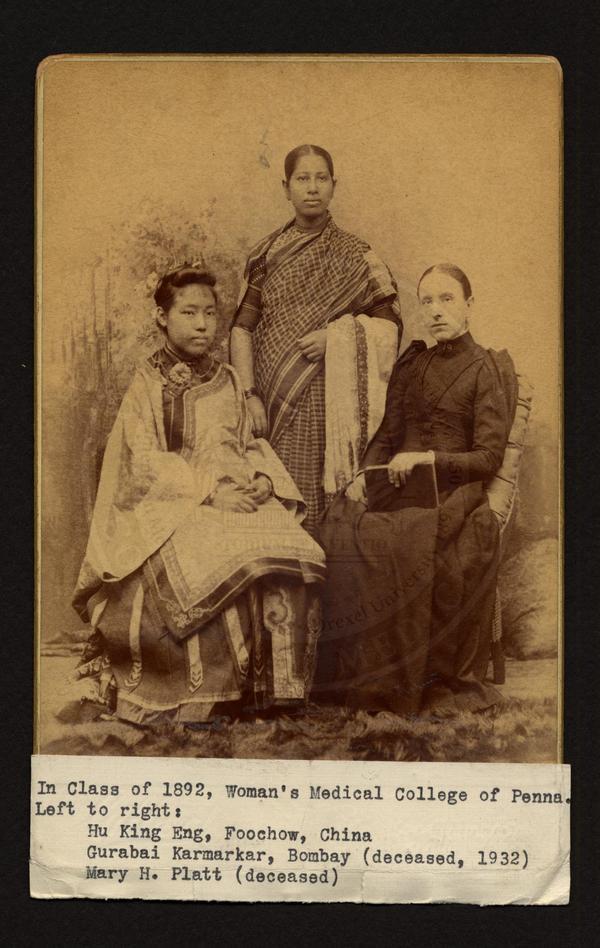
Or Camden could have just made one or both her protagonists Asian. It’s not taking from us if you include us, and it wouldn’t even be farfetched since Asians did live in and travel to western countries during that era. In fact, there are records of Asian women graduating from the Women’s Medical College of Pennsylvania in the late 1800s—the exact same college that our fictional heroine attends. It would actually be completely historically accurate if Camden had made Julia an Asian woman.
And while I didn’t realize this novella was Christian Inspirational when I picked it up to review, I don’t think that changes anything. There are millions of Asian Christians in this world and I personally know many who would appreciate a Christian romance featuring Asian protagonists.
But, speaking of Gone With the Wind. I’m reminded of this Esquire review of the movie 75 years later, where critic Stephen Marche writes:
This is the underlying reality of the racism in Gone with the Wind: its abstractness. The War is an external force outside of the personal dramas of the players. Slavery, hatred, prejudice — all may well exist but not in any personal way.
In “Toward the Sunrise,” Ashton closes the deal of a lifetime by helping his company buy up the majority of the market share of a rare kind of rubber right before the demand for the material explodes. This is depicted as a personal coup resulting from Ashton’s extensive knowledge of Asia. In the same decade in real life, Belgian King Leopold II established the Congo Free State under his personal rule after claiming he was doing it for humanitarian purposes, but instead reduced the native people to serfs and forced them to labor on his rubber plantations. His rule is notable for its sheer brutality, as failure to meet rubber quotas was punishable by death or mutilation and it is estimated that roughly half the population in the Congo was massacred between 1885 and 1908. Part of me really wonders if Camden and I have read the same history, since she writes so blithely about the happy white person side of the rubber trade without a shadow of this ugly, inerasable component that looms so large in my mind. Camden is also a college research librarian with a master’s in History so this blind spot is even more alarming to me.
I spent a lot of time trying to figure out how to write about this or even if I should. Part of me almost wanted to leave it out or only make it a small part of my review. After all, the overwhelming physical revulsion this novella caused me to experience is in part deeply personal, and many people will probably think this is an extreme reaction, since on its surface this book isn’t at the level of Marlon Brando in yellowface or that one Eloisa James novel.
But “Toward the Sunrise” doesn’t exist in a vacuum. It falls into a long Western tradition of using Asian culture and bodies in art to fuel the character development of white characters. From Eat, Pray, Love to The Last Samurai to Kill Bill to that one movie where Emma Stone says she’s a quarter Asian to Dr. Strange to Breakfast At Tiffany’s to Gwen Stefani’s entire persona and so on.
I’m not saying that that you can’t also enjoy these things. Like “Toward the Sunrise,” individually they’re ultimately harmless enough and many are great, but taken in aggregate they form a picture of Asia and Asians as an exoticized “Other.” There’s a reason why I get consistently get bile in my messages on online dating profiles or why a certain presidential nominee recently chose to describe China as “raping” the United States with its foreign trade policy. Orientalism is often seen as harmless since on its surface it seems to be appreciative and positive, but it actually fuels much of the racist depictions of and rhetoric towards Asians.
It is also worth saying that I don’t believe Camden intended to come off like this when writing “Toward the Sunrise” or that the disturbing aspects of this novella make her a bad person, but I’ve found that intent means so little in the proliferation of stereotypes and historical revisionism. People don’t mean to be racist when they touch my friends’ hair like they are poodles or tell me about how I must be so relieved to live in an advanced country like the United States (I was born in California). I also don’t think these people are inherently bad, but it doesn’t change how their small thoughtless actions still linger.
In a wonderful essay for The Toast, Nicole Chung writes:
When I think about the relative size and scope of microaggressions, I can’t help but feel ashamed of my inadequate responses. If these are just small offenses, not meant to wound, why can’t I ever manage to shut them down effectively, ensure they aren’t wielded again and again against others?
I too have regrets as a romance reader about not speaking up at these small things. Regrets about all the times I brushed aside those little record scratches while reading a romance where there was a troubling depiction of a minority character or non-western country. I am a staunch defender of romance among my friends, I push the meager few mainstream romances with people of color as protagonists into their hands and they are as hungry for them as I am. I even justified the fact that Camden has written ten novels and all of them only have white heroes and heroines (caveat: I only read the reviews and synopses for the others). “It’s not fair to drag her for this,” I argued with myself, “since she’s not any worse than anyone else in the genre.” (And ain’t that some shit.) But this time, I am going to say how I feel.
You know, Camden is a lovely writer and I enjoyed many elements of “Toward the Sunrise”—to the point where I briefly started reading the sequel. But this novella, this novella was like getting spit in the face.
Happy Asian Pacific Heritage Month.
This book is available from:





As an Amazon Associate we earn from qualifying purchases.
We also may use affiliate links in our posts, as well.
Thanks!

Thanks to the reviewer, and responders; this is why I follow SBTB. Yeah, verily we are some smart bitches!
I haven’t read this, and I probably won’t, but I will say it has started to bother me that every historical romance novel character is Totally Enlightened. You can’t pick up a novel anymore without someone being an abolitionist or an activist for the poor, being more open to and respectful of new cultures than the average Englishman, or in some other way being anachronistic. And I get the limitations of the genre, but it has started to strike me as a cop out. The truth is that most white people during these times were not that enlightened–hence history as it actually happened.
And this generally only bothers me when it’s not well done, because I think that tension is a central issue for modern readers trying to connect with the past. It’s difficult to reconcile how different an ethical viewpoint we have than did the majority of the human race throughout history–if it comes down to a vote, those of us who support gender equality or oppose slavery are outnumbered a million to one. But it also lets the reader off easy, assuming that she would have been one of the people who somehow had 21st century morals in the 1800s, when the truth is that she probably wouldn’t have been, or would have been but done little about it in the same way that most of us are against, for example, quasi-slave labor but still buy clothes from H&M or shrimp from Thailand. I actually sort of want to read a book about someone who isn’t against slavery, with maybe a character from the south who grew up that way and thinks it’s a sort of kindness or doesn’t know how to escape it, because that would be realistic and human. And that doesn’t mean that I’m unaware of the reality of history or unsympathetic, or that I haven’t read slave narratives and cried over them and been scraped raw by the casual cruelty of history. It just means that I’ve read other narratives, too–we all have, because if you grew up in the U.S. you grew up in a country where we worship men who committed evil acts on a daily basis (I’m looking at you, T.J.). I want to see those characters, too.
Which doesn’t appear to be what this book was doing, so excuse my semi-related rant.
It is a disappointment to read this review, because I would have said Elizabeth Camden is a good, intelligent writer. All her heroines are not *quite* white, because Lydia in “Against The Tide” was half Turkish. I really liked the way the author depicted her in that book.
No, it doesn’t bother me when historical characters are Totally Enlightened. After all, if a Duke can marry a servant, and everybody living in historical romance fantasy land has a perfect set of teeth, and no smallpox scars, why not? And even if your characters are of their historical times and not enlightened, there is a way for the author to present the story in such a way that we know she sees her characters blind spots.
I understand Linda’s rage because I have to avoid the whole U.S. Civil War and post-war era completely in romance(unless, say, Beverly Jenkins wrote the book) because there are way too many sympathetic depictions of people who supported the Confederacy. A Regency where a character owns a plantation in the Caribbean can ruin the book for me.
@Sara- the trouble making one
RE:”Writing [fiction, at least] is art and art is not responsible for anything other than itself. It doesn’t need to, no, shouldn’t, conform to notions of propriety or correctness or historical accuracy or any other limiting factor. That thinking places an untenable burden on a writer by demanding that while she’s writing her fictional characters in a particular voice & mindset, she also somehow work in the appropriate amount of critique…in a work of fiction.”
I think perhaps we are falling into writer-as-special-snowflake territory here. {Cue douchy segue to . . .} As a writer, I’d argue that fiction is actually entirely about how you work with “limiting factors”–some of which you must take on, some of which you choose to take on. Plot, for instance, limits you, but you need one, dammit! (Looking at you, Joyce.) And the limitations of plot–needing to make something happen–can be the inspiration for what is best in the book. Similarly, if you write a historical novel, you choose that limiting factor and have to decide how to handle it. If you write a romance novel, then the HEA is a limiting factor. It’s a little like writing a poem–do you choose free verse? A sonnet? Limitations shape and improve art, I think. AND you do all this while writing good sentences, creating complex characters, etc.! Or at least you try.
Writers are big girls. We don’t need an inspirational-fuzzy-bubble around us, protecting us while we work (though I’m open to the idea and do subscribe to Woolf’s room with a lock). Authors can and MUST think about exactly the important questions the reviewer poses.
I really appreciate all the lovely and intelligent responses here. Sara, you might have renamed yourself “the troublemaking one” but you did spark off a very thoughtful discussion.
People here really covered most of what I wanted to say, but I would like to add that when I said in my review about how some of my critique is fueled by a personal emotional response, I was mostly referring to the rage and nausea I described, not my critique of the colonial/racist view of history that Camden internalized into this book. Often when a person of color says something is painful because of racism—especially when it comes to Asian-Americans speaking up—immediately someone will ask another person of the same race (often someone from the mainland) whether it also offended them so fast I almost get whiplash. (Basically read any conversation about cultural appropriation.) I was trying to say that even if this is not where you or others get upset, this book falls into a larger pattern in our culture and that’s honestly what really distressed me. It’s nothing new and microaggressions are like having different people knock you over a thousand times and then when you lose it, everyone around you wonders why you got so upset over such a small thing. After all, it was an accident. But an accident that strangely only happens to people like you over and over again.
Re: historical accuracy, I linked an entire book of dispatches in my review that were written by missionaries and travelers about the conditions abroad under colonial powers. It is absolutely *not* something people were totally unaware of—it’s the reason why there’s a great deal of English primary sources about colonial conditions. (While I don’t mind historical romance that isn’t totally historically accurate, I did specifically cite things here that are in the historical record to back up my arguments so I’m a little miffed at the accusation that I’m trying to force a false social justice narrative.) Since Julia wanted to be a medical missionary and attended a college where quite a few asian women might have been her classmates I find it very plausible that she could have had that perspective. This is a character who gets kicked out of school because she steals a dog from its owner to protect it from being used in fights. Plus, this is also a book where a servant’s daughter has her education paid for by a paranoid, eccentric millionaire and that’s somehow more plausible?
And mainly, I was bothered that this age old mindset is perpetuated in a modern novel without any examination on the part of the author despite specific references (such as the line about the Tamil workers) to atrocities being committed.
(Side note: if you’re interested in writing on Christianity, race and colonialism from an evangelical Christian perspective, a div. school student friend suggests the work of Rev. Dr. Soong-Chan Rah, a professor at North Park Theological Seminary. I haven’t read his work myself, so I’m sorry if this leads you astray.)
@karin also thanks for letting me know about the half-turkish heroine and how it was handled well. That’s really good to know and I might someday read that book. (I also have Thoughts about POC heroines in fiction predominantly being half-white, but let’s save that.)
Hera “if it comes down to a vote, those of us who support gender equality or oppose slavery are outnumbered a million to one.”
That rather assumes that all of those slave and all of those women along with every man are going to vote against gender equality and freedom. I really do not think you can make that assumption even with some women and slaves buying into their own subjugation.
Thank you again Linda, it is impossible to make progress if these issues aren’t raised.
Before people keep slamming this book, I think they should read it. It is currently listed as Free on Amazon and its a quick read. I read it a few weeks ago and thought it was wonderful. I am Hispanic and not Asian, but we have all seen racism, and this isn’t it. I guess what worries me about Linda’s review is how such a novel could set off this kind of firestorm. How can our country learn to ‘get along’ with each other if a book this mild can trigger this level of outrage?
@Selena: I think you and I have very wide differences of opinion as to what constitutes a “firestorm” and also “outrage.” I’ve been really honored by and thankful regarding the way this discussion has gone, particularly because it is a painful subject for many people. We don’t learn to get along until we’re able to talk about painful and hurtful subjects, which is what I think we’re doing.
Some random thoughts in no particular order, mostly involving Hera, Gwen! and Jazzlet’s comments above:
@Hera – I think Gwen! was very eloquent when she said that as a writer, you have to make choices about working within the constraints of the genre. Some of those choices involve how you’re going to PRESENT characters who are not Totally Enlightened (TM). The character is NOT the author. Even in a first person narrative, there are ways of signaling that the narrator is unreliable or blinkered. In a third person narrative it’s done all the time: the hero doesn’t realize that the heroine is in love with him when it’s blindingly obvious to the readers. The heroine thinks she’s ugly because of her mouse-brown hair and the readers see the way other people react to her sparkling eyes. The character corners the market on rubber and flings a newspaper across the room in his joy, and the narrator notes that the unheeded paper falls open to a small article on an inside page about a riot on a rubber plantation being put down with several dozen believed dead, as the hero and heroine rejoice. There’s a BIG difference between white-washing unpleasant attitudes out of existence and presenting them in a way that implicitly condones them.
Linda mentioned in her initial review that Camden presents women intelligently and thoughtfully but “completely misses the boat on intersectionality.” That’s actually pretty historically realistic for the 1890s. A lot of upper class white women were redefining THEIR social and economic roles while at the same time being pretty virulently racist and classist. So having a character like Julia be pretty ragingly unconsciously racist is fine. But Ashton has traveled in Asia, and seen the conditions there first hand. So maybe part of their conversation should be rather than a love of the “mysterious Orient” him calling her out on some of her prejudices. Or vice versa. Or having an actual walking, talking, Asian character appear in the novel to maybe call BOTH characters on some of their BS. Pause to note here that in Louisa May Alcott’s 1877 novel Rose in Bloom a minor character who is a Boston heiress marries the American educated son of a Chinese merchant and no one so much as raises an eyebrow. So as Linda said, it’s not as if there weren’t Asians in the US whom the characters could have interacted with.
The fact that the author apparently takes none of these options shows that she was (probably unconsciously) buying into a narrative that makes Asians invisible – not because there weren’t any in the US at the time, but because we tend to replicate the things we read, and they’ve been erased from most of our reading. So the problem is not the characters. It’s the author.
Re: jazzlet’s comment about whether oppression would win if put to a vote, I think the problem here again is intersectionality. Historically, there have been lots of women who supported gender equality but were pretty ok with slavery, and vice versa, and some people who’ve been great about gender equality and slavery but pretty bad on imperialism and so on. The number of people who genuinely have the empathy and vision to despise ALL forms of oppression, as opposed to just the ones that affect them personally may be depressingly small, but we can always hope, and always try to put ourselves on the side of the oppressed.
Finally, re: Selena’s recent comment, I hope this doesn’t come across as unseemly outrage, but it occurs to me that a lot of the comments about how this is “not a big deal” are sort of classic examples of gas-lighting. I wonder how many people here would be ok with a man responding to a woman saying that she’d found something painful to read because of sexism “I understand why you don’t like this…However, someone else may define “right” differently and that has to be allowed for.” By making the response to a micro-aggression a “personal preference” you invalidate it as a response since it’s just emotional, and everyone has their own preferences etc. etc.
I’ve been touched by how many people instantly responded to Linda with thanks for saying what they were thinking, because it was a validation. I wouldn’t ask anyone to share something so personal on the internet, but I wonder how many of the people who offered their thanks have heard well meaning responses to previous experiences along the lines of of course you have the right PERSONALLY to get upset…but you’re the ONLY ONE who feels this way, so it’s NOT IMPORTANT.” (Emphasis mine). Linda herself was very gracious when she wrote that the problem with accumulated micro-aggressions is that “when you lose it everyone around you wonders why you got upset over such a small thing.” As in many cases of gas-lighting, you have to sometimes step back and say “WAS that a small thing?” Or was it actually a big thing and I’ve just been conditioned to believe that I’M the one being irrational?
I agree that discussion is productive, and that this one has been exceptionally respectful and substantive. But let’s not fall into the trap of thinking that “outrage” is automatically a bad thing and that we have to hide anger. Gas-lighting isn’t just something that happens to women, so if people appear excessively angry, rather than dismissing them based on your experience, why not take a few steps back and imagine what in their experience could have provoked this reaction?
I’m coming back to add a slightly longer comment now that the discussions happened. I wrote the first review and the missionary aspect felt uncomfortable to me but I chose to focus on other parts of the book. I’m grateful to this review as reading through it helped me rethink the story and see what I missed due to my own privilege.
One thing I completely agree with Linda on is how much this book would have been improved by actually seeing the characters in Asia. I was expecting that at the end and it felt like a natural progression for both of them to be struck with the reality of these places that were only ideas to them.
Discussions like this are why I check this site every day, they help make me a more thoughtful reader and librarian.
Sarah…You are right that maybe I didn’t use the best words. Most people have been very respectful.
To tell the truth, a lot of this conversation is going over my head. I’ve never heard of intersectionality and some other concepts talked about… but I do know what racism is, and I didn’t see it in this book. I think what bothers me is that the starting point for this discussion has been Linda’s review, and not the actual book. I didn’t see racism in the novella.
The discussion about people’s experiences and viewpoints are valid, and will hopefully make the genre more diverse and interesting. 🙂
@Selena – “intersectionality” is kind of an academic word. But the concept is pretty simple. It means that any one person’s identity exists at the center of a bunch of intersections (sort of like a knot at the center of a spider web). Another way to think of it is as the center of Venn diagram with tons and tons of circles. So everyone has an identity related to ethnicity, to gender, to sexuality, to where they were born, where they live, what they do for a living, what their economic status is and so on. So for example, you’ve mentioned that you’re Hispanic, and based on your user name I assume you’re a woman. You don’t stop being Hispanic because you’re a woman, or stop being a woman and think “now I’ll go be Hispanic.” Both exist at the same time and both are equally important parts of who you are. And if (for example) you’re an physicist from Chicago who plays the piano for fun, you’re still all four of those things (woman, Hispanic, physicist, Chicagoan, pianist) all at once.
The thing is, different identities tend to carry different advantages and handicaps. “Intersectionality” means being aware that just because you’re disadvantaged in ONE way doesn’t mean you’re necessarily disadvantaged in ALL ways. So, to take the historical example I hinted at above: I don’t think anyone doubts that women in the US in the 19th C suffered from systemic sexism, since they were not allowed to vote, or to enter many professions because they were women. But the life of a rich, white woman in the US in the mid-nineteenth century was probably a lot better than the life of a man who was a slave, or even a man who was a poor immigrant from Ireland.
This doesn’t mean getting into a competition about which is “worse” – racism “vs” sexism “vs” poverty. It’s about recognizing that race AND class AND gender all carry their own weight, and recognizing that what may look like it’s liberating one sub-group of people may be experienced very differently by people who share ONE part of their identity, but not ALL of them.
Looking back at my last post, here are definitions for “” and “.”
Hope that clears everything up. Didn’t mean to exclude anyone.
Shoot. I got the HTML tags wrong. The link above should be for microaggressions. This one should work for gaslighting: http://www.thehotline.org/2014/05/what-is-gaslighting/
Sorry about that.
@Rebecca: Can I just say thank you for your explanation of intersectionality? It makes the concept easier to understand and also easier to explain to others. Thank you!
A great review.
I really liked it, as it points out to a problem I have with many romance novels. As somebody else has said -romantization of colonialism.
Colonialism was a political & echonomical ideology that oppressed millions of human beings, and it was particularly awful during the 19th century as it intertwined with ‘pseudoscientific’ ideas about races. You cannot separate Imperialism and racism in the 19th and 20th centuries. It was an element that did not exist, in that form, in the empires of the past.
Anybody who knows a little bit of History knows that one of the causes of the I WW (and its second part – II WW) was precisely a fight between European colonial powers.
In writing about the past, yes, you can have racist characters, but if you as a writer don’t give a little light on the other side of the story in order to recreate a more acurate image of the past, then you are telling everybody that you, as a person, supports one-sided version of history. The one than can be read in History books written a century ago, but not nowadays.
It only shows that you know little to nothing of History.
Or that you don’t care to learn, as you are not interested in historical accuracy.
IMO, this is not an issue that has to do mainly with the colour of the skin of the reader, but with the consciousness about historical justice. I don’t consider what happened in the Belgian Congo -for instance- as something unrelated to me, as a human being or as a Western European. It’s more comfortable to ignore the past, yes, but if you don’t know it then you will not understand the complexities of this world we are living in.
Anyway, reviews are for readers, and I prefer not to waste my money on books that support that political tendency or whitewashes the past. So thank you for such an helpful review.
Wow – what an amazing discussion in these comments! It was both thought provoking and educational. (I’d also like to thank Rebecca for explaining intersectionality, as I’d never heard of it either until this post!)
I write historicals (set in the 1920s) and live in South Africa, a place where we are in a constant dialogue about race and gender bias. I completely understand that characters in historicals may be blinkered or see their world only in the way they have been taught to see it – because that is how I was raised. I was fortunate to be white and privileged, and I was completely ignorant of the experience of most of the people around me. But what I knew about my world aged 5 and what I know today are two very different things.
In the same way, as much as I accept that historical characters should be true to their age, like real people they should be able to learn, change and grow. They do not need to be activists to have doubts or questions. They can stay in character and still have their eyes opened, just as I had mine opened.
It’s also not hard in this day of the eBook for an author to add a post script including links to websites or books that show the other side of history, to acknowledge that while they may have reflected one side in their novel, there are other, darker untold sides to that same story. Even a simple author’s note saying this story doesn’t reflect the full picture would be an acknowledgement, a tiny step in the right direction.
I guess my point here is that the omission or inclusion of that other side of the story says more about the author than it does about the characters. It shows whether the author put in time and effort to investigate the untold stories as well as the history written by the ‘victors’.
As a writer of historicals, I understand how hard it is to wade through all the research to find the least biased viewpoint – especially if you’re on a deadline! It’s something I only started to do myself after I’d started writing. The 1920s seem a frivolous period, full of cocktails and jazz clubs and house parties, but for the vast majority this was a period of unrest and dire poverty. Only my latest books reflect that, but like a good character I’m learning and growing as I go along.
This is the reason I love discussions like these. Every time we have this conversation, we raise awareness. Every time an author acknowledges the double standards and complexities of the past (or present) in their work, we raise awareness. If just one person reading this review changes the way they think or write, then it has achieved success. With even small changes we can eventually change the world.