F+
Genre: Contemporary/Other, Romance
Lucynka is a long-time lurker, who has occasionally commented under a couple different names in the past. Over the last few years, she’s become really interested in the history of the romance genre, particularly those forgotten or oft-overlooked parts. You can find her on Bluesky @lucynka.bsky.social, or else over on her WordPress, where she blogs about “obscure bullshit,” including a lot of romance pulp magazines from the 1920s-’40s.
…
While my last guest post showcased some genuinely good pulp romances I’ve come across, today’s post features…well…something from the other end of the spectrum, let’s say. Today I bring you the so-bad-it’s-good 1931 novella, “ ’Neath Tropical Skies” by Mollie Donovan Maule, serialized across the May 23rd, May 30th, and June 6th issues of the popular romance pulp magazine, Love Story.
It seems the jury’s out on whether “Mollie Donovan Maule” was the pseudonym of British wife-and-husband duo Mollie Maule (née Shiells) and Donovan Maule, or whether it was just the name Mollie chose to use for her fictional output—different sources point to different answers. In any case, the couple would relocate to Kenya after World War II, establishing a repertory theater in Mombasa. (The more you know~)
The first part of “ ’Neath Tropical Skies” has actually been available through the Internet Archive for a number of years now, which is how I discovered it. I read that first part, went, “LOLWTF?” and have been casually trying to hunt down the other two parts ever since, just to satisfy my perverse curiosity. To my great delight, I finally succeeded, and come to you now, bearing the fruits of my labor.
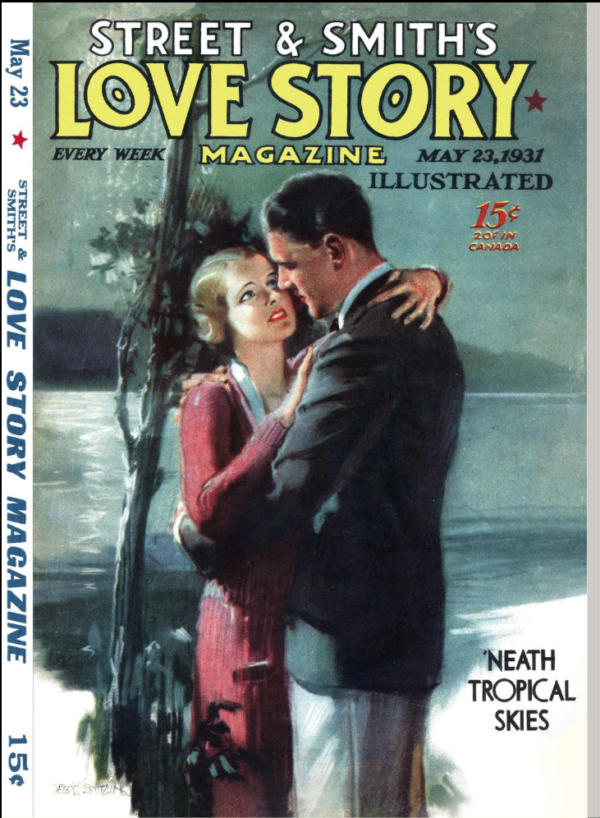
This cover (by artist Modest Stein) is honestly way too placid, and doesn’t at ALL match the tone of the story. There should at least be a boat exploding in the background.
In many ways, “ ’Neath Tropical Skies” is quintessential pulp in that it’s fast-paced, full of drama/adventure, and racist as hell. It’s also not particularly well-written, purely on a technical level (lots of stilted dialogue ahoy). It is, however, extremely entertaining in its badness, and extremely propulsive in its own, weird way. There’s a definite trainwreck quality to it, is what I’m saying. So without further ado, let’s dive in.
The story opens with our heroine, Glorine Barker, coming home to find her apartment a mess and her roommate, Chloris Desmond, nowhere to be found. (As an aside, the name “Glorine” is bad enough, but the fact that her roommate’s name is “Chloris” just makes me want to mash the two together into the portmanteau, “Chlorine.” Anyway.)

Glorine initially thinks burglars, but a cryptically apologetic note from Chloris (“Forgive me, but I dare not face him,” etc.), along with her share of next month’s rent, puts that fear to rest, at least. Still, it’s a hell of a situation to come home to, and Glorine is left wondering if this might have something to do with Chloris’s mysterious long-distance boyfriend, when who should come calling but—you guessed it—said boyfriend. He takes one look at Glorine, is all, “Darling!” and then immediately kisses her.
Chloris, it turns out, used Glorine’s photo to catfish this guy who’s been doing colonialism working in Brazil, and when he unexpectedly arrived in New York that morning to finally meet her in person (and marry her, as it so happens), she was like, “OH SHIT, I GOTTA GTFO.”
Glorine tries to explain this, but the guy, Stanton Fraser (one of the WASPiest names I have ever come across), refuses to believe it because he is, in short, a maniac of alpha proportions.
“Look here, Chloris,” he said curtly.
“My name is Glorine Barker,” she interrupted.
“I don’t know what your game is,” he went on, ignoring the interruption, “but it is evident that you’re either trying to play a particularly foolish practical joke on me, or else you’ve got some scheme on that I haven’t yet fathomed. Whatever it is, out with it! I warn you, I’m not the type of man to be played with!”
Stanton gets all manhandley with her, and while he eventually concedes that her name might actually be “Glorine” and not “Chloris,” he still fully intends to marry her, having previously fallen in love with her photograph, and now believing her to be an “adventuress” (read: con artist) who needs to be taught a lesson, essentially.
To her credit, Glorine literally tries to shove Chloris’s note in his face to prove she’s telling the truth, but unfortunately the only logic Stanton Fraser subscribes to is the Insane Troll variety. He starts making out with her, and then Glorine straight-up punches him, “str[iking] with all the force of her clenched fist upon his face.” Glorine is kind of a wet rag of a heroine, overall, but a part of me will forever love her for that.
There’s some problematic talk about how being in the tropics for so long has made Stanton a “brute” with no self-control, and then he pins her arms, covers her mouth to keep her from screaming, and orders her to get her coat. As it’s clear arguing with him is useless, Glorine reluctantly does so, and—in true damsel-in-distress fashion—faints just as he forces her into a taxi.

When she comes to, she’s in the apartment of Juan Castro, Stanton’s assistant, and we immediately know Juan is bad news simply because he’s Spanish (no, really). Stanton brought her there because Juan has a sister, Martita, so it’s a relatively appropriate place to keep Glorine prisoner safe until tomorrow, when they’ll all set sail back to Brazil.
Martita is clearly just as villainous as her brother, but she also clearly has the hots for Stanton, so when Glorine tries to appeal to her for help, she’s actually willing, purely because she wants to get rid of the romantic competition. Juan, however, has developed insta-lust for Glorine, and is like, “Whoa, whoa, hang on a minute.” The two siblings share a Meaningful Look™, and then Martita changes tack, all, “You know what, Juan is right—you’re tired and should stay here for the night.”

Realizing she’s to be a pawn in whatever dastardly plans they have, Glorine tries to throw herself out the window in desperation, but Juan catches her before she reaches it. She struggles in his arms, and then this bitch faints again, just as Juan kisses her. My first time reading this, I couldn’t help but be reminded of “Roofie Kisses” from The Boss’s Virgin, by Charlotte Lamb. I mean, it’s either that, or Glorine clearly has some blood pressure issue that needs looking into.

In another aside, this is partly why I find these old romance pulps so fascinating—because reading them is like doing genre archaeology. Like, the plot, characters, and overall vibe of this story (including how the heroine is apparently irresistible to every male character she comes across) wouldn’t be out of place in, say, an Old-Skool bodice-ripper from the 1980s.
About the only thing that would be different, had it actually been written in the bodice-ripper era, is that Stanton and Juan would doubtlessly be trying to outright rape Glorine, not just kiss her.

Well, part two opens, and we learn it really was roofie kisses! Turns out Martita drugged the brandy she gave Glorine, back in part one! Glorine also dreamt (or did she???) that Juan was again getting all handsy and possessive with her. She wakes up to find Stanton next to her, who’s all, “Well, are you going to marry me willingly or not?” and Glorine is like, “OMG, WHATEVER, JUST GET ME OUT OF HERE.”
Now, lest we forget, Stanton has literally kidnapped her with the intention of forcing her into marriage (and has similarly kissed her without her consent and grabbed her hard enough to cause physical pain), so why she looks to him as some sort of savior here can really only be chalked up to the fact that he’s of Anglo descent and not some icky Spaniard.
Stay classy, Glorine.
Stanton is thrilled because it seems Glorine has finally come around to the idea of becoming his wife, but she’s all, “Wtf, no!” There’s some back and forth, and Glorine is like, “Ugh, if only we’d met under different circumstances, I could see myself actually liking this guy.”
I don’t get it, but you do you, girl.

In the end, Glorine gets dragged along with Stanton, but he at least has the decency to say that they can be married later, on the ship, as opposed to forcing the issue before they disembark.
On the way to the docks, Glorine is stuffed in the backseat with Juan and Martita, and—owing to her having conveniently studied Spanish when she was younger—she can understand enough of what they’re whispering to each other to know that something bad is going to go down.
Realistically, you’d think Stanton would also know Spanish (or perhaps Portuguese?), considering how he’s been living and working in South America for god knows how many years, but I guess he could never be bothered to learn any other language besides English. I’d say White Patriarchy strikes again, but it’s also entirely possible that Stanton is just determined to be an idiot.
Anyway, long story short, Stanton has been hired to find some “lost city of the Inca,” supposedly rich in gold and silver. (This was a mere twenty years after Machu Picchu was “rediscovered” by Westerners, so this sort of thing was still all the rage in the cultural zeitgeist.) Juan, however, plans to double-cross him and steal all the riches for himself, at which point Martita will be able to force Stanton into marrying her, lest he be killed.
Again, I don’t see how Stanton is worth it—earlier, he was even specifically described as “not handsome”—but he’s tall and broad and tanned, and would appear to have a rugged attractiveness about him all the same, and the heart wants what it wants, I guess.

Things come to a head when they’re on the Amazon (a mutiny breaks out and Glorine almost gets choked to death), but then they reach a stalemate of sorts: Stanton’s faction is outnumbered but in possession of the ship’s ammunition, while Juan’s faction is biding their time, just waiting for Stanton and co. to be starved out.
We’re at the beginning of part three here, but then everything goes to shit when the native “Inca warriors” attack. A truce is hastily declared on the yacht, as Stanton and Juan now have an enemy greater than each other to contend with, but I’d personally be okay if the natives (referred to as “savage(s)” no less than ten times by the text) killed all of these fuckers, Glorine included.

Our intrepid hero and heroine hole up in the cabin with the telegraph machine, but—when Stanton tries to use it to send out a distress signal—he discovers it’s long-since been sabotaged by Juan. Glorine then notices Martita stuck up on deck (her countrymen refuse to give her shelter), and is like, “Omg, we need to help her!”—because Glorine, unlike all Spaniards apparently, isn’t a selfish asshole.
I haven’t indulged in many excerpts in this post, but I feel now is a good time for one, if only to really demonstrate the kind of tone we’re working with here:
“The cowardly brutes!” he exclaimed, and moved quickly to the door. “Remain here, Glorine, while I go and bring her in here with us. Put those headphones over your ears, and keep tapping on this key. Try to establish contact.”
Glorine stood, an agonized look in her eyes, fear clutching at her heart, as she watched the figure of the man who meant more to her than life itself, going to meet an almost certain death!
(In case you were wondering, yes, Glorine has officially fallen in love with Stanton by now. It’s an emotional turn that feels extremely unearned, and is seemingly based on little more than his being the lesser of two evils. Whatever.)
Stanton runs out while Glorine continues to try the telegraph machine, and lo and behold, a message finally comes through!
But oh no, Glorine doesn’t know Morse code, so all she can send is gibberish!

Then she looks out the cabin window and the yacht is now on fire!
Then an electrical shock from the telegraph machine somehow blasts her across the room?
Part of me wonders if this would make more sense to a contemporary audience, but another part of me can’t help but suspect that they’d be just as confused about the action here as I am.
But that’s not all! It’s then that Juan shows up, and his desire for pussy overrides his sense of self-preservation! (Such are the powers of a romance heroine, don’tcha know.) Glorine futilely calls for Stanton, then decides to take her chances up on deck, figuring that burning to death is better than succumbing to a Spaniard’s wiles.
BUT THEN.
Her foot gets caught in the telegraph wires, and this bitch gets electrocuted AGAIN.

That’s twice in one page! Readers, I LOL’d.
Well, this shock throws her to the floor, where she hits her head and blacks out, and thus we begin the last chapter (chapter six) of the story:
Glorine comes to in the bottom of a canoe, with Juan paddling. He somehow managed to flee the yacht, with her in tow, and is all like, “Shut the fuck up and help me row, unless you want the natives to hear us and kill us.”
He forces another kiss on her in the midst of all this, and we’re also told that the water around them is full of “gigantic alligator[s].” Muah, chef’s kiss, I love it.

BUT THEN! Glorine takes a third option, is all, “Fuck this, I’m out,” and STABS HERSELF WITH A DEADLY POISON DART SHE FOUND IN THE BOTTOM OF THE CANOE. She slips into unconsciousness AGAIN, just as shouts are heard, but OH NO, it’s American sailors, not those “primitive savages”! Did Glorine just kill herself for naught???
The icing on the cake here is that even the illustrator gets in on the insanity: The interior artwork for all three parts was done by Constance Benson Bailey (the go-to staple for Love Story serials, and basically a bargain-bin Nell Brinkley), and though the author never indicates Juan has any facial hair, Bailey nevertheless consistently depicts him with a mustache—except in his last appearance, that is, where he’s suddenly, inexplicably clean-shaven:
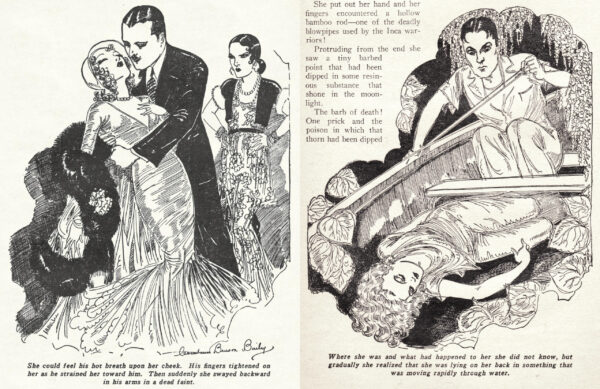
Idk, maybe the mustache burned off in the aforementioned boat fire?
Anyway, in the final scene of the story, Glorine wakes up safe in a cabin with Stanton. It turns out her telegraph gibberish was still enough to concern a nearby ship, who thankfully came to the rescue. We’re informed that Martita unceremoniously died off-screen (a predictable end, particularly as she was shown willing to throw her own brother under the bus) and that the yacht full-on blew up.

And then that whole bit where Glorine dramatically stabbed herself and was on her way to certain death? Yeah, that’s just hand-waved away with a mention of the rescue ship’s doctor being an expert in native poisons and antidotes. No mention of Juan, no mention of whether Stanton is going to resume his colonialist search for this “lost city,” but he and Glorine get to declare their love for each other and kiss, so hooray, happy ending.
As you probably suspect, I can in no way genuinely recommend this story. It’s wildly offensive (in multiple ways!), the dialogue is sometimes downright painful to read, and the romance isn’t organically developed so much as forcibly demanded by genre conventions.
That said, it is entertainingly bonkers (that scene in the telegraph cabin, omg), and Stanton does give a heartfelt grovel at the end, where he takes responsibility for everything that’s happened to Glorine and berates himself for his frankly demented behavior back in part one. I still don’t understand why these two fell in love with each other, but I do actually trust that they’ll make it work, going forward, so…yay?

It could be a lot worse, I guess is what I’m saying, and might make for an unintentionally hilarious read, provided you can stomach all the racism and whatnot.
Alas(?), the story was never reprinted and is damn near impossible to find, even if you’re willing to shell out the money, so heads up that I’ve collected all three parts here, for anyone who’s really curious. (I obviously spoiled the shit out of the story, but there are still a lot of details, particularly from the middle, that I glossed over.)
Thank you, Lucynka! What pulp romance stories have you read? Were they as truly unhinged as this one?
This book is available from:

As an Amazon Associate we earn from qualifying purchases.
We also may use affiliate links in our posts, as well.
Thanks!

Thank you Lucynka!
Oops, there was supposed to be a link to the story at the end, there. Find it here, instead.
A big thank you to Sarah for letting me share this insanity, and for providing all the lovely accompanying gifs! 😀
(Hmm, perhaps it just doesn’t like Google Drive links.)
Well, that was definitely an entertaining post to find this morning! Thank you, Lucynka.
This was hilarious!! Thank you! I look forward to more installments. I used to go to old book fairs and buy and read books by Ethel M Dell— her novels were better than her stories— and others from that time. So fun!!
Thank you for the great review. Also, thanks for the “Mwah” gif. I know Pepe Le Pew (or Pieu, as she is correctly spelled) is the poster child for #metoo, but. . . Daddy, I love him.
Proof that romance crazysauce was not invented in the 70s. Just this post, without reading the source material, was WILD.
Lucynka is right; Chlorine would have been a better name.
Speaking of not-great fiction, I used to sit at a particular carrel in the college library, and happened to find a nearby shelf of bound copies of Godey’s Ladies Book. Spent way too much study time reading the serial stories.
Thank you for this very entertaining review! I do have a question about the F+ rating which I’ve never seen befpre. Would that be worse than F, like a double F, or slightly better, right below D-?
I can totally hear Stanton talking, I’m pretty sure he’s the bad guy in a Marx brothers movie.
@Karin
Around here, F+ is reserved for books that are bad but in a crazysauce way.
https://smartbitchestrashybooks.com/2013/05/writing-reviews-some-guidelines-and-suggestions-there-are-no-absolute-rules/