
Programming note: this week’s episode is dropping on 30 April 2026. Smart Bitches Trashy Books, LLC, is withdrawing our labor on May 1, 2026, alongside other companies, school districts, and activists as part of the May Day Nationwide Day of Collective Action. For more information, visit MayDayStrong.org.
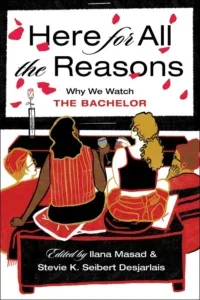 Ilana Masad and Stevie K. Seibert Desjarlais are the editors of a new and excellent anthology called Here for All The Reasons: Why We Watch the Bachelor.
The essays inside are incredible, and provide deep and incisive critique of The Bachelor franchise from people who love, or used to love it deeply. Some of the topics blew my mind. I was so excited to talk to Ilana and Stevie about their work, and we happened to record just as the latest season of The Bachelorette was cancelled, so we talk about that as well.
If you like deep examinations of pop culture and of properties typically dismissed as meaningless fluff – hello, yes, I do! – you’ll have fun with us today.
We’re going to talk about conservative fantasy, polyamory, grad school, changing portrayals of masculinity in reality tv, media literacy and so much more.
As I say during our conversation, I think the best critiques of things come from people who are fans.
TW/CW: At about 50 minutes into the interview, we discuss allegations of domestic violence from Taylor Frankie Paul, and at 1 hour and 20 minutes, we discuss the loss of their friend Dr. Katie McWain, to whom the book is dedicated.
❤ Read the transcript ❤
↓ Press Play
This podcast player may not work on Chrome and a different browser is suggested. More ways to listen →
Here are the books we discuss in this podcast:


Make sure to disable your ad blocker to see all the books.
You can find Ilana Masad at her website, IlanaMasad.com. She’s on Bluesky @IlanaSlightly, and on Instagram @Ilanaslightlyignorant.
You can read Ilana’s article, “How ‘The Bachelor’ Franchise Celebrates Polyamory” from the March 2018 issue of Playboy via the Web Archive.
Stevie’s work can be found at The Quarterly Review of Film and Television, The Journal of Pedagogy, The Journal of Popular Film and Television, and The Popular Culture Studies Journal.
We also discussed:
- “Media Literacy and Education in Finland” – Finland Toolbox
- The Finnish National Curriculum on Media Literacy: A Global Model for Education
- “Geriaction”
- The Call Your Coven podcast
- “Under the Mormon Influence: How the women of Utah blogged and posted their way into American hearts and Wallets” by Bridget Read, 9 Feb. 2026 – The Cut (Paywalled)
If you like the podcast, you can subscribe to our feed, or find us at Apple Podcasts, Spotify, or wherever you listen to your favorite shows!
❤ Thanks to our sponsors:
❤ More ways to sponsor:
Sponsor us through Patreon! (What is Patreon?)

What did you think of today's episode? Got ideas? Suggestions? You can talk to us on the blog entries for the podcast or talk to us on Facebook if that's where you hang out online. You can email us at sbjpodcast@gmail.com or you can call and leave us a message at our Google voice number: 201-371-3272. Please don't forget to give us a name and where you're calling from so we can work your message into an upcoming podcast.
Thanks for listening!
Podcast Sponsor
This episode is brought to you by Hatch.
You know how you finish a romantasy and you just need the next thing immediately? Hatch made that thing.
It’s called Ophelia — an original audio drama, inspired by Hamlet, where Ophelia finally gets to be the main character.
Forbidden magic, a crumbling kingdom, a slow-burn love triangle with a prince and his very guarded, very intriguing, best friend. The kind of love triangle where you will absolutely pick a side and you will not be quiet about it.
Book one of the three part series is now available for free wherever you stream, with new chapters dropping every Tuesday. For books 2 and 3, check out hatch.co/Ophelia.
Transcript
❤ Click to view the transcript ❤
[intro]
Sarah Wendell: Hello there and welcome to episode number 716 of Smart Podcast, Trashy Books. I’m Sarah Wendell, and my guests today are Ilana Masad and Stevie K. Seibert Desjarlais. They are the editors of a new and excellent anthology called Here for All the Reasons: Why We Watch The Bachelor. The essays inside are incredible, and they provide a very deep and incisive critique of the Bachelor franchise from people who love or used to love it deeply. Some of the topics blew my mind, and I was so excited to talk to Ilana and Stevie about their work, and then we happened to record just as the latest season of The Bachelorette was cancelled, so we talk about that as well. So if you like deep examinations of pop culture and of properties that are typically dismissed as meaningless fluff – hello, yes, I do! – you’ll have fun with us today. As I said during our conversation, I think the best critiques of things come from people who are fans.
Now, I do want to make two notes: number one, at about fifty minutes into the interview, we discuss the allegations of domestic violence, and about an hour and twenty minutes in, we discuss the loss of their friend Dr. Katie McWain, to whom the book is dedicated.
This is a bit of a longer episode, but at one point I had to ask them, Hey, can we keep recording? And they were like, Yes, please do! So this is a, a bit of a longer one, and I want to thank Stevie and Ilana for all of their time.
Hello and massive thanks to our Patreon community, who keep the show going, who make sure every episode has a handcrafted transcript from garlicknitter – hi, garlicknitter! – [Hi! – gk] – and are some of the nicest people I have ever encountered.
I have a compliment this week for Shelby:
Shelby, you won’t see this on Facebook or Instagram, but one of your childhood friends just named their adopted cat after you, because that small cat is feisty and fearless and truly fabulous, just like you at any age.
If you would like to join our Patreon community, perhaps receive a compliment of your own, and support the show, have a look at patreon.com/SmartBitches.
Support for this episode comes from Hatch. You know how when you finish a romantasy and you just need the next thing immediately? Hatch has made that thing. It’s called Ophelia, an original audio drama inspired by Hamlet, where Ophelia finally gets to be the main character. Forbidden magic, a crumbling kingdom, a slow-burn love triangle with a prince and a very guarded, very intriguing best friend – the kind of love triangle where you will absolutely pick a side, and you will not be quiet about it. Book one of the three-part series is now available for free wherever you stream, with new chapters dropping every Tuesday. For books two and three, check out hatch.co/ophelia or find the link in the show notes. Thank you to Hatch for sponsoring this episode.
All right, are you ready to talk about The Bachelor and why we watch it and what’s gone wrong and what it means and how important it is culturally? Yes, I am in! Let’s do this. I mean, I did the interview, so of course I’m in, but I hope you come along. On with the podcast.
[music]
Ilana Masad: My name is Ilana Masad. I am a novelist and book critic. I have written the novels All My Mother’s Lovers and Beings. And with my co-editor Stevie K. Seibert Desjarlais I am the editor of a new anthology, Here for All the Reasons: Why We Watch The Bachelor.
Stevie K. Seibert Desjarlais: Hello! I’m Stevie Siebert Desjarlais. I’m currently employed by the University of Nebraska-Omaha as assistant professor in a learning community titled the Goodrich Scholarship Program. My research foci include pop culture studies, feminist studies, and pedagogical studies because teaching is my jam. That’s, that’s me. And, and this is my first, this is my first book. Like, I have journal articles, but nobody reads those.
Sarah: I think everybody’s going to be reading this. I mean, you all are about to be the foremost experts on things Bachelor, which is a hot topic. So, before we get to the brouhaha of Bachelordom happening right now, I want to, I really want to focus on this book because I loved the shit out of it? Like, this is my jam. The number of times you were like –
Stevie: Ah! Thank you!
Sarah: – just like romance novels, and I’m just, like, holding a lighter like, Yes, just like romance novels.
Stevie: [Laughs]
Sarah: No one takes this shit seriously, and it is such, as the academics say, a rich text. So I –
Ilana: Yes!
Sarah: – I loved the origin story in the start of your book about finding a graduate student community while watching early seasons of The Bachelor and how there’s this sort of tension within the narration of, Okay, I’m really jamming with this. I really like this. This is also some fucked-up shit. How do I negotiate? What, what led you to say, All right, let’s write an anthology of the show? Like, who is, who’s this book for? What led you into the anthology?
Ilana: Oh!
Stevie: Such a long journey! [Laughs]
Sarah: I know!
Ilana: It’s true. Yes, if, to use Bachelor terminology, the journey started –
[Laughter]
Ilana: – with – I mean, Stevie and I became friends.
Stevie: Mm-hmm, mm-hmm.
Ilana: The Bachelor was sort of a formative part of our friendship. And when was it, like 2020, Stevie, right?
Stevie: Yeah, I –
Ilana: That we – yeah.
Stevie: Yeah, I think we, we started talking about writing something during pandemic times, because we, we were watching the pandemic-era seasons, and that’s after I’d already left Nebraska, so we were doing that sort of at, at-a-distance-watch party – we’d lost our in-person watch party – and then I moved back to Nebraska soon thereafter? And we had an opportunity to, to pitch it, or at least make some movement towards something more formal.
Ilana: Yeah, and I mean, we just kept talking about how, you know, I mean, because in 2020, between I think 2020 and 2022, there were a lot of very public conversations about the show in terms of, like, Will it survive? And, like, Why are people watching? Is anyone watching? And, you know, we had the first Black Bachelor who, like this most recent Bachelorette, came from outside of the franchise, which was, you know, an interesting choice for them that kind of blew up in their face in all sorts of ways. You know, there was all of this talk, and, and Stevie and I kept talking about how it’s so frustrating that this franchise that is built on the backs of a very sincere and long-running fandom doesn’t listen to its fans, you know –
Sarah: Yes.
Ilana: – because it, there’s this sense that, like – and I think we write something to this effect in our introduction that, like, we are the economy upon which this show rests.
Sarah: Yes.
Ilana: And reality TV does pander –
Sarah: Yes!
Ilana: – to its fans, you know? Like, that is something –
Sarah: Oh, absolutely.
Ilana: – that it does. That’s something that it’s always done from the very early days. And so why are we not taken seriously as fans and, like, why, you know – and yes, exactly, we’ve grown up on this. I mean, Stevie, you, you more than me, you, you started watching this when you were really young!
Stevie: Yeah, and I fell away from it because it – [laughs] – I mean, when one goes into a women and gender studies master’s program it’s like, we started to question the pop culture that we’re consuming, but ultimately returned to it. And, you know, there’s this whole narrative about guilty pleasure and, like, who should be watching the show; who shouldn’t be watching the show; like, what sort of introspection one should be doing if one is, like, attracted to this type of media? And ultimately, we’re going to talk about something. I might as well talk about something that I find engaging, and –
Sarah: Yes.
Stevie: – when you find somebody who connects with a thing that is a “guilty pleasure,” like, oh, thank God, I don’t have to, like, defend myself to you. We can just talk about the rich texts the way that people are intended to talk about rich texts!
Sarah: That’s like my whole job.
Ilana: Right! Exactly. I mean –
Sarah: I wanted to find people to talk about romance with. The site is twenty-one years old, and even then, twenty years ago, people would, as my co-founder Candy put it, revise downward their estimation of intelligence the minute they hear you like romance novels. And –
Ilana: Right! Which is so weird!
Sarah: it’s so weird, and it’s why I’m sort of obsessed with being like an amateur pop culture critic, because it’s, it’s fascinating. And I also know, like, speaking for myself personally, my physical tolerance of secondhand embarrassment is so low that I cannot watch any of this. Like –
[Laughter]
Sarah: – we usually recap The Bachelor and The Bachelorette, and it’s all written by one of my staff writers, Elyse. Her theory, by the way, is that the only reason people are on The Bachelor is to hang out, do their nails, get ABC to pay for a really cool trip, and try to make it as far as possible, but no one actually wants to win, because this is not a prize. And so her –
Ilana: Mm-hmm.
Sarah: – her recaps are from this perspective of how far are each of these people going to go. What was the budget for horseback riding this season? How many bathtubs –
Ilana: Mm-hmm.
Sarah: – appeared in incongruous locations? Like, this sort of –
Stevie: [Laughs]
Sarah: – piercing the veil of it, but also being like, I’m super fluent in this.
Ilana: Yeah, I mean –
Sarah: I’m going to participate and critique. And that is really –
Ilana: Exactly.
Sarah: I love that! That’s what your anthology is doing!
Ilana: Yes! I mean, I wish we’d known about Elyse! We could have invited her to contribute, honestly.
Stevie: [Laughs]
Ilana: Because, yeah, I mean, it’s, it’s its own language, and it’s its own –
Sarah: Yes.
Ilana: – subculture. And, I mean, that’s the other thing that Stevie and I talked about a lot is how, you know, we live in a time of, like, in-, increasingly niche interests, right? And –
Sarah: Oh gosh, yes.
Ilana: – in some ways that’s wonderful because we can all, you know, find the things that we’re really into and find little communities and subreddits and places to talk to people about the things that we’re really into. But, like, big reality TV franchises, just like other big franchises or like sporting events, are like this place where you, you still get a taste of a monoculture, where you can kind of –
Sarah: Yes!
Ilana: – talk to people from very different sort of walks of life, and you all do have this strange fascination in common.
Sarah: Yes. That is absolutely, absolutely true. Now, to, before I start talking about the individual essays that are all so freaking great, what do you love about The Bachelor, or what did you love about it? I’m not sure what tense to use here, and either is fine. Or both! [Laughs]
Ilana: Stevie, you, you go first.
Sarah: It’s like these are, these are the genders: your feelings about The Bachelor.
[Laughter]
Stevie: Well, I was recently at a dinner party with a colleague who’s an anthropologist, and she was telling me about a whole other different reality show that she was recently watching, and I was like, This is really validating that actual anthropologists watch reality television for the same reason I watch reality television –
Sarah: [Laughs]
Stevie: – which is just to observe other humans. Like, yes, I’ll go out in the wild, I’ll put on some dark sunglasses and just people-watch. I love that! But from the comfort of my own couch? Yes, please! I – [laughs] – wanted to see how people respond to, you know, human-to-human interaction. I know that it’s, it’s extremely manufactured. It is, you know, the horseback rides, they’re, they’re awkward as, as hell. And it’s just like this component where I get it. It’s, it’s not reality in reality television.
And yet, as Ilana and I have talked about so much over the years, despite all that, there are authentic human emotions on screen, and that’s what we dig for. Like, when we’re in our texts chatting while we’re simultaneously watching on Hulu without commercials, we’re like, Oh, that’s real! That, did you see her face? Or did you hear what he said? Like, that’s real! [Laughs] So we are – not to speak for the both of us, but I do think that part of my joy is finding that real human emotion.
Sarah: Why is finding that moment of reality among all of this facsimile – I mean, if you think about the number of things that this show is pretending that it does, that it is, it is a viable way to find a life partner, it is a viable way to meet people, among this spectacle of performing wealth – like, the aspect of the show where they’re performing wealth is just mind-blowing to me. We all live in a mansion, and we dress in evening gowns as –
Ilana: Mm-hmm.
Sarah: – all of the time! And, and then all the contestants have to pay for all that. Like, ABC is not.
Ilana: Mm-mm.
Sarah: All of this artifice, you’ve got so much artifice; why do you think it’s important for viewers to find that real moment of emotion?
Stevie: [Deep breath] Ooh! That’s a great question.
Sarah: That’s a big question.
Stevie: Yeah, no. I think it’s just good practice, just to know that, that I have discernment; that other people have discernment; that, that despite it all, we are still, at our core, humans, and we’re not robots. We’re, we haven’t been taken over by AI! There’s, there’s something really valuable about that. And I, there are at least a couple of moments every season where I get teary-eyed, not expecting to, but I’m like, Wow –
Sarah: [Laughs]
Stevie: – I’m feeling things! It’s not always the same moment, either. It’s not always associated with a romantic plot; it’s not always associated with a dramatic reveal of –
Ilana: I feel like the opposite –
Stevie: Yeah, it’s, it’s –
Ilana: – in recent years, you know? In fact –
Stevie: – unassuming.
Ilana: – like, it’s not the, yeah, it’s often not the romance anymore that we find ourselves tearing up at. It’s like the family moments, you know? Like, like Jen talking to her mom on TV, you know? And like that, trying to sort of convey to her what she’s going through and trying to decide whether to speak in English or not to speak in English.
Sarah: Yeah.
Ilana: And who is she speaking to? Is she really speaking to her mom? Is she speaking to the producers? Is she, she speaking to the audience? Like –
Sarah: Yes.
Ilana: – watching that is just so real?
Sarah and Stevie: Mm-hmm.
Ilana: And complex, you know? Or watching the moments between the contestants themselves, right? Stevie, your essay and someone else’s essay in the anthology mentioned in the, this, The Golden Bachelorette, the way that the men were being –
Stevie: Yes!
Sarah: Yes!
Ilana: You know, like, we cried so much that season.
Stevie: So much! The most tears, like – [laughs]
Ilana: The most, because we were watching men of a certain age acknowledge that they were lonely, acknowledge that they had feelings –
Sarah: Yeah.
Ilana: – allow themselves to emote on screen, on camera, in front of an audience, and not trying to downplay that emotion as unmanly. And that’s so rare –
Sarah: And supporting each other, yeah.
Ilana: And supporting each other, right.
Stevie: Yeah.
Ilana: And, like –
Sarah: And having other men go, Me too, dude. Been there.
Ilana: Right! It –
Sarah: Yeah.
Ilana: – it was really beautiful, you know, and to me, why I love The Bachelor in part is because to me it’s very much like, it’s how I take the temperature of where heterosexuality is at in this country?
[Laughter]
Sarah: There’s so many barometers in this show.
Ilana: [Laughs]
Stevie: Uh-huh, uh-huh.
Sarah: So many barometers! [Laughs]
Ilana: I mean, I have this very funny, you know – and I, I, I ended up telling Hannah Brown this, and she was baffled – ‘cause I met her once – but, and I, I yelled this in the living room with Stevie. I, like, remember this happening.
Stevie: Mm-hmm!
Sarah: Yep!
Ilana: We watched the promo for The Bachelorette for Hannah Brown’s season, and, like, she comes out in this beautiful dress, you know, in the promo, and then the dress, like, whips off and she’s in, like, this jumpsuit? And I was like, Biden’s going to win. Biden’s going to win.
Stevie: [Laughs]
Ilana: Biden is going to win the elections, because she, whoever designed that, that dress is calling back to the Hillary Clinton pantsuit.
Sarah: Pantsuit!
Ilana: And that is telling us that women in this country, the, the, specifically the audience that ABC imagines is their biggest audience, Midwestern women, are not going to vote for Trump. And we were right. And then we were wrong –
Sarah: Yep.
Ilana: – four years later. But we were right for that moment!
Sarah: Yep.
Ilana: And so, you know, I do feel like the show, it’s a mirror, right? Like, it’s a mirror and a window.
Sarah: It is absolutely a mirror. Yeah.
Ilana: And I love that about it.
Sarah: And I think another thing about these real moments of genuine emotion that people recognize and talk about, because it does form part of the discourse –
Ilana: Mm-hmm.
Sarah: – of the show in the days and hours afterward, like, Did you see this? This is not only a form of media literacy, of seeing through the artifice, but it’s also a form of human literacy, to understand –
Ilana: Exactly.
Sarah: – and empathize with people through this incredibly bizarre context.
Ilana: Mm-hmm.
Sarah: And I think my favorite thing about this anthology is how fluent all of the writers are, how knowledgeable they are about this franchise, and also how critical they are of the show and its messaging. Like, I think the best critiques of things come from people who are fans.
Stevie: Yes.
Ilana: Absolutely.
Sarah: Like, I’ve been criticizing romance novels for twenty-one years. [Laughs]
Stevie: Mm-hmm.
Sarah: And I think the genre is better because there were so many of us saying, Hold up! What if everyone was not white?
Stevie: Mm-hmm!
Sarah: What are your most pressing critiques of this show and the franchise? Setting aside the, the current Bachelorette, which is a whole other issue.
Stevie: Oh yeah.
Ilana: Mm-hmm, mm-hmm. There are some very obvious ones, right? Like just the way that they have treated contestants of color and leads of color –
Sarah: Yeah.
Ilana: – the way they’ve sort of set them up to fail in various ways, the kind of unquestioning straightness of the show. Like, I understand they want to keep the format straight, fine, but the idea that, like, there’s never a hint that anyone has ever had any curiosity in anything queer is, like, just so – it feels glaring to me, you know? Like, it, it’s the kind of silence that speaks a little too loudly.
And so, I mean, those are kind of the very obvious things, but then I think, there’s some critiques that are, like, much broader to reality TV in general, right. Which is, again, like the way that it can and does exploit people, even though now you, you would argue, and, and you can argue that, like, many people walk into reality TV with eyes wide open. They are very aware of what they’re doing; the, the genre is old enough. But there’s still exploitative practices. There’s still, you know, manipulation that goes on. Crews are still largely non-unionized, which really sucks.
Sarah: Yes. That, that, that harkens back to the, the actual foundation of the reality television industry was rooted in a strike –
Ilana: Mm-hmm. Yes.
Sarah: – because none of these people are union. Yes.
Ilana: Exactly, exactly. Stevie, what about your, your thoughts?
Stevie: I mean, you’ve touched on so many. I think with, with the popularity of new romance-focused reality shows – like, franchises even – there’s really a question about the format. So everything that Ilana said, and then me adding to it, ‘cause I’m not disagreeing with any of that, it’s just, it, it’s really dusty. And why can’t we play with the timeline? Why can’t we play with the, the week-to-week format? Because there have been times where it seemed like maybe contestants should have stuck around for longer just to suss out the chemistry, or maybe more people needed to go home outside of a rose ceremony. It just could have, could have been more dynamic from a long time ago, but really I think, given the current situation we find ourselves in vetting. So the priorities and the safety of everyone involved on screen, behind the camera, just really, you know, taking care of people! ‘Cause again, if, if I’m prioritizing watching people on screen and looking for the humanity in it, then I want to know that people are, are okay, that they’re supported.
And I think that really, one of the eye-opening kind of moments for me – not, not that I wouldn’t have come to it on my own conclusion, but one of the friends – Jess, actually, appears in the anthology – she had asked me years ago, like, Have you watched Unreal? Which is a scripted series based on somebody who is an insider who kind of knows how –
Sarah: Mm-hmm.
Stevie: – how the sausage is made in, like, a really gross way, right? She, she was, she was instrumental in me watching that and, and me thinking like, This is really, this is really gross. I mean, I would love more transparency. I love transparency in general, so more transparency in my favorite reality TV show would be great.
Ilana: Yeah, and I mean, like, we’ve –
Sarah: That would be nice.
Ilana: – we’ve seen them experiment a little bit. Like, I know there were a lot of critiques of the recent Bachelor in Paradise, and, and there was a lot that, like, was wrong, but we both found the, the sort of sleek editing that they were trying to do, the kind of new style, the slightly more self-aware, like, chyrons and like, you know, names and, and the kind of obviously scripted moments of contestants, like, dreaming about someone or whatnot. Like, we appreciated that as them at least trying to do something new?
Sarah: Yes.
Ilana: And them kind of poking fun at themselves a little bit in a way that we found enjoyable. I know it wasn’t for everyone, but we enjoyed it.
Stevie: Although I will say that my huge complaint about Bachelor in Paradise, and Ilana, I think you’ll agree with this too, is –
Ilana: Mm-hmm.
Stevie: – the ageism that came out in the franchise. I mean –
Ilana: Yeaahh.
Stevie: – it was always, it was always there because, you know, you have contestants who are like thirty, and they’re the old contestant on a regular season. But then to have, you know, the regular – I don’t know – the regulars or the youngs with the olds on the beach at the same time and just how the young people really had, I don’t know, they, they infantilized the Goldens. They thought that they were gross or, you know, they were quick to vote them off.
Ilana: Cute or gross.
Stevie: But I will say, I have watched a couple of episodes of this new HGTV show, Bachelor Mansion Takeover, and it’s the same stuff! It’s the same ageism. So there are a couple of Goldens and, and they just get treated very poorly by the younger contestants, and that really pisses me off, because I love the Golden seasons. Although I didn’t love –
Ilana: Mm-hmm.
Stevie: – the most recent Golden Bachelor. I don’t need him in my life. But I love the premise of the Golden seasons –
Sarah: [Laughs]
Stevie: – and they’re –
Ilana: Yeah.
Stevie: – a great addition to the franchise. But by and large, the, a lot of the mainstream coverage of the Bachelor franchise has said, like, viewership is down, really low, and I don’t, you know, I just, it’s this thing where I’m like, Maybe I just don’t like what other people like.
Sarah: Oh, I feel that way all the time.
Stevie: [Laughs]
Sarah: Now, I want to, I want to go back to media literacy because, Stevie –
Ilana: Yep.
Sarah: – I particularly liked how you used students’ fascination with the franchise as a way to develop critical media literacy skills, which are very important. I learned recently from the internet – so grain of salt; I can’t cite my source – that it is pretty standard practice in public school in Finland to have media literacy because they are subjected to so much propaganda from Russia, they have to learn how to see through it and they have to learn how to decode it, and it is part of their curricula, which I find incredible.
Stevie: [Laughs]
Sarah: Right, like, can you imagine? And it’s like, okay, of course they need this. Of course! It’s right there! And if you are a small country, your media is coming from somewhere else all of the time. Like, this is important. And I also want to say, in terms of using popular culture properties, when I taught composition at universities in New Jersey, when I was a graduate student, I used to give the kids tabloids –
Stevie: Ah!
Sarah: – like the National Enquirer, News of the World –
Ilana: Yeah!
Sarah: – and that was how I taught citation.
Stevie: Mm!
Sarah: So I need you to learn how to cite your sources correctly. So to overcome the hurdle of giving somebody something interesting to write about so that they would then cite sources, I was like, Pick a story and tell me about it, but you have to cite your sources correctly. So Britney Spears said in an article by blah-blah-blah, quote – how do you do all these sort of nested quotes? This is –
Ilana: Mm-hmm.
Sarah: – this is all basic, like, grammar, but I used to use the National Enquirer for that on the regular because everyone was like, I’m reading this in class? I’m like, Yes, you are reading this in class. Now let’s talk about quotation marks! Yeah.
[Laughter]
Sarah: So highest fives for using The Bachelor, because I found that was a really great way to create really interesting conversations, because of course I’m a generation apart from the students. (Now I’m, like, many generations apart from those students.)
So what are, what have some of the responses been like? How does that play out in your classes when you’re like, We’re going to talk about the Bachelor franchise here?
Stevie: Sure! So I started teaching when I was in my PhD program back in 2014, so I was a little bit closer in age to the students than I am now, and more of them watched the Bachelor franchise then than they do now. I feel like –
Sarah: Oh yeah.
Stevie: – I don’t get that as much. But back, back in the day, I did, I did use it as a way to get students’ buy-in into the work we were doing in the composition classroom, because it was a Comp 1 class, so really inquiry-based kind of understanding, analyzing, discerning what sort of messages were being conveyed. And there were some pretty significant disagreements in class just on the premise of looking at pop culture like The Bachelor as something that had any meaning whatsoever. So I had a lot of students who would dismiss it, and they would just say, It’s just entertainment; I just tune in for the drama? And even, I think, when we would, I would try to create analogies for male students – ‘cause it was very gendered; like, there were –
Sarah: Oh –
Stevie: – very few male students who would even entertain watching a show like The Bachelor? And so the, the, the closest kind of thing in Nebraska is football. So, like, Well, what are you getting out of football? And then looking at the different dynamics between audiences and then the ways that the different enter-, entertainments appealed to those audiences, what additional messages came with that. I mean, one of my good friends Katie and I actually sat out on my front porch on a football game day and, like, watched the fashion of the different students watching, walking by, and there was a, very much like a uniform.
And so bringing those observations of pop culture, not just the Bachelor franchise content, but just the world around them was really exciting to talk to them about once they got tapped into that analytical process. Like, no, I can’t –
Sarah: Yes.
Stevie: – I can’t dissect this thing because this is just a thing that I watch when I want to turn my brain off. I’m like, Ooh, but why would you want to turn your brain off? [Laughs]
Sarah: And why is this the thing that makes you turn off your brain?
Stevie: Yeah!
Sarah: Right, like why is this the thing? I, I will share that I deeply loathe football. I think it’s American cancer.
Stevie: [Laughs]
Sarah: But football’s greatest deceit is convincing everybody who loves it that it’s something greater than just entertainment.
Ilana: Mm-hmm!
Stevie: Yeah.
Sarah: And –
Ilana: Oh, absolutely!
Sarah: – there is, there is no difference between the football and the NFL and The Bachelor and, and, and romance novels. And I know that, but when you confront someone else with that they’re like, How dare you say that my thing is meaningless? I’m like, No, I’m actually saying it’s meaningful! That’s actually what we’re saying here! So it’s, it’s very fascinating to have you take, you know, a, a, a very, very simple concept like media literacy and show people through football and The Bachelor that this is meaningful text.
Jen-, Ilana, have you had that, have you had that experience too? Do you use The Bachelor to teach?
Ilana: I mean, I have not used The Bachelor to teach explicitly. I had some students who watched it, so we would always talk about it after; like, I had a couple of students? But –
Sarah: For sure, the greatest.
Ilana: But I will say that in my syllabi for comp classes, I always kind of start – and for writing classes, for that matter – I always kind of start by telling my students that they are writers and readers already, whether or not they think they are –
Sarah: Yes.
Ilana: – ‘cause they read each other’s text messages; they look at Snapchats; they, you know, they engage with the world through image and text already –
Sarah: And interpretation, too.
Ilana: – and interpretation, exactly, and so, like, they, they already know a lot of how to do these things, but they don’t think of them as useful in academics. They, they don’t –
Sarah: Yeah.
Ilana: – they don’t see the link. And so I do try to, like, bring forward the, like, the things that you do outside of this class are relevant for this class and vice versa. You know –
Sarah: And not only that, these skills are going to keep being useful. Like, I –
Ilana: Yeah, absolutely!
Sarah: – I promise. [Laughs] I super promise!
Ilana: Absolutely.
Stevie: Yeah, I, I, I was working with some photography this semester, and I was really kind of questioning if it was – I don’t know if it, if it was – this is a term that gets thrown around a lot in pedagogical conversations is rigor? So –
Sarah: Yep.
Stevie: – is what I’m doing in this classroom actually challenging them? And one of the things we were doing in class is, like, looking at these photographs, historical photographs, and asking, you know, What’s going on here? What stories are we taking from this static, unmoving image? And a lot of the students could attribute emotion like That person’s angry or, you know, This is what’s happening there. I’m like, Okay. I’m not saying you’re wrong; this is great. But what’s, what’s the input? Like, what are you interpreting? Let’s start with observation and description. And then it was like the week after I was having this crisis of am I, what am I doing with my life? What am I doing with my students’ time? Is that, you know, everything happening with ICE in Minnesota and –
Sarah: Ooh!
Stevie: – the, you know, observers there, and trusting people who are seeing things happen and being able to document what’s happening. And I was like, Well, okay, so these skills – [laughs] – like, eh –
Sarah: This is very important stuff to learn.
Forgive me. My cat demands to eat while I’m recording. Always –
Ilana: Of course.
Sarah: – always. So.
Ilana: [Laughs]
Sarah: Now, in, in the essay by Jeanna Kadlec, who I already knew of because I listen to her podcast, Call Your Coven? She focused on the extremely Christian-coded messaging that, as she said, “Peddles conservative fantasy,” and we were talking about this before we started recording. I even, I even – I don’t know what you’re supposed to call it – I tworted about this on Bluesky. This blew my mind. She wrote, “The contestants are in an open relationship with the lead while professing traditional values.” I am staggered that I have not noticed this. Now, as I mentioned, I can’t really watch this franchise because the, the secondhand embarrassment might actually kill me?
Stevie: [Laughs]
Sarah: But I edit all of the recaps that Elyse, my staff writer, does for both The Bachelor and The Bachelorette. And sometimes if she’s not available, I have to watch it, and I’m like, Why is this, why is this, why is this four hours? Why? This is like twenty-five minutes of footage. Why are we stretching this out to four hours? What is happening?
Stevie: Oh yeah.
Sarah: Oh my God. But the minute I read that I thought, every single post I’ve edited, every episode that I’ve had to, like, pinch hit for, yes! These people are all in an open polyamorous relationship on TV, and no one talks about this! Holy cow! Can you expand on that a little bit? Because my mind is still grappling with this. [Laughs] That’s, you said it’s not very queer, but surprise!
Ilana: I –
Sarah: It’s actually real queer. [Laughs]
Ilana: – would love to, because –
Stevie: Yeah.
Ilana: – Stevie knows, so the first time I watched the show with her and her friends in graduate school, I was like, Wait. These people, like, this woman is in love with multiple – it was Rachel Lindsay’s season – like she’s dating multiple men? Like, this – I, I watched, I think the episode that I watched with you was like “Hometowns.” So it was, she was meeting the families of four different men and very seriously talking about marrying them. I was like, This is polyamory? Like, they’re not admitting that that’s what it is, but it is? And not just that, but to an extent it’s even somewhat healthy polyamory in the sense that they are talking about things like feeling jealousy and needing reassurance!
Which, you know, like, there’s this sort of myth that polyamorous people just don’t feel jealous, and that’s just not true, right? Like it’s, it’s, polyamorous relationships are relationships. And so –
Sarah: With humans! Like, actual humans in them!
Ilana: Right, exactly!
Sarah: Right, yeah!
Ilana: Humans with feelings! It’s not just, like, you know –
Sarah: …dolls.
Ilana: Yeah, so – exactly.
Sarah: Yeah.
Ilana: And so the, the fact that they, that they discuss the fact that she is in a relationship with multiple men and that they express, you know, insecurities, both to her and not to her, is just, it, it was fascinating to me. And my first and, and only article for playboy.com was about how –
Stevie: [Laughs]
Ilana: – The Bachelor is actually about polyamory and, like, no one is talking about it? And –
Sarah: Well, it’s just like how people read Playboy for the articles. I would have read the hell out of that, by the way. I need to look that up.
Ilana: Yes, thank you! I need to find it. I don’t know if it’s still on their site, but I’m sure I…
Sarah: If you have a copy –
Ilana: …somewhere.
Sarah: – would you send it to me? I would love –
Ilana: Oh, I wish it was in the real magazine. Oh my God, I wish. No, it was just on the website. But yes, I will find it and send it to you for sure.
Sarah: Okay, thank you, oh my gosh, ‘cause I know people listening are going to be like, I’m sorry, you, you wrote a what now where? I need to read this.
Ilana: [Laughs] I, I will find it and send it to you. But yeah, I mean, it was something that, like, ‘cause I think among Stevie and her friends at the time, I was the only one coming into this with fresh eyes who had also had experience with polyamorous relationships? And to me, it was just, like, so obvious right from the beginning –
Sarah: [Laughs]
Ilana: – because I hadn’t been familiar with the show beforehand. Whereas I think, like you’re saying, if you’ve, if you’ve already, like, accepted this show’s format at face value –
Stevie: Mm-hmm.
Ilana: – you don’t necessarily see that aspect of it until someone points it out to you.
Sarah: Oh yes.
Ilana: And I just think it’s so funny that it’s all about getting married at the end, even though along the way it’s like, it’s speed dating on steroids.
Sarah: And swinging. [Laughs]
Ilana: And swinging! It’s speed dating, swinging –
Sarah: Drinking.
Ilana: – living with your metamours. You know, like, until fairly recently, they also often would make the final contestants stay in the same place? They, they changed that at some point, right? Like, I feel like in recent years, they’ve allowed them to have their own spaces? But for a while, like, the, the final three and final two were always, like, basically living together and, like, having awkward moments on the couch together.
Sarah: We call it the drinking couch.
Ilana: Yeah.
Sarah: In our recaps we were, Okay, so they’re all on the drinking couch. This just, this is the couch that they drink on. That’s the –
Ilana: Yeah.
Sarah: – whole job of that couch is to be drank upon.
Ilana: Yep, yep. Absolutely. Yeah. I mean, it’s, it’s wild!
Stevie: I would have to say that I don’t, I don’t remember, even in the past, really rooting for a singular outcome. So the template of they get engaged and get married at the end, like one man, one woman, it, it’s not necessarily where my desire lies and, like, what I want to see? And so it was funny to, to have Ilana come in – not funny, ha-ha – but, like, it, it was thought-provoking to have this new perspective at the viewing party and, and then to just see through that new perspective, like, okay, so when I’m watching, what do, what do I want to see? Ultimately, I don’t, I don’t need that coupling at the end, which is why I like watching the drinking couch moments, because honestly –
Sarah: Yep.
Stevie: – those are the times when people are being validated by another human being? They’re –
Sarah: Yes.
Stevie: – sharing their real feelings or vulnerabilities. Like, they’re petty, but they’re being honest with themselves. And maybe there’s some confrontations, but we see a lot more confrontation truly solved or at least, like, honestly revealed in those moments than we do even when there’s, like, dust-ups between a contestant and a lead, because do we really think that they’ve worked through some huge romantic relationship hurdle in, in, like, over a plate of cold food that’s never going to get eaten?
Ilana: [Laughs]
Stevie: I don’t think so.
Sarah: I remember – so this was the’90s. I was in grad school. Probably 1998, ‘99. Actually, I’m just going to google it: Who Wants to Marry a Millionaire?
Stevie: Yes, that was a precursor to this show, right?
Ilana: Who Wants to Marry a Multi-Millionaire, specifically. That was the Mike Fleiss –
Sarah: That’s right, multi-millionaire. That was the year 2000. That was a solid –
Ilana: Mm-hmm.
Sarah: – twenty-six years ago. I was commuting, so I was listening to a lot of New York radio, like terrestrial radio, and I remember after that show was on, every morning show that was in my presets was all talking about this show. And somebody had gotten one of the contestants to come on live, and she starts talking about how, You know, I saw them afterward, and they were so in love, and it was so beautiful. And the DJs are like, They just met! They just met like three hours ago! What do you mean they’re so in love? And I’m like, She’s still selling this narrative that this was real, and it’s like, no, it was not real, except we saw it happen, so it kinda is real? Like, wow!
Stevie: Yeah.
Ilana: I mean, that’s part of what’s so fascinating about so much reality TV is the fact –
Sarah: Yes.
Ilana: – that, like, it is, regardless of the story editing that occurs after the fact, regardless –
Sarah: Right.
Ilana: – of the producer manipulation, it is human beings in really high pressure situations where they have zero distractions. Like, they’re –
Sarah: Yep.
Ilana: – not watching TV. They are not reading books. They don’t have their phones often.
Sarah: They’re not allowed to have any of that! [Laughs]
Ilana: Right, and so the only thing they have to do is talk to each other, which is –
Sarah: Yeah.
Ilana: – an intense extrovert experience. Like, even for extroverts –
Sarah: Yes.
Ilana: – that’s intense, you know?
Sarah: Yes.
Ilana: And so in that way, so much of what occurs is of course manufactured, but that doesn’t mean that those feelings aren’t real in the moment.
Sarah: Yes.
Ilana: Like, to me, it always seems like it must feel after the fact like a fever dream –
Sarah: Oh –
Ilana: – because –
Sarah: – it has to, right?
Ilana: – you’re exhausted, you’re plied with liquor – less so now than it used to be, at least overtly – and you’ve got cameras in your faces, you’re talking for like, you know, what, eight, ten hours a day, relentlessly?
Sarah: Ignoring all of the production crew that is around you.
Ilana: Right.
Sarah: Mr. Camera Guy, Mr. Light Guy, and, and, and Madame –
Ilana: But also not –
Sarah: – Madame Sound Guy.
Ilana: – also having relationships with those people. Like, you do –
Sarah: Oh yeah!
Ilana: – like, these people do talk to those people. Not –
Sarah: Oh!
Ilana: – that’s not what we see, but that also means that they’re not only socializing with each other, they are socializing with the crew. They are –
Sarah: Yes.
Ilana: – socializing with the producers that we don’t see. Like, it’s just –
Sarah: Yes.
Ilana: – so much socializing!
Sarah: It, it is.
Stevie: Mm-hmm.
Sarah: I mean, you can’t, you can’t avoid the Bachelor franchise! Like, I don’t even watch it and I know so much about it. Like, this is incredible!
And one thing that I think of, and I actually do mean this: I sound like I’m making fun of these people, but I’m actually very sorry for every contestant who was on the season that was just can-, canceled.
Ilana: Yeah.
Sarah: They took off time for work.
Ilana: Yeah.
Sarah: They bought a whole new wardrobe. They probably worked out really hard and were significantly dehydrated so all of that, you know, you need abdomen, like my, my, my co-pilot Amanda says, an abdomen like a pack of Hawaiian rolls?
Stevie: Yes!
Sarah: You need to be dehydrated to have that. All of these men invested so much time and money and effort, and, pfft, it is gone, and that could have been a career step for them.
Stevie: Mm-hmm.
Ilana: Which says a lot about the current moment we’re in, also, the fact that that is – yeah –
Sarah: Which really does says so, so much.
Ilana: – a career maker is being on reality TV. It, it – like, I know that this is, this is not a podcast about economics, but also romance has of course always been in part about economics because –
Sarah: You can’t escape it. Yeah.
Ilana: – you can’t escape it.
Stevie: Mm-hmm.
Ilana: And it, it is fascinating to me that the job market is such and, and the examples we’re given are such, and that Gen Z especially now is given, are that, like, influencer is legitimately a viable –
Sarah: Yes.
Ilana: – idea? Of, of –
Sarah: Oh yeah, kids who want to grow up and be YouTubers –
Ilana: Right!
Sarah: – people who grow up and want to be influencers. Yeah, that’s a viable career path.
Ilana: And it’s not that it’s not work. It’s, it’s a lot of work, which I think –
Sarah: Holy cow…
Ilana: – a lot of people don’t, underestimate how much work it is. But also –
Sarah: ‘Cause they’re making it all look so easy, but yeah.
Ilana: Of course! But also it’s just so bizarre to me that, like, we are at the point in capitalism where it is completely and totally normal for young people, for children to think that selling themselves on the internet and selling a version of their personalities on the internet is, like, you know, a great career.
Sarah: Oh yeah. And that, I, I think it’s really well reflected by the title of your anthology, Here for All the Reasons? Like, all of the reasons that, why are we here? Not just the viewers, and not just –
Ilana: Mm-hmm.
Sarah: – the people who are writing these essays, but like, why are the people who are on the show, what are the reasons for them? There is a book coming out, I want to say on April 7th? I don’t remember dates and numbers very well, but it’s called Like, Follow, Subscribe: Influencer Kids and the Cost of –
Ilana: Yes.
Sarah: – a Childhood Online by Fortesa Latifi?
Ilana: Yes. I’ve been following her work –
Sarah: I interviewed her –
Ilana: – for years.
Sarah: Oh my God, the, when I interviewed her I was like, So what’s it like inside my brain? Because this is really all I think about, the – ‘cause I, I work on the internet and I’ve had to –
Ilana: Mm-hmm.
Sarah: – make very deliberate choices about how much of my life and –
Ilana: Mm-hmm.
Sarah: – you know, my critique, how much of my life goes along with that?
Ilana: Mm-hmm.
Sarah: And Alana Levinson in the, in the anthology says:
>> It’s basically an audition to do tummy tea ads on social media.
Ilana: Legit.
Sarah: >> Many former contestants are married to professional athletes. Some of them are billionaires or, or connected to billionaires. This franchise is a way for people to level up socially and economically.
Which is part of what –
Ilana: Mm-hmm.
Sarah: – I loved about Alana’s line, “It pays to not get picked.”
Ilana and Stevie: Mm-hmm!
Sarah: And yet the, the show is still a celebration, as the essays, many of them, point out of Pick Me. I think it was –
Ilana: Mm-hmm.
Sarah: – Sophie Vershbow who, who said, Pick me so my life can begin.
Ilana: Mm-hmm.
Sarah: How do you reconcile all of that, all of that tension? And what do you think of the, the reasons why people go on the show?
Stevie: I think it’s undeniable at this point that the, the cultural shift. So I look at earlier seasons, and it – they’re so innocent in comparison! [Laughs]
Sarah: Yes!
Stevie: It just – I mean, like –
Sarah: They’re not worried about their Instagram following!
Stevie: They’re not! They’re not worried about their Instagram following. The, the aesthetic, so like the fashion, the makeup, the hair, it’s all far more accessible and just, like, relatable?
Sarah: Yes.
Stevie: And then at some point, and I, I haven’t, I haven’t done sleuthing or really crunched any numbers, but there is this, this tipping point where the social media is the reason. And –
Sarah: Yeah!
Stevie: – I remember, I don’t remember when it was, but I remember Ilana and I having conversations about, like, how saturated the social media posts were with sponcon. And it was weird stuff too. Like, why is this a thing? Why are they promoting these products? Like, I don’t, you know – because during the season, I will follow-fan. I mean, I will, I will follow as a fan some of the accounts for the contestants that I enjoy their presence on screen.
And I ended up having to unfollow them pretty quickly after a season. The exceptions to those have, have actually been Gabby Windey and then Rachel Recchia? How do we pronounce her last name?
Ilana: [Ruh-she-uh], I think?
Stevie: Recchia? I still love both of them.
Sarah: Do you think that ever, like, Trista and Ryan – Trista Sutter and Ryan whose name I cannot remember – just sort of look at the subsequent seasons and are like, Wow, thank God that wasn’t our season! Whoo damn!
Stevie: I would imagine so. I would imagine so. I mean, she still comes back a lot, so I think she’s probably still on contract, which is why –
Sarah: Oh, I’m sure.
Stevie: – she’s not saying that out loud, but –
Sarah: Listen –
Stevie: – there are a few –
Sarah: – get the bag, girl! [Laughs]
Stevie: – Golden contestants –
Ilana: Yeah.
Stevie: – who have critiqued the youngs for, for their behavior, and, you know, I, I don’t think it’s coming from a bad place. I think they’re really looking at the young people and being like, Hey, what are you, what do you do with your life?
Sarah: I find it so alarming how, how, how they all look alike. Even –
Ilana: [Sighs] Oh man.
Sarah: – even all of these women who have very different backgrounds and ethnicities, at the end, they are all very similar!
Ilana: Mm-hmm, mm-hmm.
Sarah: Now, for one thing, how weird is that when you’re all living in the mansion together and there’s a whole, you know, umpty-dozen of you and you’re, like, all looking at women who look exactly the same except slightly different! The, the – I’m trying to think of the right word – just the homogeny!
Ilana: Mm-hmm.
Sarah: Just the, the way that they look, but how it changes from season to season? Like right now we’ve got, you know, barrel curls everywhere! Every-, everybody –
Ilana: Yeah.
Sarah: – got a barrel curl.
Ilana: Yeah.
Sarah: Before, there was much more variety, and now everyone looks like an influencer before they try to make that transition –
Ilana: Mm-hmm.
Sarah: – to being an influencer. Ilana, what do you think of the contestants? What – one thing I admire very much is that you and everyone in this anthology – and I want to make sure I say this – you all have an enormous amount of empathy for these people. These are not, these are not cruel critiques, and they’re not –
Ilana: Mm-hmm.
Sarah: – they’re not as if you’re talking about an object. You are –
Ilana: Mm-hmm.
Sarah: – you and all of the essayists are very aware that these are people, which I have a lot of respect for, ‘cause yes, they are people.
Ilana: Mm-hmm!
Sarah: What is your impression of the reasons why people go on the show?
Ilana: Yeah, I mean, again, I, I agree with what Stevie said that, like, you know, it used to be very, for, for different reasons, right? I recently finished reading Emily Nussbaum’s book, Cue the Sun!, which is –
Sarah: Yes!
Ilana: – about the history of reality TV. And part of what’s so interesting is how she sort of, until reality TV became a recognizable genre in the 2000s, there was more of an innocence to how people joined the show, which isn’t to say that they didn’t become aware of, of the dynamic? You know, like, there was, pretty early on already, this sense that people had that they were participating in a joint venture with –
Sarah: Yeah.
Ilana: – the people who were making the show? And, you know, did kind of deliberately do things for the drama, for the cameras. But yeah, I think the fact that now, like, reality TV is one of a subset of kind of launching points into potential fame –
Sarah: Mm-hmm.
Ilana: – is fascinating. And it’s kind of, it, it feels very end-stage capitalism to me.
Sarah: Yes.
Ilana: You know, like again, it just, feels so tied into the way that everyone now is an individual gig worker performing their identity.
Sarah: Yes.
Ilana: And it’s funny because like, you know, our, the current, the, the person who sh-, who was about to be our current Bachelorette, whose season was canceled, one of the words that she uses about herself and that people seem to use about her is authenticity. And authenticity is its own entire brand now, right?
Sarah: Yes.
Ilana: Like the idea is that people want to seem authentic and convince you that they are authentic.
Sarah: Yep.
Ilana: But, you know, I mean, it, it’s, I don’t want to get too metaphysical about it, but, like –
Sarah: Feel free!
Ilana: – it feels very quantum. Like, the, the, the fact of observing changes something, you know?
Sarah: Yes.
Ilana: The awareness of a camera changes something. The performance to a camera changes something.
Sarah: Absolutely.
Ilana: And something I’ve been thinking about a lot, too, you know, we’re all watching influencers on our little screens now, right? Like, we’re all scrolling –
Sarah: Mm-hmm.
Ilana: – individual personalities.
Sarah: Mm-hmm.
Ilana: And part of why I think reality TV continues to succeed – maybe not The Bachelor, but many reality TV shows continue to succeed – is because they are actually still social spaces where people are interacting with each other. Whereas on our little screens, we’re watching individuals –
Sarah: Yes.
Ilana: – individual influencers in their own little boxes.
Sarah: Yes.
Ilana: And that’s why translating something like MomTok into a show was so successful, because it was like –
Sarah: Mm-hmm.
Ilana: – Oh look, these women are trying to engage on this platform that doesn’t really allow a lot of space ‘cause it’s so little, right? Like, there’s not much space in the frame for all these women. So suddenly translating them to a big widescreen format – Oh, how fun!
Sarah: Oh yes! And especially the ways in which they’re taking, that The Secret Lives of Mormon Wives takes cues from the visuals of Real Housewives.
Ilana: Yes.
Sarah: It’s, it’s like a cousin spinoff.
Ilana: Mm-hmm.
Sarah: So I do want to ask you about the big news in Bachelorette land, that the entire season was canceled. Wow. Like I said –
Ilana: Mm-hmm.
Sarah: – I really do feel bad for all those contestants who are now in the hole, and I’m wondering, I’m really wondering what ABC’s exposure here is and what their liability here is. I’m sure their contracts have circumvented any consequences for that. And my understanding is – you can correct me if, if you’ve heard differently or you know differently – that ABC had to have known about her arrest for domestic violence before they casted her and that they went ahead anyway –
Ilana: One thousand percent.
Stevie: Yeah.
Ilana: One thousand percent.
Sarah: – thinking that it wouldn’t be a big deal because everyone already knew.
Ilana: Yeah.
Sarah: What is your take on the situation? What does this mean for The Bachelorette, the franchise, for – ‘cause I know The Bachelor is already, wasn’t it paused? Isn’t it like on hiatus?
Stevie: They skipped, they skipped The Bachelor –
Ilana: They skipped a season.
Stevie: – season.
Sarah: Yeah, exactly.
Ilana: Yeah.
Sarah: So if you would like to bring me up to speed –
Ilana: Yep. Stevie –
Sarah: – please feel free. But what is your take on this situation? I would just love to hear your thoughts.
Ilana: Stevie, go for it.
Stevie: Oh, wow. There –
Ilana: You’ve got the deep knowledge.
Stevie: There’s just so much discourse. And –
Sarah: There’s, there’s lore. [Laughs]
Stevie: I – [sighs] – where do you even begin? Like, yes –
Sarah: Yes.
Stevie: – anybody who’s been watching Secret Lives of Mormon Wives knows that domestic violence charges were how that first season got started. So, I mean, presumably there are people who have been following MomTok before it was even a television show who are aware of it.
Ilana: Yeah.
Stevie: Did anybody besides me read the New York Magazine piece about influencers in Utah? Because that article was eye-opening for me. Yes, I watched Secret Lives of Mormon Wives because I got pulled in. You know, my best friend and my sister-in-law both were like, You need to be watching this show because it’s hard to look away from. You know, all the wrong reasons really to watch a television show.
Ilana: [Laughs]
Stevie: But me being me, I’m like, Oh, I’ll check it out, and then binged it. So I just, this is all to say it was not a surprise to know that the choice in Bachelorette and Taylor Frankie Paul was one for questionable reasons. I mean, she was bringing in viewers because she had millions of followers on MomTok. There’s also the momentum of this other reality television program. There’s the parent company of, what, ABC/Disney having owned both of the franchises. So I think on paper, there’s an argument that could have been made for why she could bring momentum to the show? Although –
Ilana: Fresh blood, as it were.
Stevie: Yeah! I mean, Bachelor, Bachelor fans were immediately sort of like, What are you doing? Because –
Ilana: Mm-hmm.
Stevie: – we have our own calculation for momentum. And so we pick fan favorites from – well – [sighs] – we’d like to think that fan favorites are possible selections for future leads. I mean, I, for a very long time, was like, are they ever going to make Tyler Cameron the Bachelor? Because he was probably one of the most feminist men I’ve seen on screen as a contestant during Hannah Brown’s season, and I was like, I just want to see more of him. But anyways. Yeah! So it was an alienating decision, but potentially one that was going to infuse the Bachelor franchise with more money, more viewers, more –
Sarah: At a time when they need them.
Ilana: Mm-hmm.
Stevie: – relevance. Yeah.
Sarah: Yeah.
Stevie: But it was no secret that she had, like – [sighs] – I don’t know how to even say it – like, a, a difficult relationship with her ex-partner. I mean, on screen during Secret Lives of Mormon Wives, on again, off again. And going into the Bachelor/Bachelorette template, we have our own phrase: Here for the right reasons. So –
Sarah: Yes.
Stevie: – if somebody is recently out of a relationship, that’s reason to be suspect. Like, you’re not here for the right reasons; you’re not ready. You’re not open –
Ilana: Mm-hmm.
Stevie: – to finding love. These are, these are our clichés! And so I think it’s possible that our viewers have the space, the bandwidth for somebody who, who’s a little outside of the norm, but, you know, outside of reality television, this was still a suspect choice because what, you know, who was being given the platform?
So our fans, you know, it comes up a lot, a few times in the essays in our collection, the vetting of contestants. So sometimes we’ve seen contestants who have had racist posts, problematic posts, bigoted posts online for all the world to see, and sleuths go through the internet and they, they find these things. And it’s like, well, if I’m an everyday person who’s invested in understanding who I’m watching on television and I could find this, why didn’t the background checkers for the franchise find it? And, and so on one hand, it’s not surprising that corners were cut, but it’s just –
Ilana: Well, I wouldn’t even argue that corners were cut. That’s the thing. Like, I –
Stevie: Okay.
Ilana: – I, I don’t want to be a conspiracist and I’m not a conspiracist –
Stevie: [Laughs] Do it!
Ilana: – but also, at the same time, I feel like ABC is fully aware at this point in the media landscape that controversy makes headlines. Controversy –
Sarah: Oh yes.
Ilana: – gets attention. I mean, like, you know, we have, we have entire influencer networks that, that are based on rage bait, right? Like –
Sarah: Yes. I learned a term for this. It’s called outrage entrepreneur.
Ilana: Right, right! This is a whole thing, right?
Sarah: A whole industry!
Stevie: I hate that! I hate that that’s a thing!
Sarah: I hate it too! And I, I really wish I could find, like, I can search the term, and I really wish I could find who coined it. (If anyone is listening and knows who coined that term, please tell me ‘cause I want to give them like a really big cocktail, the kind that has like a whole buffet of vegetables coming out of the top?) Because yes, I hate it!
Ilana: Yeah, yeah. That’s what it is.
Sarah: And that’s what that Bachelorette candidate is!
Ilana: It, that’s what I feel like they knew from the very beginning. Because again, like, it, it wasn’t a secret from anyone –
Sarah: No.
Ilana: – that her, that, that she had been, that she pled guilty, right, to domestic violence?
Sarah: Yeah.
Ilana: I think that’s how it was? And what’s interesting about what’s happening now is that the only thing that’s different is that the video that had, that was used in court, apparently, for that domestic violence allegation and conviction was made public.
Sarah: And sold to TMZ.
Ilana: And – right – and so, you know, there are all sorts of very complex questions that come along with that. I mean, men have a history of using, you know, domestic violence allegations and child abuse allegations against their wives and girlfriends –
Sarah: Yes.
Ilana: – as a psychological terrorism tactic –
Sarah: Yes.
Ilana: – as a gaslighting tactic.
Sarah: No one will believe you.
Ilana: However – right.
Sarah: Mm-hmm.
Ilana: However, you know, the video is pretty clear about what’s happening, you know?
Sarah: Oh, it’s so awful.
Ilana: I mean, I think that this is one of these situations where everyone is behaving badly –
Sarah: Yeah.
Ilana: – for a variety of reasons. And it, it is one of the, the places where we see that, like, maybe not everything and not everyone belongs on TV! You know, like maybe we need to actually be careful. But I don’t think that ABC, like, didn’t know? I think that they just –
Sarah: No, I think they knew.
Ilana: – counted on either the video never being publicly released – because I think that they were spooked, honestly, by Cinnabon. Like, I think that if Cinnabon hadn’t – ‘cause Cinnabon, like, dropped her as a, dropped Taylor Frankie Paul as, like, a brand ambassador or whatever. And that made headlines.
Sarah: Oooh!
Ilana: I, my suspicion is if that had not happened –
Sarah: Not Cinnabon! Cinnabon holding people accountable! What?!
Ilana: I know! Who’d have thought?
Sarah: Can Cinnabon hold the presidential administration accountable, please? Jo Piazza – I don’t know if you’re familiar with her work –
Ilana: Mm-hmm, yeah.
Sarah: – Under the Influence. You, you would probably also love her book, Everyone is Lying to You?
Ilana: Yes.
Sarah: She, she said online, like, So I just want to be clear: w are holding Taylor Frankie Paul –
Ilana: Mm-hmm, yeah.
Sarah: – to a higher standard of accountability than anyone in the Epstein files. Just to be clear, that’s what we’re doing here. Yeah.
Ilana: Well, and also, I mean, it is not an accident that our sitting president got his reputation for success –
Sarah: On reality –
Ilana: – by being a reality TV –
Sarah: – television.
Ilana: – star.
Sarah: Oh yeah, he’s our first meme president, I think –
Ilana: Yes!
Sarah: – as Tressie McMillan Cot-, Cottom calls him.
Ilana: Yes!
Sarah: I think that was her.
Ilana: Yeah. And, like, it’s not, you know, he was considered a joke to, to people in the real estate industry in New York before this show, before The Apprentice –
Sarah: Mm-hmm.
Ilana: – which, like, painted him as if he were a successful businessman. And people believed his persona because, you know, we believe reality TV personas.
Sarah: That’s why you have the gold toilet.
Ilana: Yeah!
Sarah: Exactly. It’s all part of the performance.
Ilana: And so, yeah, so, I mean, in this case, what I, what I feel is that ABC just counted on it not mattering, basically?
Sarah: Yeah. Yeah.
Ilana: Especially because she’s a woman and, like, we want to support women, right? I think that probably if we hadn’t – like, to be completely honest, I do think that if her child was not crying in the background of that video –
Sarah: Yes.
Ilana: – people might have stuck by her and, like, and, and Cinnabon might not have, like, you know, taken away their brand deal with her. I don’t know.
Sarah: Yeah.
Ilana: This is all speculation, obviously. But my, yeah, my sense is ABC knew exactly what they were doing, and this was a calculated risk, and –
Sarah: They hoped it wouldn’t matter.
Ilana: – it has backfired spectacularly. I mean, I have seen, there’s all sorts of, you know, there’s all sorts of rumors flying around –
Stevie: Mm-hmm.
Ilana: – that are – who knows, right? Like, some people, I’m seeing rumors that she’s going to sue them. I’m seeing rumors that, you know, they are going to try to do something with – like, it’s very unclear what’s going to happen? What is clear is that they are going to lose, you know, hundreds of millions of dollars, and I am here to say that I’m okay with that, personally.
Sarah: Oh, I am fine. Please play the – if you, if, if, if the team of people who thought that this would be ignorable are now losing money, oh darn, I’m – and it’s, that’s not even them; they’re still getting paid.
Ilana: Mm-hmm. Exactly!
Sarah: They’re still getting paid. They’re just going to take a loss off their balance sheet. I have seen some debating of whether or not this season was canceled because of the video being so public and un-ignorable and including abuse of her child, or – and, and/or; it can be more than one thing – canceled because the timeline of her relationship with her partner, ex-partner, was visible on her other show and doesn’t line up with the timeline of The Bachelor, thereby undermining the entire narrative of the franch- –
Ilana: It’s spoiled.
Sarah: – of the franchise that –
Ilana: It was spoiled.
Stevie: I said that before the, before the season was even canceled, because –
Ilana: Yeah.
Stevie: – leading up to it, when season four –
Sarah: Tell me everything, yes.
Stevie: – when season four of The Secret Lives of Mormon Wives dropped, what, last, it was March 12th, and I was like –
Sarah: Mm-hmm.
Stevie: – Oh my God, that’s right before The Bachelorette is going to drop, and, I mean, the whole packaging of that reality show is bizarre to me, you know, coming from the Bachelor franchise where spoiling is, like, very taboo –
Sarah: Uh-huh.
Stevie: [Laughs] Our author Iftin writes about that in the anthology.
Sarah: Mm-hmm.
Stevie: And so this concept of Secret Lives of Mormon Wives is their phones are on screen with them, so they’re always on the internet. That means that their, the drama is routinely, like, old news. So when you turn into a season, tune into a season, you’re seeing things that you, if you’re following them on socials, you already kind of know about. You might, you might not have the whole insider perspective, ‘cause they hold some information back, but it is a bizarre timeline to follow! So, like you’re seeing –
Sarah: So what you’re saying is – I just want to make sure I understand correctly – the contestants – contestants, look at me – the people who are on Secret Lives of Mormon Lives – Secret Lives of Mormon Wives – they are already on social media living their lives publicly –
Stevie: Yes.
Sarah: – while it is filming.
Stevie: Yes!
Sarah: And then you see the show, which is kind of like recapping all of the stuff that you might’ve watched on social media happening in real time.
Stevie: Okay, that’s what it feels like to me.
Sarah: So they lived out their lives and they lived out the drama of the season on social media for that audience, and then it’s on the show.
Stevie: Yes.
Sarah: And in that timeline, that interferes with The Bachelor is what you’re saying. So –
Stevie: Yes.
Sarah: – please tell me more.
Stevie: So I tune in to The Secret Lives of Mormon Wives, season four, and this is –
Sarah: Right.
Stevie: – you know, ten days before The Bachelorette is starting. And I’m thinking to myself, okay, so they’ve already, they’ve already filmed The Bachelorette. And in my mind, I’m not necessarily piecing together the exact timeline, but the last episode of season four of Secret Lives of Mormon Wives ends with Taylor Frankie Paul needing to get on a plane to LA to start filming The Bachelorette, and she misses her flight because her ex and baby daddy Dakota Mortensen was at her house the night before. And they didn’t show what happened inside the house, but they show him the evening before pulling up and that he’s going in the house, and then they show him the next morning leaving the house. And then her –
Sarah: So they filmed his walk of shame, effectively.
Ilana: Yes.
Stevie: They did. And so they film, like, her mom and her sister and personal assistants, they’re, like, taking the kids out to LA. So, like, her whole family is like, Hey, you need to pack your bags! You’re not even ready; you, you have to get on this flight to LA. And she refuses? All the other wives on the show are at the airport with, like, signs, you know –
Sarah: [Gasps]
Stevie: – cheering her on to leave. And so the mom, the sister, the kids show up, and then the wives are like, Well, where’s Taylor? And they’re like, Well, she couldn’t get out of bed; she’s sick. But the wives knew already that Dakota had been there, and so then they tell her mother and her sister that she was with Dakota that night. It was like this really, ah, I’m going to say Jerry Springer-esque kind of like confrontation. Like, you know, Oh, she did it!
Sarah: My face right now! I’m just like –
Stevie: No, she did it!
Sarah: – What?!
Stevie: Yes! And so then –
Sarah: Girl, how do you – what an own goal.
Stevie: So –
Sarah: What an own goal. Damn! Girl, you screwed the thing –
Stevie: Right!
Sarah: – up! So The Bachelorette can’t –
Stevie: That is –
Sarah: That’s going to screw up the whole Bachelorette, the whole franchise idea that she’s there to find love. It poked holes in that entire façade –
Ilana: It does!
Sarah: – that she’s there for the right reasons!
Ilana: Well, exactly. It pokes holes in that, but of course then you could also argue, well, we’ve all had messy things with exes happen. Maybe this is her getting it out of her system and now she’s ready. However, we then, of course, learn that after the show, after all of these have been filmed, shortly before the season is set to drop, she has a new domestic violence allegation –
Stevie: Mm-hmm.
Ilana: – and child abuse allegation, which –
Sarah: Right.
Ilana: – immediately implies that even if she ended up with someone during her show, during, during The Bachelorette, they’re already no longer together, because she’s, she and Dakota are, are – stuff’s happening, right? So –
Sarah: Wow.
Ilana: – the whole – that’s the other argument is like, maybe ABC canceled it because it was already fully spoiled basically? And then –
Sarah: Ohhh!
Ilana: – of course, that, that is where I can see her getting into legal trouble with them, because I’m sure there are various clauses about her not being allowed to spoil things?
Sarah: Oh yeah.
Ilana: But then again –
Sarah: And a lot of the times, with some seasons, you don’t find out that they broke up, that you, that they, they’re not together until the, like, reunion show –
Ilana: Right.
Sarah: – which takes place some weeks, months after the filming.
Ilana: Right. I mean, it’s all –
Sarah: It’s live, right?
Ilana: – very messy.
Sarah: Isn’t that live?
Ilana: Yes, yes –
Sarah: Yeah.
Ilana: Yes, it’s live.
Sarah: And so maybe what led to the cancellation is the threat to the Bachelor franchise itself.
Ilana: Which is ironic, since they threatened the franchise all by themselves by bringing in someone from a different show with a different set of, like, reality TV experience and a different set of reality TV expectations? Because again, like, everybody who goes –
Sarah: Yes, I was just going to say expectations.
Ilana: Everybody who goes on The Bachelor understands how it works. Like, they understand the format. Any –
Sarah: How many seasons is this now? [Laughs] Like, I hope they do!
Ilana: I mean, it’s been going on for nearly a quarter century. You know, like, this, The Bachelor is having its quarter-life crisis.
Sarah: [Laughs]
Ilana: Arguably, it’s been having its quarter-life crisis since it’s turned twenty.
Sarah: It’s going through its Saturn return, where it has to –
Ilana: Yeah.
Sarah: – re-evaluate all of its life choices.
Ilana: Totally. Absolutely.
Sarah: Wow. Do you have any prediction about what is going to happen here? No?
Stevie: I – I mean, I can understand it dying. I really can.
Sarah: That’s actually my next question: is the franchise dying or dead? I actually wrote down –
Stevie: So –
Sarah: – three quotes from your anthology about this from different writers.
Stevie: Yes!
Ilana: Yeah.
Sarah: Jeanna Kadlec:
>> I’ve come to treat The Bachelor properties as a temperature check of where white evangelical movements are in the US, and I take heart that the show and others like it are dying.
And Alana Hope Levinson writes:
>> People are less interested in an antiquated and conservative show that refuses to change.
And then Sophie Vershbow says:
>> These are people who want to get married, not who want to marry each other as an expression of love.
Ilana: Mm-hmmm.
Stevie: Mm-hmm.
Sarah: So you’re undermining this whole value of marriage, which a lot of politicians like to jump up and down about.
Ilana: Mm-hmm.
Sarah: The show refuses to change and adapt in the twenty-five years that has, it has existed. And, and Jeanna comes right out and says, This is a temperature check of where white evangelicals are, and it’s not looking good.
Ilana: Mm-hmm.
Sarah: All of which I find fascinating. So I want to ask you both, is this franchise dying or dead? What do think?
Stevie: [Sighs] I, I won’t, I won’t be terribly sad. Like, I will miss having the community? Like, I’ll miss watching with Ilana; I’ll miss having these conversations. ‘Cause we have tried other shows, and it just didn’t hit the right note for, like, our analysis. But –
Sarah: There’s a reason why it’s twenty-five-plus years old! I get it!
Ilana: But yeah.
Sarah: Yeah!
Stevie: I can also, you know – they – they being producers – I, I can imagine a scenario where they throw a lot of money at rehabbing it and make some changes like they did with Bachelor in Paradise and having it be palatable enough to keep the core viewership.
Ilana: Mm-hmm.
Stevie: I can imagine that scenario. I’m not saying that I think it’s probable that they’ll go that direction. I just think it’s possible.
Ilana: Yeah, I mean, I think that they are currently very much in, like, PR crisis mode? And so I don’t know that anything that we will learn in the next couple of weeks, maybe even months, is going to be necessarily either indication that it’s going to be okay and it’s going to live on, or a nail in its coffin?
Sarah: Mm-hmm.
Ilana: I do think that they shot themselves in the foot pretty badly by –
Sarah: I mean, maybe both feet. Yeah.
Ilana: Maybe both feet, maybe both kneecaps really?
Sarah: [Laughs] Oh yeah.
Ilana: By, again, by, by bringing in someone from a different show, in part because I think that it betrays the fact that whoever is working on The Bachelor right now doesn’t actually understand the complexity of the reality TV genre the way that someone in that position should. You know, I mean, part of –
Sarah: That’s very true.
Ilana: Part of what’s interesting about where we are in reality TV is that it is a genre with micro genres. You know, like there are the shows where people are –
Sarah: Yes.
Ilana: There’s an entire cottage industry of shows where people are nice to each other, because there are people who are tired of the dramatic mean people, right? I mean, Great British Bake-Off! Everybody loves how nice they all are to each other! Or, I’d argue, Taskmaster.
There are micro genres within the umbrella genre, and whoever is, whoever chose to bring someone from this TikTok show to this, like, you know, old maid of a show was really not –
Sarah: [Laughs]
Ilana: – kind of understanding –
Sarah: Get off my lawn! Yeah.
Stevie: [Laughs]
Ilana: – you know, was not understanding what –
Sarah: Yeah!
Ilana: – that these genres don’t, don’t play well together!
Sarah: Right.
Ilana: They are very different.
Sarah: They were trying to mix – like, like, if, if you were going to put them into, like, related families, like, you know, genus or species –
Ilana: Right!
Sarah: – you have all of the micro genres beneath The Bachelor –
Ilana: Yeah.
Sarah: – and then you have all the micro genres beneath the Real Housewives, which was an offshoot, a reality offshoot of Desperate Housewives, which is now –
Ilana: Right.
Sarah: – having a resurgence ‘cause people are finding out about this show.
Ilana: Yeah.
Sarah: The world is a circle, I swear to God.
Ilana: I mean, truly –
Stevie: Mm-hmm!
Ilana: – truly! And I mean, I think that that is also part of – [sighs] – ironically, we are also kind of, we’ve, we’ve gone fully full circle into reality TV now being so much about the audience participation? Because again –
Sarah: Yes.
Ilana: – without us fans – to bring it back to our anthology – without our fans –
Sarah: Yep!
Ilana: – without, without us as fans, I mean. We don’t have fans, but –
Sarah: Yeah.
Stevie: Mm-hmm.
Ilana: – you know, fans like us –
Sarah: You will; don’t worry. This anthology is dope.
Ilana: Oh, well –
[Laughter]
Ilana: Thank you.
Stevie: Thank you!
Ilana: Without us, there is no discourse. There is no –
Sarah: No.
Ilana: – no, there is no reality TV. The only reason that there is so much discourse and so many articles in mainstream publications, as well as, like, meme accounts, is because we care.
Sarah: Yeah.
Ilana: And the origins of reality TV are arguably in, like, the audience participation programs on the radio of the, like, the ‘50s, at least in this country.
Sarah: Yeah.
Ilana: And so we are very necessary for these shows’ existence.
Sarah: Yes.
Ilana: And I think it’ll be interesting if one day we’ll have, like, reality TV producers, you know, who legitimately grew up on these shows and actually, like, understand them as scholars –
Sarah: Yes.
Ilana: – of the shows.
Sarah: Yes. That fluency would add a lot.
Ilana and Stevie: Mm-hmm.
Sarah: So I want to ask you, though: you brought up other countries and I’ve done a couple of interviews with Dr. Jodi McAlister, who gave you a cover quote because her series is very much behind-the-scenes of The Bachelor.
Ilana: Mm-hmm.
Sarah: And she brought up something that I still think about: that in other countries, it doesn’t necessarily end in marriage, because that’s not as important there.
Ilana: Mm-hmm.
Sarah: And if you think about American culture, well, of course, marriage is important. That’s how you secure things like healthcare!
Stevie: Yeah!
Sarah: We have still built a lot of our fundamental human rights onto the institution of marriage, whether or not that’s you can get approved for a mortgage, whether or not you have healthcare, whether or not you have access to certain benefits. But, you know, if you love somebody so much, you get the government involved, then you get a tax break. Like, that’s not as true in other countries, so the marriage part isn’t as important. And that is where you see other countries with their versions of The Bachelor, where some –
Ilana: Mm-hmm.
Sarah: – awesomely cool things happen! Where, like, was it Vietnam? That two women were like, Listen, we’re, we’re good. Like, we’re going to be together. We –
Ilana: Yeah.
Sarah: – do not need this guy we’re allegedly competing for? I’m so into her; she’s so into me. Peace out! And it’s like that –
Ilana: Yes.
Sarah: – that was worldwide news –
Ilana: Uh-huh!
Sarah: – for so many reasons!
Ilana: Uh-huh.
Sarah: What about other countries? Would, do you think that it is possible for the ABC production to look at how the franchise has grown outside of the US and take some of those lessons for inside the US? Or is that just real optimistic thinking on my pert, on my part? [Laughs]
Ilana: [Sighs] My hope, my hope is that there will be a backlash to all of this backlash? By which I mean, you know, our current presidency, the sort of insane resurgence of homophobia and transphobia and like this kind of –
Sarah: Mm-hmm.
Ilana: – this, this moral panic about the youth, about the queers, about the loss of family, about men being, you know, lonely, and apparently that’s somehow women’s fault.
Sarah: And our problem to solve, too.
Ilana: And our problem to solve –
Sarah: Yeah. Which is –
Ilana: – right. Like, my hope is that, that – things tend to kind of, these things tend to come in waves? I wish we weren’t in such a dramatic wave right now? My hope is that eventually, you know, I do think that, you know, the majority of the country does not have, like, those extreme right-wing beliefs, despite, you know, some appearances in some online spaces to the contrary. And so I think that probably there are a lot of people who would be totally down for a version of The Bachelor and Bachelorette that ends in, Hey, we give you guys a free apartment. Or Hey, you know, instead of a diamond ring, how about you take a trip together without cameras –
Sarah: [Laughs]
Ilana: – and see if you actually like each other!
Sarah: What?! That’s crazy! We, we can’t not have the diamond ring from that guy who – I don’t like the jewelry anyway, so, okay! [Laughs]
Ilana: Exactly! I know! So, like, my hope is that they could see that, you know, and I do feel like audiences would be fine with that. You know, we all surround ourselves with our own bubbles –
Sarah: Yes.
Ilana: – but I don’t know many people for whom marriage was, was or is the ultimate destination in life.
Sarah: In fact, the fact that fewer and fewer people feel that way –
Ilana: Right.
Sarah: – is cause for a lot of these moral panics that we are now experiencing.
Ilana: Exactly, and so –
Sarah: We can’t have the queers and the trans peoples interfering with the profitability of heterosexual normativity. What the hell?
Ilana: But that’s the thing: I, in, in a capitalist way, I can imagine a much more successful version of the franchise –
Stevie: Hm.
Ilana: – that acknowledges the realities of where young people actually are. They’re queerer –
Sarah: Yes!
Ilana: – than ever; they’re poorer than ever. You know, people are moving in together faster, not because they necessarily love each other, but because it’s cheaper to live together!
Sarah: Yeah!
Ilana: You know –
Sarah: And divorced women are now moving in together and buying homes together because they already know how to manage a home, and they just divide the labor and form a, a, a semi-platonic family depending on how they feel about each other.
Ilana: Right?
Sarah: That does not fit into the Bachelor narrative either.
Ilana: Right, right. And so –
Sarah: [Laughs] Imagine all the contestants are like, Listen, we need you to leave; we’re keeping this house? All of you guys, you need to go. This contestant, whoever this Bachelor is, we don’t give a shit. We’re getting out of this limo, and we are all moving in together into this mansion? They could just, like, like squatters, like really well-dressed squatters.
Ilana: It would be amazing, except for the fact that I don’t think any of them would want to live in bunk beds. And it seems like these, like there are not enough bedrooms.
Stevie: Yeah.
Sarah: No.
Ilana: Maybe there are bedrooms that they’ve set up actually as, like, other recording things, and maybe there technically are enough bedrooms –
Sarah: Nooo.
Ilana: – for all of them?
Sarah: Bunk beds…
Stevie: No.
Sarah: …beds.
Stevie: Again, watching this Bachelor Mansion Takeover on HGTV is just –
Ilana: Oh yeah! You now know!
Stevie: – like, revealing the house and how wild it is that they’re setting it up the way that they set up. But, you know, they’ve got to have the bunk beds!
Ilana: Mm-hmm.
Stevie: I, I, I think, you know, I think there’s always going to be –
Sarah: Bunk beds! I can’t get over it!
[Laughter]
Sarah: I’m sorry! I’m just imagining all of these women, they spend all of these hours on the hair and the Dyson and then the, the ball gown and then – [laughs] –
Stevie: Mm-hmm.
Sarah: – they’ve got to crawl up to the upper bunk and go to bed!
Ilana and Stevie: Yeah!
Sarah: I’m sorry!
Ilana: Well, and in The Golden Bachelor, they actually also talked about it, this. They were like, you know, can I have the bottom bed because my knees are not going to, like, I can’t handle this.
Sarah: Yes! I ain’t going –
Stevie: Yeah!
Sarah: – up in there. Like, oh my stars. Mm! Just, just imagine the seismic change of eliminating the bunk beds.
Ilana: Oh, but see, that’s part of the psychological torture.
Stevie: Yeah.
Sarah: Yes, it’s, it’s part of the psychological, like, this, it, it’s almost like summer camp, but terrible.
Ilana: Exactly!
Sarah: Yeah.
Stevie: I mean –
Ilana: Exactly.
Stevie: – that’s any power relationship, though, that the people who make it through the terrible system, they’re like, Well, I did it this way, so you have to do it this way. There’s some sort of merit in doing it this way because I did it this way? And that’s what’s heartening about –
Sarah: Mm-hmm.
Stevie: – students that I’m teaching and conversations I’m having with people –
Sarah: Mm-hmm.
Stevie: – who are a little bit more open-minded, like, Why is it? And that, to me, the question’s Why is it this way –
Sarah: Yes.
Stevie: – is, is just so appealing, and it’s just how my brain works! Chris Harrison’s trying to revitalize, like, the more traditional template for, like, a, a Fox reality dating show –
Ilana: Creepy.
Stevie: – so I think that there’s always going to be a palate for that, but maybe that kind of will, again, create more momentum for something that’s this counter.
Ilana: Yeah.
Stevie: Like, I think about the two Super Bowl halftime programs, right? Like, yeah, sure!
Sarah: Yep!
Stevie: Sure! Go –
Sarah: Go do your thing.
Stevie: – go do that thing. Yeah.
Sarah: Ain’t nobody going to watch it. Like, the, the entire idea that our goal should be marriage and we should collectively compete with other women for this asset, that is already being undermined socially and economically.
Stevie: Mm-hmm.
Sarah: And then if you look at other reality franchises that are part of this collective, like Love Is Blind, I remember watching the season where it came out later – first of all, you notice these couples break up after a year, and I was like, Well, there’s probably a contractual bonus for staying together for a year and the minute they get to day 367 they’re like, I’m out!
Ilana: Mm-hmm.
Sarah: But also in that show, they, they have that requirement of spending so much more time together, have to not –
Ilana: Yeah.
Sarah: – just like if we’re talking to a wall, and the contestants have come out and been very public about how exploitative it was, how they were manipulated, how they – okay, you saw this fight on screen, but what you don’t know is that the producer told me he said this, and the other producer told him that I was acting this way. Neither of those things were true, so we were being primed to fight with each other when we could have just been getting along.
Ilana: Mm-hmm.
Sarah: But we were primed to be fighting, and that was the goal, and that they started talking about the manipulation. Meanwhile, I had, I used to have a podcast with an author named Alisha Rai called Lovestruck Daily, and we interviewed one of the Love Is Blind candidates, or contestants – whatever – after the show, after it had come out that this had been a very exploitative experience. And we were like, So we want to ask you about the edit, and she’s like, I am not permitted to talk about that.
Ilana: Mm-hmm. Oh yeah!
Sarah: That is not something I can talk about. I am contractually forbidden from talking about the edit –
Ilana: Lots of NDAs.
Sarah: – but I can talk about this.
Ilana: Yeah.
Sarah: I can’t talk about this part, but I can talk about that part.
Ilana: Mm-hmm.
Sarah: They really broke a lot of rules by coming out and saying, This was exploitative, it was damaging to my mental health, this was all orchestrated, I am worse for this experience –
Ilana: Mm-hmm.
Sarah: – this is terrible, and I cannot support this anymore? That I –
Ilana: And yet the show keeps being made!
Sarah: Yeah –
Ilana: You know?
Sarah: – the show keeps getting made!
Ilana: Yeah!
Sarah: Like, people really want those gold goblets that can, you know, conceal how much liquor you got in your cup. Even though the –
Ilana: Yeah.
Sarah: – the contestants talk about – you know that’s for continuity? I learned later that those gold goblets are for continuity.
Ilana: Ah, that makes sense; it makes total sense.
Sarah: Because you never see the level of the beverage changing –
Ilana: So they can, yeah.
Sarah: – you can edit it in any order –
Ilana: Right.
Sarah: – like this conversation happened after, and you could tell ‘cause the wine levels –
Ilana: Mm-hmm, mm-hmm.
Sarah: – are different or whatever. That was all for the inability to establish a clear timeline in filming –
Ilana: Yeah.
Sarah: – so they could edit however they wanted. Occlude any sign of time passing.
Ilana: This is the post-modernist part of –
Sarah: Yes!
Ilana: – reality TV that I, that I enjoy in theory? In the sense of –
Sarah: Yes.
Ilana: – like, it does seem pretty fascinating to me to sit in a room and try to construct a narrative out of conversations that occurred out of order? Like, that’s –
Sarah: Yes.
Ilana: – fascinating.
Stevie: Mm-hmm.
Ilana: The fact that then it fucks with real people’s experiences, lives, and memories of how things actually happened, that’s the part that’s concerning. But, like-
Stevie: Mm-hmm.
Ilana: – in the purely intellectual exercise, like, fascinating stuff.
Sarah: Truly. And, and –
Ilana: Yeah.
Sarah: – it’s easy to forget that these are also people?
Ilana: Yes.
Sarah: Because they’re playing characters of themselves.
Ilana: Mm-hmm.
Sarah: And like you said, you find these moments of reality inside this sort of performance of self that isn’t entirely accurate.
Ilana: Mm-hmm.
Sarah: Wow, there, it, it, it really is, as, as y’all say, a rich text.
Ilana: Mm-hmm.
Sarah: Now, I want to ask you one thing. I didn’t put this in my questions, and if you don’t want to talk about this, this is okay? But I wanted to ask you. I noticed that the anthology is dedicated to Katie McWain and that this was someone you knew and that you cared about. I know that Dr. McWain was part of your original cohort of grad students who watched the show? And I just want to say I’m, first, I’m so sorry! I’m so, so sorry! Would you like to share a little bit about her with my community, since you knew her and you, this anthology probably wouldn’t – it would have been a different project had she been in it too.
Ilana: Mm-hmm.
Stevie: Absolutely. I’ll start by explaining the nickname of Bones, just for anybody – [laughs] – who might be confused by that. There were several Katies in the doctoral program –
Ilana: Many.
Stevie: – in the English department –
Ilana: Many Katies.
Stevie: – at UNL, the University of Nebraska-Lincoln. And so there was an inside joke like, There’s so many Katies we should create nicknames for the Katies, but Bones was the one that stuck the most. So the other Katies just kind of continued to go by Katie, but Bones, you know, for whatever reason, I, I can’t really say why, it, it was just – I think somebody came up with it at a bar, and it was –
Ilana: And it was a joke originally, right? Because, like –
Stevie: – it was, was a, it was a joke. It was a joke.
Ilana: She’s, like, not, she was not goth. She was not like the kind of –
Stevie: [Laughs]
Ilana: She wasn’t like a tough guy that you would call, ooh, Bones! It’s like that, it was, it was like calling a very tall guy Tiny kind of thing, you know?
[Laughter]
Stevie: Yeah. Yeah, so she, she presented when, when I was onboarding – so, like, the orientation for new graduate assistants is about a week long. It’s a boot camp, and then they put you in a classroom to teach college. [Laughs]
Sarah: Yep!
Stevie: And it was really –
Sarah: Yep.
Stevie: And I –
Sarah: Ah, academia.
Stevie: So I don’t know –
Sarah: It’s like reality TV, but even worse.
[Laughter]
Stevie: I had been –
Ilana: Uh-huh.
Stevie: – out of academia for a few years at that point, and so I was feeling a lot of imposter syndrome, and she presented on a panel, and it was just an immediate, like an immediate connection, you know, to, to use the parlance of reality television. And I was gravitated towards her. We didn’t have any classes together, but I recognized her as somebody who was approachable, somebody who was competent, and somebody who I wanted to know more about. And so I befriended her and we volunteered at a couple of places together and, you know, she became a peer mentor, even though she was younger than me. [Laughs] She just had a lot going on and, and, you know, she helped me through the graduate school process, and her community, her friendship, her support made that experience far better than it would have been otherwise. So she was at the watch parties –
Sarah: Yep.
Stevie: – and, you know, she was a champion for my success, and I like to think that I was a champion for hers. And I just, you know, there’s, there’s so many times when I wish she could have been a part of this collection, for sure.
Sarah: Oh yeah.
Ilana: Yeah. She, she was Stevie’s mentor and then Stevie was my mentor, so I always thought of her as kind of like my grandmother or like the big, big sister, you know, like in, in, like in the sorority parlance of –
Sarah: That’s so important in grad school, right?
Ilana: Yeah.
Sarah: Especially among women?
Ilana: Yeah!
Sarah: Like, you need help to guide each other through. I’ve been there. Yeah.
Stevie: Mm-hmm.
Ilana: And, like, she, she, she told Stevie about dramas in the department that, like, she needed to know about, and then Stevie, when I came, told me, like, you know, There are all sorts of good things about the department, but there are also problems and, like, here they are and don’t let this, you know – and so there’s this sort of lineage.
So she was just very much in our lives. And she and Stevie were much clo-, I mean, they were very, very close. But I got to sort of watch their friendship, and I felt very much that she was, I mean, a part of this collection. She is a part of this collection.
Sarah: Yeah.
Ilana: Because without their watch party, you know, I would not have entered –
Sarah: This wouldn’t have happened.
Ilana: – into this world, and this friend- –
Sarah: Yeah.
Ilana: – our friendship wouldn’t have happened in the same way. And this anthology wouldn’t have happened.
Sarah: Yeah. And it echoes The Bachelor and The Bachelorette, right? Because you still have contestants who didn’t get very far that you still talk about that –
Stevie: Yeah.
Ilana: Mm-hmm.
Sarah: – the fandom and the, the, the people on the screen and the people –
Ilana: Mm-hmm.
Sarah: – who you talk to on the internet – like Sochi, Sophie Vershbow’s whole article was partially about the community online and how –
Ilana: Yeah!
Sarah: – those were real people to her who were, she wanted to be with.
Ilana: Mm-hmm.
Sarah: And I think it’s sort of, it’s sort of important and also beautiful to recognize that the real people who have an impact on you can be in your watch party or on your screen, and that is all valid, you know?
Ilana: Mm-hmm. Yeah, I mean, actually, speaking of that, we, Stevie sent me something that two of our other contributors, Claire and Emma, had posted of a therapist talking about –
Stevie: Mm-hmm.
Ilana: – how this news about Frankie Taylor Paul is upsetting to people and how, like, that is –
Sarah: Ohhh!
Ilana: – is activating to people. And he was talking about how, like, even para-, your brain does not recognize whether a parasocial relationship is different than a real in-person relationship. Like, your brain –
Sarah: No, there is no difference.
Ilana: – feels –
Sarah: Yes.
Ilana: – that relationship the same, and so it feels the betrayal and the loss.
Sarah: Yep.
Ilana: And that’s not to say that we should react in the same way publicly –
Sarah: Mm-mm. No.
Ilana: – as, you know, we shouldn’t, like, go and yell at our parasocial person in the same way that we might yell at a friend who betrayed us. But it is to acknowledge that our feelings around things like this happening –
Sarah: Yes.
Ilana: – are very real, especially in a time –
Sarah: Very real.
Ilana: – when we are all so enmeshed in parasocial relationships, whether we –
Sarah: Mm-hmm!
Ilana: – want to be or not. Kind of like –
Sarah: Yeah.
Ilana: – if you are a person on the internet, you are having a variety of parasocial relationships with people.
Sarah: Oh yes! Oh yes.
Ilana: And, I mean, my recent novel was in some ways about how, like, thinking about dead people in the past is a version of parasocial relationships too. So –
Sarah: Oh yeah!
Ilana: – you know, it, it all feels of a piece, you know.
Sarah: Yes.
Ilana: And part of why we care about this silly little show is because we care about the notion of relationships and people relating to each other.
Sarah: Yes.
Stevie: Mm-hmm. Yeah.
Sarah: I always ask this question: what books are you reading that you want to tell people about?
Ilana: Okay, well, I, let’s see –
Stevie: Yeah, Ilana’s always reading so many books, and –
Ilana: [Laughs]
Stevie: – I’m, it’s hit or miss if –
Ilana: It’s my job!
Stevie: [Laughs] Yeah, it’s your job!
Ilana: Yeah, it’s different, you know? Well, so my for-pleasure book right now is I am rereading Tamora Pierce’s, the Circle of Magic books, which are like middle-grade books that I loved when I was a tween. And whenever I am in a reading rut, for my pleasure reading, I go back to old books from my childhood just to, like, get me excited about going to bed and reading before bed?
Sarah: I mean, Tamora Pierce is like top shelf –
Ilana: Oh yeah.
Sarah: – choice for that, yeah.
Ilana: Oh my God, she’s incredible. Two of my very best friendships actually came from having my initial conversations with those people being about how we both discovered that we love Tamora Pierce as, as, as young people.
And I’m also reading The Oracle’s Daughter, which is about a cult led by a woman. It’s a nonfiction book that comes out soon.
And, and I just finished reading Jack Balderrama Morley’s book, Dream Facades: The Cruel Architecture of Reality TV, which is –
Sarah: I am –
Ilana: – was kind of for research.
Sarah: – writing that one down.
Ilana: Yeah, it’s fascinating.
Sarah: Hang on!
Stevie: [Laughs]
Sarah: Cruel architecture!
Ilana: Yeah.
Sarah: Ooh! Damn! Okay –
Ilana: Yeah.
Sarah: – I’m writing that down right now!
Ilana; Yeah, yeah.
Sarah: Stevie, do you have any books you’d like to add? And if you do not, if you want to tell us what we should be watching, I would –
Stevie: I like my little stack behind me. Do you see –
Ilana: Yeah!
Sarah: I do!
Stevie: …like – [laughs] – up!
Sarah: Nice!
Stevie: So here, here’s full disclosure: I haven’t, I haven’t been reading as many books in the past month because I finished – [laughs] – I finished one book and started another, and, and both of them are great, but I, I went on this kick where I subscribed to a bunch of print magazines ‘cause I’m like, Print media has to be saved! It has to be saved by me! [Laughs]
Sarah: Oh my God, tell me what magazines?
Ilana: Yeah!
Sarah: I will – I love magazines! Tell me what magazines you are rocking, ‘cause I am so in.
Stevie: New York Magazine, The New Yorker, The Atlantic, and then I, I take Real Simple because I love the recipes –
Sarah: Oh –
Stevie: – that they put in.
Sarah: Real Simple is so great.
Stevie: I feel like there’s another one in there. Well, some-, sometimes my spouse reads me Nautilus articles because the science puts me to sleep at night? [Laughs]
But I also have been reading a lot of academic journal articles because I’m putting together a conference paper. My jam lately has been masculinity in action films, and I’m a big fan of the Nobody films. So Nobody starring Bob Odenkirk came out in 2021, and then the sequel, Nobody 2, came out last year. And I’m looking at, like, nurturing components, ‘cause it’s this character who, he’s an action figure. He’s, he got the CIA, CIA gray-work background where he’s like nobody? Right, that’s the title: he’s a nobody.
Ilana: Hmm.
Stevie: Nobody knows who he is, so they don’t see him coming. But his, like, backstory is that he’s a family man. He chose to leave that violent life because he wanted nurturing relationships –
Sarah: Mm-hmm.
Stevie: – and the world around him just won’t let him do that. They won’t –
Sarah: Yep.
Stevie: – let him be that type of man, and so –
Ilana: Which feels very apt to how –
Sarah: Very prescient.
Ilana: – toxic masculinity takes away things that men might actually want, like –
Sarah: Or need.
Ilana: Or need –
Sarah: As humans, yeah.
Ilana: – like nurture and love and, you know, intimacy.
Stevie: Wonderful.
Sarah: That sounds fascinating, though. I mean, masculinity in action film, that’s never going to run dry.
Ilana: Yeah.
Stevie: Oh no. And it, it just, it’s, it feels fun to me? So, like –
Sarah: Yeah! Chase the dopamine!
Stevie: I came across this, this term, and I’m, I can’t remember who coined it, but “geriaction”? And so, like, it’s this, you know, the, the aging action heroes who stay on our screens –
Ilana: Mm-hmm.
Stevie: – and the, it’s its own type of masculine performance. So I’m into that.
Sarah: Tom Cruise!
Stevie: Exactly! Yeah! It, the great thing about the Mission Impossible series that I’m reading about is, like, the sequential development of his masculine performance. We see it grow.
Ilana: Mm-hmm, mm-hmm.
Stevie: And that, and, like, what you, whether or not you like what you see in its growth is, it’s actually interesting that a character is able to mature into –
Sarah: Yes!
Stevie: – something else, other than just –
Sarah: Yes.
Stevie: – the same character over and over.
Sarah: The same person diving in different locations. Wow!
Ilana: Mm-hmm.
Sarah: Where can you be found? If you wish to be found, where can people find you?
Stevie: As an academic, I try to keep a low profile.
Sarah: Very smart.
Stevie: I – sorry.
Ilana: What journals can we find you in, though?
Stevie: Oh sure!
Sarah: Yeess!
Stevie: Okay.
Sarah: Oh, Ilana, saving my bacon. Yes!
Stevie: Thank you!
Sarah: Where do you wish to be found, in which academic journal?
Stevie: My scholarship can be found in the Quarterly Review of Film and Television, Pedagogy, and actually, Ilana, will you answer it while I figure out where I can be found?
Ilana: Yes.
Stevie: I’m just like –
Ilana: Yes, yes.
Sarah: It’s fine, no worries.
Ilana: [Laughs] And obviously in our book, she can be found, you know. That is also a –
Sarah: Oh yes!
Ilana: – part of the academic work that she has been doing in the past few years.
I can be found on Bluesky @IlanaSlightly. My Instagram is @Ilanaslightlyignorant. It’s because I used to have a blog called Slightly Ignorant and, you know.
Sarah: Branding is important.
Ilana: Branding is important. Also, I think that everybody is at least slightly ignorant, if not very ignorant, you know, and so it feels good to just, like, get that out of the way, that, like, there are always going to things, be things that I’m dumb about.
And you can find me at my website, ilanamasad.com; that’s I-L-A-N-A-M-A-S-A-D. I have two novels that you can find anywhere books are sold: All My Mother’s Lovers and Beings.
Stevie: Okay! So if you want to read my research, my articles can be found in the Popular Culture Studies Journal, the Journal of Popular Film and Television, the Journal of Pedagogy, and the Quarterly Review of Film and Video.
Sarah: Fantastic!
Stevie: I’ll put an extra plug in: so the discussion that I was just sharing about the Nobody film?
Sarah: Mm-hmm?
Stevie: That is in the Popular Culture Studies Journal, and that’s free online.
[outro]
Sarah: And that brings us to the end of this week’s episode. Thank you again to Ilana Masad and Stevie K. Seibert Desjarlais for all of their time talking to me, and also for this anthology, which is excellent! I encourage you to find yourself a copy. If you have ever watched The Bachelor and would like to read extremely intelligent and clever people writing about it, you will like this anthology very much.
I will also have links to all of the places and things that we discussed, including articles about media literacy education in Finland and where you can read some of Stevie’s scholarship. I will also have links to all of the books that we mentioned in the show notes at smartbitchestrashybooks.com/podcast under episode 716.
As always, I end with a terrible joke. This is terrible; that’s why I share it with you. You know how this works.
What do you call a beehive with no exit?
Give up? What do you call a beehive with no exit?
Un-bee-leave-able!
[Laughs] Yeah, that was really bad! Unbelievable! I just imagine all the groaning.
On behalf of everyone here, including Wilbur, who needs to eat when I’m recording, we wish you the very best of reading. Have a wonderful weekend, and we’ll see you back here next week. And in the words of my favorite retired podcast Friendshipping, thank you for listening. You’re welcome for talking!
[end of music]
This podcast transcript was handcrafted with meticulous skill by Garlic Knitter. Many thanks.
Remember to subscribe to our podcast feed, find us on Apple Podcasts or wherever you listen to your favorite shows.


I like Bleeting/bleeted for Bluesky posts since it reminds me of goats