
I love the podcast Mess World, which is a collaboration between Emily Kirkpatrick, who writes I Heart Mess, a newsletter about the worst of celebrity fashion, and Jessica DeFino, who writes Flesh World, which is about the beauty industry. Both take very close and critical looks at fashion and beauty, two subjects that are typically dismissed as unimportant – similar to romance fiction, so you can see why their work is my jam, my coulis, etc.
In recent months, they’ve discussed how anxieties and fraught topics in culture appear in fashion and beauty spaces, often in hyperbolic fashion. One example: luxury brands creating accessories that looked like food, just as food prices began to climb.
Fashionphile wrote about “The Delicious Convergence of Food & Fashion” highlighting food-inspired couture from Fendi, Louis Vuitton, Balenciaga, and Bottega Veneta.
Sydney Gore at Coveteur wrote about “The Great Foodification of Fashion & Decor,” highlighting how food trends during the pandemic led to food trends in high end fashion and home design.
Anna Haines covered this trend for Forbes in 2024’s “Behind the Latest Accessory Trend: Food Handbags,” examining the handbags that looked like hot dogs, pizzas, bags of chips.
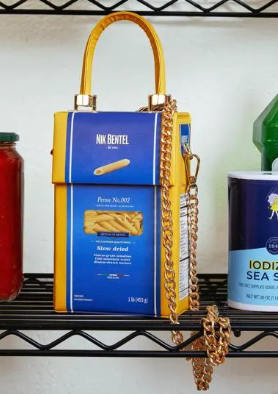
Among her examples: Nik Bentel Studio had a purse that looks like a box of De Cecco or Barilla pasta, though it is listed on their website as “Ceased and Desisted.” The featued purse image from Forbes is on the right.
My suspicion is that the first design looked like Barilla, who sent them a C&D, and then a new design came out – as announced on the Bentel Instagram, though I may have my timeline incorrect.
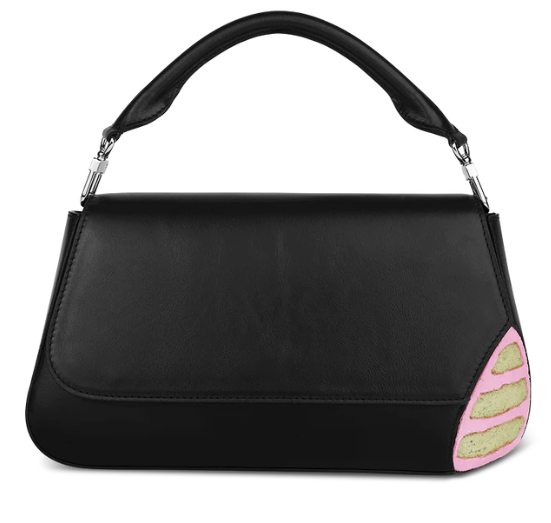
I also want to share this $950+ Strawberry Cake Bag from Tal Maslavi, which is the entire “Is it Cake?” trend rendered in luxury leather:
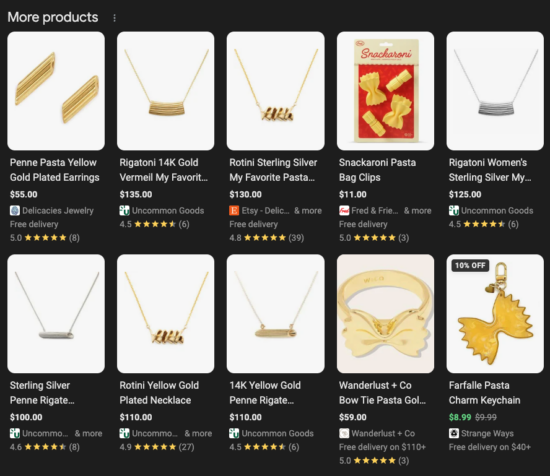
And of course, where luxury couture brands go, trends and other retailers follow. Pasta jewelry anyone?
While the coverage highlighted the kitsch and the scarcity of some of the luxury bags, they didn’t really delve into the “why.” Why are food products – inexpensive ones at that – becoming luxury items?
Emily Kirkpatrick and Jess DeFino have explored this on and off in their show, but their theory, as I said, is that scarcity of necessities makes them into luxuries, and luxury brands are capitalizing on that scarcity through their designs.
Grace Snelling touched on this luxury motif for FastCompany in March 2025: “How Produce Became the Hot New Celebrity Status Symbol.” The article highlights the work of @KFesteryga whose tagline on TikTok is “Just a girl talking about food being positioned as a status symbol.”
High inflation, rising gas prices, and stagnant employment have only worsened a situation where food staples like produce, pasta, and cake are now indicators of wealth, and are being transformed into luxury accessories.
I think something similar is happening with books, and I don’t just mean special editions.
I think in order to get where I’m trying to go with this rumination (hop on board my train of thought! There are snacks in the cubbies and it’s a smooth-ish ride) I need to explain briefly something else I’ve been thinking about nonstop for probably two years now: the difference between reading as a hobby/activity, and reading as an aesthetic.
Reading as a hobby is pretty straightforward. You’re familiar with the concept here, I am sure! Acquire books, read them, maybe talk about them, maybe review them, but some time in the day or week is for reading. It’s a dedicated activity for many of us.
Reading as an aesthetic is slightly different: it’s the process of making visible the idea of “being a reader.” This aesthetic is most visible on Instagram and TikTok because it’s part of book influencing: artistically arranged shelves in the background, sometimes organized by color. Special editions, spredges, accessories that accentuate or support reading, showcases of print books with annotations and post its sticking out all over: these are all visual markers of Being a Reader.
This phenomenon is most visible on image-based social media because that’s kind of what image-based social media is for, I think: the performance of aesthetic as identity. It is the set dressing of performing Being a Reader.
None of this is bad, or shameful, to be clear. I don’t engage much with the aesthetic element because I’m not great at it, and also I’m at an age where I want less stuff, not more. That said, I look at countless versions of the reader aesthetic daily when I look at social media. It’s pervasive and it’s popular. It’s aspirational content that feels within reach of the average consumer.
Sort of.
One element that I can’t understate: the visual aesthetic of Being a Reader involves resources. Wealth. It’s as much about performing an identity for visual consumption as it is a display of books as commodities. Whether they’re expensive, rare, or just en masse a visual representation of a very healthy book budget, there is often an element of wealth in this aesthetic.
Which brings me to my entire point (only 800 words in! Go me!):
Books are becoming luxury items, which I believe reveals a cultural anxiety about reading.
(Justifiably so.)
Let’s take a look at some of the visuals I found that support this theory.
Dior has an entire Book Cover line, featuring images of Ulysses, In Cold Blood, Dracula, and others. There are $3600 bags, $1000 tshirts, and $2000 sweatshirts.
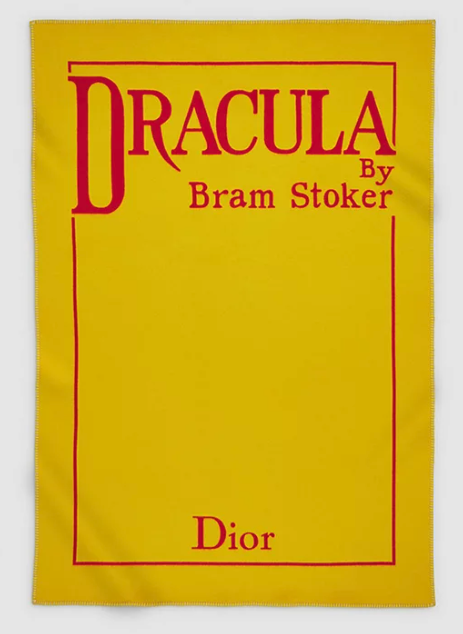
A Dior Dracula blanket: $10,500.
Embroidered Hooded Sweatshirt? That’ll be $2000.00.
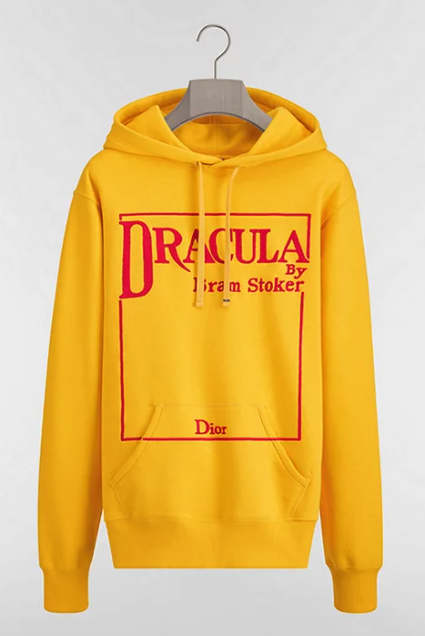
The Dior book bag is a rather popular luxury item if reproduction communities online are any indication, and the 2026 Fall collection includes:
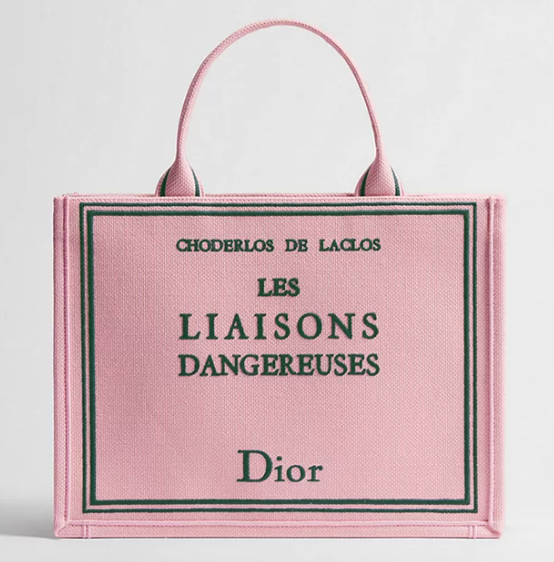 Medium Dior Book Tote, Les Liaisons Dangereuses, $3600.00
The newest Dior Book Totes include book themed editions such as A Clockwork Orange ($3900) or Madame Bovary ($3300), amid the other embroidered floral patterns. The Book Cover collection includes jackets, tshirts, scarves, totes, cropped tees, and short sleeved sweaters ranging in price from $250-$11,000.
Children’s books are also part of this collection: Macaulay Culkin was recently photographed wearing the Dior The Very Hungry Caterpillar sweatshirt, all part of the Fall 2026 collection designed by Jonathan Anderson. (I’m pretty sure the image is licensed so I don’t think I can use it, but that’s a Reddit link with multiple shots – his nail polish is terrific.)
Anderson also posted a picture of the Caterpillar bag on his Instagram, which quickly made its way to r/handbags:
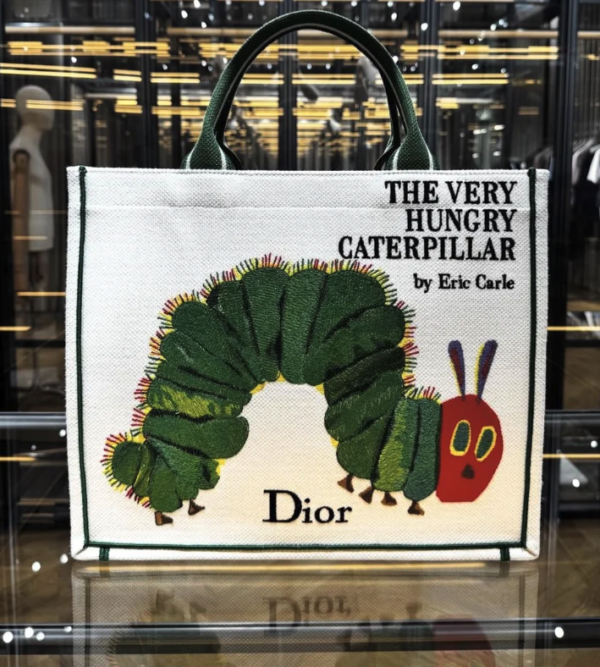
This is not the first children’s nostalgia collab for a fashion brand and will definitely not be the last. Nostalgia sells.
Gucci has collaborated with Disney; Fendi has a Pokemon collection, with some items priced at $2800 on Poshmark. A collaboration between Nostalgia and Luxury is like printing money at this point.
But the book aspect is what I’m thinking about nonstop.
In 2025, Prada partnered with author Ottessa Moshvegh to create unique characters for a luxury fashion campaign starring Carey Mulligan, and a bound limited edition of new stories by Moshvegh were sold in stores.
MiuMiu staged a Summer Reads popup in cities such as London, Paris, and Seoul in 2025, where shoppers could receive a free copy of one of three books, including Persuasion by Jane Austen, A Woman by Sibilla Aleramo, and Forbidden Notebook by Alba de Céspedes.
Petra Viekkola wrote about this phenomenon in July 2025 in “Books Are the New Luxury – And Everyone Wants a Taste.”
The latest: Coach book charms, produced in partnership with Penguin Random House.
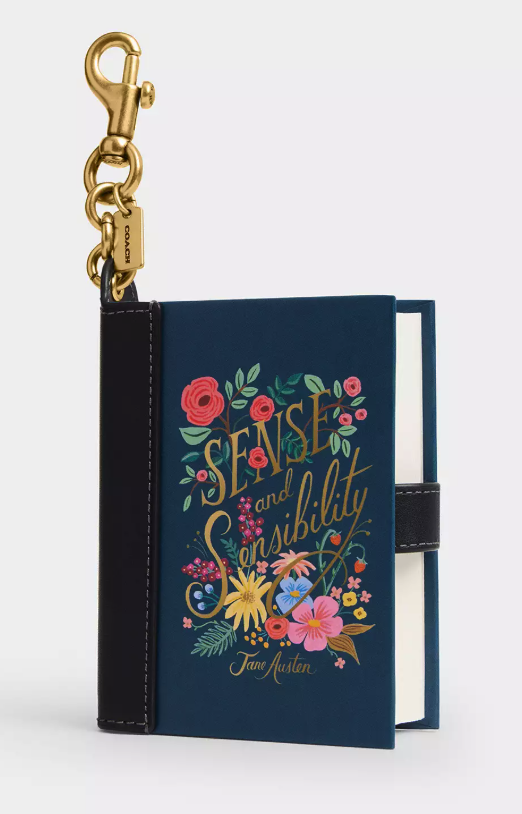
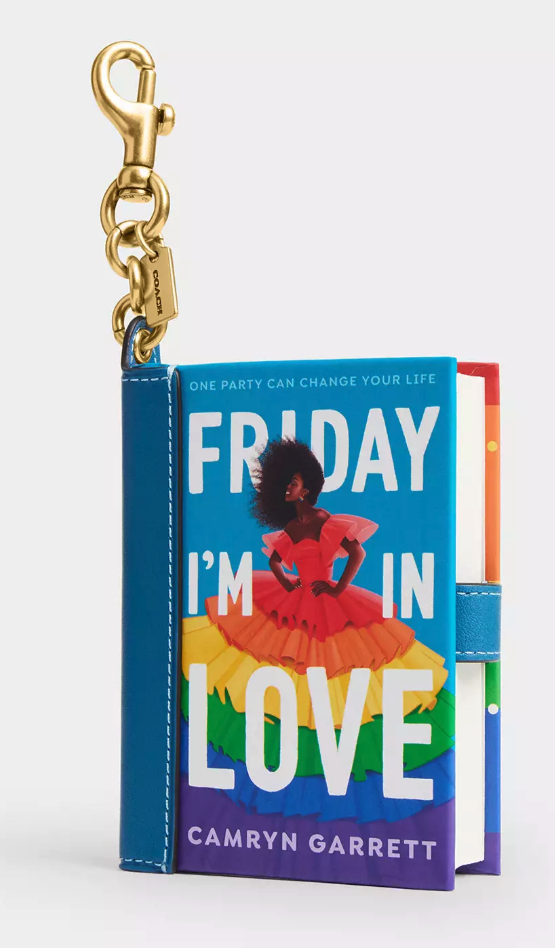
The book charm titles I’ve seen mentioned online include:
- Sense and Sensibility by Jane Austen
- I Know Why the Caged Bird Sings by Maya Angelou
- Friday I’m in Love by Camryn Garrett
- I’ll Give You the Sun by Jandy Nelson
- Little Fires Everywhere by Celeste Ng
- Untamed by Glennon Doyle
- The Book of Answers by Carol Bolt
- Frankenstein by Mary Shelley
- Kokoro by Natsume Soseki (in Japanese)
- The Forest of Wool and Steel by Natsu Miyashita (in Japanese)
- Welcome to the Hyunam-dong Bookshop by Hwang Bo-Reum (Korean)
- Honmono by Sung Haena
- Honeybees and Distant Thunder by Riku Onda
- The Try Everything Life By Yan Xiaoyu
They’re small, too: they measure 4.25″ by 3″ (10.8cm x 7.5cm) and weigh about 4 ounces (113g).
And, yes, they’re readable. They’re full copies of books, meant to dangle from a purse.
Aside: the book charms are also an example of a luxury brand following an Etsy/small business success: miniaturizing books into accessories has been a product line for a long time. Earrings, tree ornaments, miniature bookshelves – you’ve probably seen them.
The difference now is the branding and price point. The Coach book charms retail for about $100, but they’re sold out*, available on secondhand retailers like Mercari and Poshmark for $200-400.
*Small correction: they were sold out, then I went to look at all the titles to be sure I had them listed correctly and some were available. When I refreshed the page, they were sold out again.
The Coach book charms got quite a bit of coverage. NBC News framed it as “Reading is so trendy now that Coach is making book charms.” (And in a related article, NBC News covered the ‘performative reading’ trend.)
This is another commodification of books into accessories while also rendering them mostly unfit for either purpose. Yes, they’re actual books, but they’re rather small. And yes, they’re accessories for a purse, but they’re also delicate – because they’re paper. God forbid it rains on a book charm. Books as designer trinkets are not necessarily made for reading: though they’re books, they’re awfully impractical for an analog reading experience.
While Coach isn’t a luxury brand on par with Dior or Fendi, it’s typically described as “accessible” or “affordable luxury.” So I think the book charms are also a signal of wealth as much as five shelves of special edition books: I can spend money to hang a miniature Coach book off my bag. It proclaims “Being a Reader” with a single object.
Deploying books as wealth indicators is not a new practice, to be clear. Buying matched sets of leather bound books which will never be read solely to decorate a room was and is a common practice. In previous eras, it was a signal of wealth just to have books, and part of the set dressing of affluence that of course you could read them. If you wanted.
I’m reading (har har) this situation very differently: the act of reading itself is becoming a luxury.
It is a vast privilege to say “I can read.”
I have time to read and not focus on anything else.
I have the time and the money to read for pleasure.
I don’t have to wait for limited access to a copy from a library whose budget is stretched to the breaking point. I own this book.
All of that is akin to luxury right now.
As Viekkola wrote on her Substank post,
Reading now signals sophistication, introspection, and cultural capital. It represents attention in an age of distraction. Focus, taste, time: these qualities have become aspirational. And brands have noticed. For them, books aren’t just content. They’re a positioning tool, a way to express values without a noisy and worn-out slogan.
So in that context, Luxury Book Products like $2000 sweatshirts and $100 limited edition book trinkets make perfect sense. Terrible, perfect sense. But I maintain: it’s more than just branding and content. There’s a narrative within the item itself.
Book Luxury signals exclusivity, wealth, and leisure, and, more importantly in my perspective, highlights the tension and anxiety about literacy and book access.
Who can read?
Who has access to books?
Who has time and money – and who does not? (Who can focus on a book through the current era?!)
If reading is a powerful aesthetic (which it is) it follows that books become trinkets, pieces of clothing, and personal emblems of that aesthetic, and in doing so, highlights the tension over reading itself.
Reading was and is a powerful equalizer: one obvious example was that it was illegal to teach enslaved people to read. Now, we have multiple legislative and marketplace attacks that are reducing equal access to books.
We have declining literacy rates per the National Literacy Institute (TW for Dr. Phil on their website, ew), and we have less media literacy while I’m on the subject.
We have book banning bills in Congress. We have nonstop challenges to books in libraries, and political and physical threats made against librarians. Tennessee Library Director Luanne James was fired for refusing to comply with an order demanding LGBTQIA+ books be moved from the children’s section to the adult stacks. Libraries are closing, or reducing their hours – my local libraries are now closed on Sundays, which SUCKS.
And, of course, the mass market paperback, one of the most successful technologies to boost literacy, is mostly dead in part because it’s too expensive to produce, ship, and sell them. Without the lower price point of mass market, books are collectively more expensive. Publishers are laying off people; lines for middle grade and children such as Dial Books for Young Readers are being shuttered. We have more AI slop and AI-written books masquerading as human art.
It ain’t great in book land.
The act of reading is under attack and books as expensive accessories are an emblem of that. Just as the rising prices of basic staple foods led to expensive food couture, the union of luxury brands and books are a representation of social anxiety about reading. The use of children’s book titles like The Very Hungry Caterpillar underscore that access to books for young people is in danger.
Which is why all the luxury book accessories unsettle me: books being co-opted into luxury accessories not only point to scarcity and wealth (hoarding) but, to me, reveal the dangers facing literacy and book access in the US.
If food couture is a wealth signal that reveals anxiety about access to food, I read these new book accessories similarly: they’re a wealth signal that reveals the increasing fragility of literacy and book access for children and adults.
So while they’re cute, and colorful, and extremely adorable, the reveal of the Coach book charms and the Dior book line had me sitting back in my chair, thinking, “That’s not good.”
And listen, if you wanted one, or you bought one, I don’t blame you. They’re beautiful!
Alas, I can’t stop my brain from thinking, “Ok, but why?” And the answer I’ve come up with feels ominous and chilling.
What do you think? Have you noticed books or reading positioned as a luxury or luxury aesthetic?
I’ve been thinking that ebooks are the new mass market paperback. While it’s true that you need a device to read them and devices are themselves expensive, any smart phone will do. But perhaps access to smart phones is not as ubiquitous as I think it is.
Thank you for this very thoughtful discussion. As I was reading it, my first thought was of “book haul” posts, especially from bookstores but also from libraries. There seems to be a difference between those of us who post books from excitement about sharing with fellow readers, about new books to read, rather than flaunting – or am I just justifying myself to myself?