
 OverDrive is the company that provides a lot of digital content to libraries. If you’ve borrowed an ebook or an audiobook in Libby, or read a magazine in Kanopy, that’s OverDrive.
It seems there is some AI weirdness with audiobook narration on OverDrive, and the narrator is only part of the story.
On Monday, October 14, librarian Robin Bradford posted on Bluesky that she’d purchased an AI audiobook for her library system and she was really upset about it:

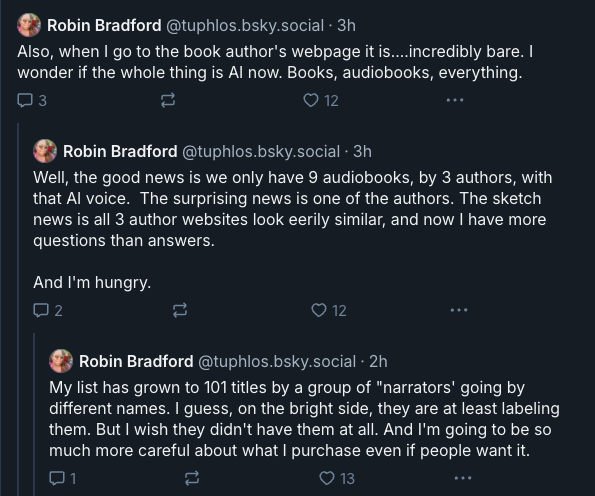
Over 100 titles by AI “narrators” were in their catalog, and Robin was having trouble finding indications that the authors themselves are real?
Interesting.
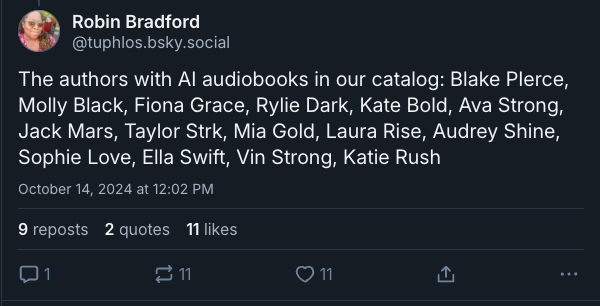
Not only is that A LOT of audiobooks, but similar to my casual foray into contemporary romance cover art, I noticed that there was a odd pattern to those author names:
- Mostly one or two syllable first names
- One syllable last names
- All very basic nouns and adjectives as surnames
That homogeneity is a little strange, right? Good thing I’m really nosy.
I reached out to Robin for an interview to learn more. What had brought this to her attention? What was her next step? While we were corresponding, we both searched names and author websites for more information.
This is really weird, y’all.
Her investigation started when she received a message from a patron of her library system that there was something wrong with an audiobook they had borrowed.
The patron reported that during a quiet part of the audio, there seemed to be a tiny portion of another recording inserted into the silence. It happened more than a few times and the patron also provided a timestamp, because this patron is very awesome.
Robin says that this isn’t unusual, and the process is pretty routine: “It’s usually just a corrupted file transfer or something. And we contact the publisher and let them know, or let OverDrive know, and it gets re-uploaded.”
So then what happened?
Robin: “So I went to look up the specific book to see who the publisher was. Mostly because I wanted to know. We would contact OverDrive about the error, and they would fix, or talk to the publisher directly.”
Digital files get corrupted often enough, so this isn’t alarming. But then, Robin and her coworkers noticed the name of the narrator: “Scarlett Synthesized Voice.”
Scarlett, I noticed, is pretty busy: their books appear in Everand, and Audiobooks.com, as well as Chirpbooks and Libro.fm.
Even more intriguing: all the books featuring this narrator are very similar in appearance, and all of them were authored by one of the names Robin noted earlier.
In other words, the authors Robin mentioned were all using AI/synthesized voice narrators.
Here’s a screenshot from Libro.fm’s search results:
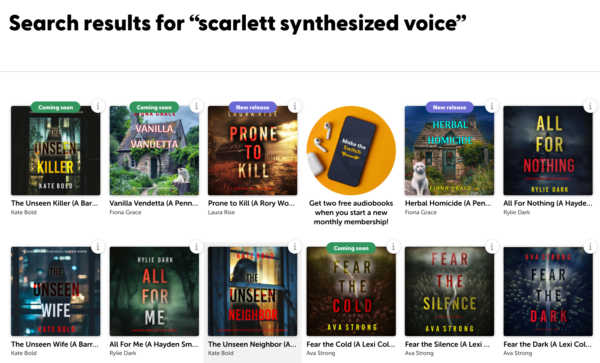
These results are similar to what Robin saw within her own library’s OverDrive. When she searched for just the terms “synthesized voice” she found over 100 books, as she mentioned on BlueSky.
Let’s take a look at the books themselves for a second:
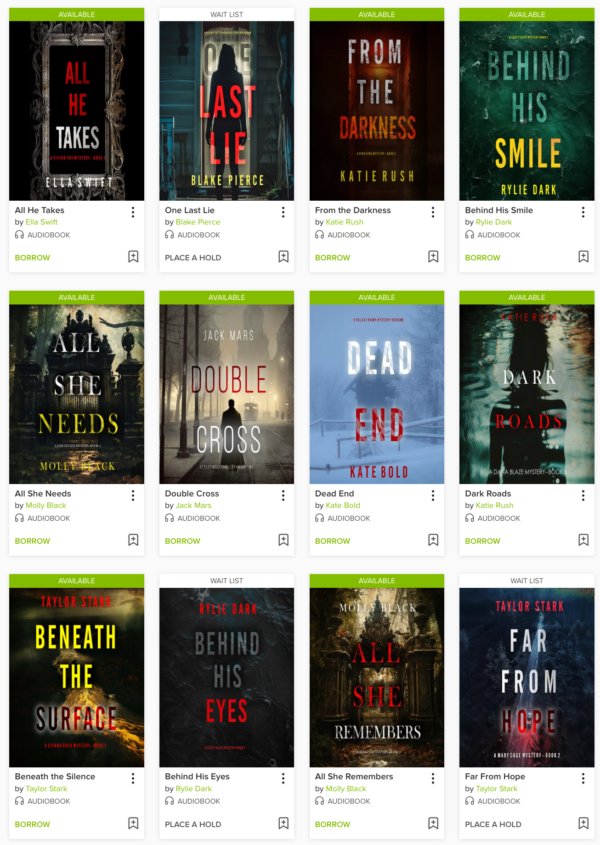
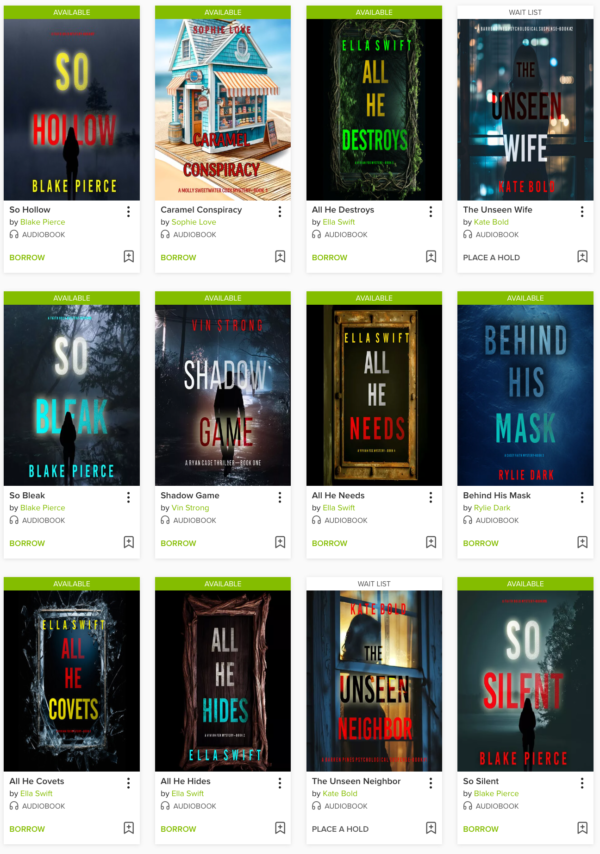
Look at the similarity in format and style across all these authors. All He Verbs. So Adjective. The Unseen Noun. Not to mention the repeated silhouette, the outer glow, likely courtesy of Photoshop. VERY consistent imagery, right?
All these authors with different names and different series, with similar cover formats, styles, and the same audiobook narrator, who isn’t real?
Huh.
Back to my conversation with Robin. Robin hadn’t initially noticed it was an AI narrator because she never pays attention to the narrator when there’s a patron report of a problem with an audiobook: “It’s always file problems, not narrator problems.”
“And it’s probably still not a narrator problem. It could have happened to any file. BUT, it sent me down the rabbit hole of ‘oh shit, I bought an AI narrated book?’
“I wonder how many of those I bought on accident.”
“OH SHIT, we have HOW MANY?”
Hello and greetings from the depth of the rabbit hole that swallowed us both.
I noticed, as did Robin, that there is no publisher listed that we could find. I pointed out the similarities in the cover art, style, genre, and names, which made me wonder if the author(s) are AI, too.
“That is where I am right now,” Robin replied. “And I’m shocked because I would have sworn on a stack of bibles that Blake Pierce was a real person.”
As she said earlier in her thread on BlueSky, “I go to the book author’s webpage it is….incredibly bare. I wonder if the whole thing is AI now. Books, audiobooks, everything.”
We started googling the authors and the results are very similar: websites that are mostly pages listing the books in a series, sparse bios that follow the same format of listing what series the author has written, and very, very few with social media outside of a Facebook group Page (thank you Desdemona for the correction), and none of the social media accounts are linked from the author websites.
Let’s take another look at that list of names:
- Blake Pierce – website is all series lists, no social media linked, but does have a Facebook page
- Kate Bold – website is all series lists, no social media aside from a Facebook
grouppage, which isn’t linked that I could find. - Molly Black – website is all series lists, same template as Kate Bold, no social media
- Fiona Grace – website is all series lists, same template, no social media links
- Rylie Dark – website is all series lists, same template, no social media linked,
but I found a Twitter account, a Twitch account, and an OnlyFans** - Ava Strong – website is all series lists, no social media links
- Jack Mars – website is all series lists, no social media links
- Taylor Stark– website is all series lists, same template as Bold, no social media links
- Mia Gold – website is all series lists, same template, no social media
- Laura Rise – website is all series lists, same template, no social media, newsletter link broken
- Audrey Shine – website is all series lists, same template, no social media, Facebook page found via google, not via link on site. Audrey does have a profile at CozyMystery.com
- Sophie Love – website is all series lists, no social media linked
- Ella Swift – website is all series lists, no social media linked
- Vin Strong – website is all series lists, same template, no social media linked
- Katie Rush – website is all series lists, same template, no social media linked.
** Thank you to Dario in the comments who found a digital footprint for Rylie Dark going back to 2019, and who is likely a separate person from the “author” Rylie Dark, who, per Dario, first appeared in 2021.
The lack of social media linked from the author website is really sending me: what author who isn’t a Massive Major Name eschews social media?!
I want to go back to Blake for a second: when I image searched “Blake Pierce author” this result caught my attention.

The Babelio page is in French, but features that image.
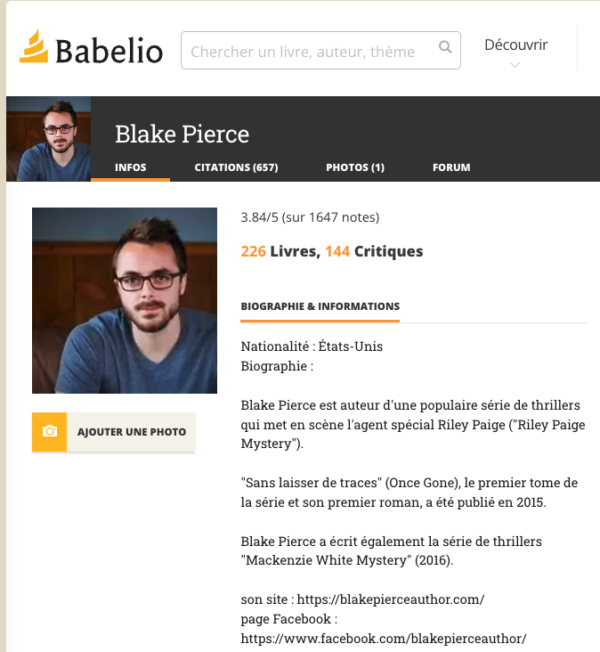
And Glasses Blake shows up when I searched for Molly Black as a “related person:”

When I used a reverse-image search for that image of Glasses Blake, I honestly thought I’d get a stock image site.
No, I got a Fresh Fiction interview with an author named Tyrell Johnson? Who is, and has been confirmed, a real person with real humanity and everything?
Johnson, author of Wolves of Winter, also uses this photo on Audible and Amazon. His book was reviewed in the NYT with another photo at the top – same person, I think. He also has an active Twitter account. His book, The Lost Kings, was narrated by living human Saskia Maarleveld (their narration is excellent).
Why is Tyrell Johnson’s author photo being used for Blake Pierce? No idea.
I tried to reach out to Tyrell Johnson, but the website listed on their Facebook page, tyrelljohnsonauthor.com, loads to a Penguin Random House page for their book with no contact options. I’ve reached out via Facebook but haven’t heard back.
Deep in that rabbit hole, Robin and I kept googling Blake Pierce. And I had to sit back in my chair and recognize for a moment that, alongside Robin, I was researching whether these authors were real people. What a tremendously bizarre use of our time!
We were not the first to ask this question: on Reddit in r/books, four years ago someone asked the same question:
Who is Blake Pierce? And the collective ghost writer theory.
I was presented to the works of one named Blake Pierce, a murder/mystery author that carries a baggage of hundreds of books published, with multiple series with different protagonists running simultaneously. And for such a huge number of books, Blake Pierce keeps the quality high (for mostly free books that you can get for Amazon Kindle).
After searching the web for some information about the author I ran into something weird: nothing. Not a photo, nor a biography.
The abysmal number of books published, the lack of information about the author and the overall not-charging brought up the idea of a collective ghost writer situation where a number of different writers join together and publish books using the same author name to facilitate it’s distribution – such as in the fringe theory that Shakespeare was not one, but multiple writers joining ideas and hands to create masterworks.
SO, anyone of you ever heard about such a thing for real as in collective ghost writers? And do YOU know anything about BLAKE PIERCE?
Have a good one.
The commenters searched copyright.gov and found that “the copyright claimant is Noah Lukeman from Larchmont New York. Lukeman seems to be a literary agent based in NY. Maybe using new authors to write the series??”
Another commenter said, “Apparently a woman. Supposedly wrote the first book in 2015. I’m going to go with a collective of writers.”
A year ago, another person updated: “Here we are now 3 years later. by the end of 2023. Blake Pierce will have written 244 books. He /She is writing 61 books just in 2023 for release.”
Two months ago, a user noted that there were no print editions of Blake Pierce books in any Barnes & Noble:
This thread is interesting. I am only now reading it as I noticed something odd last weekend. I went to our local, ginormous Barnes and Noble store to search for some books by Blake Pierce. I have purchased several in the Apple books store, but have always preferred to actually hold a book versus reading my phone. I looked at the shelves and didn’t see one book by Blake Pierce. I thought that was weird considering, as many have mentioned, the number of books out under the author.
And anyone reading a book by Pierce from Apple would see the many, many pages before the Table of Contents in these books highlighting the bazillions of books by this author.
I showed the lady at B&N all the books listed and she, too, thought it odd I hadn’t found any. So she searched.
And of all the B&N stores in our city and a few surrounding towns, there was not ONE STORE that contained even one of Pierce’s books.
There were a few that could be purchased online, but even then nowhere near the amount written. We tried to look at the books and maybe come up with a different name under which they may have been published but came up empty handed.
Is this weird to anyone else? Sorry to be commenting on such an old post, but I saw someone comment in 2023, and as mentioned I just started reading these books lately. Thanks for your time and have a great day!
How many books has Blake Pierce published as of right now? According to GoodReads:
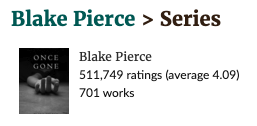
SEVEN. HUNDRED. AND. ONE. books. Again, with very similar, repetitive cover art for each series:

Repeating a cover motif? Totally normal, I agree. But Seven Hundred Books? No interviews, promotional posts, or social media that I could find? That’s very strange. The Reddit “collective of authors” theory makes some sense.
Robin noted that the publisher on the Blake Pierce titles are attributed to Lukeman Literary, but there’s no mention of Pierce or any of the other authors on the Lukeman website.
Back to my conversation with Robin, where we were sending each other links and using a lot of exclamation points.
Robin: “OverDrive has 1,234 (that number, tho) audiobooks with a synthesized voice. It’s not an insignificant amount.”
When I shared with her my discovery of Tyrell Johnson’s interview with Fresh Fiction and the image used by Blake Pierce, she replied,
“Okay but look at that. He’s answering questions, it’s an interview, THIS is something I would use to verify humanity.”
“I’m not trying to verify identity. I don’t care if HelenKay Dimon and Darby Kane are the same person. I care if they ARE HUMAN. And an interview would be one of the ways I would try and verify that. Are there things in the world where they have answered questions.”
(Please note that I got really excited when I found an interview with Blake Pierce on the Central Illinois Business Podcast, but it’s likely a different person with the same name. Woe.)
I think there are a number of issues here, starting with the presence and proliferation of AI narrators. Audiobook narrators (the human ones) are already fighting against use of AI in their profession.
And I don’t want to listen to an AI narrator, personally. I’m glad they’re marked “Synthesized Voice” but that’s relying on librarians or consumers to notice.
But this particular situation seems weird beyond the question of the narrator. Not only did Robin and I spend time trying to identify why so many books by authors with similar names used an AI narrator, but then we spent time trying to figure out if all the authors themselves were human. And in a lot of cases, we aren’t sure if we know the answer.
Librarians already have to educate themselves about new books when there are hundreds per day, if those books are even accessible to libraries (KU books are not, for example). Now there’s research time for “Is this a human?” Egads.
The library system had already spent money on licensing these books for the library system, but Robin was not planning to buy more. However, some of the titles had hold lists, and usually a book with a hold list will be re-purchased if the license is expired.
I searched to see if the library system had a policy or guidelines about AI narration or AI writing for items in circulation, and presently they do not. My attempts to research library AI policies generally mostly yielded results about using AI for patron experience, such as this statement from the Holderness Free Library in New Hampshire.
Nick Tanzi at The Digital Librarian has written about AI policy and the need for it, but again it’s mostly focused on patron interaction and AI tools for librarians and patrons, not AI-written or AI-narrated materials in circulation. The Massachusetts Library system offers a list of resources regarding issues surrounding AI, but again, no circulation policy that I found. And the University of North Texas (go Mean Green) has resources from the federal government and others about AI, but again, not a circulation policy.
I imagine policies about AI narration and AI authorship are in development, if the question has been brought up. As I said to Robin, there’s going to have to be a meeting, possibly a committee, and definitely a task force. Or all three.
The presence of AI audiobook narration in a library catalog, and the possibility of AI-authored books in circulation, is a policy question that I don’t think has an answer yet, but is one that requires attention.
I want to know whether the person who wrote the book I’m reading is a human, or a conglomeration of networked machine knowledge using an abhorrent amount of electricity and water, per the UN, among other environmental effects. I don’t want to read AI-written books, and I don’t want to listen to AI-narrated audio, and the burden of research to determine both is on me, an individual. On a library system level, that amount of oversight seems impossible.
I reached out to OverDrive to ask if they had a policy or guideline regarding AI audiobook narration, and Jan Leitman, Chief Marketing Officer, responded, saying:
OverDrive does not exclude AI narrated content from the catalog. Where synthetic/AI narration is used, we request that this information is included by supplying publishers in the metadata.
So it’s not a requirement, but it is a request that metadata entries include mention of AI narrators.
When I asked where in the metadata fields this information is commonly replied, Ms. Leitman confirmed that it’s “typically found in the Narrator Name field.”
I’ve reached out to Noah Lukeman for comment and to request contact information for the mysterious Blake Pierce and haven’t heard back.
Does your library have a policy about AI narration or AI-written books in circulation?
Have you encountered AI audiobook narration?
ETA 11:30am ET: Pete Milan a writer and audiobook narrator, shared that he’d “looked into this awhile back; you can go to the US Copyright Office website and it’ll tell you if the text was generated by AI. For instance, one of Rylie Dark’s latest:”
Here’s a screenshot:
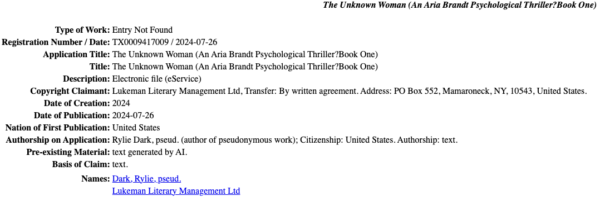
“Text generated by AI.”
ETA 12:00pm : Julia on Bluesky replied that they’d gone down the Lukeman Literary rabbit hold a few months ago, “when I mistakenly bought a Molly Black book thinking it was a self-published book. …Lukeman Literary works with Eleven Labs on the audiobooks.”
Update 22 October 3:25pmET
CozyMystery.com, linked above, replied on BlueSky:
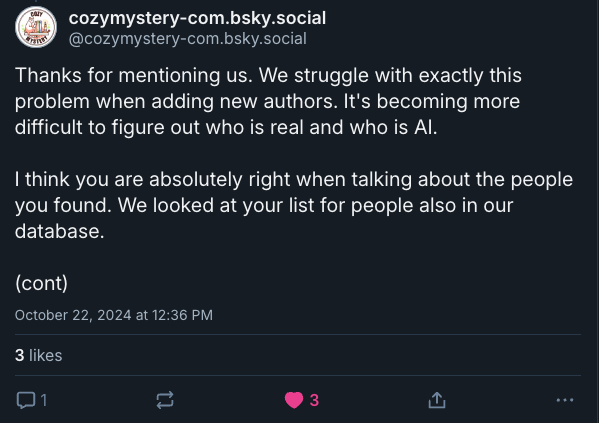
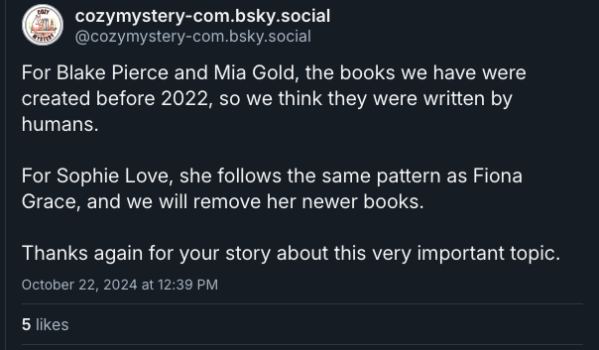
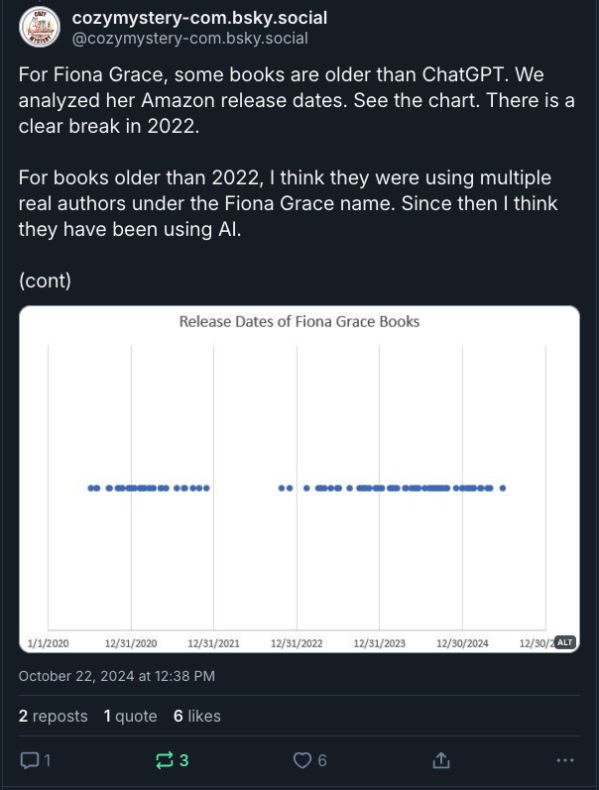
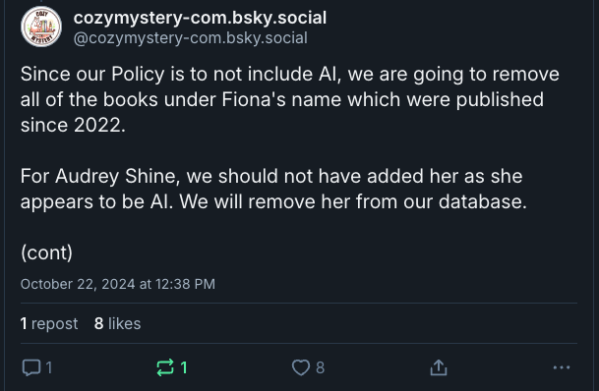
Hooray for having a policy! Thanks, CozyMystery.com!
Thanks for this deep-dive!
Excellent article.
I just want to mention, those are not Facebook groups, they are Facebook Pages. Some authors have Facebook groups, and they’re different. They’re actual groups.
Wow — this is like a thriller titled ALL HE PUBLISHES! Thanks for putting it together!
@Kolforin, maybe more like “To Serve the Readership”?
@Desdemona – thank you for the correction – will update!
This is fascinating and disturbing at the same time. Appreciation to you and Robin for sharing your research.
Hope it’s OK to point out a typo: it’s “Bluesky” not “Blusky” (see https://bsky.social/about/support/tos for example).
I found a Blake Pierce Twitter account but there are only a few tweets and they’re all generic book promo, mostly “I am so excited/thrilled to announce…” https://x.com/Blake_Pierce_/with_replies?lang=en
As a writer and an artist for over 40 years – I die a little more each day when I go onto the internet. None of this surprises me, but it instills more handwritten letters and writing books long hand, more painting and weaving with real fabrics, more reasons to go hug a dog, a horse, full immersion in the real outdoors, and ever so grateful that most of my life I did not have to deal with the monster that is A.I. And that I will be joining the society of creative anachronism in the near not later future.
Blessings to All!
I haven’t listened to AI audiobook narration, but I spend a lot of time avoiding it on audible. Browsing through their new books page is super frustrating since so many are AI and there’s no way to filter them out.
I’m big into genealogy and a while back I had an ad for an author who wrote genetic genealogy type fiction pop up in my Facebook feed. The book has to be written by AI (or a really terrible author) because it was written in such a crazy “cookbook” style. I actually left a review stating that on Amazon.
How do you go about proving this?
I was looking into this a while back; there are even more names.
Taylor Night
Morgan Rice
Bella Lore
They all have the same basic web template as the others and the same lack of personal information.
I sent an email to my library (Seattle) with a link to your piece and asked what they are doing in relation to AI (like if there is a policy in the works). If I get a substantive reply back, I’ll share. Thank you for doing this deep dive! I do feel that this content must be labeled so that library staff and library patrons can make an informed choice. This is, of course, why corporations that produce such content would be violently against labeling, because they know what patrons’ choices are likely to be. It feels very reminiscent of GMO labeling.
Thanks, Laura – fixed!
Update: I searching Copyright.gov for the most recent Blake Pierce book—”One Last Lie (Governess #1)—because I noticed the comment about the agency holding the copyright was older and I was curious if the recent books had the same copyright holder.
And the record says (emphasis mine):
Authorship on Application: Blake Pierce, pseud. (author of pseudonymous work); Citizenship: United States. Authorship: text.
Pre-existing Material: text generated by artificial intelligence.
Copyright Note: Regarding material excluded: Statement added by Copyright Office from additional information provided by applicant.
Now I want to check the other authors but don’t have time at the moment—here’s a link to the search engine if someone else wants to give it a shot: https://cocatalog.loc.gov/cgi-bin/Pwebrecon.cgi?DB=local&PAGE=First
The Snopes fact-check web site has reported some internet stories, pictures, and videos as AI generated, and I think they have check-it-yourself guides. Up to now, I’ve been content to let them do the work.
2024 “large language model” A.I. as I understand it, shreds existing documents and glues pieces together again, word by word. This reads adequately until you get a sense that there’s nothing actually there.
These books may be trash, but so is a lot that people like to read. Imagine the revolution in practice if public libraries only stocked food books.
I did just check one more Black Pierce record from 2023 to see aaaaaaaaaaand here is a lengthy statement from the registrant on the creation process that I don’t think was intended to be published in full tbh:
“This is a work of human authorship, a work of the author’s own original mental conception. We had complete creative control over the work?s expression, from start to finish. In this case, a computer was also used in a finite capacity as merely an assisting instrument in contributing portions of generative-AI material. The entire creative conceptualization of the plot, including how to execute it step by step, was done by a human. Approximately 60 to 80% of the writing is original and human-written. For the portions that are AI generated, nearly 100% of what was AI generated has been either revised, re-arranged or re-written by a human writer. The final product contains very little content that is untouched AI-generated content. When we prod the computer, we do so not with instruction but rather with lengthy sections of our own original human writing which the AI can use as a basis to understand our style and to generate more writing in the same style as our pre-existing writing. We never prod the AI with simple general commands, and we never prod the AI to generate writing ?in the style of? any one author. When the AI generates, it generates several options for us to choose from, and we embark on a human process to choose options, or portions of options, or to reject them. The AI often goes off-track every 100 words. This requires constant human re-directing and writing. When done we embark on a human process to revise the entire chapter. Additionally, the final book then goes to a professional editor, who offers lengthy, original, human editorial reports and we then go back and rewrite the book again, once again, entirely with human writing. The AI is not involved that process at all. I authorize the copyright office to add a limitation statement to this application to exclude the material that was generated by an AI program. I understand that this claim will cover the text that I created, but must exclude the ?text generated by artificial intelligence.?.”
If there is a way to link directly to the record I can’t find it, but it’s for “All He Takes (A Nicky Lyons FBI Suspense Thriller?Book 6)”.
(I meant “good books”, how did that happen. Still, another good point. 🙂
@Rose: WHOA. WHOA INDEED WHOA. I don’t think that was meant to be published in full, either.
That last item about looking up information in the US Copyright database is really interesting, because I thought that AI produced work could not be protected by copyright law: https://builtin.com/artificial-intelligence/ai-copyright
In the past, when faced with AI generated material, the US Copyright Office has refused to allow it to be copyrighted because copyright ONLY applies to things that are created by humans. It’s a real sticky area, one that I am steeped in frequently, as I am a technology integration consultant for educators and schools. I also spent years as a media researcher, and so this stuff both fascinates and concerns me.
Thanks to the lovely and talented Rose Lerner for sharing the “author” response from US Copyright records. We need to be having the conversations and highlighting what is happening, before we are presented with a new definition of what it means to be human, without us having a voice in the discussion.
I assure you Ty is a real person…he was my student! He’s not a deeply online person, but I promise you, he’s about to be mortified by this.
@Tod: I’m relieved! I was pretty sure he was a real human, and it’s VERY odd that his photo is part of the possibly-AI author profile for Blake Pierce.
Like Rose, I also poked around the copyright website (bless its clunky heart) and found that Noah Lukeman has about 250 copyright listings, but Lukeman Literary Management has almost a thousand
Can’t think of when I last saw the copyright being held by the agent rather than the author or publisher (in the case of pseudonyms and ghost writers).
Link here: https://cocatalog.loc.gov/cgi-bin/Pwebrecon.cgi?SC=Author&SA=Lukeman%20Literary%20Management%20Ltd&PID=F4ENv-h0HSVtfTehAx6qdqzHIsEM&BROWSE=1&HC=962&SID=4
If you look at Noah Lukeman’s website, the authors he claims to represent are all big names, like Sting and the Dalai Lama. Funny that he also represents all of these mysterious nobodies.
@Amygee – isn’t that wild? A weirdly-formatted collage of famous people, and no mention of all these writers.
This hits hard. As an author who publishes independently I struggle for credibility already. I get the, “If you are self-pub then you aren’t a ‘real’ writer,” all the time. Irritating. And now I guess I’ll have to prove I’m a ‘real’ person now.
My gratitude for the deep rabbit hole dive. Rabbit holing? Deep rabbiting? (Sounds dirty/painful-nevermind)
Thanks for this deep dive! It would be a step forward to make Lukeman disclose his involvement in what feels like a massive scam—maybe not illegal, but certainly a scam. If this is NOT all AI-generated content, then they should disclose the ghostwriters and pay them their royalties. Also, we should all reach out to our libraries and bring this issue up so our librarian friends can check that these books don’t become super popular. I am reaching out to my library now.
The unregistered charity Lukeman runs from his literary agency website is like an entire red flag factory on its own (link: https://lukeman.com/read-and-recover/)
You can buy him an ereader, so he can fill it with books by this same list of authors! It’s not officially registered as a charity because that’s so much paperwork!
I feel like we stepped into a Leverage episode.
Narrator here. Boy oh boy, this is disturbing. Thanks for doing this research!
I encountered AI narration a few months ago on Audible. I was hunting for an Agatha Christie Hercule Poirot to listen to and gobsmacked at the number of choices. I believe some of her works have come out of copyright, which first accounted for the plethora of choice. But some of them were super cheap. $1.50 for an audio narration? Only after poking around, did I notice that one mentioned AI narration.
Is it possible these books are being requested by bots? AI written and voiced books getting bought by libraries because bot “readers” asked for them gets us to AI centipede which is on my bingo card.
@Stacy: That’s a good question. Blake Pierce definitely has readers. So do other authors that Robin has researched. But I wonder if there are also bots boosting popularity in specific lists by purchasing or requesting. All the systems can be gamed, as we’ve learned.
Also I am extremely disturbed by “AI centipede.” *shudder*
I’ve recently been finding an increasing number of those AI-generated “summary” books (i.e. “[real book] summary” but it’s just AI slop) in one of my libraries’ Libby catalogues. Notably, in none of these cases do they have the real book that this is supposedly a summary of. I wonder if their centralised buying system is buying these versions by mistake instead of the original books, particularly if they’re cheaper.
I haven’t noticed AI narrators, but I don’t listen to audiobooks, so I wouldn’t. And I haven’t particularly seen AI authorship in the library catalogue outside of these “summaries” and similar, but I do mostly read things by authors I’ve heard of, or which have been recommended to me, so it might be that I’m just skimming past them. But I find the way these “summaries” sneak in to be pretty worrying, especially as they seem pretty dubiously legal, and it’s extra bad if they mean the library never buys the original book, which they might have intended to buy.
However, the library in whose catalogue I’ve spotted the highest number of these is one that seems to have … not great acquisition policies without much discernment or, indeed, human engagement (for example, they’ll often dump an entire collection of books into the catalogue at once, including hundreds of public domain classics at one point — which made it impossible to find anything else in Libby since they were occupying the first 100 pages of results, and the vast majority of which were probably on Gutenberg anyway!). And there’s no way to flag to them that titles look dodgy, at least not within the app. It’s a consortium of several library systems, so I wouldn’t even know where to start trying to contact them directly.
I *just* (literally 15 minutes ago) responded to a patron request for a large print version of a Jack Mars title (one of the names on the list of suspicion.) It was an easy no, because the title doesn’t exist in that format. But, the request was from a real live person with a library card. So, these books DO have fans.
I am beyond grateful to Robin and Sarah for putting in the research and publicizing this.
I checked my library. We have a distressing number of these, but they’re not in Overdrive – they’re in Hoopla. I have notified the librarians responsible for the collection.
As to those who say, “eh, if people are reading them, what’s the harm?”, the harms are these:
1. The extruding of these works (I do not say “writing” or “narrating” causes incalculable harm to the planet, as noted above.
2. The word-extrusion-machines operate on a plagiarism model – that is, stealing the real work of thousands (millions) of real humans, without their permission and without compensation
3. Every dollar of Your Tax Money spent on these fake books with fake narrators goes to enriching a scam artist and grifter, and not to supporting real authors and real narrators. But as “publishers” flood the market with cheap fakes, the real artists will not be able to make a living, and soon the fakes are all that will be available.
In response to Finn’s comment. I know our local library let go of most of the librarians and replaced them with part-time library associates. I suspect there is no one directing acquisitions. So what is available in Libby or Hoopla is what is pushed to patrons. Heck, they even got rid of Dewey and replaced it with a ‘simpler’ shelving system of rough categories for non-fiction. For the record, I have a MLIS but only worked in special libraries, not public.
Absolutely fascinating! I have not read all of the comments however, Scarlett Johansson was the voice of the AI robot in the movie HER with Joaquin Phoenix. Coincidence…?
Blake Pierce has been super popular recently. We have had a ton of holds on their books. Thank you to Robin and Sarah for digging into this mess!